Stress
Stress is the body's response to the demands placed upon it, and anything that makes such a demand is a stressor. A moderate response sharpens performance, but excessive or prolonged stress narrows attention, degrades decisions and, over time, harms health.
Stress is the body's response to the demands placed upon it. Anything that makes such a demand is a stressor, whether it is heat, a rough-running engine, a deteriorating forecast or a row at home before the flight. Stress is not in itself harmful: a moderate response raises alertness and can improve performance. Too much, or too much for too long, narrows attention, degrades decisions and eventually damages health.
Stress appears in every Human Performance syllabus and in crew resource management training, which EASA requires to cover stress, surprise and startle. The subject matters because the demands of flying peak at exactly the moments when a stressed pilot is least able to meet them: an emergency, a go-around in bad weather or a sudden alarm.
Stress and stressors
How much stress a demand produces depends on perception: on how the person judges the demand against his or her ability to cope. The same stressor weighs differently on different people, and on the same person on different days. Success reduces it: once a stressful task has been handled well, the same situation is less stressful the next time.
The body constantly regulates itself to keep its internal state stable, for example by sweating when hot. This self-regulation is homeostasis, and physical stress arises when external conditions strain or exceed it.
The FAA's Pilot's Handbook of Aeronautical Knowledge (PHAK) groups stressors into three types:
- Physical (environmental): heat, humidity, noise, vibration, lack of oxygen.
- Physiological: fatigue, poor fitness, sleep loss, missed meals, illness.
- Psychological: social and emotional factors, mental workload.
EASA texts add that hunger, thirst, fatigue and lack of sleep are normally within a crew member's own control, and that no duty should be started with any of them unresolved. Stress is also cumulative: an unresolved irritation before the flight makes an in-flight problem weigh disproportionately more. Stress is the S of the FAA's IMSAFE personal checklist (illness, medication, stress, alcohol, fatigue, emotion).
Acute and chronic stress
Acute stress is short-lived and has an identifiable cause, such as an engine problem or a diversion. It can raise arousal to a useful level and usually subsides when the situation is resolved.
Chronic stress comes from long-running pressures such as money, work, bereavement or relationships. It steadily uses up the spare mental capacity a pilot needs, so that an ordinary in-flight problem can tip him or her into overload. Its warning signs include disturbed sleep, irritability, loss of appetite and withdrawal.
Anxiety, sometimes called imaginary stress, is a stress response with no stressor actually present, triggered by anticipating a risk and feeling unable to cope with it. EASA texts note that it can be strong enough to set off the full physiological stress response.
The autonomic nervous system
The nervous system has three subdivisions: the central nervous system (brain and spinal cord), the peripheral nervous system (sensory and motor nerves) and the autonomic nervous system (ANS). The ANS controls the glands and the involuntary muscles of the organs and blood vessels, and with them breathing, blood pressure, digestion, sweating and body temperature, without conscious control.
The ANS has two branches. The sympathetic nervous system prepares the body for immediate physical action in response to a new and sudden stressor. The parasympathetic nervous system restores the body to normal functioning once the danger has passed.
Fight-or-flight and stress hormones
The sympathetic response is the fight-or-flight response. The adrenal glands release adrenaline, the liver releases sugar into the blood, the heart rate, blood pressure and breathing rate rise and the pupils dilate. The body is ready to run or fight, which is of limited use to a pilot strapped into a seat who needs to think. Over-breathing driven by anxiety can lead to hyperventilation, whose symptoms mimic hypoxia.
If the stress continues, the hormone cortisol is released. It helps convert fats into sugar so that the muscles stay supplied, and EASA texts note that it also acts on the brain to strengthen the memory of stressful events.
General adaptation syndrome
The general adaptation syndrome (GAS), described by Hans Selye, is the pattern of the body's reaction to a real, perceived or anticipated threat. It is triggered by the arousal mechanism acting through the autonomic nervous system and runs through three stages:
- Alarm: the sympathetic fight-or-flight reaction, with adrenaline.
- Resistance: if the stressor persists, the body sustains its mobilisation to give time to find a solution, with cortisol keeping energy available. Outward performance can look normal while reserves are being consumed; poor sleep, irritability and repeated minor infections are early warnings.
- Exhaustion: reserves are depleted and performance and health break down; at the extreme, the stage can end in death.
EASA texts note that the health effects of chronic stress usually appear first in the digestive system, as nausea, indigestion, diarrhoea and eventually ulcers, and are also linked to heart disease, high blood pressure, headaches and sleep disorders.
Arousal and the Yerkes-Dodson law
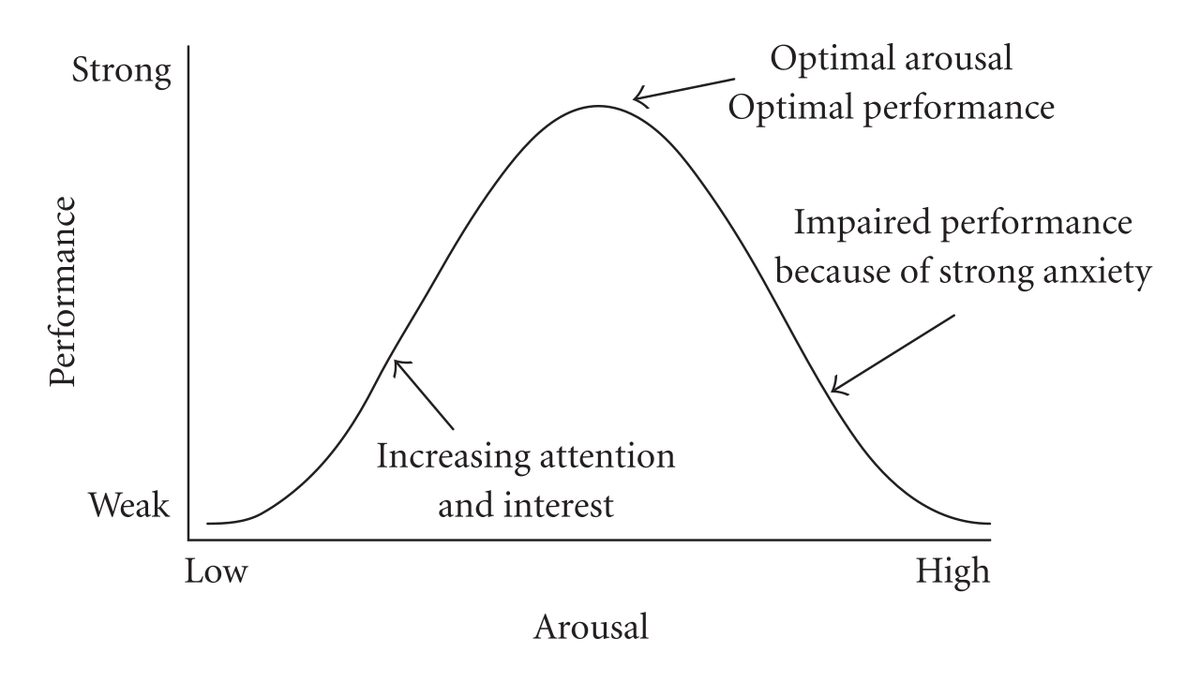
Arousal is a person's readiness to respond. The Yerkes-Dodson law describes its relationship to performance as an inverted U:
- Low arousal, as on a long, quiet automated cruise, slows the scan and lets attention wander, so radio calls and slow changes are missed (see fatigue).
- Optimum arousal, in the middle, gives the most efficient performance.
- High arousal narrows attention onto whatever seems most urgent. Peripheral cues and warning flags go unseen, and EASA texts note that auditory information is commonly the first to be discarded, which is how a clearly audible warning goes unheard. Forgetfulness, fixation, confirmation bias and difficulty setting priorities follow.
Overload may be qualitative, a task too difficult, or quantitative, too many responses needed in the time available. The peak of the curve moves to a lower arousal as tasks become more complex, so a difficult task starts to suffer at a level of arousal that a simple, well-practised one still tolerates. The practical lesson is that the moment a flight becomes complicated is the moment to simplify it, doing fewer things at once rather than trying harder. EASA texts sum it up: decisions made under stress are rarely of high quality.
Startle effect
The startle effect is the physiological and mental reaction to a sudden, unexpected and intense event: an autopilot disconnect, a loud bang, a stall or terrain warning, an abrupt upset. Guidance on upset prevention and recovery from ICAO, EASA and the FAA separates startle, the involuntary reflex to the stimulus, from surprise, the realisation that events do not match what was expected. The FAA's AC 120-111 describes an adrenaline surge, tunnelled attention and the risk of freezing or making an incorrect reflex input. The reflex passes quickly; the harm lies in the seconds spent rebuilding a picture of the situation that has just been shown to be wrong, and in any instinctive control input made meanwhile. Loss of control accidents such as Air France 447 are widely cited in this context.
The defences are to fly the aircraft first, stabilise it and buy time before diagnosing, to rely on trained procedures and memory items, and to call out what is happening. Training now deliberately includes unexpected events so that crews practise the first seconds of the response.
Life and organisational stress
Major life events are powerful stressors. The life events stress scale used in training texts weights them numerically: the death of a spouse, partner or child scores 100, divorce 73, marital separation 65, the death of a close family member 63, personal injury or illness 53, marriage 50 and loss of a job 47. The FAA's AIM lists a serious argument, a death in the family, separation or divorce, loss of a job and financial catastrophe among emotionally upsetting events after which a pilot should not fly until satisfactorily recovered. EASA's Part-MED (MED.A.020) forbids exercising licence privileges when aware of any decrease in medical fitness.
Organisational stress arises when management puts continual pressure on staff to operate in ways driven more by short-term cost than by safety and good practice. EASA texts list its symptoms as poor industrial relations, absenteeism and a rising accident and incident rate.
Defence mechanisms
Defence mechanisms are largely unconscious ways of protecting the mind from the discomfort of stress. Denial refuses to accept that a problem exists; rationalisation supplies a plausible-sounding reason, such as "the reported visibility there is always pessimistic", that lets a poor decision stand; repression pushes the threat out of mind. Under high stress a pilot may show regression, reverting to old, well-learned behaviour, such as the procedures of a previous aircraft type, in place of current ones. Defence mechanisms relieve the feeling but leave the problem untouched, and in aviation they are dangerous because they take the event out of the learning loop.
Coping and stress management
EASA texts describe three coping strategies:
- Action coping, or problem-focused coping, reduces the demand by removing the problem or changing the situation, for example by reviewing fuel, alternates and timing and acting on a revised plan. It is the effective strategy whenever any part of the problem is under the pilot's control.
- Cognitive coping reduces the felt impact, through mechanisms such as denial or rationalisation.
- Symptom-directed coping, with coffee, tea, alcohol or tobacco, treats the symptoms and leaves the stressor untouched.
On the flight deck, EASA texts give five guidelines: keep it simple and fly the aircraft; accept the situation rather than concealing facts or danger; use all crew resources; the captain, unless incapacitated, makes the decisions and controls the situation; and never give up, because there is always a suitable response. Experience, learning that makes correct responses automatic, and crew resource management are the main tools for raising tolerance to stress.
Stress management should be both preventive, keeping stress low, and curative, reducing stress that already exists, through fitness, relaxation techniques and counselling where needed. For chronic stress the answer is to tackle the cause and seek support, not to fly anyway. The AIM notes that most pilots do not leave stress on the ground, and that stress combined with fatigue is an especially hazardous mix.
Frequently asked questions
What is the Yerkes-Dodson law?
It describes the relationship between arousal and performance as an inverted U. With too little arousal, as on a long, quiet night cruise, attention wanders and the scan slows. At a moderate level performance is best. Beyond it, attention narrows, cues are missed and errors multiply. The peak comes at a lower arousal for complex tasks than for simple, well-practised ones, which is why a complicated situation should be simplified.
What are the three stages of the general adaptation syndrome?
The alarm stage is the fight-or-flight reaction, in which the sympathetic nervous system and adrenaline mobilise the body for immediate action. In the resistance stage the body sustains its effort, with cortisol helping to keep energy available, while outward performance may look normal. If the stress continues, the exhaustion stage follows as reserves run out, with illness and a sharp fall in performance.
What is the difference between startle and surprise?
Startle is an involuntary reflex to a sudden, intense stimulus such as a loud bang or an alarm, with a surge of heart rate and alertness. Surprise is a cognitive reaction to an event that does not match what was expected. Either can delay or distort the first control input for several seconds, which is why training stresses stabilising the aircraft first and acting on the trained procedure rather than the first impulse.
What are the three types of stressors?
The FAA's Pilot's Handbook of Aeronautical Knowledge groups them as physical, physiological and psychological. Physical stressors are environmental, such as heat, noise, vibration and lack of oxygen. Physiological stressors include fatigue, missed meals, illness and poor fitness. Psychological stressors are social and emotional factors, such as family or money worries, and mental workload. Their effects add together.
How can pilots cope with stress?
EASA training texts describe three kinds of coping. Action or problem-focused coping removes or changes the source of stress and is the effective strategy whenever the problem can be influenced. Cognitive coping reduces the felt impact, for example by rationalising. Symptom-directed coping, with coffee, alcohol or tobacco, treats symptoms only. On the flight deck the guidelines are to keep things simple, fly the aircraft and use all crew resources.
Test yourself on Stress
The v1prep banks cover this topic in Human Performance and Limitations (040), with a worked explanation for every answer. EASA ATPL, PPL, IR and CPL, the FAA written tests and A320/B737 type ratings.
Start practising →Sources and further reading
- FAA Pilot's Handbook of Aeronautical Knowledge (FAA-H-8083-25C), Chapter 2, Aeronautical Decision-Making, and Chapter 17, Aeromedical Factors
- FAA Aeronautical Information Manual, Chapter 8 Section 1 (8-1-1 Fitness for Flight)
- ICAO Doc 9683, Human Factors Training Manual
- FAA AC 120-111, Upset Prevention and Recovery Training
- EASA Easy Access Rules for Air Operations (ORO.FC.115 and AMC, CRM training)
- EASA, Explanatory Note to ED Decision 2018/001/R, Part-FCL theoretical knowledge learning objectives (040 Human Performance)
- ICAO Doc 10011, Manual on Aeroplane Upset Prevention and Recovery Training
Library articles are written for study and exam preparation. They do not replace your aircraft's approved documentation, your operator's procedures or the regulations themselves.