Level Bust
A level bust is any departure of an aircraft from the vertical limit of its ATC clearance: climbing or descending through the cleared flight level or altitude, leaving it without clearance, or levelling at a different one. The FAA calls it an altitude deviation; pilots often say altitude bust.
A level bust happens when an aircraft leaves the vertical limit of its clearance. It climbs or descends through the cleared flight level or altitude, starts a climb or descent before it has been cleared, or levels off at a figure other than the one it was given. American usage prefers altitude deviation or altitude bust, but the problem is the same. It is one of the commonest pilot deviations that air traffic services record, and it attacks the barrier that keeps aircraft apart vertically.
Few level busts are pure handling errors. Most begin earlier, with a number that goes wrong: a clearance misheard or meant for someone else, a figure mis-set on the autopilot selector, an altimeter left on the wrong datum. The defences are therefore procedural: readback and hearback, cross-checked altimeter settings, a monitored level-off, and a crew that treats the cleared level as a number it may not get wrong.
What is a level bust
In controlled airspace aircraft are usually separated vertically by 1,000 ft, including in RVSM airspace between FL 290 and FL 410 (see separation standards). An aircraft that overshoots its cleared level by a few hundred feet has used up most of that margin. The ground system notices at about the same point. Controllers verify a Mode C readout against the pilot's reported level to a tolerance of ±300 ft (±200 ft in RVSM airspace), and once verified, a readout that moves more than 300 ft away in the expected direction shows that the aircraft has left its level (see transponder and SSR). SKYbrary and the EUROCONTROL ATM Lexicon give a narrower formal definition with the same thresholds: any unauthorised vertical deviation of more than 300 ft from an ATC flight clearance, reduced to 200 ft in RVSM airspace.
A level bust can happen in any phase:
- in the climb or descent, by flying through the cleared level;
- in level flight, by drifting off it after an autopilot disconnect or in turbulence;
- by leaving a level early, on the strength of a clearance meant for another aircraft or of an altitude that was only expected;
- on a departure or arrival, by missing a level constraint on a SID or STAR.
A bust downwards carries a further hazard: it can take the aircraft below the minimum safe altitude as well as into the traffic below.
Common causes
The causes fall into a few families, and each has its own defence.
| Family | Typical error | Main defence |
|---|---|---|
| Communication | Level misheard, clearance taken from a similar call sign, readback error not caught | Full readback with call sign, active hearback, query any doubt |
| Altimeter setting | Wrong QNH, standard not set at the transition altitude or QNH not set at the transition level, hPa and inHg confused | Set and cross-check at every change, both pilots |
| Automation | Wrong figure on the altitude selector, capture mode not armed, value changed during the level-off | Point at and call the selection, check the flight mode annunciator |
| Procedures | SID or STAR level constraints misread, expected altitude treated as a clearance | Brief the constraints, know exactly what the clearance authorises |
| Workload | Checklist, radio call or failure in the last 1,000 ft | Sterile flight deck, one pilot monitoring the level-off |
| Handling | Hand-flown overshoot, turbulence, late level-off | Lead the level-off, reduce the vertical speed early |
FAA training material notes that altitude deviations are among the most frequent pilot deviations and that most involve a mis-set altitude or an autopilot vertical mode that did not capture the level. Expectation plays a part too. A crew that usually receives a particular level on a particular departure hears it again when the controller says something else.
Clearances and readback
The readback is the controller's only check that the instruction arrived intact. Under SERA.8015, which mirrors ICAO procedures, the pilot must read back level instructions, altimeter settings and transition levels, the last even when they come from the ATIS, together with route and runway clearances, headings, speeds, SSR codes and new frequencies. The call sign ends the readback, so the controller hears who accepted the level. If the readback is wrong, the controller replies NEGATIVE and gives the correct version. The FAA's AIM asks US pilots to read back altitude assignments and restrictions and, in general, any part of a clearance containing numbers.
The readback protects nobody if the controller does not listen to it. Nor does it change the clearance: under 14 CFR 91.123, a pilot may deviate from a clearance only in an emergency, in response to a TCAS resolution advisory or after obtaining an amended clearance, and a wrong readback that ATC misses does not authorise the wrong level.
Phraseology separates similar numbers. Flight levels are spoken digit by digit except whole hundreds, so FL 100 is "flight level one hundred" and FL 110 is "flight level one one zero". Altitudes use hundreds and thousands, as in "three thousand five hundred feet". The datum is always stated: flight level, altitude or height. When two aircraft with similar call signs share a frequency, pilots listen carefully, use the full call sign and question any instruction that may be meant for the other.
Some clearances are misread because of what they leave out. An expected altitude authorises nothing until the controller clears it. In the United States, "climb via SID" requires the published altitude restrictions to be flown, whereas a plain "climb and maintain" cancels them unless they are restated (see ATC clearances).
Surveillance adds a last layer. With Mode S enhanced surveillance, the transponder sends the selected altitude to the ground, so a controller can see a wrong figure on the selector before the aircraft reaches it.

Altimeter setting cross-checks
An altimeter cross-check (also written crosscheck) compares the altimeters with each other and with a known reference. It is done at several points in every flight.
- Before flight. With QNH set, each altimeter should read the known elevation of the aircraft's position. PANS-OPS allows ±60 ft for instruments with a test range up to 30,000 ft and ±80 ft for a range up to 50,000 ft; the FAA's Instrument Flying Handbook uses 75 ft for IFR. The captain's, first officer's and standby altimeters must also agree within the tolerance in the flight manual.
- At the transition. Climbing, standard pressure (1013 hPa, 29.92 inHg) is set at the latest on passing the transition altitude; descending, QNH is set at the latest on passing the transition level. Both pilots set their own displays and the standby, then compare the settings and the altitude indications. Airbus procedures, for example, call for the PF and PM to cross-check both after each change.
- In RVSM airspace. The two primary altimeters must agree within 200 ft, and crews check this before entering, for instance before the North Atlantic oceanic area.
- On first contact. The transponder always reports pressure altitude referenced to 1013.25 hPa, whatever is set on the subscale, and the ground system converts it. A wrong setting in the cockpit therefore shows up as a mismatch between the reported level and the Mode C readout.
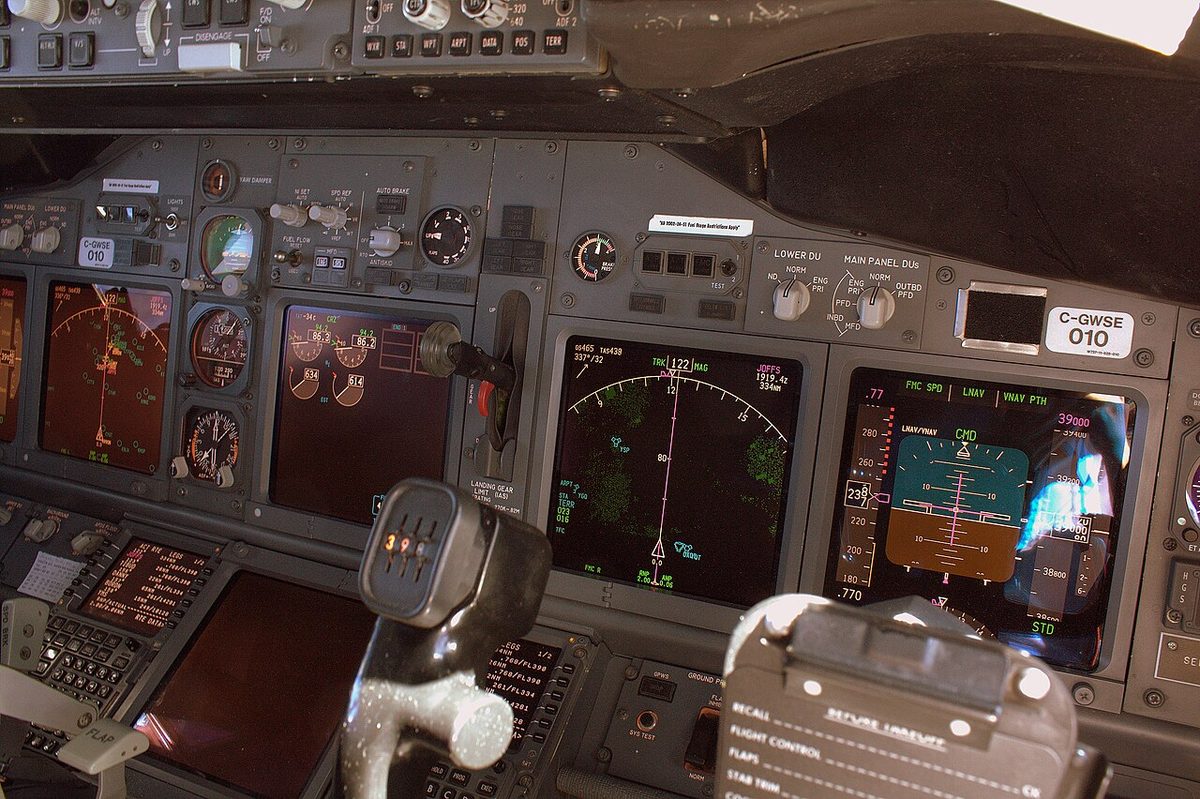
Near sea level each hectopascal is worth about 27 to 30 ft. An aircraft on the ground at 1,240 ft elevation with QNH 1008 but 1013 still set reads about 1,375 ft. The same error in the air places the aircraft 135 ft below where the crew believes it is (see altimeter settings, altitude and height).
Warning: 29.92 inHg and 992 hPa sound alike on the radio but are about 21 hPa apart, close to 600 ft of altimeter error. A QNH below 1000 hPa is spoken with its unit, hectopascals, and the unit belongs in the readback too.
Cold air adds a different error. The aircraft is lower than indicated, which threatens terrain clearance rather than separation from other aircraft flying the same pressure levels. It is corrected by adding cold-temperature corrections to minimum altitudes (see cold-weather altimetry).
Level-off technique and callouts
The level-off is where a wrong number becomes a bust, so crews structure it.
- Set the selector at once. The cleared level goes into the altitude window of the mode control panel or flight control unit as soon as it is received. One pilot sets it, the pilot monitoring in many SOPs and the pilot flying in others (Boeing makes the 737's mode control panel the pilot flying's responsibility), and both pilots verify it by pointing and calling, before or with the readback.
- Check the mode. The flight mode annunciator must show the level capture armed. Selecting a figure is not enough if the active vertical mode will not capture it.
- Call the approach to the level. At 1,000 ft before the cleared level, many crews call "one thousand to go". FAA guidance recommends the same habit to single pilots, because it catches level-offs forgotten during radio calls and chart changes.
- Watch the capture. One pilot monitors the level-off, with no checklists or non-essential tasks in that phase. The FAA's sterile flight deck rule for airline crews covers taxi, take-off, landing and all other flight below 10,000 ft except cruise.
- Reduce the rate. A high vertical speed close to the level makes an overshoot more likely, and with traffic at the adjacent level it can trigger an unnecessary resolution advisory. The rate is reduced as the level approaches, and a hand-flying pilot starts the level-off early enough to arrive without overshooting.
The altitude alerting system backs this up. It alerts the crew on approaching the selected altitude and warns, at least aurally, of a deviation from it. EASA's CAT.IDE.A.140 requires one in commercial air transport on turboprops above 5,700 kg or with more than nine passenger seats and on all turbojets; the FAA requires one on turbojets under 14 CFR 91.219. On most Boeing 737 variants a momentary tone sounds 900 ft before the selected altitude and the current altitude box becomes bold until 300 ft to go; a deviation of 300 ft sounds a tone and turns the box amber and flashing. The Airbus A320 uses a C-chord aural alert, and inhibits it in the approach once the glideslope is captured or the landing gear is down. The alerter supplements the pilots' scan; it does not replace it.
Exam tip: the approach to a selected altitude and a deviation from it after capture are the two situations an altitude alerting system must warn of. The alert itself is part of the defence, not proof that the level was correct.
Consequences and prevention
A level bust in busy airspace removes the vertical separation the controller was relying on. If another aircraft is close, ACAS may issue a resolution advisory. The RA is flown even against an ATC instruction, the controller stops being responsible for separation from the affected aircraft, and the crew reports when the clearance has been resumed (see ACAS and TCAS). A bust downwards can also end in controlled flight into terrain, especially when an altimeter error has already put the aircraft lower than indicated.
When a bust is noticed, the crew returns promptly to the cleared level and tells ATC. Reporting the event feeds the safety programmes that look for the same trap at the same place.
Prevention comes down to a few habits, each covering a different family of causes:
- read back every level with its datum and call sign, and query anything unexpected;
- set the cleared level on the selector immediately, then point, call and cross-check;
- set and cross-check altimeters at every change of datum, including the standby;
- confirm the capture mode on the flight mode annunciator, call "one thousand to go" and monitor the level-off;
- keep the flight deck sterile below 10,000 ft and during every level-off;
- brief SID and STAR level constraints, and treat an expected level as exactly that.
Good habits are shared across the crew. The pilot monitoring who calls a wrong figure on the selector, or a vertical speed that is still high at 500 ft to go, is doing exactly what the procedures are designed for (see crew coordination, briefings and callouts).
Frequently asked questions
What is a level bust in aviation?
A level bust is any unauthorised departure from the level in an ATC clearance. The aircraft climbs or descends through its cleared flight level or altitude, leaves it without clearance, or levels at a different one. The FAA calls it an altitude deviation. Because controllers separate aircraft vertically by as little as 1,000 ft, a bust of a few hundred feet can remove most of the margin between two aircraft.
What are the most common causes of a level bust?
Most start with a number that goes wrong. A clearance is misheard or taken from a similar call sign, a readback error goes uncorrected, the wrong figure is set on the autopilot altitude selector, or an altimeter is left on the wrong setting at the transition. Others come from a vertical mode that never captures the level, a hand-flown level-off without a lead, or a distraction in the last 1,000 ft.
How are altimeters cross-checked before flight?
With QNH set, each altimeter should read the known elevation of the aircraft's position. PANS-OPS allows 60 ft for instruments with a test range up to 30,000 ft and 80 ft for those tested to 50,000 ft, while the FAA's Instrument Flying Handbook uses 75 ft for IFR. The pilots' altimeters and the standby must also agree within the flight manual tolerance. In RVSM airspace the two primary altimeters must agree within 200 ft.
Must a pilot read back a level instruction?
Yes. SERA.8015 and ICAO procedures put level instructions, altimeter settings and transition levels on the mandatory readback list, together with route and runway clearances, headings, speeds, SSR codes and new frequencies. The readback ends with the call sign. A controller who hears an error replies NEGATIVE and repeats the correct level, and a wrong readback that goes uncorrected still does not authorise the wrong level.
What does an altitude alerting system do?
It alerts the crew as the aircraft approaches the altitude selected on the autopilot panel, and warns, at least aurally, if the aircraft then deviates from it. EASA's CAT.IDE.A.140 requires one on commercial turboprops above 5,700 kg or with more than nine passenger seats and on all turbojets; the FAA requires one on turbojets under 14 CFR 91.219. On most Boeing 737 variants the deviation alert comes 300 ft from the selected altitude.
Test yourself on Level Bust
The v1prep banks cover this topic in Operational Procedures (070), with a worked explanation for every answer. EASA ATPL, PPL, IR and CPL, the FAA written tests and A320/B737 type ratings.
Start practising →Sources and further reading
- EASA Easy Access Rules for Standardised European Rules of the Air (SERA), SERA.8015 Air traffic control clearances
- ICAO Doc 8168, Procedures for Air Navigation Services, Aircraft Operations (PANS-OPS), and related Annexes
- FAA Aeronautical Information Manual, Chapter 4 Section 4, ATC Clearances and Aircraft Separation
- FAA Aeronautical Information Manual, Chapter 7 Section 2, Barometric Altimeter Errors and Setting Procedures
- 14 CFR 91.123, Compliance with ATC clearances and instructions
- 14 CFR 91.219, Altitude alerting system or device, turbojet-powered civil airplanes
- EASA Easy Access Rules for Air Operations (Regulation (EU) No 965/2012), instruments and equipment (CAT.IDE)
- SKYbrary, Level Bust
Library articles are written for study and exam preparation. They do not replace your aircraft's approved documentation, your operator's procedures or the regulations themselves.