Crew Coordination, Briefings and Callouts
Crew coordination is the way a multi-pilot crew divides and exchanges its duties, shares its plan through briefings and keeps both pilots aware of the flight path and the automation through standard callouts, so that each pilot can detect and correct the other's errors.
Crew coordination is the set of procedures by which two or more pilots operate one aircraft as a single system. Duties are divided so that one pilot always flies and the other always monitors; the plan is shared before each critical phase in a briefing; and standard callouts keep both pilots aware of what the aircraft and its automation are doing. The aim is not efficiency but error detection: two pilots rarely make the same mistake at the same moment, provided each knows what the other intends.
The principles come from crew resource management and are written into each operator's standard operating procedures. Details differ between manufacturers, so the examples below are labelled Airbus or Boeing where it matters, but the structure is common to all multi-pilot operations and is tested in EASA and FAA exams alike.
Pilot flying and pilot monitoring
The pilot flying (PF) controls the aircraft; the pilot monitoring (PM) watches it. The roles are assigned for each flight or each sector and are independent of rank: the captain may be PM, and remains in command whichever seat does the flying.
| Boeing general duties | Airbus normal operations | |
|---|---|---|
| PF | Taxiing, flight path and airspeed control, aeroplane configuration, navigation | Fly and navigate |
| PM | Checklist reading, communications, tasks asked for by the PF, monitoring of taxi, flight path, speed, configuration and navigation | Monitor the flight path, navigation and systems; communicate |
The FAA's advisory circular on standard operating procedures, AC 120-71, replaced the old term pilot not flying with pilot monitoring to make the point that the second pilot's primary job is monitoring. A 1994 NTSB study found monitoring failures in 84% of the crew-caused accidents it reviewed. The PM cross-checks the flight path against the briefed plan, makes the deviation calls and handles the radio and checklists; the PF acknowledges and corrects.
Task sharing and transfer of control
Task sharing (Airbus writes tasksharing) allocates each control to a pilot so that two hands never reach for the same one. On the A320, entries on the autoflight control panel are made by the PF with the autopilot engaged, and by the PM at the PF's request when flying manually, except that the PF may engage the autopilot and autothrust. In abnormal operations the PM performs the procedure while the PF flies, navigates and takes over the radio (see managing non-normal situations).
Only one pilot flies at a time, so a transfer of control must be explicit. The standard exchange is "I have control" from the pilot taking over and "you have control" from the pilot handing over. On the A320, a PM who needs to act on the sidestick announces "I have control" and presses and holds the sidestick pushbutton to take full priority. The FAA's Airplane Flying Handbook teaches a three-step positive exchange of flight controls: "You have the flight controls", "I have the flight controls", "You have the flight controls", with a visual check that the other pilot really is flying. Accidents have happened when each pilot assumed the other had the controls, so FAA guidance for commercial pilots is to agree the roles and the transfer phrase in a briefing whenever a second pilot is on board, even one who is not a required crew member.
Control is also passed deliberately when one pilot must go head-down. If the runway or intersection changes during taxi, Airbus guidance has the PM update the FMS while the PF keeps taxiing; before cross-checking the new take-off data, the PF either stops the aircraft or hands control to the PM.
Sterile flight deck in critical phases
The sterile cockpit rule removes distraction when the workload and the consequences of error are highest. In the United States, 14 CFR 121.542 forbids nonessential duties and nonessential conversation during critical phases of flight, defined there as all ground operations involving taxi, take-off and landing, and all other flight operations below 10,000 ft except cruise flight. Company paperwork, calls about galley supplies and casual conversation all wait. Part 135 has an equivalent rule, and since 2014 Part 121 also bans the personal use of wireless devices and laptops at the duty station throughout flight time. Boeing's standard callout procedures likewise prohibit unnecessary conversation below 10,000 ft.
EASA defines the critical phases for aeroplanes, in Annex I to Regulation (EU) No 965/2012, as the take-off run, the take-off flight path, the final approach, the missed approach and the landing including the landing roll, plus any other phase the pilot-in-command or commander decides. Under CAT.GEN.MPA.105 the commander may not permit any crew member to perform any activity during critical phases except duties required for the safe operation of the aircraft. Older EU-OPS texts, still quoted in exam material, applied the duty restriction to take-off, initial climb, final approach and landing, and their definition of critical phases did not include the missed approach. Part 91 imposes no sterile rule on private flights, but the FAA expects commercial pilots to apply the principle even when flying alone.
Crew and threat-based briefings
A crew briefing turns two individual plans into one shared mental model. Human performance texts give three qualities of an effective briefing: it is short, with fewer than about ten ideas, splitting longer material into parts; it is individual, prepared for this flight; and it is understood by the whole crew, because a simple plan everyone supports beats a brilliant one that is misunderstood. It emphasises the points where the crew will need to co-operate.
A threat-based briefing puts the threats of the day first: a short runway, a tailwind, terrain, a late runway change or an inoperative item. It skips what both pilots can read on the chart, and it is interactive rather than a monologue, as AC 120-71 recommends. It ends with the decisions taken in advance: what will trigger a rejected take-off, a go-around or a diversion (see threat and error management). The cabin crew receive their own briefing before departure and whenever something unusual develops.
Take-off briefing
The take-off briefing (FAA spelling takeoff briefing) is given before the phase with the least time to decide, so it pre-decides. In Boeing procedures the pilot who will make the take-off gives the taxi and take-off briefings. A typical airline briefing covers:
- the runway and intersection, and the taxi route with its hot spots;
- the performance data: masses, thrust, flap setting and V-speeds;
- the departure procedure and clearance;
- the engine-out procedure, which may differ from the SID;
- the rejected take-off criteria and each pilot's duties;
- the threats particular to the day.
On the A320 the preliminary take-off performance computation is itself a coordination tool: it gives both pilots a common view of the plan and the same assumptions. When the SOPs call for a cross-check, the crew compare runway, take-off shift, V1, VR and V2, green dot speed, thrust setting, flaps, trim, packs, anti-ice and the engine-out acceleration altitude. Single pilots brief themselves the same way, for example on what they will do if the engine fails at low height.
Approach and landing briefing
The approach briefing, or approach and landing briefing, is given before descent, while there is time. It covers the weather and runway condition, the approach chart (frequencies, courses, fix altitudes, the minima and the missed approach), the automation and FMS set-up, the speeds and configuration, the threats, and each pilot's role. Chart-to-FMS verification of fix names, courses and altitudes catches database and entry errors before they matter. Most important of all, the crew agree what will make them go around, so that the decision at the stabilisation gates or at the minima is already made.
Standard callouts
Standard callouts are fixed words spoken at fixed points. They share information, confirm that the other pilot is alert and, by their absence, reveal a problem. Airbus gives the example of "POSITIVE CLIMB" announced by the PM followed by "GEAR UP" ordered by the PF: the sequence guarantees a common plan before the gear moves. Boeing states the philosophy: the PM makes callouts from instrument indications or observations, the PF verifies and acknowledges, and if the PM misses a callout, the PF makes it. A missing callout may mean a system or indication failure, or an incapacitated pilot.
| Moment | Airbus A320 | Boeing 737 |
|---|---|---|
| Take-off roll | PM "THRUST SET" before 80 kt; "ONE HUNDRED KNOTS", PF "CHECKED" | PM "80 KNOTS", PF "CHECK" |
| Decision and rotation | PM "V1", "ROTATE" | PM calls or confirms the automatic "V1"; "ROTATE" |
| After lift-off | PM "POSITIVE CLIMB", PF "GEAR UP" | PM "POSITIVE RATE", PF "GEAR UP" |
| Approaching the minima | Automatic "HUNDRED ABOVE" at DH or MDA + 100 ft | PM "APPROACHING MINIMUMS" at 100 ft above DA or MDA |
| At the minima | Automatic "MINIMUM"; the PF announces the decision | PM "MINIMUMS"; PF "LANDING" or "GO AROUND" |
The minimums callout is the clearest example of task sharing: the PM watches the altitude and calls, the PF looks for the visual references and decides. In the flare the A320 PM calls "PITCH PITCH" if the pitch attitude reaches 10° or approaches the tail strike limit indicator, and "BANK BANK" at 7° of bank. Many callouts are automatic, such as the radio altitude calls and the A320's "RETARD" at 20 ft in a manual landing, but they supplement the crew's own calls rather than replace them.
FMA callouts and mode awareness
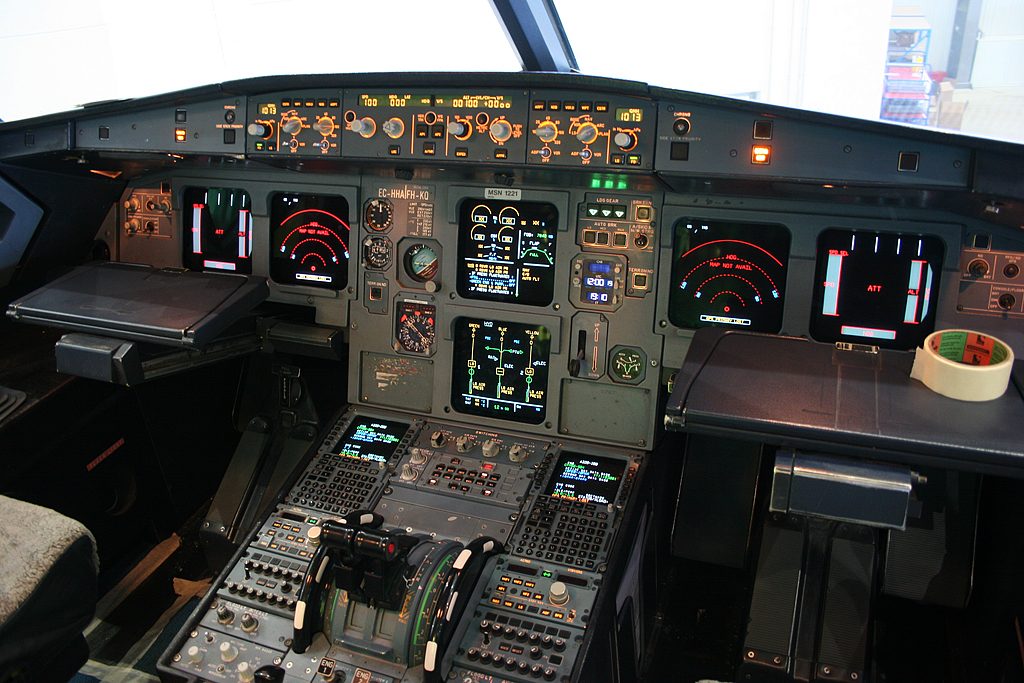
The flight mode annunciator (FMA) is the only display that states which autothrust, vertical and lateral modes are actually engaged or armed. A selection on the glareshield panel is only a request; the FMA shows the answer. FMA callouts (mode verbalisation) close that loop. Airbus's third golden rule, "understand the FMA at all times", requires the crew to monitor, announce, confirm and understand every change, and Boeing's FCOM describes announcing FMA and thrust mode changes as good CRM practice.
Modes change without pilot input too: on capture of an altitude, a localiser or a glide path, and on a reversion. On the A320 a reversion is signalled by a triple click, the new mode boxed on the FMA for 10 seconds and flashing flight director bars. The 2013 Asiana Flight 214 accident at San Francisco is the case most often quoted for mode awareness: on a visual approach the autothrottle of the Boeing 777 went to HOLD, in which it no longer controlled the speed, without any of the three pilots noticing, and the aircraft struck the seawall short of the runway.

Automation and manual flying
Airbus's second golden rule is to use the appropriate level of automation at all times, which may be manual flight. The decision to fly manually is agreed between both pilots and based on the aircraft's status, fatigue, weather, traffic and familiarity with the area. When the aircraft does not follow the intended path, the fourth rule applies: go down a level, from managed to selected guidance or from selected guidance to manual flying (hand flying). The FAA gives the same advice for automation surprise: when a crew asks "what is it doing now?", reduce the automation, fly the aircraft, and re-engage once the mode logic is understood. Its Safety Alerts for Operators on manual flight operations, SAFO 13002 and SAFO 17007, encourage operators to let pilots hand-fly when conditions permit, because continuous autoflight erodes the skill of recovering from an undesired state (see flight deck automation).
The autopilot has limits of its own. The minimum autopilot engagement height after take-off and the minimum use heights on approach are flight manual values, adopted in the operator's SOPs:
| Aircraft | After take-off | Example on approach |
|---|---|---|
| Airbus A320 | 100 ft AGL, at least 5 s after lift-off | 160 ft AGL on an ILS with CAT 1 on the FMA; 250 ft with FINAL APP, V/S or FPA |
| Boeing 737 | Not below 400 ft AGL | Single-channel approach: not engaged below 50 ft AGL (FAA AFM) |
| Embraer E190 | 400 ft (E1); 200 ft (E2) | 80 ft on an ILS or LPV approach (E2) |
In the United States, 14 CFR 121.579 ties the minimum heights for autopilot use en route, on approach and after take-off to the altitude loss the flight manual shows for an autopilot malfunction and to its minimum engagement height.
Exam tip: the PM calls, the PF acknowledges and acts. If a callout is missing, the other pilot makes it. A pilot who fails to respond to two clear challenges about a significant deviation is assumed to be incapacitated, the two-challenge rule, and the other pilot takes control.
Frequently asked questions
What is the difference between the pilot flying and the pilot monitoring?
The pilot flying (PF) controls the flight path, the speed and the configuration and navigates. The pilot monitoring (PM) monitors the flight path, the navigation and the systems, reads checklists, handles radio communications and carries out tasks the PF asks for. Either pilot, captain or first officer, can take either role, and the captain remains in command whoever is flying. FAA guidance replaced pilot not flying with pilot monitoring to stress the monitoring task.
What is the sterile cockpit rule?
Under 14 CFR 121.542, no crew member may perform, and no certificate holder may require, nonessential duties or conversation during critical phases of flight, defined as taxi, take-off and landing and all other flight operations below 10,000 ft except cruise flight. In EASA rules the commander may permit only duties required for safe operation during the critical phases, which include the take-off run and flight path, final approach, missed approach and landing.
How should control of the aircraft be handed over between pilots?
By an explicit spoken exchange that leaves no doubt about who is flying, such as I have control and you have control. The FAA recommends a three-step positive exchange of flight controls, with a visual check, and on the A320 a pilot taking over announces I have control and presses the sidestick pushbutton. Accidents have occurred when each pilot believed the other was flying.
What should an approach briefing include?
The weather and runway condition, the approach chart details such as frequencies, courses, fix altitudes, minima and the missed approach, the automation and FMS set-up, speeds and configuration, the threats of that particular approach and the crew roles, including what will cause a go-around. Modern threat-based briefings put the threats first, are interactive, and skip chart items both pilots can read for themselves.
What is the minimum autopilot engagement height after take-off?
It is set by each aircraft's flight manual and the operator. The A320 allows the autopilot to be engaged from 100 ft AGL, at least 5 seconds after lift-off. Boeing 737 limitations forbid engagement below 400 ft AGL after take-off, and the Embraer E190 E1 also uses 400 ft. In the United States, 14 CFR 121.579 ties the minimum heights for autopilot use to the flight manual.
Test yourself on Crew Coordination, Briefings and Callouts
The v1prep banks cover this topic in Operational Procedures (070), with a worked explanation for every answer. EASA ATPL, PPL, IR and CPL, the FAA written tests and A320/B737 type ratings.
Start practising →Sources and further reading
- 14 CFR 121.542, Flight crewmember duties (sterile flight deck)
- EASA Easy Access Rules for Air Operations (Regulation (EU) No 965/2012)
- FAA Advisory Circular 120-71B, Standard Operating Procedures and Pilot Monitoring Duties for Flight Deck Crewmembers
- FAA Airplane Flying Handbook (FAA-H-8083-3C), Chapter 1, Introduction to Flight Training (positive exchange of flight controls)
- FAA Advisory Circular 120-51E, Crew Resource Management Training
- NTSB AAR-14/01, Asiana Airlines Flight 214, Boeing 777-200ER, San Francisco, California
- Flight Safety Foundation, ALAR Briefing Note 7.1, Stabilized Approach
Library articles are written for study and exam preparation. They do not replace your aircraft's approved documentation, your operator's procedures or the regulations themselves.