Aviation Security
Aviation security is the combination of measures, people and resources that safeguards civil aviation against acts of unlawful interference, such as hijacking, sabotage or violence on board, as distinct from aviation safety, which protects against accidents and unintentional hazards.
Aviation security protects civil aviation from deliberate harm: hijacking, sabotage, attacks on airports and violence on board. It is the counterpart of aviation safety, which deals with accidents and unintended hazards, and the two often meet on the flight deck, where a locked door, a transponder code and a diversion decision serve both.
The international framework has two layers. Criminal law treaties, the Tokyo, Hague and Montreal Conventions, decide which States may prosecute offenders and oblige them to punish hijacking and sabotage severely. Preventive standards in ICAO Annex 17 (Security), titled Safeguarding International Civil Aviation against Acts of Unlawful Interference, require every State to run a security programme covering airports, operators, passengers, baggage and cargo. Air law and operational procedures papers test both, and the United States adds its own layer run by the Transportation Security Administration (TSA).
- Unlawful Interference Defined
- Tokyo, Hague and Montreal Conventions
- Annex 17 and National Programmes
- Passenger and Baggage Screening
- Cargo Security and Known Consignors
- Disruptive Passengers
- Armed Personnel on Board
- Unlawful Interference in Flight
- Isolated Aircraft Parking Position
- US Security Framework (TSA)
- Frequently asked questions
Unlawful Interference Defined
Annex 17 states the aim of aviation security as safeguarding civil aviation operations against acts of unlawful interference, and makes the safety of passengers, crew, ground personnel and the general public the primary objective in every security matter. It defines acts of unlawful interference as acts or attempted acts such as to jeopardise the safety of civil aviation, including:
- unlawful seizure of an aircraft, better known as hijacking;
- destruction of an aircraft in service;
- hostage-taking on board an aircraft or at an aerodrome;
- forcible intrusion on board an aircraft, at an airport or on the premises of an aeronautical facility;
- introduction on board an aircraft or at an airport of a weapon or hazardous device or material intended for criminal purposes;
- use of an aircraft in service to cause death, serious bodily injury or serious damage to property or the environment;
- communication of false information that jeopardises the safety of an aircraft, its occupants, ground personnel or the public.
The list is not exhaustive: a hoax bomb warning counts even though no device exists.
Tokyo, Hague and Montreal Conventions
Three treaties form the core of aviation criminal law.
| Convention | Formal subject | Key points |
|---|---|---|
| Tokyo, 1963 | Offences and certain other acts committed on board aircraft | State of Registration has jurisdiction; commander's powers |
| Hague, 1970 | Suppression of unlawful seizure of aircraft | Hijacking; in force 14 October 1971 |
| Montreal, 1971 | Suppression of unlawful acts against the safety of civil aviation | Sabotage and other acts; in force 26 January 1973 |
The Tokyo Convention (1963), the Convention on Offences and Certain Other Acts Committed on Board Aircraft, makes the State of Registration competent to exercise jurisdiction over offences on board, which is why it prosecutes an offence committed over the high seas. Tokyo also covers acts that are not crimes but jeopardise safety or good order on board, and it gives the aircraft commander the powers described below under disruptive passengers. The Montreal Protocol of 2014, which amends the Tokyo Convention and has been in force since 1 January 2020, extends jurisdiction over such offences to the State where the aircraft lands and the State of the Operator, so that unruly passengers can be prosecuted where they arrive.
The Hague Convention (1970), the Convention for the Suppression of Unlawful Seizure of Aircraft, deals with hijacking alone. It defines when an aircraft is in flight, obliges States to make the offence punishable by severe penalties, and allocates jurisdiction to the State of Registration, the State of landing if the offender is still on board, the State of the Operator and the State where the offender is found. A State holding a hijacker must either extradite or prosecute.
The Montreal Convention (1971), the Convention for the Suppression of Unlawful Acts against the Safety of Civil Aviation, covers acts other than seizure: violence against a person on board an aircraft in flight, destroying or damaging an aircraft in service, placing a device on an aircraft, destroying or damaging air navigation facilities, and communicating false information. A supplementary protocol signed at Montreal in 1988 extended it to acts of violence at airports serving international civil aviation.
Exam tip: several instruments carry Montreal's name. The 1971 Convention is about sabotage and security, the 2014 Protocol amends Tokyo, the 1999 Convention governs airline liability to passengers (see carrier liability), and the 1987 Montreal Protocol on ozone-depleting substances is why halon is being phased out. Tokyo means jurisdiction on board; The Hague means hijacking.
Annex 17 and National Programmes
Each Contracting State must establish and implement a written National Civil Aviation Security Programme (NCASP), and designate, and specify to ICAO, an appropriate authority responsible for developing, implementing and maintaining it. The programme sets up airport security committees, ensures that contingency plans and training exist, and requires security needs to be built into the design and construction of new airport facilities and alterations to existing ones. A State should also make the appropriate parts of its NCASP available in writing to other States on request, and includes security clauses in its bilateral air transport agreements.
Below the national programme sit airport and operator security programmes. The operator is responsible for training programmes that make its staff aware of security rules and minimise the opportunities for unlawful interference. Annex 17 also defines the areas an aerodrome is divided into:
- Airside is the movement area of an airport, with adjacent terrain and buildings or parts of them, access to which is controlled.
- A security restricted area is the part of airside identified as a priority risk area where other security controls are applied in addition to access control, such as the departure areas beyond screening, the ramp and baggage make-up areas.
Passenger and Baggage Screening
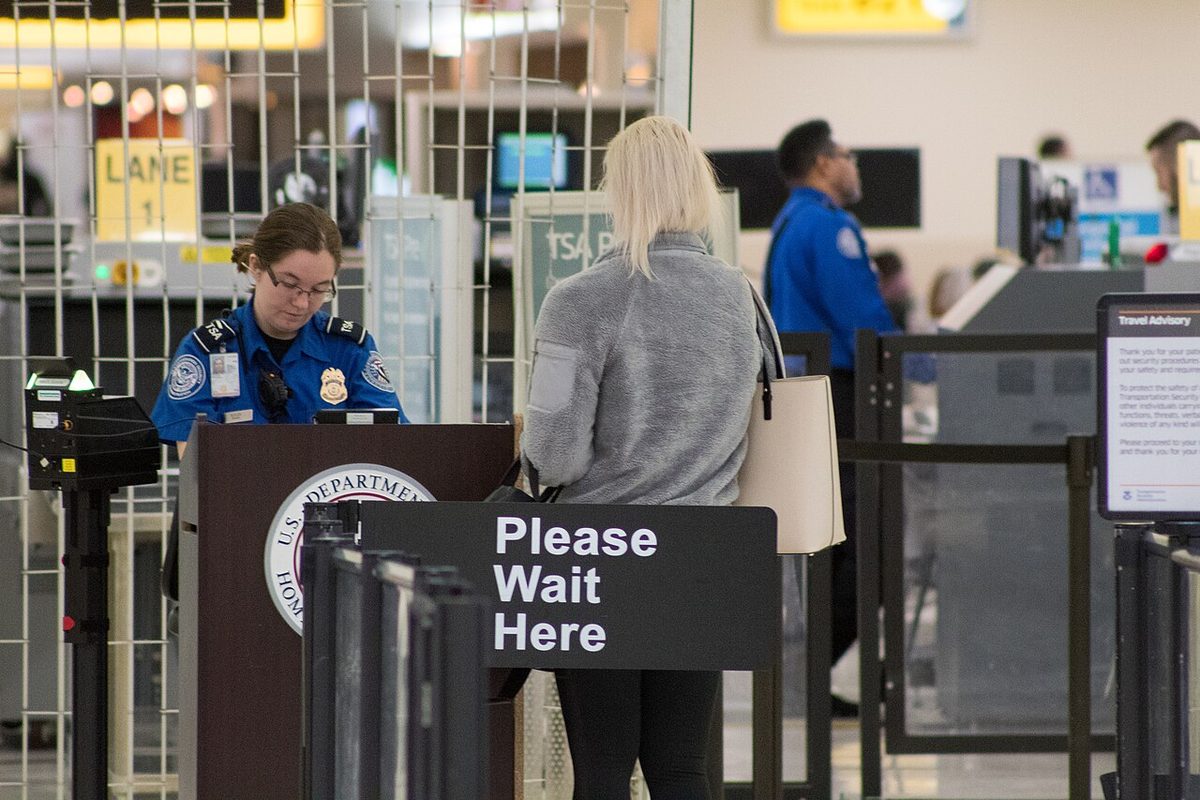
Security screening is the application of technical or other means intended to identify or detect weapons, explosives or other dangerous devices, articles or substances that could be used to commit an act of unlawful interference. Passengers and their cabin baggage are screened before boarding, and screened passengers must not mix with unscreened people afterwards. If mixing occurs, the passengers and their baggage are screened again before boarding.
Hold baggage is screened and protected from interference until it is loaded. Passenger and baggage reconciliation ensures that an aircraft does not carry the checked baggage of a passenger who is not on board unless that baggage has been identified as such and subjected to additional security controls, since an unaccompanied bag is the classic way to put a bomb on board without travelling with it. Unidentified baggage is baggage at an airport, with or without a tag, which is not picked up by or identified with a passenger; finding it triggers specific handling and screening procedures.
Cargo Security and Known Consignors
Cargo, mail and other goods are protected by three kinds of control: screening before loading, approval and security controls applied to the agents and consignors in the supply chain, and access control so that only authorised people reach the consignments. A known consignor is a consignor that originates cargo or mail for its own account and whose procedures meet common security rules and standards sufficient for the consignment to be carried on any aircraft. A regulated agent, such as a freight forwarder, is an entity that applies security controls to cargo or mail. The separate rules for hazardous articles are in Annex 18 (see dangerous goods).
Disruptive Passengers
Annex 17 describes a disruptive passenger as one who fails to respect the rules of conduct at an airport or on board, or to follow the instructions of airport staff or crew, and thereby disturbs good order and discipline.
Under the Tokyo Convention the commander may impose reasonable measures, including restraint, on a person who has committed or is about to commit an offence or an act jeopardising the safety of the aircraft or good order on board, may enlist the help of crew and passengers, may disembark such a person in a State where the aircraft lands, and may deliver a suspected serious offender to the authorities there. European operating rules add that the commander may disembark any person, or any part of the cargo, that may represent a hazard to the aircraft or its occupants, and may refuse to carry an inadmissible passenger, deportee or person in custody whose carriage poses a safety risk. Deportees and persons in custody are normally boarded before the other passengers, and the pilot-in-command is told they are on board (see facilitation).
In practice the flight deck door stays locked, one pilot keeps flying while the other co-ordinates with the cabin crew, and ATC is asked for police on arrival or a diversion. In the United States, interference with crewmembers is an offence: 14 CFR 121.580 forbids anyone to assault, threaten, intimidate or interfere with a crewmember performing duties on board, and 49 USC 46504 makes interference a federal crime punishable by up to 20 years' imprisonment.
Armed Personnel on Board
Where a State allows armed law enforcement officers on board, special authorisation under that State's law is required, and the pilot-in-command must be told the number of armed persons and their seat locations.
Unlawful Interference in Flight
A crew subjected to unlawful interference sets transponder code 7500, unless the situation warrants 7700. If ATC asks for confirmation and a verbal reply is not possible, the crew says nothing: ATC takes silence as confirmation and starts the unlawful interference procedures, which is why a pilot who selects 7500 by mistake must deny it at once in plain language, and why the FAA tells pilots not to pass through 7500 when changing codes. ATC gives the aircraft priority and does not mention unlawful interference on the frequency unless the aircraft has done so first and doing so will not aggravate the situation. The alerting service declares the alert phase (ALERFA) for an aircraft known or believed to be the subject of unlawful interference, and the ATS unit collects all pertinent information and passes it to the units concerned, including those at the known or presumed destination (see transponder codes).
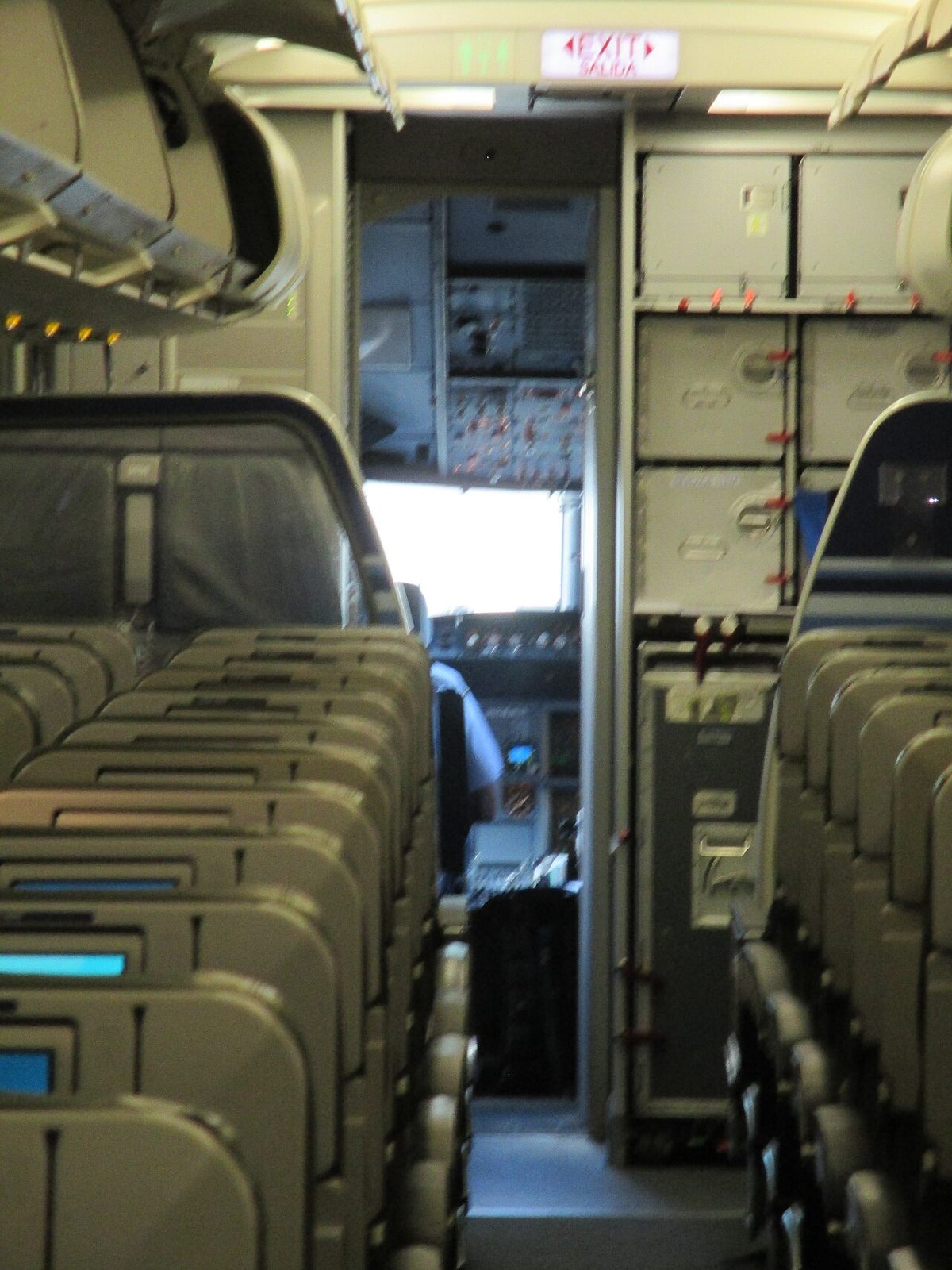
If the aircraft must leave its assigned track and cannot tell ATC, it flies, unless regional procedures say otherwise, at a level that differs from normal IFR cruising levels by 500 ft where vertical separation is 1,000 ft, or by 1,000 ft where it is 2,000 ft. Larger passenger aeroplanes have a flight deck door that can be locked and unlocked from either pilot station, with a means of monitoring the area outside, and that resists small-arms fire and grenade shrapnel. EU-OPS 1.1255 required it above 45,500 kg or 60 passenger seats; its successor, ORO.SEC.100, applies above 54,500 kg, above 45,500 kg with more than 19 passenger seats, or with more than 60 seats. The door is closed before engine start and, except for authorised access, stays closed, locked when security procedures or the commander require, until engine shutdown. Operators also carry a bomb search checklist supported by guidance on the least-risk bomb location, the place on each type where a suspect device does least harm (see flight deck security and bomb threats). After the event the commander, or the operator, reports without delay to the designated local authority and to the authority of the State of the Operator.
Isolated Aircraft Parking Position
An aerodrome designates an isolated aircraft parking position for an aircraft known or believed to be the subject of unlawful interference, or that for other reasons must be kept apart. ICAO requires it to be at least 100 m from other parking positions, buildings and public areas, and not over underground utilities such as gas, fuel, electrical or communications lines.
A State in whose territory a seized aircraft lands provides such assistance as the circumstances require, including navigation aids, air traffic services and permission to land. It detains the aircraft on the ground unless its departure is necessitated by the overriding duty to protect human life, and it takes adequate measures for the safety of passengers and crew until their journey can be continued. It informs the State of Registry and the State of the Operator by the most expeditious means, as well as States whose citizens were on board, and ICAO.
US Security Framework (TSA)
In the United States, security is the responsibility of the Transportation Security Administration (TSA), created after the attacks of September 2001, while the FAA remains responsible for safety. Airlines operate under security programmes required by 49 CFR 1544 and airports under 49 CFR 1542. A Part 121 passenger aeroplane has a hardened flight deck door under 14 CFR 121.313(j), which 121.587 requires to be closed and locked at all times while the aircraft is being operated, except to let authorised persons pass under approved procedures.
Federal air marshals fly armed on selected flights. The Federal Flight Deck Officer (FFDO) programme trains and deputises volunteer pilots, through the Federal Air Marshal Service, to carry a firearm on the flight deck. Vetted airline crew once used Known Crewmember checkpoints; between June and September 2026 the TSA replaced these with its own Crewmember Access Point (CMAP), which checks each crew member's identity biometrically. New-hire pilots undergo a fingerprint-based criminal history records check. Foreign nationals seeking flight training in the United States need TSA approval under the Alien Flight Student Program (AFSP) before their training starts.
Frequently asked questions
What is an act of unlawful interference in aviation?
ICAO Annex 17 defines acts of unlawful interference as acts or attempted acts that jeopardise the safety of civil aviation. The list includes unlawful seizure of an aircraft, destroying an aircraft in service, hostage-taking on board or at an aerodrome, forcible intrusion, bringing a weapon or dangerous device on board for criminal purposes, using an aircraft to cause death or serious damage, and communicating false information that endangers an aircraft or people.
What is the difference between the Tokyo, Hague and Montreal Conventions?
The Tokyo Convention of 1963 covers offences and acts committed on board aircraft, gives jurisdiction to the State of Registration and sets out the commander's powers. The Hague Convention of 1970 deals specifically with the unlawful seizure of aircraft, or hijacking. The Montreal Convention of 1971 covers other unlawful acts against the safety of civil aviation, such as sabotage, placing devices on aircraft, damaging air navigation facilities and communicating false information.
What transponder code does a pilot set when the aircraft is hijacked?
The pilot sets Mode A code 7500, unless the circumstances make 7700 more appropriate. If ATC asks the crew to confirm 7500 and a reply is not possible, the crew says nothing and ATC takes the silence as confirmation. A pilot who selects 7500 by mistake must say at once, in plain language, that the aircraft is not being subjected to unlawful interference.
How far must an isolated aircraft parking position be from other areas?
ICAO requires the isolated aircraft parking position, used for an aircraft known or believed to be the subject of unlawful interference, to be at least 100 m from other parking positions, buildings and public areas. It must also not be located over underground utilities such as gas and fuel lines or electrical and communications cables, so that a device on board cannot damage them.
What powers does the aircraft commander have over a disruptive passenger?
Under the Tokyo Convention the commander may take reasonable measures, including restraint, against a person who has committed or is about to commit an offence or an act jeopardising the safety or good order of the flight. The commander may also disembark such a person where the aircraft lands and deliver a suspected serious offender to the authorities. In the United States interfering with a crewmember is a federal crime.
What is a Federal Flight Deck Officer?
A Federal Flight Deck Officer (FFDO) is a volunteer US airline pilot who has been trained and deputised through the Federal Air Marshal Service, under 49 USC 44921, to carry a firearm and defend the flight deck against an act of air piracy. The programme sits within the Transportation Security Administration's layered security system, alongside screening, hardened flight deck doors and federal air marshals.
Test yourself on Aviation Security
The v1prep banks cover this topic in Air Law (010), with a worked explanation for every answer. EASA ATPL, PPL, IR and CPL, the FAA written tests and A320/B737 type ratings.
Start practising →Sources and further reading
- ICAO Annex 17, Aviation Security (ICAO Store)
- EUROCONTROL ATM Lexicon, Acts of unlawful interference (Annex 17 definition)
- ICAO, Administrative package, Protocol for the Suppression of Unlawful Acts of Violence at Airports Serving International Civil Aviation
- SKYbrary, Unlawful Interference
- SKYbrary, Unruly Passengers
- ICAO, Administrative package, Protocol to Amend the Convention on Offences and Certain Other Acts Committed on Board Aircraft (Montréal Protocol 2014)
- FAA Aeronautical Information Manual, Chapter 4 Section 1 (4-1-20, Transponder and ADS-B Out Operation)
- 14 CFR 121.580, Prohibition on interference with crewmembers
Library articles are written for study and exam preparation. They do not replace your aircraft's approved documentation, your operator's procedures or the regulations themselves.