Acceleration and G-Forces
G-force is acceleration expressed as a multiple of the acceleration due to gravity. Sustained positive g drains blood from the head, causing grey-out, blackout and G-induced loss of consciousness; negative g forces blood into the head. Impact and vibration are short, sharp or repeated forms of the same stress.
Acceleration is any change in the speed or direction of motion. In aviation physiology it is expressed as g, a multiple of the acceleration due to gravity, so a pilot sitting still on the ground experiences 1 g. In flight the load factor sets the g the occupants feel: a steady level turn at 60° of bank produces 2 g, and a hard pull-out from a dive can produce far more (see load factor). The body tolerates acceleration poorly along the head-to-foot axis, because the blood is a heavy column of fluid that the heart must lift to the brain.
Three kinds of acceleration matter. Sustained acceleration, lasting long enough for the blood to shift, is the one met in turns, pull-ups and aerobatics; it causes grey-out, blackout and loss of consciousness. Impact acceleration is brief and violent, as in a crash, and the question is structural injury. Vibration is repeated small accelerations that tire the body and degrade vision. Airline pilots rarely meet large g, but every pilot may meet it in an upset recovery or a spiral dive, when grey-out is the warning that the pull has become severe (see upset prevention and recovery).
G-force axes
Aviation medicine describes acceleration along three body axes:
| Axis | Direction | Typical cause |
|---|---|---|
| Gx | Fore and aft, chest to back | Take-off acceleration, braking, a crash deceleration |
| Gy | Lateral, side to side | Sideslip, skids, lateral impact |
| Gz | Vertical, head to foot | Turns, pull-ups, push-overs; the usual g in aviation |
Positive g (+Gz) presses the pilot down into the seat and drives the blood towards the feet, as in a pull-up or a steep turn. Negative g (−Gz) lifts the pilot out of the seat and drives the blood towards the head, as in a push-over or inverted flight. Sustained Gx is tolerated better than Gz, because it does not shift blood between the heart and the brain.
Positive and negative G
Under positive g the blood's effective weight increases, so the heart has to pump against a heavier column to reach the head. Blood pressure at eye and brain level falls, and blood pools in the legs and abdomen. The brain's supply suffers because the blood cannot reach it, not because the blood lacks oxygen; this is a stagnant hypoxia (see hypoxia).
ATPL texts give this progression for a relaxed pilot without protection, although tolerance varies widely between individuals:
| Positive g | Typical effect |
|---|---|
| 2 g | Limbs and head feel heavy |
| 2.5 g | Impossible to rise from a sitting position |
| 3–4 g | Organs displaced downwards; grey-out and tunnelling of vision |
| 4–5 g | Breathing in becomes difficult |
| Above about 5 g | G-induced loss of consciousness |
| Above about 8 g | Loss of sensation |
The FAA's Aeronautical Information Manual (AIM) describes the same sequence in aerobatics: narrowing of the visual fields, then grey-out, black-out and unconsciousness. It notes that the centrifugal effect of a steep turn has the same result as a rapid pull-up.
Negative g reverses the direction of the load. Organs are forced upwards and blood is forced into the head. This causes facial congestion and pain, a throbbing pressure in the head and eyes, a slowed heart rate and difficulty breathing. At high negative g, small blood vessels in the face and eyes may burst. Human tolerance to negative g is far lower than to positive g: about −3 g, for short periods only. A light aeroplane's negative load factor limit is also much smaller than its positive one, so sharp pushes are doubly unwelcome.
Grey-out, blackout and G-LOC
The eye gives the first warning because the retina can only be perfused while the blood pressure reaching it exceeds the pressure inside the eyeball. As positive g builds, the retina loses its supply before the brain does, and the effects arrive in order:
- Grey-out (also written greyout): vision loses colour and dims, and the field narrows from the edges inwards (tunnel vision). The cells at the edge of the retina fail first.
- Blackout: vision is lost completely, but the pilot is still conscious and can hear.
- G-induced loss of consciousness (G-LOC): the brain's oxygen supply fails and the pilot collapses.
ATPL texts place grey-out at about 3 to 4 g and G-LOC typically above about 5 g for a relaxed, unprotected pilot. Some of them use "blackout" loosely as a synonym for G-LOC. When the g is removed the effects reverse almost at once, but confusion and difficulty focusing persist for a few seconds after consciousness returns. The AIM warns that even a brief loss of consciousness can lead to control inputs that overstress the aircraft or fly it into the ground or into another aircraft.
The visual stages are a warning only if the g builds gradually. If it builds very quickly they can pass too fast to be noticed, and consciousness can be lost with little warning.
The response to grey-out is to unload: ease the back pressure until vision returns. In a spiral dive the wings are rolled level first and the aeroplane is then pulled out gently within its load limits, because pulling while banked adds g without raising the nose (see spins and spiral dives).
Exam tip: Grey-out comes before blackout, and blackout before G-LOC, because the retina fails before the brain. Grey-out at 3 to 4 g, G-LOC typically above 5 g, relaxed tolerance about +3.5 g, negative tolerance about −3 g for short periods only.
Red-out
Red-out (also written redout) is a red veil over the vision under negative g. ATPL texts attribute it to blood forced into the head and to the lower eyelid being pushed up across the eye. The AIM lists discomfort, headache, red-out and even unconsciousness as possible effects of a rapid push-over. Red-out is a sign that the negative g is already high, and at that level small blood vessels in the eyes may burst.
Factors affecting G-tolerance
G-tolerance is the level of acceleration a person can sustain before vision or consciousness fails. ATPL texts put the relaxed long-duration tolerance at about +3.5 g. It is lower in anyone affected by:
- hypoxia or hyperventilation
- hypotension, dehydration or heat
- low blood sugar, for example after a missed meal
- fatigue or stress
- alcohol or smoking
- obesity.
The AIM adds that tolerance depends on the pilot's skeletal anatomy, cardiovascular system, nervous system, the quality of the blood, general physical condition, and experience and recency of exposure. The body adapts with practice, so a manoeuvre flown regularly has a decreasing effect, and tolerance falls again after a lay-off. The AIM advises consulting an aviation medical examiner before starting aerobatic training, because poor physical condition reduces tolerance. Tolerance also depends on how the g is applied: the higher and longer the load, and the faster it builds, the sooner vision or consciousness fails. A seat that reclines the body shortens the vertical distance from heart to eyes and so raises tolerance.
Anti-G suits and straining
The anti-g straining manoeuvre (AGSM) is the pilot's own defence. It combines hard tensing of the leg and abdominal muscles with a forced breath-hold against a closed glottis, a Valsalva-type manoeuvre, repeated rhythmically every 3 to 4 seconds. The straining raises the pressure in the abdomen and chest, holds the diaphragm up and helps return blood to the heart, so more blood reaches the head. ATPL texts put the long-duration tolerance of a pilot using anti-g straining at about +7 to +8 g, against about +3.5 g relaxed. Straining is tiring to sustain, and high g is itself one of the recognised causes of hyperventilation.
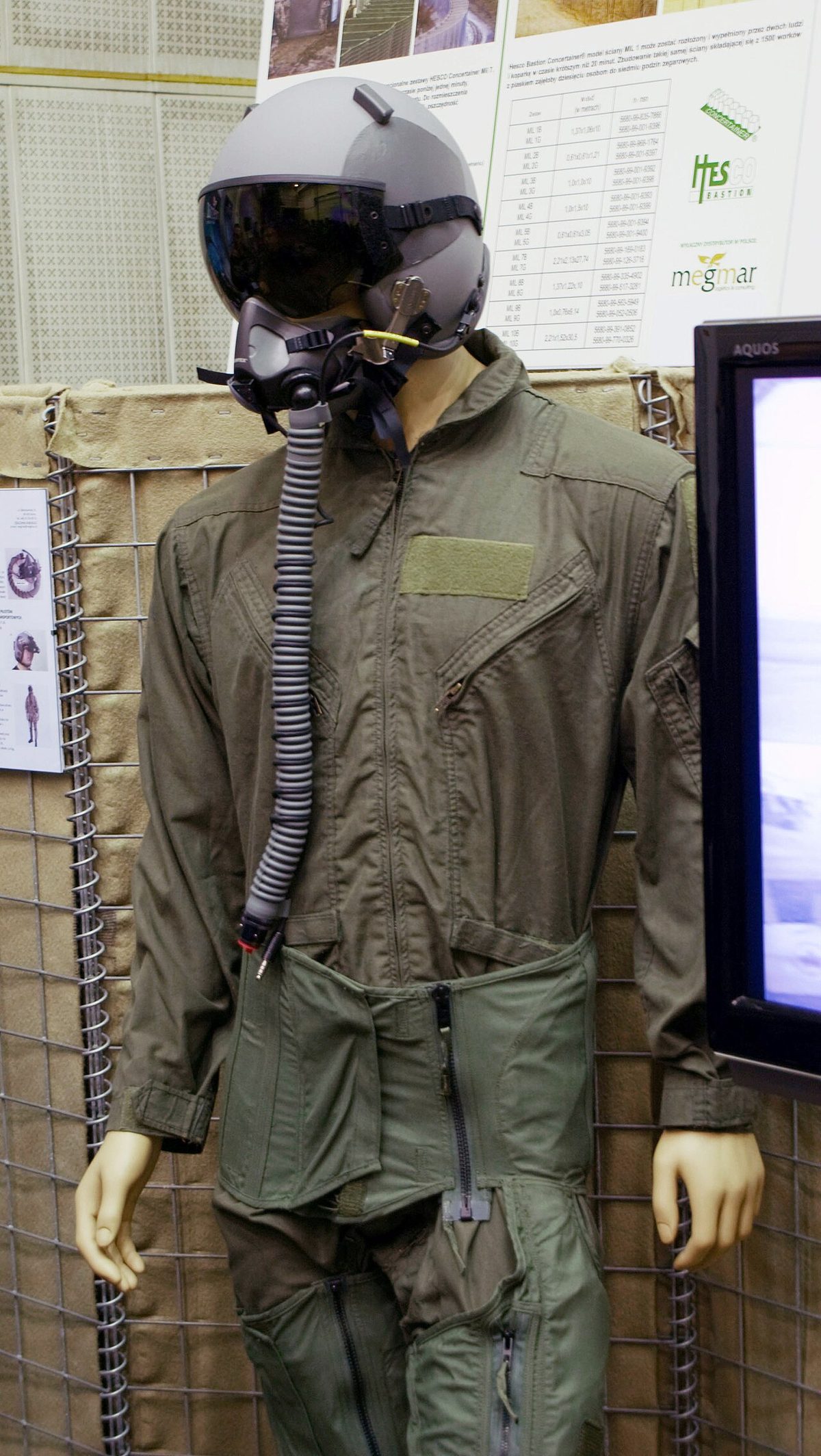
The anti-g suit is trousers with inflatable bladders over the abdomen, thighs and calves. An anti-g valve inflates them automatically as the g rises, squeezing the lower body to limit the pooling of blood. Worn together with straining, it adds a further 1.5 to 2 g. Anti-g suits are military equipment. Civil aerobatic pilots rely on straining, fitness, a good seat position and a gradual build-up of exposure.
Impact forces and submarining
In a crash, the acceleration lasts a fraction of a second and the limit is structural injury rather than blood flow. ATPL texts put the short-duration impact tolerance, before serious injury or death, at about 25 g in the vertical axis and 45 g in the fore and aft axis. Whether an occupant survives depends heavily on how the load is spread across the body and on the strength of the seat and its attachments. Certification standards, such as the emergency landing conditions of CS-25, set the loads that seats and restraints must withstand.
Submarining is the occupant sliding forward and down under the lap strap during a sudden deceleration. The strap then bears on the soft abdomen instead of the pelvis, and the body can strike structure ahead. The best protection is a five-point harness: a lap belt, two shoulder straps and a crutch or negative-g strap that holds the lap belt down on the pelvis. Cockpit seat design aims at lumbar support, vibration absorption, a good fit to the pilot's body, protection against g and the prevention of submarining.
Vibration
Whole-body vibration reaches the pilot through the seat, floor and controls from engines, propellers, rotors and turbulence. Parts of the body resonate at particular frequencies, so the effect depends strongly on the frequency. ATPL texts associate these frequency bands with these effects:
| Frequency | Main effect |
|---|---|
| 1–4 Hz | Interference with breathing |
| 4–10 Hz | Chest and abdominal pain |
| 8–12 Hz | Backache |
| 10–20 Hz | Headache, eyestrain, throat pain, speech difficulty, muscular tension, reduced visual acuity |
Vibration is also a physical stressor, grouped by the FAA with heat, noise and lack of oxygen, and it adds to fatigue over a long flight. It is among the recognised causes of hyperventilation. Seats designed to absorb vibration, and well-maintained engines and propellers, reduce the exposure. A different problem, flicker vertigo, comes from light flickering through a propeller or rotor, not from vibration (see visual illusions).
Frequently asked questions
At what g does a pilot grey out or lose consciousness?
ATPL texts give typical figures for a relaxed pilot without protection. Grey-out and tunnel vision begin at about 3 to 4 g, breathing in becomes difficult at 4 to 5 g, and G-induced loss of consciousness typically occurs above about 5 g. Relaxed tolerance is usually quoted as about 3.5 g. Individual tolerance varies widely and falls with fatigue, dehydration, hypoxia, low blood sugar, heat, alcohol and smoking.
What is G-LOC?
G-LOC is G-induced loss of consciousness. Under sustained positive g the heart cannot maintain blood pressure at head level, and the brain runs short of oxygen. Grey-out and blackout normally come first, because the retina fails before the brain, but a rapid onset of g can leave little warning. When the g is removed consciousness returns quickly, but confusion and difficulty focusing persist for a few seconds.
What is the difference between grey-out, blackout and red-out?
Grey-out is a dimming and loss of colour in the vision, starting at the edges, caused by positive g reducing blood flow to the retina. Blackout is the complete loss of vision that follows while the pilot is still conscious and can hear. Red-out is a red veil over the vision under negative g, when blood is forced into the head. Some ATPL texts use blackout loosely to mean G-LOC.
What is the anti-g straining manoeuvre?
The anti-g straining manoeuvre, or AGSM, combines hard tensing of the leg and abdominal muscles with a forced breath-hold against a closed glottis, like a Valsalva manoeuvre, repeated rhythmically every 3 to 4 seconds. It raises the pressure in the chest and abdomen and helps return blood to the heart. ATPL texts put a straining pilot's tolerance at about +7 to +8 g, against +3.5 g relaxed, and an anti-g suit adds a further 1.5 to 2 g.
What is submarining in a crash?
Submarining is the occupant sliding forward and down under the lap strap during a sudden deceleration. The strap then loads the soft abdomen instead of the strong pelvis, and the legs and body can strike structure ahead. A five-point harness, whose crutch or negative-g strap holds the lap belt down on the pelvis, is the best protection against it and spreads impact loads over the strongest parts of the body.
Test yourself on Acceleration and G-Forces
The v1prep banks cover this topic in Human Performance and Limitations (040), with a worked explanation for every answer. EASA ATPL, PPL, IR and CPL, the FAA written tests and A320/B737 type ratings.
Start practising →Sources and further reading
- FAA Aeronautical Information Manual, Chapter 8 Section 1 (8-1-7 Aerobatic Flight)
- FAA Pilot's Handbook of Aeronautical Knowledge (FAA-H-8083-25), Chapter 17, Aeromedical Factors
- FAA Pilot Safety Brochure, Acceleration in Aviation: G-Force
- FAA Airplane Flying Handbook (FAA-H-8083-3C)
- EASA Easy Access Rules for Large Aeroplanes (CS-25), Subpart C, Emergency landing conditions
Library articles are written for study and exam preparation. They do not replace your aircraft's approved documentation, your operator's procedures or the regulations themselves.