Time, Sunrise and Twilight
Time in air navigation is measured from the Earth's rotation: 360° of longitude pass the Sun in 24 hours, so longitude and time are interchangeable. Aviation works in Coordinated Universal Time (UTC), and sunrise, sunset and civil twilight fix the legal boundaries of night.
Time and longitude are two ways of expressing the same thing. The Earth turns through 360° relative to the Sun in 24 hours, so every meridian has its own local time, and the difference between the times of two places is simply their difference in longitude converted at 15° to the hour. Navigators have used this since long before radio: a position could be fixed only as accurately as the time was known.
For today's pilot, time matters in three ways. All aviation messages, flight plans and clearances use Coordinated Universal Time (UTC), so local times must be converted before any planning starts. Sunrise and sunset tables entered by latitude give local mean time and need an arc-to-time correction. And the legal boundary between day and night, which decides whether a day-only pilot or aeroplane may fly, is set by civil twilight rather than by sunset. The subject forms the time section of EASA 061 General Navigation, and the FAA knowledge tests ask the same conversions together with the FAA's own night definitions.
- Solar and sidereal days
- Apparent time, mean time and the equation of time
- Arc-to-time conversion and local mean time
- UTC, standard time and daylight saving
- The International Date Line
- Sunrise, sunset and the three twilights
- Polar day and polar night
- The Air Almanac and celestial navigation
- Frequently asked questions
Solar and sidereal days
A day can be measured against two references. A sidereal day is one rotation of the Earth relative to the distant stars and lasts about 23 h 56 min 04 s. A solar day is the interval between two successive passages of the Sun across the same meridian. During one rotation the Earth also travels roughly a degree along its orbit, so it must turn a little more than 360° before the Sun is back on the meridian. The sidereal day versus mean solar day difference is therefore about four minutes, the solar day being the longer.
The distinction reaches the flight deck through inertial navigation. The gyros of an inertial reference system must be corrected for the Earth's rotation in space, the sidereal rate of about 15.04° per hour, slightly faster than the 15° per hour of the solar clock.
Apparent time, mean time and the equation of time
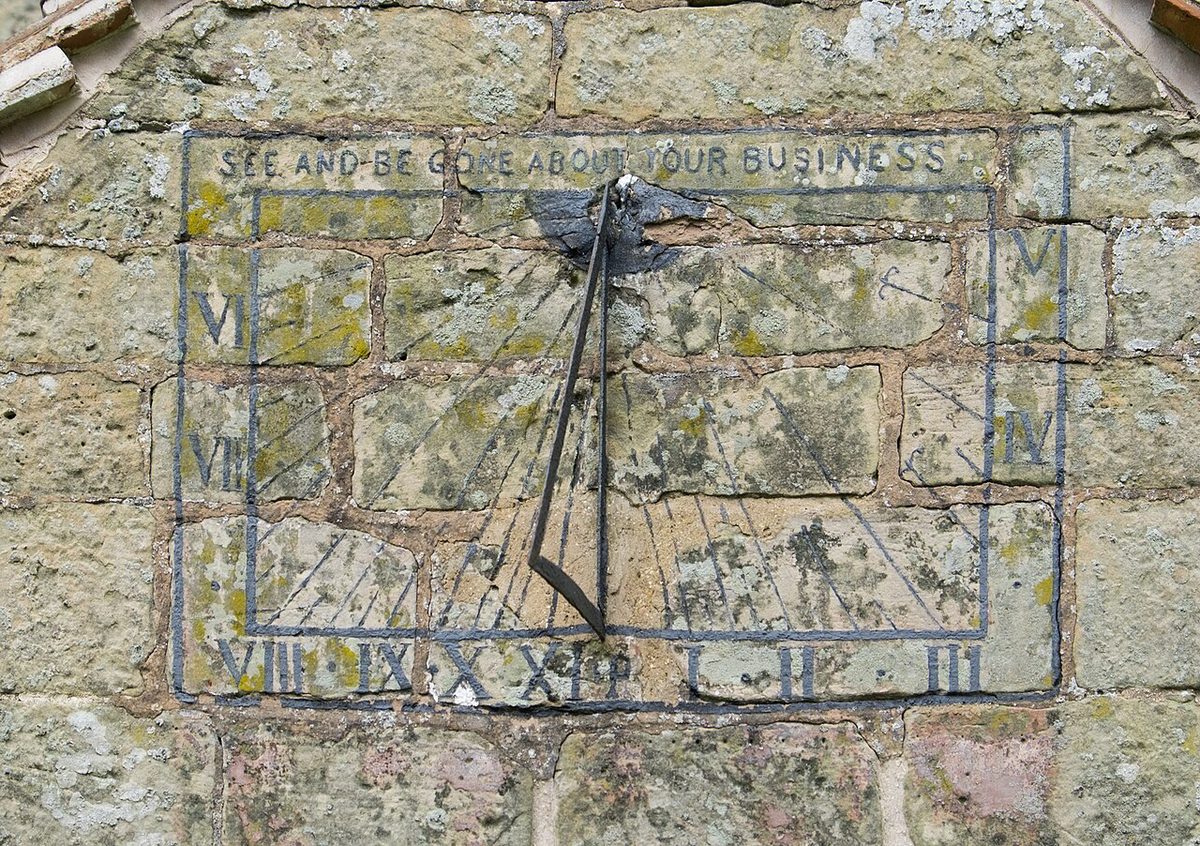
Apparent solar time is time kept by the real Sun: apparent noon is the moment the Sun crosses the local meridian, and a sundial reads apparent time. The real Sun is a poor clock. The Earth's orbit is an ellipse, so the Earth moves faster when nearer the Sun, and the Earth's axis is tilted about 23½° to the plane of its orbit, so the Sun's apparent path is inclined to the equator. Apparent solar days are therefore of unequal length through the year.
Mean solar time replaces the real Sun with a fictitious mean Sun that moves at a uniform rate along the celestial equator. Every mean solar day lasts exactly 24 hours, and clocks keep mean time. The difference between apparent and mean time is the equation of time. It follows a smooth annual cycle, reaching about 16 minutes in November and about 14 minutes, in the opposite sense, in February.
The tilt of the axis also produces the Sun's declination, its angular distance north or south of the celestial equator. Declination is about 23½°N at the June solstice, about 23½°S at the December solstice and zero at the equinoxes in late March and late September. For a given date, the declination and the observer's latitude decide how long the Sun is above the horizon.
Arc-to-time conversion and local mean time
Local mean time (LMT) is the mean time of the observer's own meridian. Because the mean Sun crosses 15° of longitude every hour, the arc-to-time conversion is fixed:
| Arc (longitude) | Time |
|---|---|
| 360° | 24 hours |
| 15° | 1 hour |
| 1° | 4 minutes |
| 15′ | 1 minute |
| 1′ | 4 seconds |
At any instant, places east of Greenwich have a later LMT than UTC and places to the west an earlier one, because the Sun reaches them first or last. The rule is longitude east, UTC least; longitude west, UTC best.
- At 0800 UTC, overhead 123°E: 123° is 8 h 12 min, added because the longitude is east, giving 1612 LMT.
- Sunset tabulated as 2005 LMT at an aerodrome on 010°W: 10° is 40 minutes, and UTC is the later time in the west, so sunset is at 2045 UTC.
- Between aerodromes on 017°W and 026°E the change of longitude is 43°, or 2 h 52 min. When LMT at the western one is 1140, it is 1432 at the eastern one.
Exam tip: an aeroplane leaving 030°E at 1400 LMT and flying four hours to 030°W arrives at 1400 LMT. The 60° of westward travel is exactly four hours of time, which cancels the elapsed time. Convert to UTC first and such questions cannot catch you out.
UTC, standard time and daylight saving
Coordinated Universal Time (UTC) is the international time reference. For everyday purposes it equals mean time at the Greenwich meridian, and it replaced Greenwich Mean Time (GMT) in aviation usage; the suffix Z, spoken Zulu, marks a UTC time. ICAO requires times to be given in UTC in hours and minutes of the 24-hour day beginning at midnight, and air traffic services give time checks to the nearest half minute.
LMT changes continuously with longitude, so no country keeps it. Standard time (zone time) is the legal civil time of a region, normally a whole number of hours from UTC, each hour corresponding nominally to a band of 15° of longitude, with boundaries bent to follow national borders. Some States use half or quarter hours: India keeps UTC+5:30, Nepal UTC+5:45 and Newfoundland UTC−3:30. Daylight saving time (DST), called summer time in Europe, advances clocks by one hour in summer, so a State on UTC+1 keeps UTC+2 in summer. In the United States, Pacific Standard Time is UTC−8 and Pacific Daylight Time UTC−7; Eastern Standard Time is UTC−5 and Eastern Daylight Time UTC−4.
Conversions are safest in a fixed order: local to UTC, add the elapsed time, then UTC to local. A departure at 0930 local from an aerodrome keeping UTC+3, with 4 h 20 min to a destination keeping UTC−1, leaves at 0630 UTC, arrives at 1050 UTC and lands at 0950 local time. Adding the flight time to the departure local time would give 1350, four hours wrong.
The International Date Line
Counted eastwards from Greenwich, 180°E is 12 hours ahead of UTC; counted westwards, 180°W is 12 hours behind it. They are the same meridian, so the two sides of it differ by a whole day. The International Date Line (IDL) is where the date changes. It follows the 180° meridian in open ocean but deviates around island groups and countries, such as Kiribati, Fiji and eastern Russia, so that each keeps a single date.
- Crossing westbound, for example from Hawaii towards Japan, the date is advanced one day.
- Crossing eastbound, from 179°E to 179°W, the date is put back one day: an aeroplane crossing eastbound on 10 March enters 9 March.
The UTC date is unaffected by the crossing. Convert both ends to UTC and the date line cannot cause an error.
Sunrise, sunset and the three twilights
Sunrise and sunset are the moments the upper edge of the Sun's disc appears on, or disappears below, the horizon. Because the sky remains lit after sunset, the evening is divided by the Sun's depression below the horizon:
| Twilight | Ends in the evening when the centre of the Sun is | Practical meaning |
|---|---|---|
| Civil twilight | 6° below the horizon | Outdoor work still possible without artificial light; defines night |
| Nautical twilight | 12° below the horizon | Much darker; no operational use for pilots |
| Astronomical twilight | 18° below the horizon | Sky fully dark |
Morning twilight is the same sequence in reverse. Twilight lasts longest where the Sun's daily path meets the horizon at a shallow angle. Near the equator the Sun sinks almost vertically and twilight is brief; at 60°N in June it slides down at a low angle, evening civil twilight is much longer, and summer nights practically disappear.

For a given date, the LMT of sunrise, sunset and twilight depends only on latitude, because every meridian sees the same event at the same local mean time. Tables are therefore entered with date and latitude, and the pilot applies the arc-to-time correction for longitude to obtain UTC. AIPs publish sunrise, sunset and twilight times for named aerodromes, normally in UTC, in GEN 2.7.
The definitions of night that follow from these events differ between rule books:
| Rule | Boundary used |
|---|---|
| SERA (EU) definition of night | End of evening civil twilight to beginning of morning civil twilight |
| 14 CFR 1.1 night, used for logging night time | End of evening civil twilight to beginning of morning civil twilight, as published in the Air Almanac and converted to local time |
| 14 CFR 91.209 position lights | Sunset to sunrise |
| 14 CFR 61.57(b) night currency to carry passengers | Three take-offs and three full-stop landings within the preceding 90 days, between one hour after sunset and one hour before sunrise |
A day-only flight is planned backwards from the end of civil twilight at the destination. If civil twilight ends at 1942 UTC, the flight takes 1 h 20 min and the pilot wants 15 minutes in hand, the latest landing is 1927 UTC and the latest take-off 1807 UTC.
Polar day and polar night
Day length varies with latitude and season because of the tilt of the axis, and the variation grows towards the poles. Poleward of the polar circles, at about 66½° (90° less the axial tilt), the Sun stays above the horizon for 24 hours or more around the summer solstice, the midnight Sun or polar day, and stays below it around the winter solstice, the polar night. Just inside the circle the winter Sun is only a little below the horizon at midday, so a spell of twilight can still occur around noon.
Because night is defined by civil twilight, high-latitude aerodromes may see no legal night for weeks in summer and only a few hours of legal day in winter. That limits flights planned by day only, and it matters to crews whose body clocks lose the usual cues of light and dark (see sleep and circadian rhythms).
The Air Almanac and celestial navigation
The Air Almanac is the standard table of astronomical data for air navigation. It gives the positions of the Sun, Moon, planets and selected navigation stars against UTC, together with sunrise, sunset and twilight tables for a range of latitudes. The FAA's definition of night refers to it directly.
Celestial navigation uses those tables to fix position. The navigator measures the altitude of a heavenly body above the horizon, in aircraft with a bubble sextant, and compares it with the altitude computed for an assumed position at the time of the sight. The result is a position line; sights on two or three bodies give a fix. Before inertial systems and GNSS it was the main means of fixing position on long oceanic flights, and it shows why time mattered so much: an error of 4 seconds of time is an error of 1′ of longitude, one nautical mile on the equator.
Note: the time problems in exams nearly all reduce to the same two steps. Convert longitude to time at 4 minutes per degree, then decide the sign from whether the place is east or west of Greenwich. Doing all the arithmetic in UTC removes date line and time zone errors.
Frequently asked questions
What is the difference between UTC and local mean time?
UTC is the single worldwide time reference used for flight plans, NOTAM, weather messages and clearances; in everyday use it equals the mean time at the Greenwich meridian. Local mean time is the mean solar time of the observer's own meridian. It runs ahead of UTC east of Greenwich and behind it to the west, by 4 minutes for every degree of longitude.
How do you convert longitude into time?
The Earth turns 360° in 24 hours, so 15° of longitude equals one hour, 1° equals 4 minutes and 1 minute of arc equals 4 seconds. To find local mean time, convert the longitude to time and add it to UTC if the longitude is east, or subtract it if west. The memory aid is longitude east, UTC least; longitude west, UTC best.
What is civil twilight?
Civil twilight is the period between sunset and the moment the centre of the Sun's disc is 6° below the horizon in the evening, and the matching period before sunrise in the morning. Outdoor work is still possible without artificial light. Nautical twilight continues to 12° and astronomical twilight to 18°, when the sky is fully dark. Only civil twilight matters to pilots, because it defines night.
When does night begin for flying?
Under the EU rules of the air (SERA) and 14 CFR 1.1 in the United States, night is the time between the end of evening civil twilight and the beginning of morning civil twilight. The FAA uses other boundaries for particular rules. Position lights are required from sunset to sunrise, and night landings for passenger currency must fall between one hour after sunset and one hour before sunrise.
What happens to the date when you cross the International Date Line?
Crossing the date line westbound, for example from Hawaii towards Japan, the local date is advanced by one day. Crossing eastbound, from 179°E to 179°W, the date is put back one day, so the same date is lived twice. The line follows the 180° meridian but bends to keep island groups and countries on a single date. Working every time problem in UTC avoids mistakes.
Why is a sidereal day shorter than a solar day?
A sidereal day is one rotation of the Earth relative to the distant stars and lasts about 23 h 56 min 04 s. During that rotation the Earth also moves about a degree along its orbit, so it must turn a little more than 360° before the Sun is back on the same meridian. The mean solar day of 24 hours is therefore about four minutes longer.
Test yourself on Time, Sunrise and Twilight
The v1prep banks cover this topic in General and Radio Navigation (061/062), with a worked explanation for every answer. EASA ATPL, PPL, IR and CPL, the FAA written tests and A320/B737 type ratings.
Start practising →Sources and further reading
- Commission Implementing Regulation (EU) No 923/2012, Standardised European Rules of the Air (SERA), Article 2 definitions
- ICAO Annex 2, Rules of the Air (time and time checks in UTC)
- 14 CFR 1.1, General definitions (night)
- 14 CFR 61.57, Recent flight experience, pilot in command
- 14 CFR 91.209, Aircraft lights
- EASA, Explanatory Note to ED Decision 2018/001/R, Part-FCL theoretical knowledge learning objectives (061 General Navigation)
Library articles are written for study and exam preparation. They do not replace your aircraft's approved documentation, your operator's procedures or the regulations themselves.