Flight Time Logging and Recent Experience
Flight time logging is the pilot's record of every flight, sorted by role and conditions, which proves the experience a licence or rating requires. Recent experience rules, such as three take-offs and landings in 90 days before carrying passengers, decide whether a licensed pilot may use those privileges today.
Every licence, rating and airline job is granted on proof of experience, and the proof is the pilot's logbook. Flight time logging is the discipline of recording each flight in a way that shows not only how long the pilot flew but in what role and in what conditions: as pilot in command or co-pilot, solo or dual, by day or night, visually or on instruments, locally or cross-country. The categories are defined by regulation, and they are not the same in Europe and the United States.
A licence proves that the pilot was once competent. Recent experience rules deal with the present: they require a minimum of recent practice before the pilot may carry passengers, fly at night or fly under instrument flight rules. They sit alongside the validity of ratings and medical certificates, each with its own clock (see class and type ratings).
Aeronautical experience
Aeronautical experience is the FAA's term for the pilot time a certificate or rating requires, such as the 40 hours of a private certificate or the 1,500 of an ATP; Part-FCL speaks of flight experience. Both count flight time, but define it slightly differently. ICAO Annex 6 and Part-FCL count an aeroplane's flight time from the moment it first moves for the purpose of taking off until it finally comes to rest at the end of the flight, so a push-back counts. The FAA definition in 14 CFR 1.1 starts when the aircraft moves under its own power for the purpose of flight and ends when it comes to rest after landing. Airlines call either version block time.
Night time has its own boundaries. For logging, 14 CFR 1.1 and the EU rules of the air (SERA) define night as the period between the end of evening civil twilight and the beginning of morning civil twilight (see time, sunrise and twilight). The FAA uses other limits for particular rules, as the night currency rule below shows.
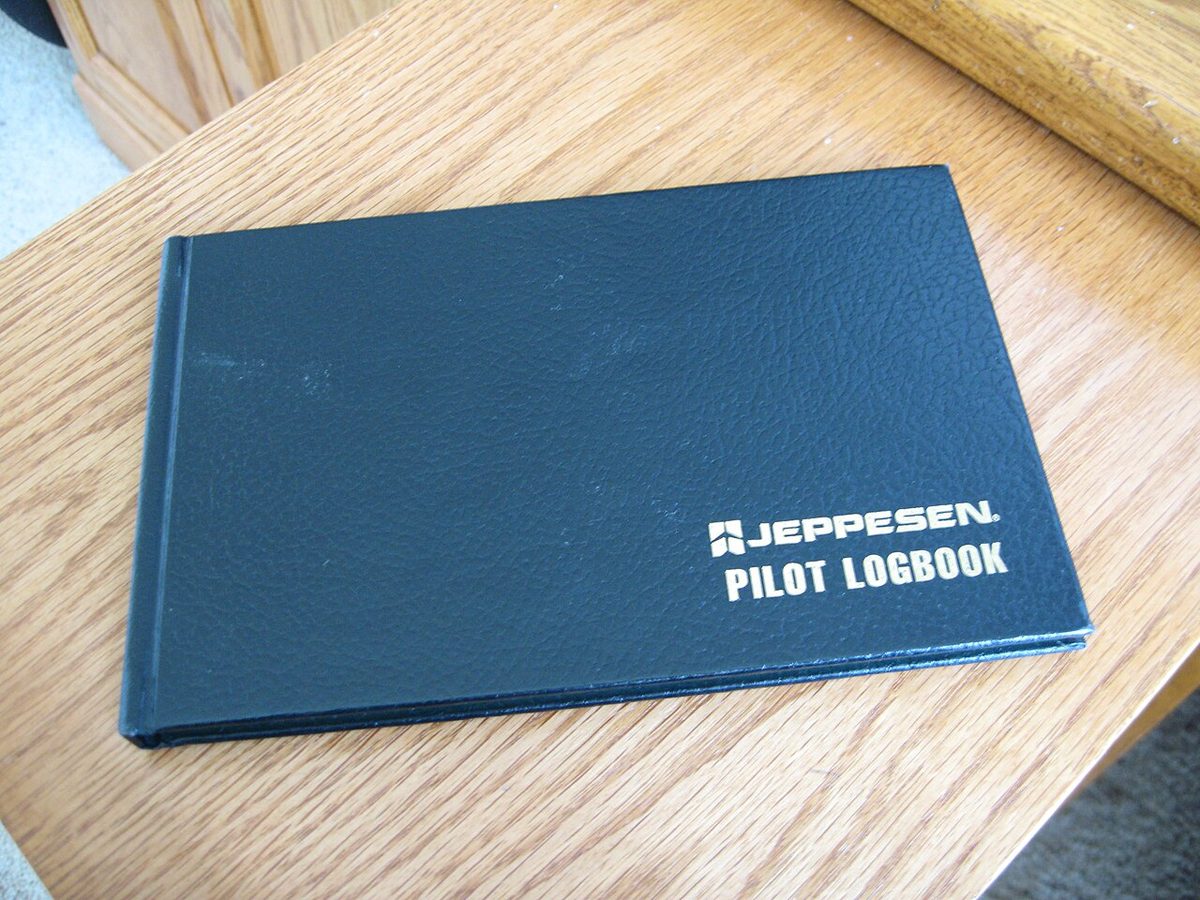
Pilot logbooks
Under Part-FCL every pilot keeps a reliable record of the details of all flights flown, in a form and manner set by the competent authority, and must present that flight time record without undue delay when an authorised representative of the competent authority asks. The logbook is not among the documents carried in flight: those are the licence, the medical certificate and a photographic identity document. It should not be confused with the aircraft's journey log, which belongs to the aircraft.
The FAA rule, 14 CFR 61.51, is narrower. A pilot must log only the training and aeronautical experience used to meet the requirements for a certificate, rating or flight review, and the experience used to show recent flight experience. Each required entry includes the date, the total flight time, the departure and arrival points, the aircraft type and identification, and the kind of pilot experience or training. Most pilots log everything anyway, because employers compare the totals on an application with the logbook and look for missing endorsements, arithmetic errors or time that looks padded. A fraudulent or intentionally false logbook entry is grounds for suspension or revocation of every certificate the pilot holds (see FAA regulations and enforcement).
Logging PIC and PICUS time
Logging pilot in command time and acting as pilot in command are different questions. Acting as pilot in command means carrying the final authority and responsibility for the flight (see pilot in command and flight crew composition). Logging PIC time is a matter of the logging rules, which under 14 CFR 61.51(e) allow a pilot to log PIC time chiefly in three cases:
- as sole manipulator of the controls of an aircraft for which the pilot is rated (category, class and type if a type rating is required);
- as the sole occupant of the aircraft;
- when acting as pilot in command of an aircraft on which more than one pilot is required by its type certificate or by the regulations under which the flight is conducted.
Two pilots may therefore log PIC time on the same flight: a private pilot flying under a view-limiting device logs it as sole manipulator, and a safety pilot who acts as pilot in command logs it as well. For the FAA ATP, the 250 hours of PIC time may be PIC time or time as second in command performing the duties of the pilot in command under supervision, in any combination.
Part-FCL takes a different approach. The pilot in command logs PIC time, the co-pilot logs co-pilot time, and between them sits pilot in command under supervision (PICUS): flight time in which a co-pilot performs the duties and functions of the pilot in command under the supervision of the pilot in command. PICUS is how an airline first officer builds command experience before a command course, and Part-FCL credits it: the ATPL(A) requires 500 hours as PICUS or 250 hours as PIC, the 250 hours possibly made up of at least 70 hours as PIC and the rest as PICUS, and 200 hours of cross-country flight time of which 100 as PIC or PICUS. A student acting as pilot in command with an observing instructor logs student pilot-in-command (SPIC) time.
Solo and sole manipulator time
Solo flight time is flight time during which a student pilot is the sole occupant of the aircraft. It is counted separately from dual instruction; the EASA PPL(A), for example, requires at least 10 hours of supervised solo time, including 5 hours of solo cross-country flight.
Sole manipulator of the controls is the FAA phrase for the pilot actually flying. It matters beyond logging: the FAA recent experience rules count only take-offs and landings made as sole manipulator of the controls, which is why a pilot in the right seat watching someone else land does not become current.
Cross-country time
Cross-country time is time on a flight from a point of departure to a point of arrival along a pre-planned route, using standard navigation procedures. Part-FCL defines it in essentially those terms. The FAA definition in 14 CFR 61.1 is stricter: the flight must include a landing at a point other than the point of departure, and for most certificates and ratings that landing point must also lie more than a set straight-line distance from the original point of departure. Under the FAA definition a flight that lands only where it started is not cross-country, however long it lasts.
On top of the general definition, each licence names a qualifying cross-country flight:
| Licence or rating | Qualifying cross-country |
|---|---|
| EASA PPL(A) | One solo flight of at least 270 km (150 NM), with full-stop landings at two aerodromes other than the departure aerodrome |
| FAA commercial (single-engine) | A cross-country of at least 300 NM with landings at three points, one at least 250 NM from the start, plus a day and a night training cross-country of at least 100 NM straight-line |
| FAA instrument rating | An IFR cross-country with an instructor of at least 250 NM, with an instrument approach at each airport and three different kinds of approach |
| EASA IR(A) | 50 hours of cross-country flight as pilot in command before the rating, at least 10 in aeroplanes |
| ATPL(A) / FAA ATP | 200 hours (100 as PIC or PICUS) / 500 hours (200 on the military and degree routes to a restricted ATP) |
Instrument time and safety pilots
Instrument time is time in which the pilot controls the aircraft solely by reference to instruments. Under 61.51(g) an FAA pilot logs it only for the time actually flown that way, in actual conditions or in simulated conditions under a view-limiting device, and an entry used for a rating or for recency must show the location and type of each instrument approach and, when one was required, the name of the safety pilot. Part-FCL also counts instrument ground time in flight simulation training devices; of the 75 hours of instrument time the ATPL(A) requires, no more than 30 may be instrument ground time.
A safety pilot is required whenever an aircraft is flown in simulated instrument flight. Under 14 CFR 91.109(c) the safety pilot must hold at least a private pilot certificate with category and class ratings appropriate to the aircraft, the other control seat must be occupied by that pilot, and the aircraft must have fully functioning dual controls. The safety pilot is a required crew member and therefore needs medical qualification, but no instrument rating.
Recent experience requirements
Under Part-FCL (FCL.060) a pilot may not operate an aircraft in commercial air transport or carrying passengers, as pilot in command or co-pilot, without at least three take-offs, approaches and landings in the preceding 90 days in an aircraft of the same type or class, or in a full flight simulator representing it. The rule restricts only flights with passengers or in commercial air transport, so a private pilot who has lapsed can regain recency by flying the three circuits alone. Airline operators add their own recurrent training and checks, such as the operator proficiency check (see airline pilot training and checking).
The FAA rule, 14 CFR 61.57(a), is similar: three take-offs and three landings in the preceding 90 days as sole manipulator of the controls in an aircraft of the same category, class and, if required, type, before carrying passengers. In a tailwheel aeroplane the landings must be to a full stop; in other aeroplanes touch-and-go landings count by day. Part 121 pilots meet the separate rule of 121.439: three take-offs and landings in the type in the preceding 90 days, usually through line flying or in an approved simulator.
Exam tip: recency is rolling. The three landings must all fall inside the preceding 90 days, so a pilot who made three landings on the same day becomes non-current 90 days later, and the oldest landing always sets the date.
Night currency
To act as pilot in command at night in commercial air transport or with passengers, FCL.060 requires at least one take-off, approach and landing at night as pilot flying in the preceding 90 days, in the same type or class or a full flight simulator, unless the pilot holds a valid instrument rating. The night landing counts towards the three; it is not a fourth. This recency is separate from the night rating that an EASA LAPL or PPL holder needs to fly at night at all.
The FAA's night currency rule, 61.57(b), is stricter: three take-offs and three landings to a full stop in the preceding 90 days, as sole manipulator of the controls, in the same category, class and type if required, during the period from 1 hour after sunset to 1 hour before sunrise. Night currency also satisfies the day requirement. The FAA thus uses three definitions of night for three purposes: civil twilight for logging night time, sunset to sunrise for position lights, and the one-hour margins for night currency.
The three-month rule
The three-month rule is the informal name for the revalidation window of European ratings. A class rating or an instrument rating revalidated by a proficiency check within the 3 months immediately before its expiry date keeps its original anniversary: the new period runs from the old expiry date, not from the date of the check. An instrument rating check flown earlier still revalidates the rating, but the new year then starts from the date of the check and the unexpired validity is lost. The rule is unrelated to the 90-day passenger recency, which is counted in days and has no fixed anniversary.

Flight review and WINGS
An FAA pilot certificate has no expiry date, so the FAA uses the flight review of 14 CFR 61.56 to make sure every pilot flies with an instructor periodically. No pilot may act as pilot in command unless, within the preceding 24 calendar months, a flight review has been completed and endorsed: at least 1 hour of ground training and 1 hour of flight training with an authorised instructor. The counting runs in calendar months, so a review completed on 14 August 2024 is valid until 31 August 2026. A practical test for a certificate, rating or operating privilege, or a pilot proficiency check, within the preceding 24 calendar months replaces it.
The FAA's WINGS pilot proficiency programme offers another way: a pilot who completes a phase of the programme within the same 24 calendar months need not accomplish a flight review. The European counterpart is built into the single-engine piston class rating: a pilot who revalidates it by experience must fly a training flight of at least 1 hour with an instructor in the 12 months before expiry.
Frequently asked questions
What flight time must a pilot log?
Under Part-FCL a pilot keeps a reliable record of all flights flown, in the form the competent authority sets, and presents it on request. Under 14 CFR 61.51 an FAA pilot must log only the training and experience used for a certificate, rating or flight review and to show recent experience, although most log everything. Each entry records the date, total time, departure and arrival points, aircraft type and registration, and the kind of experience or training.
Can a safety pilot log PIC time?
Under FAA rules, yes, if the safety pilot is acting as pilot in command. Flight in simulated instrument conditions makes the safety pilot a required crew member, so the pilot flying under the view-limiting device logs PIC as sole manipulator of the controls, while the safety pilot who has agreed to act as pilot in command also logs PIC. The safety pilot needs at least a private certificate with the category and class ratings, and must be medically qualified.
What is PICUS time?
Pilot in command under supervision is flight time in which a co-pilot performs the duties and functions of the pilot in command under the supervision of the pilot in command. Part-FCL credits it towards command experience. The ATPL(A) accepts 500 hours as PICUS in place of 250 hours as pilot in command, or a mix of at least 70 hours as pilot in command topped up with PICUS, and PICUS counts towards the 100 hours of cross-country flight that must be flown as pilot in command or PICUS.
What are the night currency requirements for carrying passengers?
Under EASA's FCL.060 a pilot in command at night must have made at least one take-off, approach and landing at night as pilot flying in the preceding 90 days, within the three required for any passenger flight, unless holding a valid instrument rating. Under 14 CFR 61.57(b) an FAA pilot needs three take-offs and three full-stop landings in the preceding 90 days, made between 1 hour after sunset and 1 hour before sunrise.
How often does an FAA pilot need a flight review?
A flight review is needed within the preceding 24 calendar months, so one flown on any day of a month is valid to the end of the same month two years later. It consists of at least 1 hour of ground training and 1 hour of flight training with an authorised instructor. A practical test for a new certificate or rating, a proficiency check, or a completed phase of the FAA WINGS programme within that period replaces it.
Test yourself on Flight Time Logging and Recent Experience
The v1prep banks cover this topic in Air Law (010), with a worked explanation for every answer. EASA ATPL, PPL, IR and CPL, the FAA written tests and A320/B737 type ratings.
Start practising →Sources and further reading
- EASA Easy Access Rules for Aircrew (Regulation (EU) No 1178/2011), FCL.010, FCL.050 and FCL.060
- EASA Easy Access Rules for Air Operations (ORO.FC, flight crew requirements)
- 14 CFR 61.51, Pilot logbooks
- 14 CFR 61.56, Flight review
- 14 CFR 61.57, Recent flight experience, pilot in command
- 14 CFR 91.109, Flight instruction; simulated instrument flight and certain flight tests
- 14 CFR 1.1, General definitions
Library articles are written for study and exam preparation. They do not replace your aircraft's approved documentation, your operator's procedures or the regulations themselves.