Aviation Fuel Grades and Properties
Aviation fuels are specified grades of gasoline for piston engines (avgas) and of kerosene or wide-cut distillate for turbine engines. Each grade is defined by a specification that fixes properties such as anti-knock rating, density, flash point, freezing point and volatility.
Aviation fuel comes in two families. Piston engines burn aviation gasoline, or avgas, a volatile spark-ignition fuel whose most important property is its resistance to detonation. Turbine engines burn kerosene-type fuels such as Jet A-1, or occasionally wide-cut fuels that blend gasoline and kerosene fractions. The families are not interchangeable: jet fuel in a piston engine destroys it through detonation, and avgas does not appear on the approved fuel list of an airliner such as the A320.
Each grade is made to a specification that holds its properties within set limits. A handful of them matter to pilots: the anti-knock rating of avgas, the specific gravity that turns volume into mass, the flash point that governs the fire risk on the ground, the freezing point that limits how cold the fuel may become in flight, and the volatility that decides whether it boils in the lines. Additives and water are covered in fuel additives and contamination.
Aviation gasoline grades
Aviation gasoline (avgas) is gasoline refined and blended for aircraft spark-ignition engines. It is dyed so that the grade can be recognised in a drained fuel sample:
| Grade | Colour | Performance rating | Notes |
|---|---|---|---|
| Avgas 100LL | Blue | 100/130 | Low lead; the most common grade today |
| Avgas 100 | Green | 100/130 | Same rating as 100LL, higher lead content |
| Avgas 115 | Purple | 115/145 | High-power engines with high compression ratios |
| Avgas 80 | Red | Former grade, no longer in general use |
Avgas 100LL, where LL stands for low lead, performs exactly like grade 100 against detonation but carries less tetraethyl lead, the additive that provides much of that performance. The lead that remains still leaves deposits: a long idle with the mixture fully rich fouls the spark plugs with lead and carbon, which shows as an excessive drop at the magneto check. All grades have a specific gravity (SG) of about 0.72 at 15 °C, and the FAA uses a standard weight of 6 lb per US gallon for weight and balance (see fuel mass and fuel loading).
The rule for substitution is simple. A higher grade may be used where the flight manual permits it; a lower grade than the one placarded, never.
Octane rating and performance number
The octane rating measures a fuel's resistance to detonation, the explosive self-ignition of the unburnt charge after normal ignition (see mixture control and abnormal combustion). It is found by comparing the fuel in a test engine with a reference blend of iso-octane, which resists knock well, and normal heptane, which knocks readily. A fuel that behaves like a blend of 80 % iso-octane and 20 % heptane is rated 80 octane. Fuels better than pure iso-octane are rated by performance number, which compares the power the engine can develop without knock on the fuel with the power it develops on iso-octane.
Avgas grades once carried two figures, as in 100/130. The first is the rating with a lean, or weak, mixture, as used in the cruise; the second is the rating with a rich mixture, as at take-off power, where the surplus fuel cools the charge and suppresses detonation. Current grade names keep only the first figure: 100LL is a 100/130 fuel.
A higher compression ratio raises thermal efficiency but also the working pressures, and it needs a fuel with a higher rating. An engine given a lower-rated fuel than it was designed for detonates at high power, particularly on a hot day, and can be destroyed within minutes. Jet fuel has almost no resistance to detonation: a piston engine will usually start and run on it at low power, then detonate and fail when take-off power is applied (see refuelling safety and fuel emergencies). The gas turbine does not need an anti-knock fuel, because its combustion takes place at substantially constant pressure, without the pressure peaks of the piston engine.
Jet A and Jet A-1
Jet A-1 is the kerosene-type turbine fuel of civil aviation throughout most of the world, also known by its British name AVTUR (aviation turbine fuel). Its nominal SG is about 0.8 at 15 °C, typically 0.79 to 0.82, its flash point 38 °C and its specification freezing point −47 °C. Jet A is essentially the same fuel with a higher freezing point, −40 °C, and is generally available only in the United States. The difference matters on long, cold flights: the A320's limitations set a minimum fuel temperature of −43 °C for Jet A-1 but −36 °C for Jet A.
Turbine fuels are not dyed. Their natural colour ranges from straw yellow to completely colourless, and they have a characteristic smell of paraffin and an oily feel. Kerosene is also a poor lubricant, so the fuel pumps and fuel control units it passes through rely on additives to limit wear. For weight and balance, the FAA's figure for jet fuel is about 6.7 lb per US gallon, heavier than avgas, and applying it to avgas is a classic error.
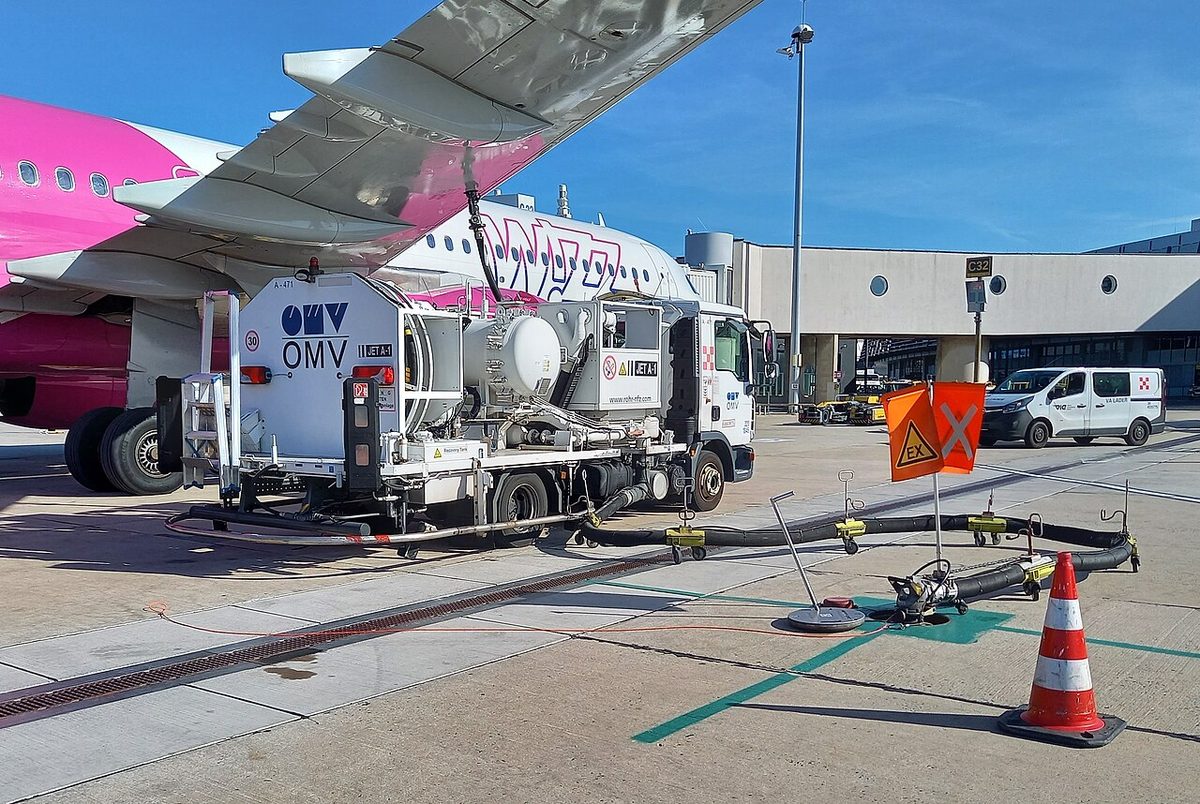
Wide-cut and military fuels
Jet B, known in British use as AVTAG (aviation turbine gasoline), is a wide-cut fuel: a blend of gasoline and kerosene fractions with a wider boiling range than Jet A-1. Its SG is about 0.77 and its freezing point −50 °C, which suits very cold operations, but its flash point can be as low as −20 °C and its range of flammability is wider. It ignites far more easily at ground temperatures, so it is rarely used in civil aviation and is found mainly in some military and arctic operations.
The military grades carry JP (jet propellant) numbers, and several appear on civil approved fuel lists:
| Fuel | Type | Where used | Notes |
|---|---|---|---|
| JP-4 | Wide-cut | Military | Treated with Jet B in A320 limitations |
| JP-8 | Kerosene | Military | Treated with Jet A-1 in A320 limitations |
| JP-5 | Kerosene, high flash point | Naval aviation (AVCAT) | On the A320 approved list |
| TS-1, RT | Kerosene | Russia and neighbouring states | On the A320 approved list |
| No. 3 Jet Fuel | Kerosene | China | Treated with Jet A-1 in A320 limitations |
JP-4 is the military wide-cut fuel, and aircraft manuals group it with Jet B: on the A320ceo both have a maximum fuel temperature of 49 °C instead of the 54 °C allowed for the kerosene grades. JP-8 is the military counterpart of Jet A-1, and No. 3 Jet Fuel the Chinese one; the A320 gives both the same −43 °C minimum as Jet A-1.
Fuel specifications
A grade is defined by its specification, a document that sets the limits for the fuel's composition and properties and the tests that check them. The ATPL texts refer to the UK specifications of the Directorate of Engine Research and Development (DERD): avgas, for example, was specified in DERD 2485. Wide-cut Jet B is covered by ASTM D6615, and one standard flash point test for jet fuel, ASTM D56, uses the Tag closed cup tester.
What matters on the flight deck is the approved fuels list of the aircraft and its engines. The A320's limitations certify Jet A, Jet A-1, Jet B, JP-4, JP-5, JP-8, No. 3 Jet, RT and TS-1. They may be mixed in any proportion, but once fuels are mixed the minimum temperatures published for the individual grades no longer apply. EASA's type certificate data sheet also lists the fuels approved for each engine: the LEAP-1A and PW1100G-JM lists of the A320neo omit Jet B, JP-4 and AVTAG/FSII, which the CFM56 and V2500 lists include, and even on the ceo, Jet B and JP-4 are not authorised on aircraft fitted with jet pumps.
Flash point and calorific value
The flash point of a fuel is the lowest temperature at which the vapour above a heated sample ignites momentarily, or flashes, when a flame is applied. Below it, the liquid does not give off enough vapour to form an ignitable mixture at its surface. Jet A-1's 38 °C lies above most ground temperatures, which is why kerosene is comparatively safe to handle and may be loaded with passengers on board under the precautions of EASA's CAT.OP.MPA.195. The same rule forbids refuelling with avgas or wide-cut fuel, or a mixture of them, while passengers are embarking, on board or disembarking, because these fuels give off ignitable vapour at ordinary temperatures.
A high flash point is one of the qualities of an ideal fuel, together with easy flow at low temperature and high altitude, complete combustion, a high calorific value, freedom from corrosion, lubricity and easy starting. No fuel offers them all at an acceptable cost, so every grade is a compromise: kerosene gives a high flash point, gasoline easy cold starting.
Calorific value is the heat energy released by the complete combustion of a unit mass of fuel. Because the energy comes with the mass, not the volume, engines, performance data and fuel plans all work in kilograms or pounds. Warm fuel is less dense: a litre of it holds less mass, and therefore less energy, although each kilogram still releases the same. The fuel's mass must therefore be established with its actual density, not assumed from its volume.

Freezing and waxing points
Kerosene does not freeze at one temperature as water does. It is a blend of many hydrocarbons, and as it cools the heaviest of them come out of solution first as paraffin wax crystals. The wax can clog the fuel filter and interfere with the fuel control unit long before the fuel becomes solid. The limit is published in the specification as the freezing point, and the ATPL texts call the same figure the waxing point: −47 °C for Jet A-1, −40 °C for Jet A and −50 °C for Jet B.
Aircraft limitations keep a margin above it. The Boeing 737 limits tank fuel temperature, before take-off and in flight, to −43 °C or 3 °C above the freezing point of the fuel in use, whichever is higher. The A320 sets −43 °C for Jet A-1, JP-8 and No. 3 Jet and −36 °C for Jet A, 4 °C above the freezing points of Jet A-1 and Jet A respectively; a crew using Jet A monitors the fuel temperature once the total air temperature reaches −34 °C. A fuel system icing inhibitor acts on water, not wax, and the 737's limitations state that it does not change the minimum.
Waxing is kept in check at three levels. The refinery keeps the heavy hydrocarbons low, the engine heats the fuel ahead of its filter (see gas turbine engine fuel system), and the crew keep the fuel temperature above the limit, descending to warmer air or increasing the Mach number if it approaches. Indications and cold-soak are covered in fuel quantity and temperature indication.
Volatility and vapour lock
Volatility is a fuel's tendency to evaporate. Avgas is highly volatile, which helps a cold engine start and lets a carburettor mix it readily with air; kerosene is far less volatile, which is why its flash point is high; wide-cut fuel lies between. A liquid boils when its vapour pressure reaches the pressure on its surface, so as the aircraft climbs and the pressure falls, the fuel boils at a lower temperature. This is low pressure boiling, and warm fuel at high altitude is the classic case.
When fuel boils in a line, the vapour displaces the liquid and interrupts the flow: a vapour lock, spelt vapor lock in American texts. A pump that sucks fuel from the tank lowers the pressure in the line further and makes boiling more likely. Booster pumps in the tanks avoid it by pushing the fuel towards the engine under positive pressure (see fuel feed, boost pumps and crossfeed). In light aircraft the electric boost pump does the same job, and fuel-injected engines are particularly susceptible to vapour lock, above all when a hot engine is restarted (see carburettors and fuel injection).
Among turbine fuels, wide-cut grades are the most volatile. On an A320ceo with centre tank feed pumps using JP-4 or Jet B, a wing fuel temperature above 30 °C at engine start limits the aircraft to 35,000 ft until the centre tank is empty, above 40 °C to 30,000 ft, and above 49 °C to 25,000 ft. The reason is the feed sequence: with hot, volatile fuel at altitude, the centre tank pumps can deliver less pressure than the wing tank pumps, so the centre fuel would no longer be used first. When JP-4 is used at ambient temperatures above 10 °C, the engines are also dry-motored for 2 minutes after shutdown.
Exam tip: avgas 100LL blue, 100 green, 115 purple, all about SG 0.72; jet fuel is not dyed. Jet A-1: SG about 0.8, flash point 38 °C, freezing point −47 °C; Jet A −40 °C; Jet B flash point as low as −20 °C, freezing point −50 °C. Never a lower avgas grade than specified. The boiling point falls with altitude, and booster pumps prevent vapour lock.
Frequently asked questions
What is the difference between Jet A and Jet A-1?
Both are kerosene-type turbine fuels with a flash point of about 38 °C and a specific gravity of about 0.8. The difference is the freezing point: −47 °C for Jet A-1 and −40 °C for Jet A. Jet A-1 is the international civil grade, while Jet A is generally available only in the United States. Aircraft limits differ accordingly: the A320 allows Jet A-1 down to −43 °C but Jet A only down to −36 °C.
What does LL mean in avgas 100LL?
LL stands for low lead. Avgas 100LL has the same anti-knock performance as avgas 100, a 100/130 rating, but contains less of the lead additive that raises detonation resistance. It is dyed blue, avgas 100 green and avgas 115 purple, and all grades have a specific gravity of about 0.72. The lead that remains still fouls spark plugs when an engine idles for long with a rich mixture.
What is the flash point of jet fuel?
The flash point is the lowest temperature at which the vapour above a heated sample ignites momentarily when a flame is applied. For Jet A-1 it is 38 °C, above most ground temperatures, which makes kerosene comparatively safe to handle. The wide-cut fuel Jet B has a flash point as low as −20 °C, and avgas gives off ignitable vapour at ordinary temperatures, which is why neither may be loaded with passengers on board.
Can a piston engine use a different grade of avgas?
Only a higher grade, and only where the flight manual permits it. The octane rating or performance number measures resistance to detonation, so a lower grade than specified lets the engine detonate at high power and can destroy it within minutes. Jet fuel is the extreme case: a piston engine may start and run on it at low power, then detonate and fail when take-off power is applied.
Why is Jet B not normally used by airlines?
Jet B is a wide-cut blend of gasoline and kerosene fractions. Its low freezing point of −50 °C suits very cold operations, but its flash point can be as low as −20 °C and it has a wider flammability range, so it is more dangerous to handle than Jet A-1. It is mainly used in some military and arctic operations, and it may not be loaded while passengers are embarking, on board or disembarking.
What is vapour lock?
Vapour lock is an interruption of the fuel flow by fuel that has boiled in the lines. A liquid boils when its vapour pressure reaches the pressure on its surface, so the boiling point falls as the aircraft climbs, and warm fuel at altitude is the classic case. Pumps that suck fuel make it worse; booster pumps in the tanks, or the electric boost pump of a light aircraft, keep the fuel under positive pressure and prevent it.
Test yourself on Aviation Fuel Grades and Properties
The v1prep banks cover this topic in Aircraft General Knowledge (021), with a worked explanation for every answer. EASA ATPL, PPL, IR and CPL, the FAA written tests and A320/B737 type ratings.
Start practising →Sources and further reading
- FAA Aviation Maintenance Technician Handbook, Powerplant (FAA-H-8083-32B), Chapter 2, Engine Fuel and Fuel Metering Systems
- FAA Aviation Maintenance Technician Handbook, Airframe (FAA-H-8083-31B), Chapter 14, Aircraft Fuel System
- FAA Pilot's Handbook of Aeronautical Knowledge (FAA-H-8083-25), Chapter 7, Aircraft Systems
- EASA Easy Access Rules for Air Operations (Regulation (EU) No 965/2012), CAT.OP.MPA.195 Refuelling/defuelling with passengers embarking, on board or disembarking
- EASA TCDS EASA.A.064 (Airbus A318/A319/A320/A321), Explanatory Note, Annex I, Special Condition P-27 Flammability Reduction System (definitions)
- EASA, Explanatory Note to ED Decision 2018/001/R, Part-FCL theoretical knowledge learning objectives (021 Airframe, systems and powerplant)
- Shell Aviation, Civil jet fuel grades (Jet A-1, Jet A, TS-1, No. 3 Jet Fuel)
- Shell Aviation, Military jet fuel grades (JP-8, JP-5)
Library articles are written for study and exam preparation. They do not replace your aircraft's approved documentation, your operator's procedures or the regulations themselves.