Operations Manual and Flight Crew Documentation
The operations manual is the operator's manual of policies, procedures and information that its operations personnel must follow. It builds on the manufacturer's documents, above all the approved aircraft flight manual, and on the operating manuals, such as the FCOM and FCTM, that describe how to fly the type.
A pilot never flies from memory alone. Behind every procedure sits a documented source: the certification data approved with the type, the manufacturer's operating manuals, and the operator's own operations manual (OM), which turns all of it into company policy. Knowing which document says what, and which one prevails when they differ, is part of airmanship and a regular exam subject.
The documents form a hierarchy. The regulations bind the operator; the aircraft flight manual (AFM) sets the limits of the aircraft; the manufacturer's flight crew operating manual (FCOM), quick reference handbook and flight crew training manual (FCTM) explain how to operate within them; and the operations manual adds the operator's procedures, often more restrictive than the manufacturer's. Light aircraft condense much of this into one book, the pilot's operating handbook (POH).
Operations manual structure
ICAO Annex 6 requires every commercial operator to provide an operations manual for its operations personnel, and EASA sets out its content in Part-ORO (ORO.MLR). The European operations manual is divided into four parts:
| Part | Content |
|---|---|
| A, general or basic | The operator's policies, instructions and procedures that do not depend on the aircraft type, such as its method of operational control |
| B, aeroplane operating matters | Everything type-specific: limitations, normal, abnormal and emergency procedures, performance, mass and balance, systems, the minimum equipment list (MEL) and the configuration deviation list (CDL) |
| C, route and aerodrome information | Instructions and information for the routes, areas and aerodromes the operator uses |
| D, training | Training syllabi and checking programmes for all operations personnel |
Several rules shape the manual. The current EASA rule, ORO.MLR.100, requires that all personnel can understand the language in which the parts relevant to their duties are written; EU-OPS, still quoted in exam material, required English unless the authority approved otherwise. EU-OPS also required amendments that need approval to be approved before they take effect, and allowed the manual in a form other than printed paper provided the format is accessible, usable and reliable for the user. Today most crews carry it on an electronic flight bag, and the parts relevant to their duties are carried on board.
The operations manual can be more restrictive than the manufacturer but never less. The loading, mass and centre of gravity must stay within the AFM limits, or within the operations manual limits where these are more restrictive. The MEL is based on the manufacturer's master minimum equipment list but may not be less restrictive than it (see technical log, MEL and deferred defects). Company planning minima, stabilisation criteria and weather avoidance distances are all published there and govern on the line.
In the United States, 14 CFR 121.133 and 121.135 require each Part 121 certificate holder to prepare and keep current a manual, with prescribed content; 121.137 requires the appropriate parts to be carried on board and available to crew members; and 121.141 requires either the approved AFM or the operator's manual, where it contains the flight manual information clearly identified as such, to be carried in each aeroplane.
Flight operations manual
US airlines usually call the general part of their manual the flight operations manual (FOM). New-hire pilots meet it in their indoctrination course, before systems ground school, because it sets the company policies and procedures that apply whatever the aircraft; the same course covers the flight and duty rules of Part 117, security, hazardous materials and CRM. In European terms it corresponds broadly to Part A.
The operator's operations specifications sit alongside it: the authorisations, such as low-visibility approaches, ETOPS or the use of an electronic flight bag, that define what the manual's procedures may be used for (see air operator certification).
AFM and pilot's operating handbook
The Aircraft Flight Manual (AFM), called the Airplane Flight Manual by the FAA, is the document approved by the certifying authority with the type. For large aeroplanes its content is laid down in the certification specifications: the operating limitations, the operating procedures and the performance information. What the AFM says is binding. Under 14 CFR 91.9 no one may operate a civil aircraft without complying with the limitations in its approved flight manual, markings and placards, and the flight manual must be on board. The configuration deviation list (CDL) lists the secondary parts that may be missing at dispatch; missing panels found on the walk-round are checked against it for possible dispatch and any operational consequences. Optional equipment is covered by supplements to the manual.
Not everything in the manual is a limitation. The maximum demonstrated crosswind, 38 kt including gusts for the A320, is the strongest crosswind met during certification; it is not a limitation unless the manufacturer places it in the limitations section.
The pilot's operating handbook (POH) is the light-aircraft form of the flight manual. Most modern light aircraft follow GAMA Specification No. 1, the standard format of the General Aviation Manufacturers Association, so every handbook presents the same information in the same place:
| Section | Content |
|---|---|
| 1 | General: dimensions, descriptive data, symbols and definitions |
| 2 | Limitations: speeds, powerplant, mass and centre of gravity, placards |
| 3 | Emergency procedures |
| 4 | Normal procedures |
| 5 | Performance |
| 6 | Weight and balance, and the equipment list |
| 7 | Aircraft and systems description |
| 8 | Handling, servicing and maintenance |
| 9 | Supplements for optional equipment |
The POH incorporates the approved flight manual material, and Section 6 of the handbook for each individual aircraft holds its own empty mass and centre of gravity, which the pilot must use rather than the typical figures. GAMA-format handbooks also standardised definitions: basic empty weight, for example, includes unusable fuel, full engine oil and the optional equipment fitted. The performance charts are produced with new aeroplanes flown by test pilots and contain no built-in margin, so a pilot flying an older aeroplane should add one.
FCOM and FCTM
The Flight Crew Operating Manual (FCOM) is the manufacturer's operating manual for crews of transport aircraft. It describes the systems, sets out the limitations, the normal, abnormal and emergency procedures, and gives performance data in a form usable on the line. Boeing's limitations chapter separates AFM limitations from non-AFM operational information, and notes that where the AFM and the FCOM conflict on weight limitations, the AFM governs. The FCOM describes a basic configuration: Airbus warns that the location and type of emergency equipment may vary between customers, and that the placards on the aircraft are authoritative.
The quick reference handbook (QRH) holds what crews need quickly: memory items, procedures for events that the warning system cannot detect, such as smoke, evacuation or ditching, and performance tables such as landing distances with failures. It exists on paper and, increasingly, in electronic form. Airbus also issues operations engineering bulletins (OEBs), procedures for a known problem that can supersede an ECAM procedure or status message; crews review the OEBs applicable to their aircraft before flight, paying most attention to the red OEBs that must be applied before the ECAM procedure.
The Flight Crew Training Manual (FCTM) is the manufacturer's manual of technique. Where the FCOM says what to do, the FCTM explains how and why: handling techniques, the reasoning behind the procedures, and recommended practice in situations such as a runway change during taxi, when the PM updates the FMS while the PF taxies, and the PF stops or hands over control before cross-checking the new data. On the A320, the onboard library application gives access to the FCOM, MEL, AFM, CDL and FCTM together.
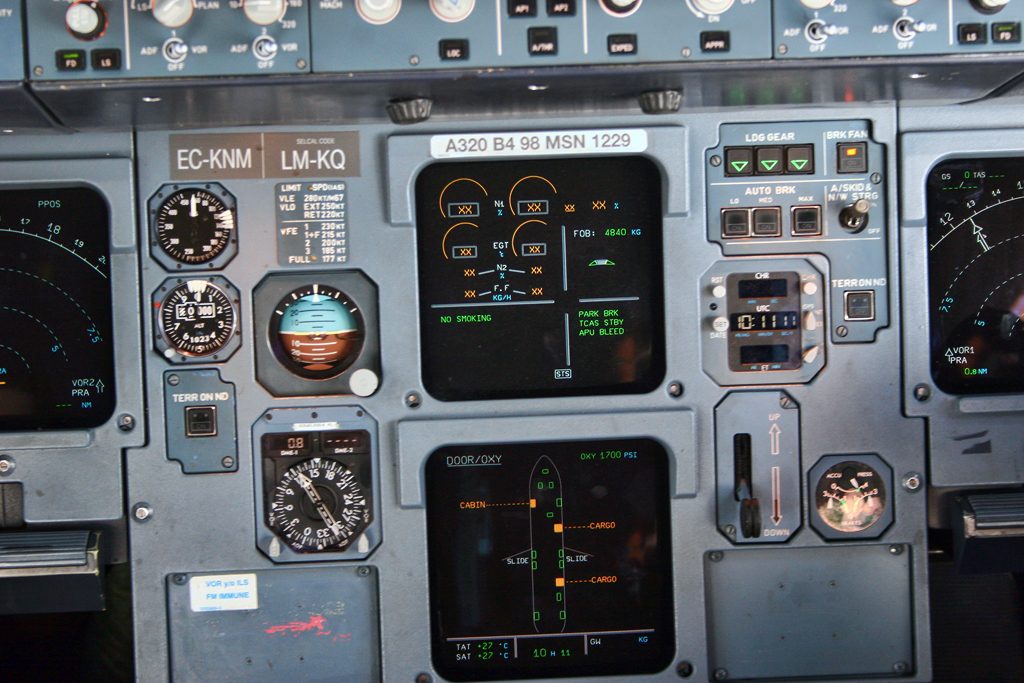
Each document has its place: the AFM prevails over the FCOM, the operator's procedures in its operations manual may be stricter than both, and the FCTM advises rather than prescribes.
Cabin crew operating manual
Cabin crew have their own documentation. Airbus publishes a Cabin Crew Operating Manual (CCOM) describing the cabin systems and the emergency equipment from the cabin crew's point of view; the FCOM refers to it for the description of portable emergency equipment, and its symbol list explains the placards that mark where equipment is stowed. Operators turn this material into their own cabin crew procedures and training, part of the operations manual.
Flight crew use it too: the emergency equipment on the flight deck and in the cabin, evacuation signals and cabin communication procedures are shared ground between the two crews, which is why joint training and briefings refer to the same documents.
Airport planning document (ACAP)
Aircraft Characteristics for Airport Planning (ACAP) is the manufacturer's document for airport designers, planners and operators rather than pilots; Boeing publishes the equivalent as Airplane Characteristics for Airport Planning. It gives each variant's dimensions, ground clearances, turning radii and manoeuvring data. Pilots meet its figures in type rating courses and exams:
| A320 family (ceo) | A319 | A320 | A321 |
|---|---|---|---|
| Wheelbase, nose gear to main gear | 11.04 m | 12.64 m | 16.91 m |
| Minimum theoretical pavement width for a 180° turn | 20.64 m | 22.90 m | 27.6 m |
| Overall length | 33.84 m | 37.57 m | 44.51 m |
The ACAP values are theoretical minima. The FCOM gives larger widths for the turning technique it recommends, about 24 m for the A320 and 30 m for the A321 on a dry runway, and even those contain no margin, which the crew add on a wet or contaminated surface. The wheelbase explains the difference between variants: the longer the distance between nose and main gear, the wider the turn.

Exam tip: the AFM is approved and binding; the FCOM and FCTM are manufacturer guidance; the operations manual is the operator's law for its crews, and may be more restrictive but never less restrictive than the AFM and the MMEL.
Frequently asked questions
What are the four parts of an operations manual?
Under the European rules the operations manual is divided into four parts. Part A, general or basic, holds the operator's policies and procedures that do not depend on the type. Part B covers aeroplane operating matters for each type, including limitations, procedures, performance, mass and balance and the MEL. Part C gives route, area and aerodrome information, and Part D sets out the training.
What is the difference between the AFM and the FCOM?
The aircraft flight manual (AFM) is the certification document approved by the authority. It contains the limitations, procedures and performance on which the type certificate rests, and it is binding. The flight crew operating manual (FCOM) is the manufacturer's operating manual for crews, with system descriptions, normal and non-normal procedures and performance data in usable form. The AFM is the approved document, and Boeing's FCOM, for example, states that the AFM governs if the two conflict on weight limitations.
What are the sections of a pilot's operating handbook?
Most modern light aircraft follow GAMA Specification No. 1, which puts the handbook in the same order. Section 1 is general information, 2 limitations, 3 emergency procedures, 4 normal procedures, 5 performance, 6 weight and balance and the equipment list, 7 the aircraft and its systems, 8 handling, servicing and maintenance, and 9 supplements for optional equipment. The approved flight manual material is incorporated in it.
What is the FCTM in aviation?
The flight crew training manual (FCTM) is the manufacturer's manual of techniques. Where the FCOM says what to do, the FCTM explains how and why: handling techniques, the reasons behind procedures and recommended practices for situations such as a runway change during taxi. It supports training and line flying but does not override the AFM, the FCOM or the operator's procedures.
What is the ACAP?
Aircraft Characteristics for Airport Planning is the manufacturer's document for airport designers and planners. It gives each variant's dimensions, clearances, wheelbase and turning data. For example, Airbus gives a minimum theoretical pavement width for a 180 degree turn of 22.90 m for the A320 and 27.6 m for the A321; the FCOM quotes larger widths for the recommended turning technique.
Test yourself on Operations Manual and Flight Crew Documentation
The v1prep banks cover this topic in Operational Procedures (070), with a worked explanation for every answer. EASA ATPL, PPL, IR and CPL, the FAA written tests and A320/B737 type ratings.
Start practising →Sources and further reading
- EASA Easy Access Rules for Air Operations (Regulation (EU) No 965/2012), ORO.MLR manuals, logs and records
- ICAO Annex 6, Operation of Aircraft, Part I, International Commercial Air Transport, Aeroplanes
- EASA Easy Access Rules for Large Aeroplanes (CS-25), Subpart G, operating limitations and information
- 14 CFR Part 121, Operating Requirements, Domestic, Flag, and Supplemental Operations (121.133 to 121.141, manual requirements)
- 14 CFR 91.9, Civil aircraft flight manual, marking, and placard requirements
- FAA Pilot's Handbook of Aeronautical Knowledge (FAA-H-8083-25), Chapter 9, Flight Manuals and Other Documents
Library articles are written for study and exam preparation. They do not replace your aircraft's approved documentation, your operator's procedures or the regulations themselves.