Human Information Processing
Human information processing describes how a pilot turns signals from the senses into action: sensing, perceiving, deciding, acting and checking the result. Each stage has fixed limits of capacity and time, and knowing them explains many errors and the defences built against them.
A pilot is a system for turning information into action. Signals arrive from the eyes, the ears and the balance organs; the brain decides what they mean and what to do; the hands and feet carry out the decision; and the result comes back through the senses as feedback. Human information processing is the study of that chain, and the human performance syllabus uses it as the framework for memory, attention, decision-making and error.
The model matters because every stage has limits that training cannot remove. Sensory stores fade within seconds, perception fills gaps with expectation, the central decision maker handles one decision at a time, and every response takes time. Checklists, standard phraseology, callouts, briefings and automation are all, in part, engineering around these limits.
The information processing model
The functional model taught in EASA human performance courses has five stages:
- Detection: a stimulus reaches a sense organ and is received.
- Perception: the brain interprets it, using context, expectation and knowledge from long-term memory.
- Decision: the central decision maker chooses what to do, drawing on working memory.
- Action: the response is selected and carried out, often through a stored motor programme.
- Feedback: the senses report the result, which starts the cycle again.
Between the senses and perception sit the sensory stores; attention selects what passes on; working memory holds what is in use; and long-term memory supplies knowledge, schemas and skills. The model is useful for analysing error, because a failure to detect, to perceive, to remember or to act each needs a different cure. ATPL texts note that errors in simple repetitive tasks occur about once in a hundred times, and that the rate climbs quickly with stress, fatigue and low morale.

Neurons and nerve signals
The nervous system has three parts. The central nervous system (CNS) is the brain and spinal cord, encased in bone. The peripheral nervous system (PNS) is the network of sensory nerves, carrying signals from the receptors, and motor nerves, carrying commands to the muscles. The autonomic nervous system runs the glands and involuntary muscles, controlling breathing, blood pressure, sweating and body temperature without conscious control, and triggers the fight-or-flight response.
Messages travel by electrochemical means. A nerve cell, the neuron, carries the impulse electrically along its length; at the junction between two neurons, the synapse, the signal is passed on chemically. The brain, about 2 % of body weight, uses about 20 % of the body's oxygen, which is why hypoxia affects thinking so early.
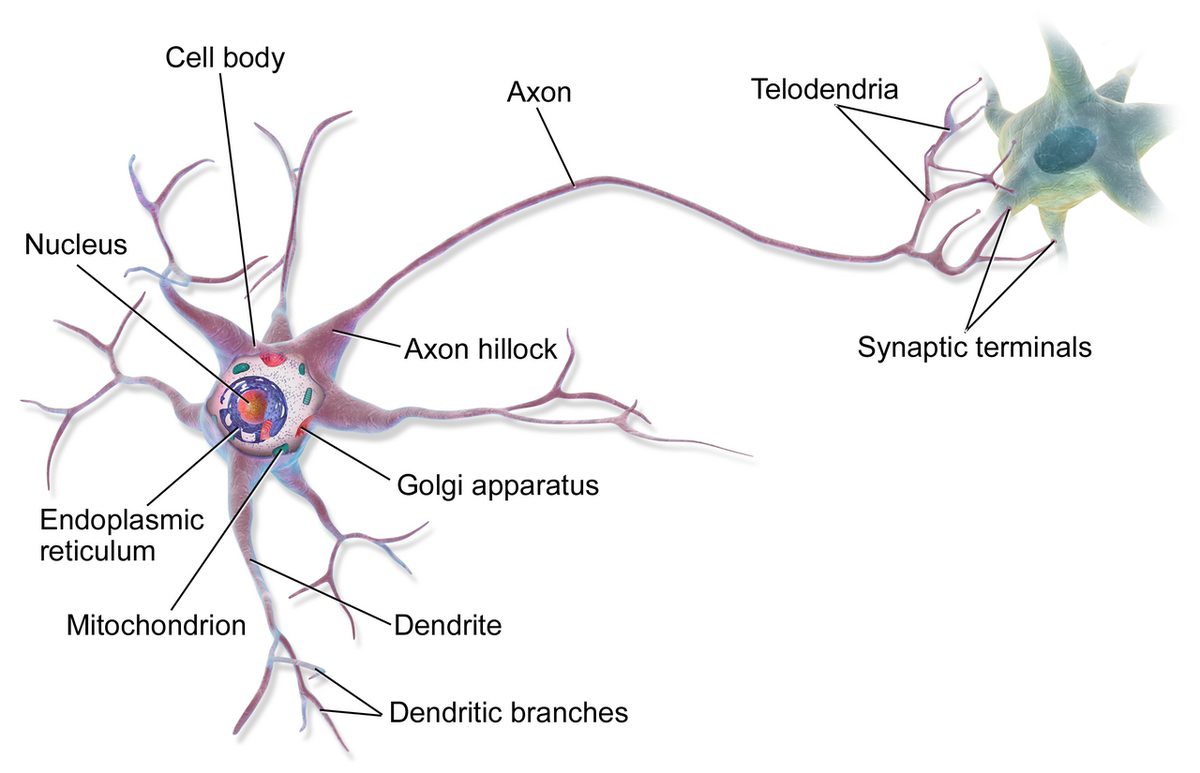
Vision dominates the input. The eye sends signals to the brain along about 1.2 million neurons against about 50,000 from the ear, and about 80 % of the information humans process arrives through the visual channel.
Sensory memory
Each sense has its own brief store, holding raw input long enough for attention to decide whether it matters:
| Store | Sense | Duration |
|---|---|---|
| Iconic memory | Sight | About 0.5 to 1 second |
| Echoic memory | Hearing | About 2 to 8 seconds, the longest |
Echoic memory can be replayed. If you realise halfway through that a clock is striking the hour, you can still count the strokes you did not consciously hear. The stores for touch, taste and smell have little significance in aviation.
Sensory adaptation, or habituation, is the tendency of receptors to reduce their response to a continuous stimulus. It is why clothes stop being felt soon after dressing, and why people living near an airport barely notice the noise after a month. The same economy means that a steady, unchanging signal can fade from awareness, while a change is noticed.
Perception and Gestalt principles
Perception is not a recording. The brain builds a best guess from fragments of sensory data, context and expectation, and under a poor signal or high workload the expectation can dominate. Gestalt theory (German Gestalt, shape) describes perception as an active construction in which the brain sorts and combines cues until a coherent whole appears. Its laws of perceptual organisation deal with proximity, continuity, similarity, symmetry, simplicity and closure, and the brain will fill in cues that are not actually present.

The cost is the illusion, defined in ATPL texts as a mismatch between what we sense and what we expect. Many visual illusions on approach arise when the brain fits an unfamiliar runway to a familiar picture. Hearing works the same way: a pilot waiting for a descent clearance will readily hear a garbled callsign as their own, and a pilot always cleared to 3,000 ft may read back 3,000 when the clearance was 5,000. The defences are procedural: use full callsigns, listen to the whole message before acting, and challenge any clearance that does not fit.
ATPL texts describe a visual perception cascade, from visual input through the brain's reaction to perception and recognition. It takes about 1 second in perfect conditions; the full sequence on to evaluation, decision, action and the pilot's response takes 5 to 7 seconds, and longer in darkness, poor visibility or a head-on approach, which is why see-and-avoid leaves so little margin.
Schemas and pattern recognition
Long-term memory is organised into mental schemas, representations of categories of objects, events and people. Hearing a word such as "football" activates a whole cluster of knowledge about rules, players and stadiums. Schemas make perception fast, but they can also supply details that were never there: people asked to recall an office often "remember" books that were not in it.
Pattern recognition is the expert's use of schemas. An experienced pilot correlates cues from many sources and recognises a malfunction from its overall pattern, while a pilot without that experience diagnoses more slowly, cue by cue. The same mechanism produces frequency bias, the tendency to call to mind a frequently met scenario and apply it where it does not fit; see cognitive biases.
The Kegworth accident of 1989 shows the whole chain failing. A fan blade failed in the left engine of a Boeing 737-400. Faced with heavy vibration and smoke, the crew reacted prematurely and in a way contrary to their training, the AAIB found, and throttled back the right engine without assimilating the engine instruments. The shuddering stopped at that moment, feedback that seemed to confirm their choice, and the right engine was shut down. The left engine's vibration indicator read maximum, but it was a small display on the new electronic engine instruments with no attention-getting feature, and the crew did not take it in.
The central decision maker
At the centre of the model is the central decision maker, and its chief limitation is that it is single-channel: it can process only one decision at a time. People feel that they make several decisions at once, but they are switching rapidly between them, and each switch costs time. Flying while holding a conversation is possible only because the flying runs as motor programmes. When demand exceeds capacity, tasks are shed, often without the pilot noticing which ones; see attention, vigilance and distraction.
Information theory measures what reaches the decision maker in bits. One bit is the quantity of information that reduces the receiver's uncertainty by half, so a message that tells the receiver nothing new carries no information, however clearly it is transmitted.
The decision maker works at different levels depending on familiarity, as Rasmussen's skill-rule-knowledge model describes. Rule-based behaviour, such as a fire drill, applies a learned procedure but needs a conscious decision to start. Knowledge-based behaviour, when no procedure fits, is slow and effortful, and its error rate rises sharply. Recognising that a situation has become knowledge-based is itself a cue to slow it down.
Motor programmes and reflexes
A motor programme is a behavioural subroutine learned by practice and repetition, held in long-term memory and carried out without conscious thought. It is what makes an experienced pilot's scan and control inputs cost almost no attention, leaving capacity that a beginner, doing the same work at the rule or knowledge level, does not have. The price is that skill-based slips occur only in the experienced; see memory and learning.
A reflex action, such as snatching a hand away from a hot surface, is faster still, because it involves only a loop between the limb and the spinal cord. The brain is bypassed and fewer neurons are involved.
Reaction time and the speed-accuracy trade-off
A simple reaction time, such as pressing a button when a light comes on, is about 0.2 seconds. It grows with the complexity of the decision, because every extra choice loads the central decision maker, so reactions in flight are much longer. The maxim in ATPL texts is that a correct response is better than a fast one.
There is a speed-accuracy trade-off. Delay can be dangerous, as in an engine failure just after take-off, but haste breeds error. High arousal produces faster but less accurate responses. Auditory stimuli attract attention more readily than visual ones but are more often responded to in error, and between the ages of 20 and 60 responses become slower but more accurate.
Exam tip: An error of commission is a prepared response triggered by an unexpected stimulus. A pilot primed for an engine shutdown drill has shut down an engine at the noise of a falling tray. Prepare decisions in advance, but cross-check the stimulus before acting on it.
Kegworth shows the same trade-off: the AAIB found that the crew reacted prematurely. Except close to the ground, at take-off and on landing, time in flight rarely dictates a very quick decision, and crews can make more of it by holding, slowing down, going around or delaying. The safest first response to a surprise is to stabilise the aeroplane and then think.
Frequently asked questions
What are the stages of the human information processing model?
The functional model used in pilot training has five stages. Detection receives the stimulus, perception interprets it, decision chooses a response, action selects and carries it out, and feedback shows whether it worked. Behind these stages sit the sensory stores, attention, working memory and long-term memory. Naming the stage at which a failure occurred shows the right defence, since a failure to perceive needs a different cure from a failure to decide or to act.
What is the difference between iconic and echoic memory?
Both are sensory stores that hold raw input for a moment before it is selected for further processing. Iconic memory holds visual input for about 0.5 to 1 second; echoic memory holds sound for about 2 to 8 seconds, the longest of the sensory stores. That is why you can still count the chimes of a clock you only started listening to halfway through, replaying them from echoic memory.
What does single-channel processing mean?
The central decision maker can process only one decision at a time. People feel they make several decisions at once, but they are switching rapidly between them, and each switch costs time. Pilots can fly and talk together only because well-practised skills run as motor programmes that need no conscious decision. When demand exceeds capacity, tasks are shed without the pilot noticing which ones.
What is a normal human reaction time?
A simple reaction, such as pressing a button when a light comes on, takes about 0.2 seconds. Reaction time grows as the decision becomes more complex, so responses in flight take much longer. For spotting another aircraft, ATPL texts put the visual perception cascade at about 1 second in perfect conditions and the full sequence to the pilot's response at 5 to 7 seconds. A correct response matters more than a fast one.
What is Gestalt theory in aviation human factors?
Gestalt theory holds that perception is an active construction. The brain sorts and combines the available cues until they form a coherent whole, following principles such as proximity, continuity, similarity, symmetry, simplicity and closure, and it fills in cues that are not actually there. It explains why pilots see what they expect to see, and why incomplete or misleading cues can produce convincing visual illusions.
Test yourself on Human Information Processing
The v1prep banks cover this topic in Human Performance and Limitations (040), with a worked explanation for every answer. EASA ATPL, PPL, IR and CPL, the FAA written tests and A320/B737 type ratings.
Start practising →Sources and further reading
- ICAO Doc 9683, Human Factors Training Manual
- EASA Easy Access Rules for Aircrew (Part-FCL theoretical knowledge syllabus, 040 Human Performance and Limitations)
- FAA Aviation Instructor's Handbook (FAA-H-8083-9)
- FAA Pilot's Handbook of Aeronautical Knowledge (FAA-H-8083-25), Chapters 2 and 17
- AAIB Aircraft Accident Report 4/1990, Boeing 737-400 G-OBME near Kegworth, 8 January 1989
Library articles are written for study and exam preparation. They do not replace your aircraft's approved documentation, your operator's procedures or the regulations themselves.