ATC Flight Plan
An ATS flight plan is the specified information about an intended flight, or part of a flight, that a pilot or operator gives to air traffic services units. It tells controllers what the aircraft is, where and how it will fly, and when to start searching if it goes missing.
An ATS flight plan is the specified information about an intended flight that is given to air traffic services units. It is a short, coded message that tells every unit along the route what the aircraft is, what it can do, where and when it will fly, and what to look for if it does not arrive. The layout is the ICAO flight plan, a standard form whose numbered items become the FPL message sent to the units concerned.
It is not the operational flight plan, the operator's own document of headings, times and fuel. The rules come from ICAO Annex 2 and the PANS-ATM (Doc 4444), applied in Europe through the Standardised European Rules of the Air (SERA) and in the United States through 14 CFR Part 91 and the AIM.
- When a flight plan is required
- IFR, VFR and DVFR flight plans
- AFIL and repetitive flight plans
- Items 7, 8, 9 and 13: identification, rules and departure
- Items 10 and 18: equipment and other information
- Item 15: route
- Items 16 and 19: EET, alternates and persons on board
- EOBT, changes and IFPS processing
- Closing the flight plan
- Frequently asked questions
When a flight plan is required
SERA.4001 requires a flight plan before:
- any flight, or part of a flight, to be provided with an air traffic control service;
- any IFR flight within advisory airspace;
- any flight within or into areas, or along routes, where the competent authority requires one to facilitate flight information, alerting and search and rescue, or co-ordination with military units or adjacent States;
- any flight across an international border, unless the States concerned prescribe otherwise;
- any flight planned to operate at night, if it leaves the vicinity of an aerodrome.
States add their own cases. France, for example, also requires one for all IFR flights, with an exception for certain helicopter flights in Class G airspace, and for VFR flights over the sea beyond the lesser of fifteen times the aircraft's altitude and the distance from which it could reach land suitable for an emergency landing with an engine inoperative.
A plan filed on the ground for a flight that will receive an air traffic control or advisory service, or that will cross a border, must be submitted at least 60 minutes before departure, or at least 3 hours before EOBT if the flight may be subject to flow management measures, and not more than 120 hours ahead (SERA.4001). A plan filed in flight must reach the ATS unit at least 10 minutes before the aircraft is estimated to reach the point of entry into a control or advisory area, or the point where it crosses an airway or advisory route.
In the United States, 14 CFR 91.173 requires an IFR flight plan and an ATC clearance for IFR flight in controlled airspace. VFR flight plans are optional, but they trigger search and rescue. Special areas add their own rules: the Washington, DC Special Flight Rules Area requires a flight plan for entry.
IFR, VFR and DVFR flight plans
An IFR flight plan covers a flight under instrument flight rules and is the basis of its clearance. A VFR flight plan covers a flight under visual rules, either because a controlled or cross-border flight needs one or to benefit from the alerting service. A flight can combine the two, IFR then VFR or the reverse, with the change point marked in the route.
A Defense VFR (DVFR) flight plan is a United States form of VFR plan. Under 14 CFR Part 99, aircraft entering the United States through an Air Defense Identification Zone must file either an IFR or a DVFR flight plan, carry an operating transponder and two-way radio, and make the position reports required. The purpose is identification for national security, not air traffic service.
AFIL and repetitive flight plans
A flight plan can be filed from the air, directly to the ATS unit or an air-ground station. The ICAO abbreviation for such a plan is AFIL, a flight plan filed in the air, and it is subject to the 10-minute rule above.
Airlines do not send a new plan for every scheduled service. A repetitive flight plan (RPL) is a flight plan for a series of frequently recurring, regularly operated flights with identical basic features, submitted by the operator for the ATS units to keep and use repeatedly. Its listing assumes IFR, a scheduled air service and a Mode A/C transponder unless noted otherwise. New entries are marked with a plus sign and deletions with a minus. A change of destination is too significant for an amendment: the RPL is cancelled for that day and an individual flight plan filed. Known long in advance, RPLs also help air traffic flow management predict sector loads.
Items 7, 8, 9 and 13: identification, rules and departure
Flight plan item 7 (aircraft identification) is the identification used in flight: the registration, or the operator's ICAO designator followed by the flight number, such as BAW123. The Mode S transponder must be set to exactly this string, in its flight plan form rather than the spoken form (Speedbird one two three). Any mismatch can leave the aircraft uncorrelated on the controller's display.
Flight plan item 8 carries two letters. The flight rules indicator is I (IFR throughout), V (VFR throughout), Y (IFR first, then VFR) or Z (VFR first, then IFR). The type of flight is S (scheduled air service), N (non-scheduled air transport), G (general aviation), M (military) or X (other). A scheduled airline IFR flight therefore files IS.
Item 9 gives the number of aircraft if more than one, the ICAO type designator and the wake turbulence category, set by maximum certificated take-off mass: L (LIGHT) 7,000 kg or less, M (MEDIUM) more than 7,000 kg and less than 136,000 kg, H (HEAVY) 136,000 kg or more, and J (SUPER) for the A380.
Item 13 is the departure aerodrome's four-letter ICAO location indicator followed directly by the estimated off-block time (EOBT) in UTC. The EOBT is the time the aircraft is expected to start moving for departure, not the take-off time. An aerodrome without an indicator is entered as ZZZZ and named in item 18 after DEP/.

Items 10 and 18: equipment and other information
Flight plan item 10 declares what is carried and serviceable, in two parts separated by an oblique stroke.
Before the stroke come communication, navigation and approach aids. S stands for the standard fit of VHF radiotelephony, VOR and ILS unless the ATS authority prescribes another combination; N means none is carried or serviceable. Other letters add to it, among them G (GNSS), D (DME), F (ADF), L (ILS), O (VOR), I (inertial navigation), W (RVSM approval), X (MNPS approval) and R (PBN approval). An aircraft filing SW has standard equipment and RVSM approval.
After the stroke comes surveillance: N (nil), A (Mode A), C (Mode A and C), S (Mode S with pressure-altitude and aircraft identification), with further codes for ADS-B such as B1, 1090 MHz extended squitter out. An aircraft whose transponder fails before departure and cannot be repaired informs ATS, files N and follows the published exemption procedures.
Exam tip: older texts include ADF in S; since the 2012 flight plan amendment ADF is declared separately with F. The same letter means different things either side of the stroke.
Flight plan item 18 (other information) carries keyword groups that do not fit elsewhere:
- EET/ followed by a FIR boundary designator and elapsed time: EET/EBUR0029 means 29 minutes from take-off to the Brussels FIR;
- PBN/ with the navigation specifications held, obligatory when R is filed in item 10;
- REG/ (registration, if different from item 7), OPR/ (operator), SEL/ (SELCAL code);
- DEP/ naming a departure aerodrome entered as ZZZZ in item 13;
- RALT/ for en-route alternates, and NAV/, COM/ and DAT/ for equipment details.
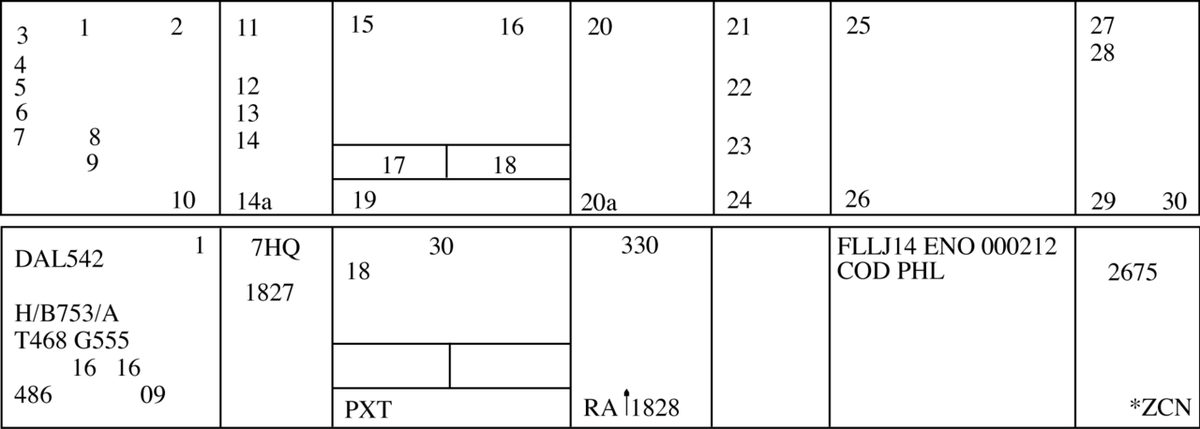
Item 15: route
Flight plan item 15 (route) opens with the cruising speed and level. Speed is the true airspeed as N followed by four figures in knots (N0485), K and four figures in km/h, or M and three figures for a Mach number (M082). Level is F and three figures for a flight level (F330), A and three figures for an altitude in hundreds of feet (A045 for 4,500 ft), S or M for metric levels, or the letters VFR. The groups have fixed lengths, so a light twin at 120 kt and FL80 files N0120F080.
The route follows as a string of ATS route designators and significant points. Direct routing (DCT) joins two points not connected by an ATS route, but is not needed between successive points defined by coordinates or by bearing and distance. Only changes need entering: a planned change of speed of 5 % of TAS or 0.01 Mach or more, or a change of level, is written at the point where it happens, with both speed and level repeated. A planned change of flight rules is written the same way, the point followed by VFR or IFR.
Items 16 and 19: EET, alternates and persons on board
Flight plan item 16 (destination, total EET and alternates) gives the destination indicator, the total estimated elapsed time (EET) and up to two destination alternates, for example EDDM0140 EDDS. For IFR flights the EET runs from take-off to the point at which the instrument approach is expected to begin, or to overhead the aerodrome when no such point is associated with it. En-route alternates go in item 18 after RALT/; how alternates are chosen is covered in alternate aerodromes.
Flight plan item 19 (supplementary information) is for search and rescue. It is not transmitted with the FPL message but kept by the filing office, ready if the aircraft becomes overdue:
| Group | Content |
|---|---|
| E/ | Fuel endurance, the total usable fuel expressed as time |
| P/ | Persons on board (POB) |
| R/ | Emergency radio carried |
| S/, J/, D/ | Survival equipment, life jackets, dinghies |
| A/ | Aircraft colour and markings |
| N/ | Remarks |
| C/ | Name of the pilot-in-command |
Endurance is what is actually on board, not the legal minimum. ICAO wording, reproduced in the French AIP, treats endurance or persons on board that are incorrect at departure as a significant change to be reported.
EOBT, changes and IFPS processing
Once filed, a plan must stay true. Under SERA.8020 a controlled flight reports a variation of 5 % or more in the average true airspeed at cruising level, and passes a revised estimate when the time for the next reporting point, FIR boundary or destination is found to be in error by more than 2 minutes (older texts give 3). A controlled flight delayed by more than 30 minutes beyond its EOBT must amend its plan, or cancel it and file a new one; an uncontrolled flight has 1 hour.
In most of Europe flight plans are not sent to each unit separately: the Integrated Initial Flight Plan Processing System (IFPS), run by the EUROCONTROL Network Manager, receives each plan, checks it against the route network and restrictions, and distributes accepted plans to every ATC unit concerned, which also gives flow management its demand picture. The tolerances are tighter than the ICAO ones: a delay (DLA) or change (CHG) message is required once the EOBT will be exceeded by more than 15 minutes. As the French AIP entry for Lyon notes, a DLA can put the EOBT back but can never bring it forward.
Closing the flight plan
SERA.4020 requires an arrival report at the earliest possible moment after landing from any flight whose flight plan covers the whole flight. It goes to the ATS unit at the arrival aerodrome or, where there is none, by the quickest means available to the nearest ATS unit, and gives aircraft identification, departure aerodrome, arrival aerodrome and time of arrival. France lets pilots close by telephone, for instance through the BRIA office listed in the AIP.
The alerting service is provided, as far as practicable, to every aircraft that has filed a flight plan. If no arrival report is received, the uncertainty phase begins when the aircraft fails to arrive within 30 minutes of its last notified ETA, and can progress to the alert and distress phases (see alerting service and search and rescue).
The FAA procedure differs. A VFR flight plan is activated by the pilot after departure and must be closed by the pilot with Flight Service after landing; a tower does not close it. If it is not closed within 30 minutes of the ETA, Flight Service begins overdue action. An IFR flight plan is closed automatically on landing at an airport with an operating tower. At an airport without one, the pilot must cancel IFR with ATC or Flight Service promptly, because until then other IFR traffic is held off the airport.
Warning: an unclosed flight plan starts a real search for an aircraft sitting safely on the ground. Close it before leaving the aircraft.
Frequently asked questions
How long before departure must a flight plan be filed?
Under SERA.4001, a flight plan for a flight that will receive an air traffic control or advisory service, or that crosses an international border, must be submitted at least 60 minutes before departure, or at least 3 hours before the estimated off-block time if the flight may be subject to flow management measures. A plan filed in the air must reach the ATS unit at least 10 minutes before the aircraft reaches the point of entry into the control or advisory area.
What do the letters I, V, Y and Z mean in item 8 of a flight plan?
They are the flight rules indicator. I means the whole flight is planned under IFR and V the whole flight under VFR. Y means the flight starts under IFR and changes to VFR, and Z means it starts under VFR and changes to IFR. With Y or Z the point where the rules change is written in the route, item 15, followed by VFR or IFR.
What does the letter S mean in item 10 of the flight plan?
Before the oblique stroke, S declares the standard equipment for the route, VHF radiotelephony, VOR and ILS, carried and serviceable, unless the ATS authority prescribes another combination. The 2012 amendment removed ADF from that standard set, so ADF is now declared with F. After the stroke, in the surveillance part, S means something else, a Mode S transponder with pressure-altitude and aircraft identification.
What happens if you forget to close a flight plan?
The alerting service assumes the aircraft may be in trouble. Under ICAO procedures the uncertainty phase begins when an aircraft fails to arrive within 30 minutes of its last notified estimated time of arrival, and it can escalate to the alert and distress phases and a search. In the United States, Flight Service starts overdue action if a VFR flight plan is not closed within 30 minutes of the ETA.
How long can a departure be delayed before the flight plan must be changed?
Under ICAO and SERA procedures a controlled flight must amend its flight plan, or cancel it and file a new one, when it is delayed by more than 30 minutes beyond the estimated off-block time. For an uncontrolled flight the figure is 1 hour. In the European IFPS zone a delay (DLA) or change (CHG) message is needed once the EOBT will be exceeded by more than 15 minutes.
Test yourself on ATC Flight Plan
The v1prep banks cover this topic in Flight Planning (033), with a worked explanation for every answer. EASA ATPL, PPL, IR and CPL, the FAA written tests and A320/B737 type ratings.
Start practising →Sources and further reading
- Commission Implementing Regulation (EU) No 923/2012, Standardised European Rules of the Air (SERA)
- EASA Easy Access Rules for Standardised European Rules of the Air (SERA)
- ICAO Doc 4444, Procedures for Air Navigation Services, Air Traffic Management (PANS-ATM), 16th edition, as published by Airservices Australia
- AIP France, ENR 1.1, General rules (flight plans)
- AIP France, AD 2 LFLL, Lyon Saint-Exupéry (A-CDM departure procedure and flight plan updates)
- FAA Aeronautical Information Manual, Chapter 5 Section 1, Preflight (flight plans)
- 14 CFR 91.169, IFR flight plan, information required
Library articles are written for study and exam preparation. They do not replace your aircraft's approved documentation, your operator's procedures or the regulations themselves.