Fuel Additives and Contamination
Fuel additives are chemicals added in small quantities to aviation fuel to give it properties the base fuel lacks, such as resistance to ice, static or wear. Fuel contamination is anything in the fuel that should not be there, above all water, sediment, microbial growth and the wrong grade.
Fuel leaves the refinery clean and made to a specification, but it is handled many times before it reaches an engine: stored, pumped through filters and hoses, loaded into tanks that breathe outside air, and carried through large changes of temperature. Some properties the base fuel lacks are supplied by additives. Others it acquires along the way are unwanted, and the most persistent of these contaminants is water.
Contamination rarely announces itself before it causes trouble. Water in a light aeroplane's fuel can stop the engine, often shortly after take-off; ice crystals and microbial growth block the filters of a jet engine; and the wrong grade of fuel, the subject of refuelling safety and fuel emergencies, destroys a piston engine through detonation. The defences are the same at every level: the right additives, tanks and drains that keep water out or let it be removed, and a sample taken before flight.
Fuel additives overview
Fuel additives are chemicals added to fuel in small quantities, at the refinery or at the airfield, to give it properties it would not otherwise have. Which additives a grade may or must contain is set by its specification, and aircraft and engine approved fuel lists sometimes name the additive: the engine lists of the A320 family include designations such as AVCAT/FSII, fuel with an icing inhibitor.
Avgas contains tetraethyl lead, which raises its resistance to detonation, and a dye that identifies the grade: 100LL is blue, 100 green (see aviation fuel grades and properties). Turbine fuels are not dyed, and the additives found in them include:
| Additive | Purpose |
|---|---|
| Fuel system icing inhibitor (FSII) | Lowers the freezing point of water in the fuel; also suppresses fungal growth |
| Static dissipator | Raises the fuel's conductivity so that static charge dissipates quickly |
| Lubricity additive | Reduces wear in fuel pumps and fuel control units |
| Corrosion inhibitor | Protects the metal of tanks and fuel system components |
| Metal deactivator | Suppresses the catalytic effect of copper on the oxidation of the fuel |
Fuel system icing inhibitor
Jet fuel always contains some water, dissolved in it or suspended as tiny droplets. The colder the fuel, the less water it can hold, so as it cools in the cruise, water comes out of solution as droplets. These can freeze into ice crystals that block fuel filters and other components.
A fuel system icing inhibitor (FSII), today diethylene glycol monomethyl ether (DiEGME), which replaced the ethylene glycol monomethyl ether (EGME) still named in older ATPL texts, lowers the freezing point of that free water so that it stays liquid. It has a second benefit: it acts as a biocide and suppresses the fungus that lives in water in turbine fuel. FSII is added at the refinery or at the airfield, and it matters most for cold operations and for fuel that is stored for a long time.
Two points are often confused. First, FSII protects against ice formed from water, not against wax formed from the fuel itself, so it does not change an aircraft's fuel temperature limits: the Boeing 737's limitations state explicitly that FSII does not alter the minimum tank fuel temperature. Second, turbine engines do not depend on it alone: they warm the fuel ahead of the filter, usually in a fuel-cooled oil cooler, and warn the crew of an impending filter bypass (see gas turbine engine fuel system).
Static dissipator additive
Fuel flowing fast through hoses, filters and nozzles generates static electricity, and the faster the flow, the greater the charge. A spark where fuel vapour is concentrated, at the filler or in the tank, is the classic refuelling fire. A static dissipator additive, or anti-static additive, raises the electrical conductivity of the fuel. It does not stop the charge being generated, but it lets the charge dissipate quickly instead of building up, shortening the time for which a static hazard exists during high-rate refuelling.
The additive complements the other precautions and does not replace them. The aircraft is still bonded to the fuelling equipment with a dedicated wire before any cap is opened, and the airframe's own bonding keeps every part at the same potential (see electrical bonding, static and interference).
Lubricity additives
Fuel is not only burnt. It lubricates the rubbing surfaces of the fuel pumps and the fuel control unit, and on some aircraft it also cools and lubricates the tank pumps themselves: the Boeing 737's AC tank pumps are cooled and lubricated by the fuel passing through them, which is one reason why running a centre tank pump dry is prohibited.
Kerosene is a relatively poor lubricant, and low-sulphur fuels have poorer natural fuel lubricity still. A lubricity additive, such as the agent named HITEC in the ATPL texts, reduces wear in the high-pressure fuel pumps and fuel control units. The benefit is long-term: fewer pump failures and lower maintenance costs.

Water contamination
Water is the most common fuel contaminant, and water contamination of fuel has three main sources:
- Condensation. Once fuel is in the tanks, the main source of water is the moist air in the space above it. As the temperature falls, for example overnight, the moisture condenses on the tank walls and runs into the fuel.
- Rain, through filler caps and seals that are poorly fitted or worn.
- Delivery. The fuel itself arrives carrying dissolved water, which comes out of solution when it cools.
In the tank, water exists in three states. Dissolved water is invisible and comes out of solution as the fuel cools. Suspended water makes the fuel look cloudy or hazy: in a sample, a haze that settles slowly towards the bottom is water, while one that rises quickly to the top is only air. Free water is denser than fuel and does not mix with it, so it sinks to the lowest point of the tank and shows in a sample as clear drops or a layer beneath the fuel.
Free water reaching a piston engine causes rough running or a stoppage; it neither dissolves in the fuel nor burns off. In turbine aircraft it freezes into ice crystals at altitude, it feeds microbial growth, and it upsets the fuel gauges: water has a far higher permittivity than fuel, so a capacitance probe standing in water over-reads, sometimes beyond full scale (see fuel quantity and temperature indication).
The simplest defence is to leave little air in the tanks. Filling them after the last flight of the day excludes most of the moist air, and with it the water that would condense. The price is that full tanks can overflow through the vents when the fuel warms and expands the next morning, and that the fuel load may be more than the next flight can carry.
Certification assumes that some water will always be present. CS 25.951(c) requires a transport aeroplane's fuel system to work with fuel saturated with water at 26.7 °C (80 °F) and carrying 0.20 cm³ of free water per litre (0.75 cm³ per US gallon), cooled to the most critical condition for icing. The 2008 accident to a Boeing 777 at London Heathrow showed that ice can also accumulate in the tanks and feed system over a long cold flight and then be released, which led EASA to add a special condition on water and ice for the A320neo.
Microbial growth
Microbial growth in turbine fuel is caused mainly by the fungus Cladosporium resinae, now also classified as Hormoconis or Amorphotheca resinae. It lives in the fuel but grows where there is water, at the fuel-water interface at the bottom of the tank, and in those conditions it grows rapidly. It forms mats and long green filaments that block filters, pumps and fuel control units, and its waste products are corrosive, particularly to the sealants of integral fuel tanks, so an infected tank can start to leak (see fuel tanks, venting and inerting). Fuel that stands for long periods is the most vulnerable.
Because the fungus needs water, the main countermeasure is to remove the water by draining tanks regularly. FSII suppresses the growth as a biocide, and tanks are inspected and cleaned at scheduled intervals. A blocked engine fuel filter, announced in flight by a filter bypass indication, can be the first sign of contamination.
Water drains, strainers and gascolators
Tanks are designed so that water and sediment can be found and removed. The engine's fuel pick-up is placed above the bottom of each tank, so that settled water and dirt stay below it; the fuel left there is part of the unusable fuel (see fuel mass and fuel loading). At the lowest point of each tank a water drain valve, or sump drain, lets a sample be drawn off.
A light aeroplane adds a fuel strainer at a low point of the system between the tanks and the engine, usually a gascolator: a strainer combined with a sediment bowl and its own drain, where water and dirt that pass the tank outlets collect. Transport aircraft use coarse inlet screens on the tank pumps to keep debris out of their impellers, and a fine engine filter downstream. CS 25.997 requires a strainer or filter between the tank outlet and either the fuel metering device or an engine-driven positive-displacement pump, whichever is nearer the tank.
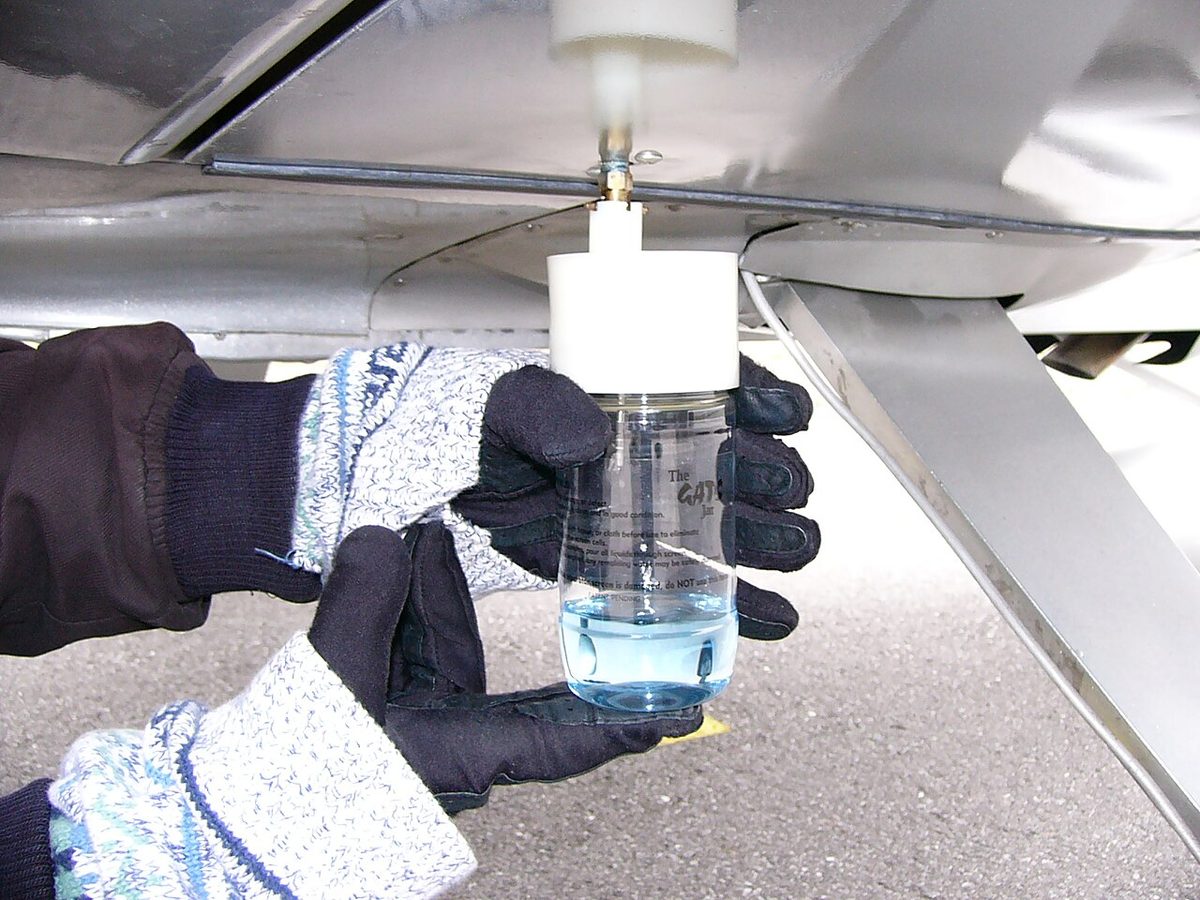
The fuel contamination check is part of every light aircraft pre-flight inspection:
- Allow a few minutes after refuelling for any water to settle.
- Drain a sample from each tank sump and from the gascolator into a clear tester, before the first flight of the day and after each refuelling.
- Look for water, as clear drops or a layer at the bottom, for sediment such as rust or dirt, and for the wrong grade, shown by colour and smell.
- Keep draining until the sample is clean, then check that each drain has closed.
Draining only the gascolator is not enough, because water settles in each tank separately. Water that keeps reappearing points to a leaking cap or seal, and is a matter for maintenance rather than for further draining. On transport aircraft the tank drains are worked by ground crew or maintenance, and a sample that shows water is drained until clear in the same way.
Exam tip: FSII lowers the freezing point of water in fuel and is also a biocide, but does not change fuel temperature limits. Cladosporium resinae grows at the fuel-water interface, blocks filters and corrodes tank sealant. In a sample, haze rising quickly is air, haze falling slowly is water. Top up the tanks to limit condensation.
Frequently asked questions
What does a fuel system icing inhibitor do?
Jet fuel always contains some water, which comes out of solution as the fuel cools at altitude and can freeze into ice crystals that block filters. A fuel system icing inhibitor (FSII), today diethylene glycol monomethyl ether (DiEGME), lowers the freezing point of that free water. It also suppresses the fungus that grows in water in turbine fuel. It acts on water, not wax, so it does not change the aircraft's minimum fuel temperature limit.
What is Cladosporium resinae?
Cladosporium resinae, now also classified as Hormoconis or Amorphotheca resinae, is a microbiological fungus that can live in turbine fuel. It grows at the interface between fuel and water, forming mats and long green filaments that block filters, pumps and fuel control units. Its waste products are corrosive, particularly to tank sealants, and can cause leaks. Regular water draining, the biocidal effect of FSII and tank inspection keep it under control.
Why are fuel tanks filled after the last flight of the day?
Once fuel is in the tanks, the main source of water is the moist air in the space above it. As the temperature falls overnight, that moisture condenses on the tank walls and runs into the fuel. Filling the tanks leaves little room for air and so little water to condense. The drawbacks are that full tanks can overflow through the vents as the fuel warms and expands, and that the fuel may be more than the next flight can carry.
What is a gascolator?
A gascolator is the main fuel strainer of a light aeroplane, a filter with a sediment bowl and a drain, fitted low in the fuel system between the tanks and the engine. Water and sediment that pass the tank outlets collect in it. It is drained into a clear tester before the first flight of the day and after refuelling, together with each tank sump, and draining continues until the sample is clean.
Why is a lubricity additive added to jet fuel?
Fuel lubricates the rubbing surfaces of the pumps and fuel control units it passes through, but kerosene on its own is a relatively poor lubricant, and modern low-sulphur fuels are poorer still. A lubricity additive, such as the HITEC agent named in the ATPL texts, reduces the wear of high-pressure fuel pumps and fuel control units, improving their reliability and cutting maintenance costs.
Test yourself on Fuel Additives and Contamination
The v1prep banks cover this topic in Aircraft General Knowledge (021), with a worked explanation for every answer. EASA ATPL, PPL, IR and CPL, the FAA written tests and A320/B737 type ratings.
Start practising →Sources and further reading
- FAA Aviation Maintenance Technician Handbook, Airframe (FAA-H-8083-31B), Chapter 14, Aircraft Fuel System
- FAA Aviation Maintenance Technician Handbook, Powerplant (FAA-H-8083-32B), Chapter 2, Engine Fuel and Fuel Metering Systems
- FAA Pilot's Handbook of Aeronautical Knowledge (FAA-H-8083-25), Chapter 7, Aircraft Systems
- EASA Easy Access Rules for Large Aeroplanes (CS-25), CS 25.951 Fuel system (general) and CS 25.997 Fuel strainer or filter
- EASA TCDS EASA.A.064 (Airbus A318/A319/A320/A321), Explanatory Note, Annex I, Special Conditions E-37 Water/Ice in Fuel System and E-49 LEAP-1A Fuel Filter Location
- AAIB Aircraft Accident Report 1/2010, Boeing 777-236ER G-YMMM, London Heathrow, 17 January 2008
- FAA Advisory Circular AC 20-29C, Approval and Use of Fuel System Icing Inhibitors (FSII)
Library articles are written for study and exam preparation. They do not replace your aircraft's approved documentation, your operator's procedures or the regulations themselves.