Thrust Reversers and Reverse Thrust
A thrust reverser turns part of a jet engine's airflow forward after landing, so that the engine produces a retarding force. Doors or a sliding sleeve block the normal flow path and deflect the air, and several independent locks keep the reverser stowed in flight.
A thrust reverser turns part of a jet engine's airflow forward, so that after touchdown the engine pushes the aeroplane backwards instead of forwards. Reverse thrust is a decelerating force that does not depend on the friction between tyres and runway, which makes it most valuable exactly where wheel braking is weakest: at high speed and on wet or contaminated runways. It also reduces brake wear.
A reverser is also one of the few systems that could turn a normal flight into a catastrophe if it worked at the wrong time. Airliner reversers are for ground use only, and much of their design, the interlocks, locks, restow logic and warnings, exists to keep them stowed in flight. The landing technique around them is covered in landing technique and crosswind operations; this article covers the reverser itself.
Principle of reverse thrust
An engine's thrust is the reaction to the momentum it gives the air. If the air leaves the engine with a forward component, the reaction points rearwards. A reverser does this by blocking the normal flow path and deflecting the flow outward and forward. The retarding force grows with the thrust set and is most effective at high speed, early in the landing roll; reverse is reduced as the aeroplane slows.
On a high-bypass turbofan only the fan stream is usually reversed. The core exhaust keeps flowing rearwards and keeps producing forward thrust, so raising the rpm in reverse increases both the fan's reverse thrust and the core's forward thrust. The net retarding force is the difference between the two.
A propeller reverses differently, by turning its blades to a negative angle. That needs no doors, acts quickly and stays effective down to low speed, one reason why propeller aeroplanes decelerate well on the landing roll (see propellers and propeller control).
Clamshell and target reversers
Turbojets and early low-bypass engines reverse the whole exhaust at the rear of the jet pipe. Two designs are used.
- Clamshell door reversers have doors inside the jet pipe. When deployed, they close off the normal exhaust exit and uncover cascade vanes in the sides of the jet pipe, which turn the gas forward.
- Target, or bucket, thrust reversers have two doors at the rear of the jet pipe. Deployed, they close together behind the propelling nozzle and deflect the exhaust outward and forward.
Both are hot-stream reversers: their doors must withstand the full exhaust temperature.
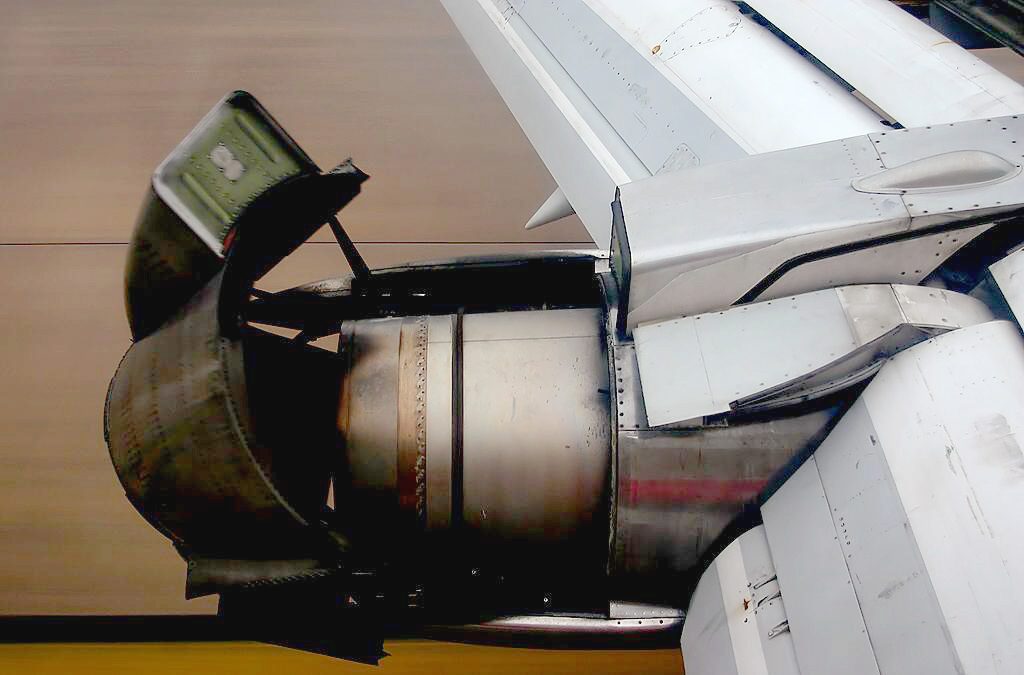
Cascade reversers and blocker doors
High-bypass engines reverse the cold fan stream, which carries most of the thrust. The usual design is the cascade thrust reverser. The rear part of the fan cowl is a translating sleeve that slides aft on deployment. As it moves, blocker doors fold down into the fan duct and close it, and the fan air, with nowhere else to go, escapes through cascade vanes exposed by the sleeve, which turn it outward and forward. The Boeing 737 NG uses this design, with hydraulically operated left and right translating sleeves; so does the IAE V2500 of the A320.
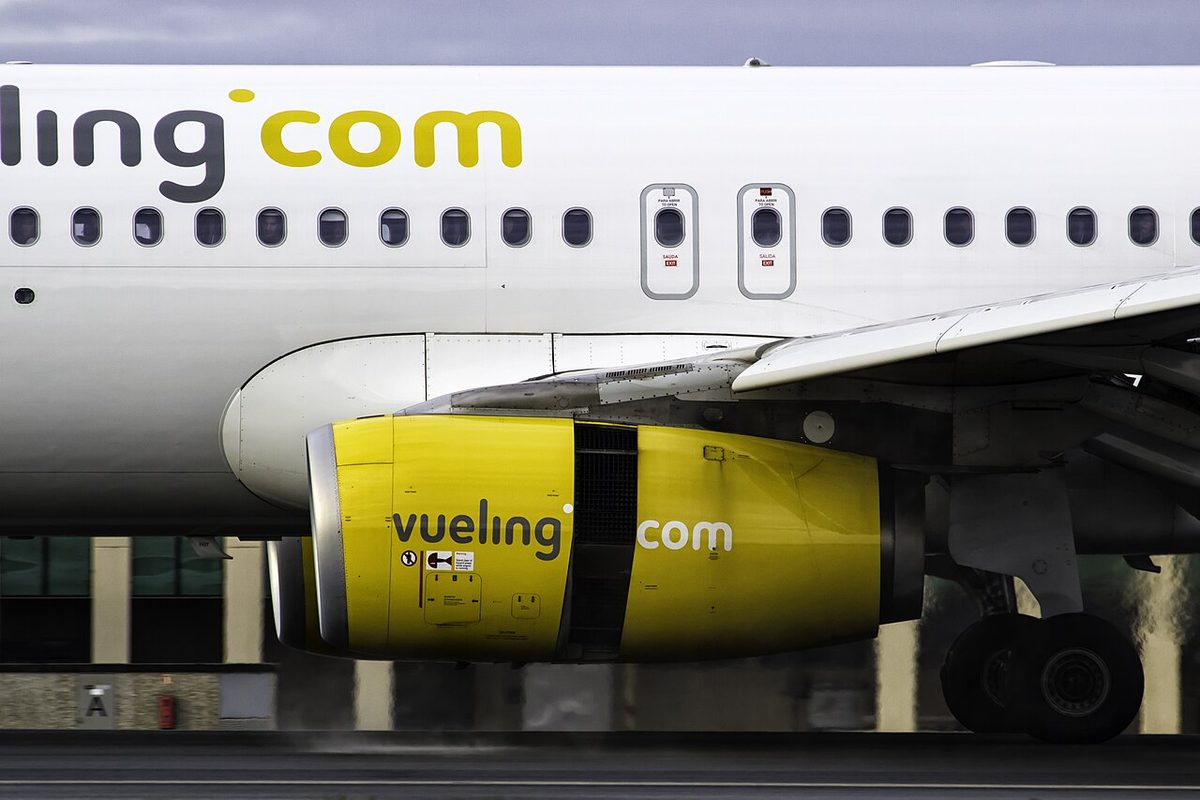
The CFM56-5B of the A320 uses a different cold-stream design, the pivoting-door reverser. Each reverser has four doors set into the fan cowl, each with its own actuator and latch. When deployed, the doors pivot into the fan duct, blocking it and turning the fan air outward and forward through the openings in the cowl, while the core exhaust is not reversed. Full deployment takes less than 2 seconds.
A reverser is often an airframe part not supplied by the engine manufacturer. CS 25.934 nevertheless requires reversers to meet the engine test requirements of CS-E 890, which call for the reverser to be fitted for the engine's endurance test; for the A320neo, whose engine makers ran that test without it, EASA accepted an equivalent means of compliance.
Actuation and hydraulic control
Most airliner reversers are hydraulic. On the A320, engine 1's reverser is powered by the green system and engine 2's by the yellow system; on the 737, engine 1's by system A and engine 2's by system B, with the standby system as an alternate source that deploys and stows the reverser more slowly, so some thrust asymmetry can be expected (see hydraulic pumps and power sources). Pneumatic actuators driven by bleed air are used on some aircraft, and the Boeing 787 uses electric actuation.
The four actuators of each CFM56-5B reverser work under a hydraulic control unit (HCU), and the FADEC monitors the pressure in the HCU downstream of its pressurising valve. The 737 uses an isolation valve and a control valve. Its amber REVERSER light comes on when the reverser is commanded to stow and goes out about 10 seconds later, when the isolation valve closes; if it stays on for more than about 12 seconds, a malfunction has occurred and the master caution lights.
Several conditions must be met before the reverser moves:
- The forward thrust lever must be at idle; reverse cannot be selected otherwise, and once reverse is selected a locking pawl stops the 737's forward thrust lever from moving.
- The aircraft must be on the ground. The 737 reverser can deploy when either radio altimeter senses less than 10 ft or the air/ground system is in ground mode; the A320 needs both main landing gear compressed, a reverse signal from at least one SEC and one FADEC channel operating.
- While the reverser is in transit, the engine is held at reverse idle. On the 737 the reverse thrust lever is blocked at the reverse idle position until the reverser is more than 60% deployed; on the A320 and the E190-E2 the engine control holds idle until deployment is complete.
On the A320 the pilot lifts the reverser latching levers on the thrust levers to pass the forward idle stop. The REV indication on the engine display is amber while the reverser is unlocked or in transit and green when it is fully deployed, and on the 737 the crew call "reversers normal", or "no reverser" for the engine concerned.
Locks and auto-restow
A stowed reverser is held by several independent locks, so that a single failure should not deploy it. Each door of the A320's CFM56-5B reverser has its own latch, and the 737's reverser has a synchronisation shaft lock; a failure detected in its circuitry lights the amber REVERSER light. Improved locking systems followed the loss of Lauda Air Flight 004 after an in-flight reverser deployment.
Certification sets the standard. JAR 25.933(a), part of the A320's certification basis and quoted in the annex to its EASA type-certificate data sheet, requires that a reverser intended for ground operation only be designed so that "during any reversal in flight, the engine will produce no more than flight idle thrust", and that either the reverser can be restored to forward thrust, or the aeroplane can continue safe flight and landing with the reverser in any possible position.
Thrust reverser auto-restow is one way of meeting the first option. On the 737, an auto-restow circuit compares the actual and commanded sleeve positions; if stowage is incomplete or the sleeves move towards deploy without a command, it opens the isolation valve and drives them back to stowed, and holds them there until the reverser is commanded to deploy or maintenance action is taken. A pause of about 16 seconds while stowing can engage the electro-mechanical lock and stop the sleeves in mid-travel. The A320 originally had an in-flight auto-restow; for the A320-214 with CFM56-5B4 engines and for the A321, Airbus deleted it, and the equivalent safety findings recorded in the data sheet accepted the deletion because in-flight deployment had been shown to be extremely improbable and the deletion improved protection against inadvertent deployment. On the ground before take-off, the automatic restow remains, and if it fails a REV FAULT warning prohibits dispatch (see failure conditions and system safety).
Reverse idle and use on landing
Reverse is selected immediately after the main landing gear touches down. A320 crews select maximum reverse or reverse idle, the lowest reverse setting, which gives slightly more thrust than forward idle; maximum reverse is mandatory in an emergency, when the deceleration is not as expected, after a failure affecting landing performance, after a long flare or touchdown and with an unexpected tailwind. On the 737, reverse idle is detent No. 1, detent No. 2 gives reverse adequate for normal operations, and pulling beyond it gives maximum reverse. Once reverse has been selected, only a full-stop landing can be made: an engine that stayed in reverse would make safe flight impossible.
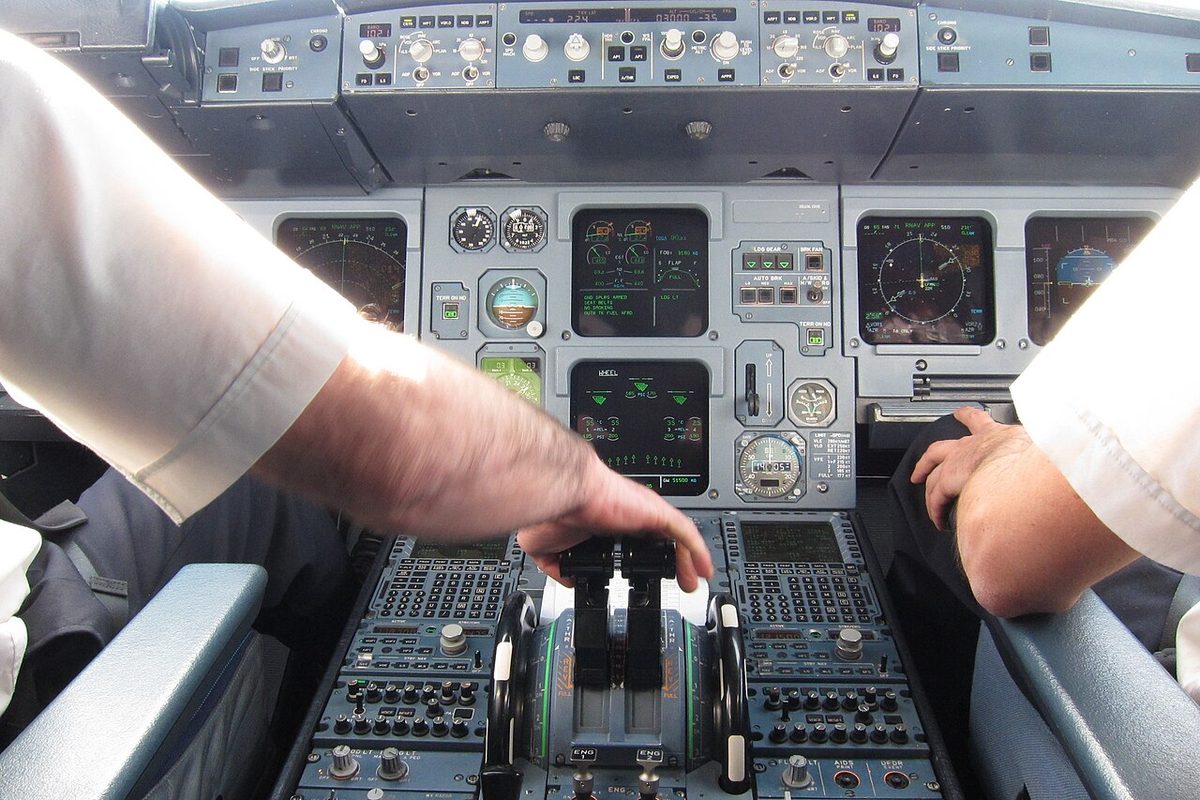
Reverse is reduced as the aeroplane slows:
| Type | Practice |
|---|---|
| A320 | Reverse idle at the "seventy knots" call; maximum reverse not below 70 kt; idle reverse permitted to a stop; stow at taxi speed, at 25 kt on snow |
| Boeing 737 | By 60 kt, begin reducing so as to reach reverse idle before taxi speed, then stow |
| E190-E2 (one operator) | Minimum reverse at 60 kt, reversers closed at 30 kt |
When stowing, the thrust levers must not be pushed past forward idle, and reverse is never used to move the aircraft backwards on the A320. In a rejected take-off, 737 crews apply maximum reverse consistent with conditions and return to reverse idle by taxi speed if the runway allows.
Performance rules give reverse thrust limited credit. No credit is taken on a dry runway, either in the certified landing distance or in the accelerate-stop distance, while wet and contaminated runway data may include it (see landing distance). With one reverser inoperative on a twin with wing-mounted engines, operators may forbid use of the working reverser because of the yaw it would cause. On the E190-E2, selecting maximum reverse on both levers then gives only minimum reverse on the working engine; maximum reverse must be selected on that engine alone.
Reverse also affects directional control. In a crosswind on a slippery runway, part of the reverse thrust pulls the aeroplane towards the downwind edge once it weathercocks. The recovery is to reduce to reverse idle and release the brakes, regain the centreline with rudder and nosewheel steering, then reapply reverse and braking (see wet and contaminated runways).
Exhaust gas re-ingestion
At low forward speed, the air turned forward by the reverser meets little opposing airflow, and the intake's suction can draw it back into the engine together with hot gas and runway debris. This exhaust gas re-ingestion distorts the airflow into the compressor, can cause engine stalls with an excessive EGT, and throws runway debris into the fan. That is the reason for the low-speed limits above, which the ATPL texts give as reverse idle at typically 60 to 80 kt, and for keeping power to a minimum in all ground operations, reverse included (see bird strike and foreign object damage).
Uncommanded deployment
An uncommanded thrust reverser deployment in flight produces sudden asymmetric thrust and drag, and the protections against it are layered: the locks prevent it, the engine control limits the thrust if it happens, and the crew are warned. On the A320, if all four doors are unstowed, or if a door is unstowed or its position indefinite with pressure in the HCU, and reverse has not been selected, the FADEC's idle protection commands idle thrust. The ENG REVERSE UNLOCKED warning comes on when a door is not locked stowed in flight, or on the ground without a deploy order, and the REV indication flashes for 9 seconds before remaining steady; ENG REV PRESSURIZED shows hydraulic pressure in the reverser with the doors stowed and no deploy order. The ATPL texts add two further safeguards found on some types: a deployment during forward thrust may close the thrust lever automatically, and a restow during reverse may move the reverse lever back to the deploy position. The 737 MAX replaced the NG's REVERSER light with REVERSER LIMITED and added REVERSER COMMAND and REVERSER AIR/GND alerts.
Exam tip: Reverse thrust can be selected only with the forward thrust lever at idle and the aircraft on the ground. Under JAR 25.933(a), a reversal in flight must leave the engine at no more than flight idle, and it must be restowable or the aeroplane must be controllable with it in any position.
Frequently asked questions
How does a thrust reverser work?
It blocks the engine's normal flow path and turns the air forward. On older turbojets and low-bypass engines, clamshell or target doors at the rear act on the whole exhaust. On high-bypass turbofans only the fan air is reversed: a translating sleeve slides aft and blocker doors turn the fan flow outward and forward through cascade vanes, or pivoting doors in the fan cowl do the same. The core exhaust keeps pushing forward.
Why is reverse thrust reduced to idle at low speed?
At low forward speed the air turned forward by the reverser can be drawn back into the engine intake, with hot gas and runway debris. Re-ingestion distorts the airflow, can stall the compressor and raise the EGT, and can damage the engine. Reverse is therefore reduced at a speed set by the manufacturer: to reverse idle at 70 kt on the A320, and on the Boeing 737 from 60 kt so as to reach reverse idle by taxi speed. The reversers are stowed at taxi speed.
Can thrust reversers be deployed in flight?
Not on airliners. Their reversers are for ground use only, and air/ground logic, thrust lever interlocks and several independent locks prevent deployment in flight. The certification basis of the A320, JAR 25.933(a), requires that a reversal in flight leave the engine producing no more than flight idle thrust, and that the reverser can be restowed or the aeroplane can land safely with it in any position.
Is reverse thrust included in landing distance calculations?
Not in the certified dry-runway landing distance or the dry-runway accelerate-stop distance, which take no credit for it. On wet and contaminated runways the performance data may take credit for reverse thrust, where it matters most because it does not depend on tyre friction. A reverser deferred under the minimum equipment list removes that credit and brings its own landing distance penalty.
What is reverse idle?
Reverse idle is the lowest reverse setting: the reverser is deployed but the engine runs at idle. On the A320 it gives slightly more thrust than forward idle and may be used down to a stop. Crews may select it after touchdown when maximum reverse is not needed, and return to it from maximum reverse as the aircraft slows, because at low speed higher reverse settings risk re-ingestion.
Test yourself on Thrust Reversers and Reverse Thrust
The v1prep banks cover this topic in Aircraft General Knowledge (021), with a worked explanation for every answer. EASA ATPL, PPL, IR and CPL, the FAA written tests and A320/B737 type ratings.
Start practising →Sources and further reading
- 14 CFR 25.933, Reversing systems
- EASA Easy Access Rules for Large Aeroplanes (CS-25), CS 25.933 and CS 25.934, thrust reversers
- EASA TCDS EASA.A.064, Annex I, Special Conditions and Equivalent Safety Findings (P-1002 and P-3008 Thrust Reverser Autorestow, E-43 Thrust Reverser Testing)
- FAA Aviation Maintenance Technician Handbook, Powerplant (FAA-H-8083-32B)
- EASA, Explanatory Note to ED Decision 2018/001/R, Part-FCL theoretical knowledge learning objectives (021 Powerplant)
- FAA AC 91-79B, Aircraft Landing Performance and Runway Excursion Mitigation
Library articles are written for study and exam preparation. They do not replace your aircraft's approved documentation, your operator's procedures or the regulations themselves.