Propellers and Propeller Control
Propeller control is the regulation of a propeller's blade angle. A fixed-pitch propeller has one angle; a constant-speed propeller has a governor that varies the angle automatically to hold the rpm the pilot selects, and may add feathering, fine-pitch stops and reverse pitch.
A propeller converts engine torque into thrust, and how well it does so depends on the angle at which its blades meet the air. That angle changes with airspeed and rpm throughout a flight. Propeller control is the means of keeping it right: nothing at all on a fixed-pitch propeller, a pilot's selection on a controllable-pitch propeller, and an automatic governor on the constant-speed propellers of most higher-performance aeroplanes.
On multi-engine aeroplanes and turboprops the pitch-change mechanism does more. It can feather the propeller of a failed engine, hold the blades above a minimum angle in flight, and reverse them to help stop the aeroplane on landing. The aerodynamics of the blade itself, helix angle, twist and efficiency, are covered in propeller aerodynamics.
Blade pitch: fine and coarse
The blade angle, or pitch, is the angle between the blade's chord line and the plane of rotation, measured at a reference station along the blade. A small blade angle is fine pitch (low pitch); a large one is coarse pitch (high pitch).
- In fine pitch, each revolution takes a small bite of air. The propeller absorbs little torque per revolution, so the engine can turn fast and develop full power at low airspeed: the setting for take-off and climb.
- In coarse pitch, each revolution takes a larger bite. At high airspeed the blade still meets the air at an efficient angle, and the engine turns more slowly for the same power: the setting for cruise.
The hub is usually covered by a spinner, a streamlined fairing that reduces the drag of the hub.
Fixed-pitch propellers
A fixed-pitch propeller has a single blade angle, chosen by the manufacturer, and works at its best angle of attack at only one combination of airspeed and rpm. Manufacturers sometimes offer two versions for the same aeroplane:
- a climb propeller, with finer pitch, which lets the engine reach full rpm at low airspeed for take-off and climb but over-revs at high cruise speeds;
- a cruise propeller, with coarser pitch, efficient at high speed but slower to accelerate and climb.
With a typical fixed-pitch propeller sized for cruise, the blades are at too coarse an angle for the conditions during the take-off run: the airspeed is low, the blade angle of attack is excessive and the propeller's torque holds the rpm below maximum even at full throttle. As speed builds, the angle of attack falls towards its optimum and the rpm rises. On a fixed-pitch aeroplane the tachometer is the main power indication, so a loss of power, such as carburettor icing, shows directly as a fall in rpm.
Controllable and constant-speed propellers
A controllable-pitch propeller can change its blade angle in flight. In its simplest form the pilot sets the blade angle directly. The FAA counts a controllable-pitch propeller, with retractable gear and flaps, among the features that make an aeroplane a "complex airplane", for which a logbook endorsement is needed.
A constant-speed propeller is a controllable-pitch propeller governed automatically. The pilot selects an rpm with the propeller lever, and a propeller governor, or constant speed unit (CSU), varies the blade angle to hold that rpm as airspeed, attitude and power change. Power is then set with two levers: the throttle sets the manifold pressure, and the propeller lever sets the rpm.
The governor's behaviour follows from one rule: it holds rpm by changing pitch.
- Throttle opened, propeller lever untouched: engine torque rises, the rpm begins to rise, and the governor coarsens the blades to absorb the extra power at the same rpm. Only manifold pressure and fuel flow show the change.
- Airspeed increasing in a descent: the blade angle of attack falls, the rpm tends to rise, and the governor coarsens the blades.
- Airspeed decreasing in a climb: the rpm tends to fall, and the governor fines the blades.
Because the governor holds the rpm, a loss of power, such as carburettor icing, shows as a fall in manifold pressure, not rpm, or as a slow loss of airspeed in level flight.
Exam tip: when increasing power, move the propeller lever forward before the throttle; when reducing power, throttle back before the rpm. High manifold pressure at low rpm gives high cylinder pressures and invites detonation.
Governor and constant speed unit
The governor is driven by the engine and contains three key parts:
- Flyweights, which swing outwards as rpm rises and represent the actual rpm;
- the speeder spring, which pushes against the flyweights and whose compression is set by the propeller lever: lever forward, more compression, higher selected rpm;
- the pilot valve, positioned by the balance between the two, which directs oil to or from the pitch-change mechanism in the hub.
When flyweight force and spring force balance, the governor is on speed: the pilot valve is neutral and the blade angle holds steady. In an overspeed, the flyweights move outwards, the pilot valve moves, and oil flows so as to coarsen the blades; propeller torque rises until the rpm falls back to the selected value. In an underspeed, the flyweights collapse inwards, the speeder spring moves the valve the other way, and the blades are fined until the engine accelerates the propeller back to the selected rpm.
In a single-acting propeller, oil pressure acts on one side of the pitch-change piston only, and a mechanical force opposes it. Which way the oil pushes depends on the design:
| Installation | Oil pressure drives blades | Opposing force drives blades | If oil pressure is lost |
|---|---|---|---|
| Typical single-engine, non-feathering | Towards coarse | Towards fine: centrifugal twisting moment and a spring | Fine-pitch stop, tendency to overspeed |
| Typical light twin, feathering | Towards fine | Towards coarse and feather: springs and counterweights | Towards feather |
The centrifugal twisting moment of the spinning blades tends to turn them towards fine pitch, and the aerodynamic twisting moment towards coarse; the first is normally the larger. In a double-acting mechanism, oil pressure is directed to either side of the piston. The engine oil must be warmed to the temperature the flight manual prescribes before the propeller is exercised, because cold, thick oil moves sluggishly through the governor and hub.
Propeller overspeed and underspeed
In the governor's own language, overspeed and underspeed are the small, momentary departures from the selected rpm that it corrects all the time. A propeller overspeed in the wider sense is an rpm above the engine or propeller limit, which the governor has failed to prevent.
On a typical single-engine aeroplane, a total loss of governor oil pressure lets the blades run onto the fine-pitch stop, and the engine tends to overspeed. The pilot contains it with the throttle and by reducing airspeed. A fixed-pitch propeller can overspeed in a dive, since nothing coarsens its blades as airspeed rises. Turboprops commonly have an overspeed governor, a separate device that limits rpm if the primary governor fails.
Propeller rpm and diameter are limited by the tips: the tip meets the air at the combination of its rotational speed and the aeroplane's true airspeed, and as that approaches the speed of sound, shock waves cut thrust and raise drag and noise sharply.
Feathering and unfeathering
A feathering propeller can be turned fully coarse, until its blades lie edge-on to the airflow at about 90° to the plane of rotation. The blades then produce no useful aerodynamic force, the propeller stops, and the drag is the least of any condition of a dead engine's propeller:
- windmilling, particularly in fine pitch: the greatest drag;
- stopped with the blades flat: less;
- feathered: the least.
Propeller feathering matters most on twins. After an engine failure a constant-speed unit reads the falling rpm as an underspeed and fines the blades, so, left alone, the propeller windmills in fine pitch, adding large asymmetric drag and yaw and risking further damage to the engine. Feathering removes that drag, improves climb performance and reduces the minimum control speed; see asymmetric flight. On a light twin, moving the propeller lever to the feather position releases the hub oil, and the springs and counterweights drive the blades to feather. A single-engine aeroplane usually cannot feather, but after an engine failure the drag of a windmilling constant-speed propeller can be reduced by pulling the propeller lever fully back to coarse.
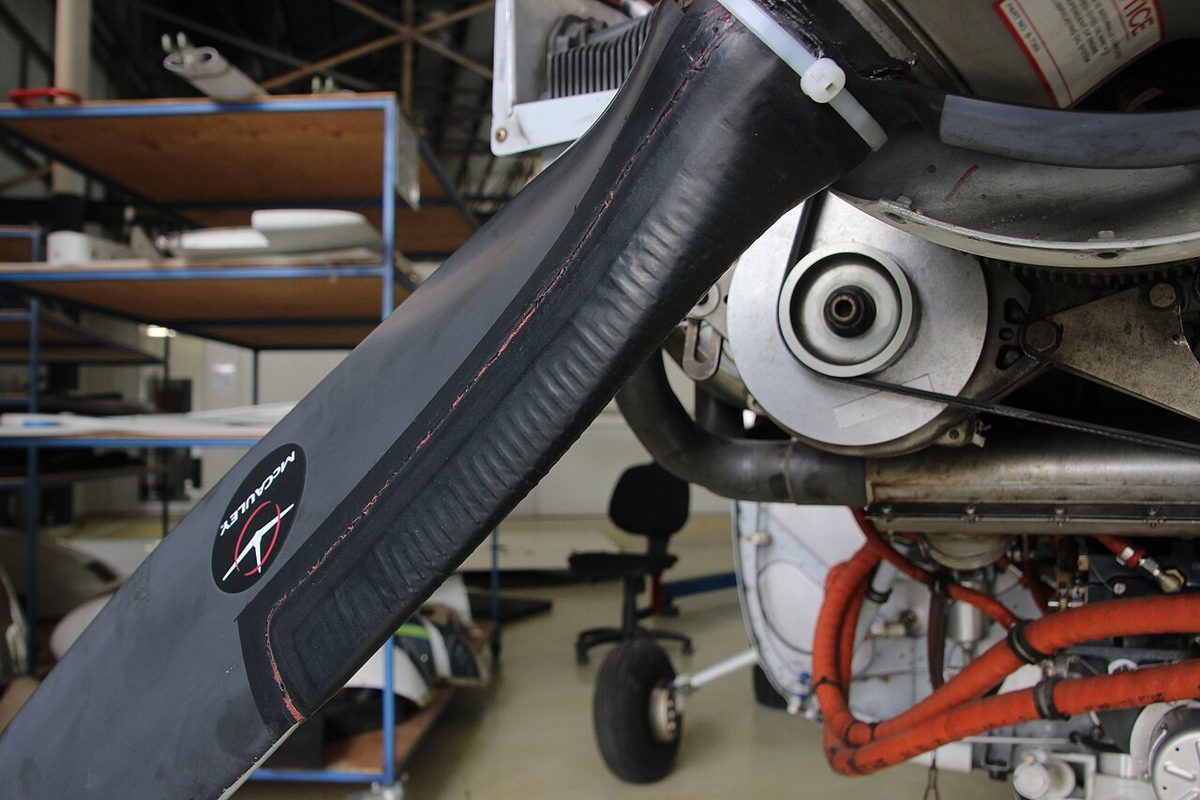
Centrifugal latches, or anti-feathering latch pins, stop a feathering propeller from feathering during a normal shutdown on the ground. As rpm decays at shutdown, spring-loaded pins engage and hold the blades short of feather. In flight, a windmilling propeller turns fast enough to keep them disengaged, but if the rpm is allowed to decay too far before the pilot feathers, the latches engage and feathering is no longer possible. Feathering is therefore completed promptly after an engine failure.
An automatic feathering system, or autofeather, fitted to some multi-engine aeroplanes, feathers the propeller of a failed engine without waiting for the crew. Where one is fitted, certification may establish the minimum control speed with that propeller feathered rather than windmilling; see minimum control speeds.
To unfeather in flight, the blades must be driven back towards fine so that the airflow can turn the engine for a restart. On some light twins an unfeathering accumulator stores governor oil under gas pressure while the engine runs; releasing it drives the blades out of feather without prolonged use of the starter motor.
Fine-pitch stops and reverse pitch
A propeller fine-pitch stop is the mechanical limit to how fine the blades can go. In flight it keeps the blade angle above a minimum, protecting against overspeed and the very high drag of a propeller windmilling at a very fine angle. A wrongly set fine-pitch stop shows up in the engine's ground power check.
On many turboprops the flight fine-pitch stop can be withdrawn on the ground, letting the pilot control blade angle directly through the power levers, down to a ground fine setting and beyond. Propeller reverse pitch turns the blades to a negative angle, so that the propeller pushes air forwards and produces reverse thrust. Because it is achieved simply by changing blade angle, reverse pitch acts quickly and stays effective down to low speed during the landing roll; see landing distance. Selecting ground fine or reverse in flight would be hazardous, so the systems are protected against it.
Synchronisers and reduction gearing
On a twin, two propellers turning at slightly different rpm produce an audible beat and vibration. A propeller synchroniser trims the governor of the slave engine so that its rpm matches the master engine's exactly. Because the slave could follow a failing master engine's rpm downwards, manufacturers require the synchroniser to be off for take-off and landing and after an engine failure.
A propeller reduction gearbox lets the propeller turn more slowly than the engine. An engine develops more power at high rpm, but a large propeller turning that fast would have supersonic tips. Propeller reduction gearing resolves the conflict, which is why faster piston aeroplanes and all turboprops use it; smaller light-aircraft engines drive the propeller directly from the crankshaft. The torque reactions of the turning propeller are described in propeller torque and slipstream effects.
Frequently asked questions
What is the difference between fine pitch and coarse pitch?
Pitch describes the blade angle, the angle between the blade chord and the plane of rotation. Fine pitch is a small blade angle: each revolution takes a small bite of air, the engine can reach high rpm, and it suits take-off and climb at low airspeed. Coarse pitch is a large blade angle: each revolution takes a bigger bite, the rpm is lower for a given power, and it suits cruise at high airspeed.
How does a constant-speed propeller work?
The pilot selects an rpm with the propeller lever, which sets the compression of the speeder spring in the governor. Engine-driven flyweights in the governor sense the actual rpm. If the rpm rises above the selected value, the flyweights move outwards and direct oil to coarsen the blades; if it falls, they move inwards and the blades are fined. When flyweight force and spring force balance, the governor is on speed and the blade angle stays steady.
Why is the propeller of a failed engine feathered?
A constant-speed unit reads the falling rpm of a failed engine as an underspeed and fines the blades, so the propeller windmills in fine pitch, the condition with the most drag. Feathering turns the blades edge-on to the airflow: the propeller stops, the drag is the least possible, the yaw on a twin is reduced and the dead engine is not turned further. Climb performance and directional control both improve.
What happens if a constant-speed propeller loses oil pressure?
It depends on the design. On a typical single-engine aeroplane with a non-feathering propeller, oil pressure drives the blades coarse, so without it the centrifugal twisting moment and a spring drive them onto the fine-pitch stop, and the engine tends to overspeed. On a light twin with feathering propellers, oil pressure holds the blades fine, so without it springs and counterweights drive them towards feather.
What does a propeller synchroniser do?
A propeller synchroniser adjusts the governor of the slave engine so that its rpm matches the master engine's exactly. This removes the beating noise and vibration caused by a small rpm difference between the two propellers. Because the slave engine could follow a failing master engine's rpm downwards, manufacturers typically require the synchroniser to be off for take-off and landing and after an engine failure.
Test yourself on Propellers and Propeller Control
The v1prep banks cover this topic in Aircraft General Knowledge (021), with a worked explanation for every answer. EASA ATPL, PPL, IR and CPL, the FAA written tests and A320/B737 type ratings.
Start practising →Sources and further reading
- FAA Pilot's Handbook of Aeronautical Knowledge (FAA-H-8083-25C), Chapter 7, Aircraft Systems (propellers)
- FAA Airplane Flying Handbook (FAA-H-8083-3C), Transition to Multiengine Airplanes
- FAA Aviation Maintenance Technician Handbook, Powerplant (FAA-H-8083-32B), Propellers
- 14 CFR 61.1, Applicability and definitions (complex airplane)
- EASA Easy Access Rules for Aircrew (Part-FCL), AMC and GM with the theoretical knowledge syllabus (021, Powerplant)
Library articles are written for study and exam preparation. They do not replace your aircraft's approved documentation, your operator's procedures or the regulations themselves.