Pressure Altimeter
A pressure altimeter is an aneroid barometer graduated in feet. It measures the static pressure around the aircraft and displays the height at which that pressure occurs in the International Standard Atmosphere, relative to the reference pressure the pilot sets on its subscale.
The pressure altimeter is a barometer graduated in feet. It measures the static pressure of the air around the aircraft and shows the height at which that pressure would be found in the International Standard Atmosphere (ISA), counted from a reference pressure the pilot sets. It is the primary altitude instrument of almost every aircraft, and the one on which vertical separation, terrain clearance and approach minima depend.
Because it infers height from pressure, the altimeter is only as good as its assumptions: a correct setting on the subscale, an atmosphere close to ISA and a static source free of error. This article describes how the instrument works, the forms it takes and the errors it suffers. Which setting to use and when, QNH, QFE or standard, is covered under altimeter settings.
Principle of the pressure altimeter
Static pressure falls with height, but not linearly. Near sea level 1 hPa corresponds to about 27 to 30 ft; at FL200 it is about 50 ft and near FL400 about 100 ft, because the air is thinner. The altimeter is calibrated to the ISA pressure and height relationship: 1013.25 hPa and +15 °C at mean sea level, a temperature lapse of 1.98 °C per 1,000 ft up to 36,090 ft and a constant −56.5 °C above. Its linkage includes a variable magnification so that the uneven pressure changes produce an evenly spaced scale.
The instrument takes only static pressure, supplied by the pitot-static system. With 1013.25 hPa set, it shows pressure altitude; with any other setting, it shows the ISA height difference between the measured pressure and the setting. FAA material calls the reading with the current local setting the indicated altitude. The actual height above sea level, the true altitude, equals indicated altitude only when the setting is correct and the air column below the aircraft matches ISA.
Aneroid capsule mechanism
The sensing element is the aneroid capsule: a thin corrugated metal capsule, sealed and evacuated or nearly so, held open against the surrounding pressure by its own springiness or a spring. It sits in an airtight case connected to the static line. When static pressure falls in a climb, the capsule expands; when it rises in a descent, the capsule contracts. A linkage of levers and gears magnifies that small movement and drives the pointers.
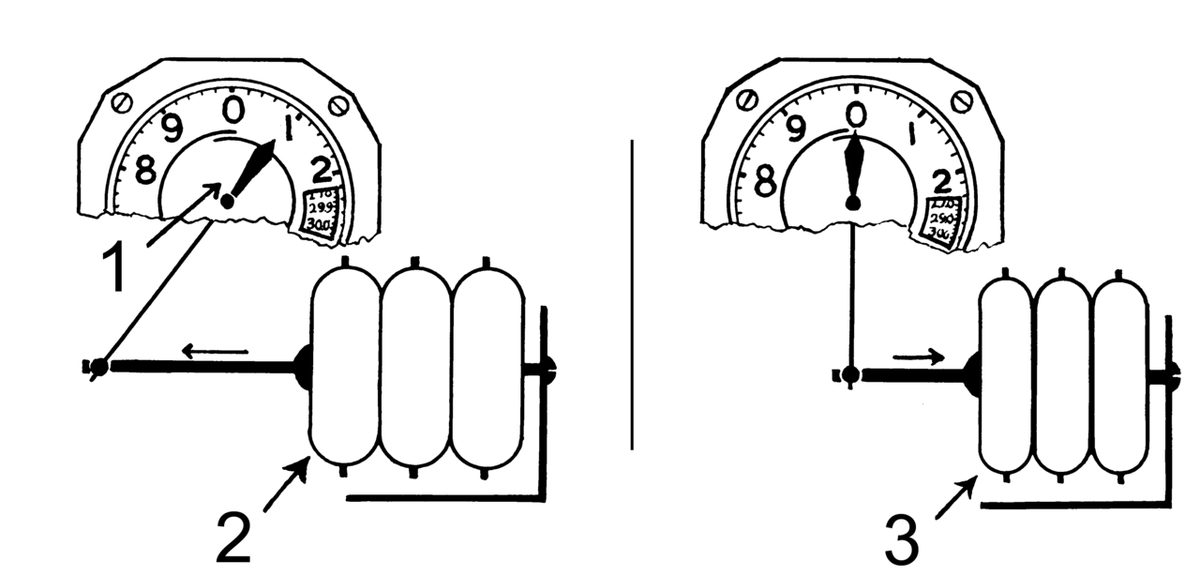
Temperature changes inside the instrument would alter the springiness of the capsule and the length of the linkage, so a bimetallic compensator corrects for them. It deals only with the temperature of the mechanism. It does nothing about the temperature of the atmosphere, which is the cause of the separate temperature error described below.
The simple altimeter has a single capsule, a single pointer and no adjustable subscale. The cabin altimeter of a pressurised aircraft is an instrument of this simple kind.
Sensitive, servo and encoding altimeters
The sensitive altimeter is the standard mechanical instrument. It uses a stack of two or three capsules for greater movement, jewelled bearings to reduce friction, a display of three pointers geared 100 : 10 : 1, and a variable-datum subscale that the pilot sets with a knob.
The servo altimeter removes the mechanical link between capsule and pointers. An electrical pick-off, typically an inductive E and I bar, senses the capsule's position; an amplifier drives a servo motor that positions the pointers and counters. Friction and linkage lag almost disappear: lag becomes negligible below rates of about 10,000 ft/min, and accuracy at high altitude is better than that of a sensitive altimeter.
An encoding altimeter also provides an output for the transponder. It sends altitude in 100 ft increments in a Gillham code, a modified Gray code, and the encoded value is always pressure altitude referenced to 1013.25 hPa, whatever the pilot has set on the subscale. Air traffic control converts it to altitude on QNH at low levels and uses it directly as a flight level higher up (see transponder and SSR).
On transport aircraft the captain's and first officer's altitudes are computed by separate air data computers, each with its own static source and automatic position error correction, while a standby altimeter remains pneumatic and fed from a third, independent static system.
Altimeter displays and subscale
The three-pointer altimeter has a long pointer reading 100 ft per division (one revolution per 1,000 ft), a short pointer reading thousands and a very short pointer reading tens of thousands. The pointers look alike, and misreading the display by 10,000 ft, for example taking 9,650 ft for 19,650 ft, contributed to accidents. A striped or crosshatched sector that appears below 10,000 ft is a reminder of which ten thousand the aircraft is in; it signals nothing about serviceability.
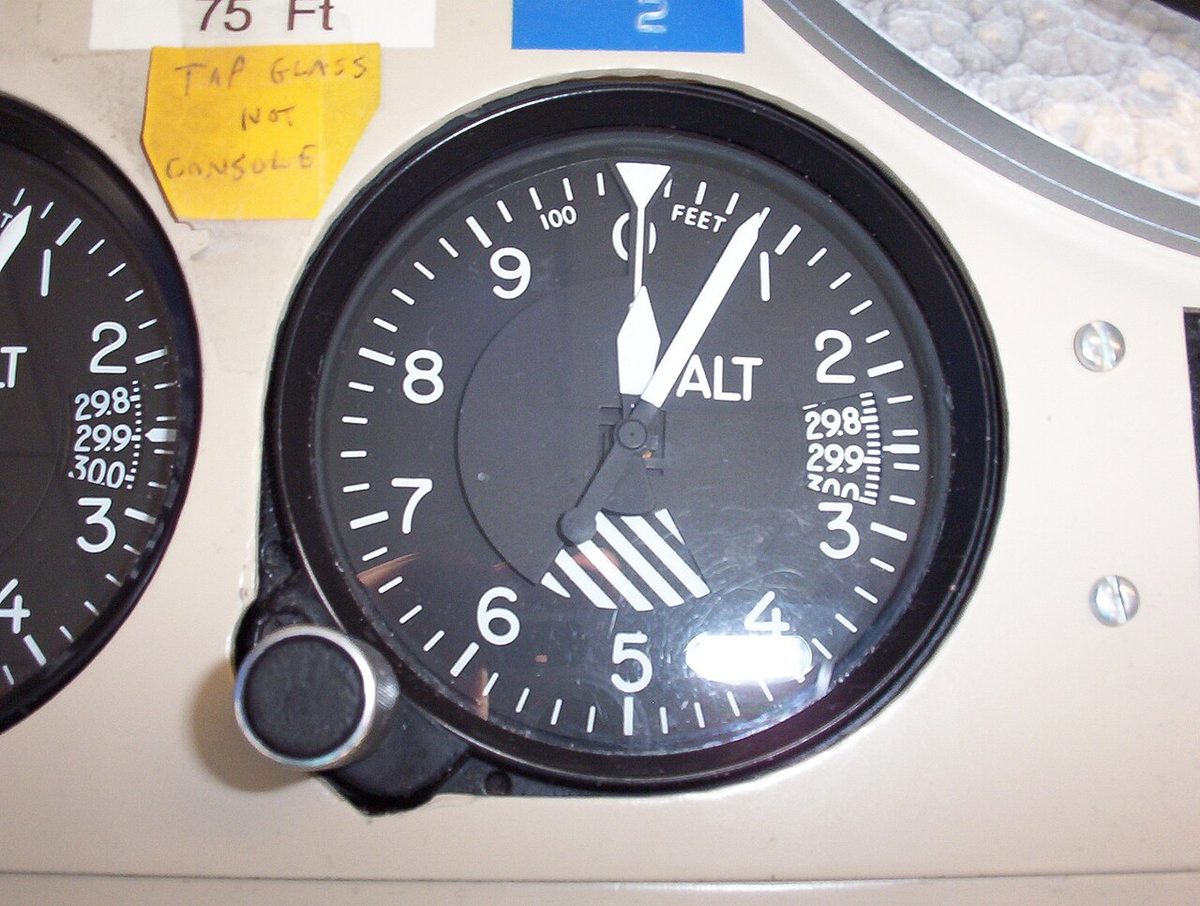
The counter-pointer altimeter, or drum-pointer altimeter, removes the ambiguity by showing thousands of feet on a rolling digital counter and hundreds on a single pointer that turns once per 1,000 ft. The pointer is kept because the eye reads its movement as a rate of change more easily than it reads changing digits. Electronic flight displays use a vertical altitude tape with a digital readout; the Boeing 737 PFD shows a green crosshatch below 10,000 ft and boxes the barometric setting in amber if a local setting is still set when climbing above the transition altitude, or standard when descending below the transition level.
The altimeter subscale, known in the United States as the Kollsman window, shows the reference pressure in hectopascals, inches of mercury or both. Turning the knob to a higher setting increases the reading. Before flight, with QNH set, the altimeter should read the known aerodrome or checkpoint elevation: PANS-OPS tolerances are ±60 ft for instruments tested to 30,000 ft and ±80 ft for those tested to 50,000 ft, and the FAA's Instrument Flying Handbook and AIM 7-2-3 use 75 ft before an IFR flight. Where no local setting is available, setting the elevation and reading the subscale gives a usable value to compare with nearby stations.
Barometric error: high to low
Barometric error, or altimeter setting error, is the error produced by a subscale setting that no longer matches the real reference pressure. Flying towards lower pressure with the old setting, the aircraft follows the descending pressure surfaces and the altimeter over-reads by about 27 to 30 ft per hectopascal, or about 1,000 ft per inch of mercury. An aeroplane indicating 3,500 ft with 1020 hPa set in an area where the QNH is 1005 hPa is 15 hPa, about 450 ft, lower: roughly 3,050 ft. The memory aid is "high to low, look out below".
The same logic explains why the UK uses the lowest forecast QNH as its regional pressure setting: a setting lower than the actual QNH makes the altimeter under-read, so the aircraft is at or above its indicated altitude.
Exam tip: a setting higher than the actual pressure makes the altimeter read high; a setting lower than the actual pressure makes it read low. Set 1002 hPa on a 350 ft aerodrome where the QNH is 993 hPa and the altimeter shows about 590 to 620 ft on the ground, 9 hPa too high.
Temperature error and cold corrections
Altimeter temperature error arises because the calibration assumes ISA temperatures. In air colder than ISA, pressure falls faster with height, the pressure levels crowd closer to the ground and the altimeter over-reads; in warmer air it under-reads. "High to low" therefore applies to temperature as well as pressure.
The error is proportional to the height of the aircraft above the source of the altimeter setting and to the temperature deviation. PANS-OPS gives a rule of thumb of 4 per cent of that height for every 10 °C below standard, about 4 ft per 1,000 ft per degree. At an aerodrome 2,000 ft high reporting −14 °C, 25 °C colder than ISA for its elevation, a final approach fix published at 5,000 ft lies 3,000 ft above the aerodrome, so the correction is about 4 × 3 × 25 = 300 ft.
A cold temperature altimeter correction is added to published minimum altitudes on cold days, and ATC is told when corrected altitudes are flown on segments it controls; FAA procedures name the intermediate and missed approach segments. The FAA publishes Cold Temperature Airports, marked on charts with a snowflake and a temperature, at or below which corrections are applied to the listed segments. Baro-VNAV approaches carry temperature limits for the same reason. Above the transition altitude all aircraft on standard pressure share the error, so vertical separation between them is preserved, but terrain clearance is not. The method is set out in cold-weather altimetry.
Lag, pressure and altimetry system errors
Instrument error covers manufacturing tolerances, friction and backlash in the mechanism, and the slowness of a capsule to return to its shape after a long time at one level (hysteresis). Altimeter lag error makes a mechanical altimeter under-read in a climb and over-read in a descent, because the pointer cannot keep up with a rapid change; servo and air data driven displays largely eliminate it.
Altimeter pressure error, the position error of the static source, comes from the airframe disturbing the airflow at the static port. It varies with speed, angle of attack and configuration, and in ground effect most installations sense a higher pressure, so the altimeter reads slightly low. For transport aeroplanes, 14 CFR 25.1325 and its CS-25 equivalent limit the resulting altitude error to ±30 ft per 100 kt of speed between 1.23 VSR0 with flaps extended and 1.7 VSR1 with flaps retracted; air data computers apply a static source error correction. Manoeuvre-induced error gives brief false readings in rapid pitch changes.
A blocked static source freezes the altimeter at the altitude of the blockage. A static line leaking into a pressurised cabin makes it read close to the cabin altitude instead. Selecting a cabin alternate static source in an unpressurised aircraft makes it read slightly high.
Altimetry system error (ASE) is the total difference between the altitude an aircraft's system displays with standard pressure set and the pressure altitude of the undisturbed air it is flying in. It is the combined result of the errors described above. Reduced vertical separation minima (RVSM) depend on keeping it small, so RVSM aircraft are specifically approved, their height-keeping is monitored, and the crew compares the two primary altimeters, which must agree within 200 ft in flight. On the ground, the Boeing 737's limits for RVSM operation are 50 ft between the captain's and first officer's displays at field elevations up to 5,000 ft, 60 ft from 5,001 to 10,000 ft, and 75 ft between either display and field elevation. Its standby altimeter does not meet RVSM accuracy.

Cabin altimeter
A pressurised aircraft also carries a cabin altimeter. It is a simple aneroid instrument, calibrated to standard pressure, that measures cabin pressure and shows it as cabin pressure altitude, normally no more than about 8,000 ft in the cruise. With the cabin vertical speed indicator and the differential pressure gauge it forms the minimum set of pressurisation indications; on the Boeing 737 cabin altitude and differential pressure share one dual-scale instrument. Oxygen rules are written in terms of cabin pressure altitude, and transport certification rules require a warning to the crew when it exceeds 10,000 ft (see decompression and pressurisation).
Note: the radio altimeter is a different instrument altogether. It measures height above the terrain directly beneath the aircraft by timing a radio signal, and has neither a subscale nor any barometric or temperature error.
Frequently asked questions
How does a pressure altimeter work?
A pressure altimeter contains one or more sealed, evacuated capsules inside a case connected to the static ports. As the aircraft climbs and static pressure falls, the capsules expand, and a linkage or servo drives the pointers. The scale is calibrated using the pressure and height relationship of the International Standard Atmosphere, measured from the pressure set on the subscale, so the reading is only correct when that setting and the real atmosphere match the assumptions.
What does high to low, look out below mean?
It reminds pilots that flying from high pressure towards low pressure without resetting the subscale, or from warm air into colder air, makes the altimeter over-read, so the aircraft is lower than indicated. Near sea level the pressure error is about 27 to 30 ft per hectopascal, or about 1,000 ft per inch of mercury. The temperature error is roughly 4 per cent of the height above the altimeter setting source for every 10 °C below standard.
What is the difference between a sensitive, a servo and an encoding altimeter?
A sensitive altimeter uses a stack of two or three capsules, jewelled bearings, three pointers and an adjustable subscale. A servo altimeter senses the capsule position electrically and drives the display with a motor, removing linkage friction and almost all lag. An encoding altimeter sends pressure altitude to the transponder as a digital code in 100 ft steps, always referenced to 1013.25 hPa whatever the pilot has set on the subscale.
What is the Kollsman window on an altimeter?
The Kollsman window is the name used in the United States for the small subscale window in which the pilot sets the reference pressure on a sensitive altimeter; European texts usually call it the subscale. Turning the setting knob changes the datum from which altitude is measured: QNH gives altitude above mean sea level, QFE height above the aerodrome, and 1013.25 hPa or 29.92 inHg gives pressure altitude for flight levels. Increasing the setting increases the reading.
Why does the altimeter read wrong in cold weather?
The altimeter assumes the temperature of the International Standard Atmosphere. Cold air is denser, so pressure falls more quickly with height and a given pressure level lies closer to the ground. The instrument therefore over-reads and the aircraft is lower than indicated. The error grows with height above the altimeter setting source, which is why pilots add cold temperature corrections to published minimum altitudes on very cold days and tell ATC.
Test yourself on Pressure Altimeter
The v1prep banks cover this topic in Instrumentation (022), with a worked explanation for every answer. EASA ATPL, PPL, IR and CPL, the FAA written tests and A320/B737 type ratings.
Start practising →Sources and further reading
- FAA Pilot's Handbook of Aeronautical Knowledge (FAA-H-8083-25), Chapter 8, Flight Instruments
- FAA Instrument Flying Handbook (FAA-H-8083-15B), Chapter 5, Flight Instruments
- FAA Aeronautical Information Manual, Chapter 7 Section 2, Barometric Altimeter Errors and Setting Procedures
- FAA AIP ENR 1.8, Cold Temperature Barometric Altimeter Errors, Setting Procedures and Cold Temperature Airports
- ICAO Doc 8168, Procedures for Air Navigation Services, Aircraft Operations (PANS-OPS), and related Annexes
- 14 CFR 25.1325, Static pressure systems
- FAA, Design for RVSM Compliance, RSSE and 3σ Error Evaluation
- EASA, Explanatory Note to ED Decision 2018/001/R, Part-FCL theoretical knowledge learning objectives (022 Instrumentation)
Library articles are written for study and exam preparation. They do not replace your aircraft's approved documentation, your operator's procedures or the regulations themselves.