Volcanic Ash
Volcanic ash is the cloud of fine particles of glass and rock that an eruption throws into the atmosphere. It can reach cruising levels and drift for days far downwind, it gives no useful weather radar echo, and it melts inside jet engines, where it can cause flameout.
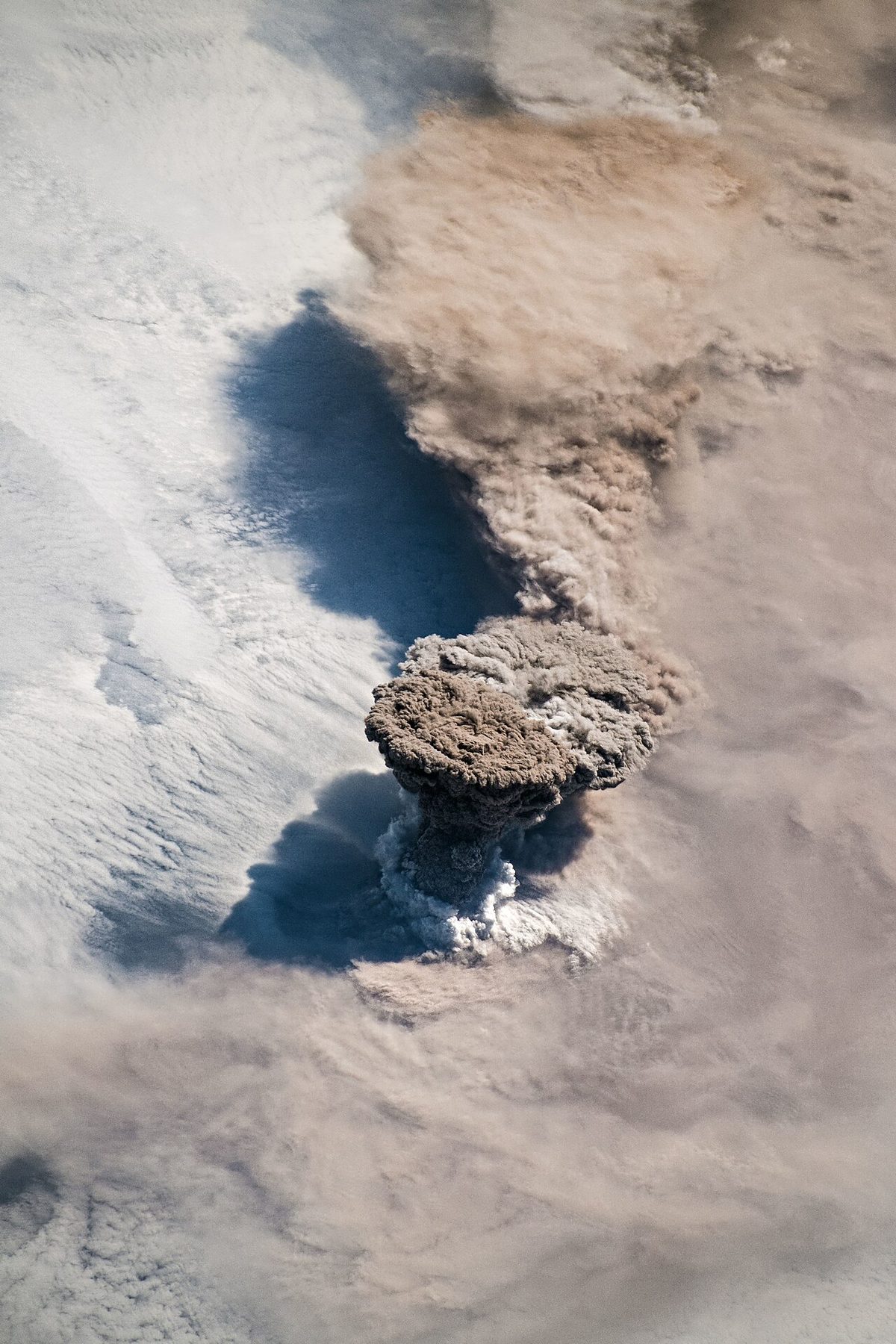
Volcanic ash is the fine debris of shattered rock and volcanic glass that an explosive eruption throws into the atmosphere. A strong eruption can carry it to jet cruising levels, where the upper winds spread it into a volcanic ash cloud that drifts hundreds of miles downwind and can stay aloft for days, long after the eruption column has gone from view.
To an aircraft, ash is abrasive dust that also melts inside jet engines. British Airways flight 9, a Boeing 747 over Java in 1982, and KLM flight 867 in 1989 both lost all their engines temporarily after flying into ash, and both crews restarted them. Because ash is one hazard that weather radar cannot show, an international system of advisory centres, warnings and colour codes now exists to keep crews out of it.
Why volcanic ash is dangerous
Volcanic ash consists of small particles of glass and rock, largely silica. Three properties make it a hazard out of proportion to its appearance:
- It melts in engines. Its melting point is low enough for it to melt in the hot section of a turbine engine and then re-solidify on the turbine.
- It is hard to detect. The dry particles give no useful echo on weather radar, and the cloud is often invisible at night or when mixed with ordinary cloud.
- It spreads far and lasts. Ash at flight levels can travel hundreds of miles downwind of the volcano and remain for days, so aircraft far from any eruption can meet it.
The hazard is not confined to jets. Ash clogs air filters and has caused severe damage to piston aeroplanes, and breathing it causes respiratory problems for crew and passengers.
Effects on engines, windows and systems
| Part of the aircraft | Effect of ash | Consequence |
|---|---|---|
| Engine hot section | Ash melts in the combustor and coats the turbine | Surge, rising EGT, loss of thrust, flameout of one or all engines |
| Compressor and fan | Abrasion of blades | Lasting damage and loss of efficiency, even after a short encounter |
| Windscreens | Scoring and sandblasting | Forward view badly degraded, especially for the landing |
| Pitot-static system | Blockage of probes | Unreliable airspeed and altitude |
| Airframe and antennae | Sandblasting of leading edges and antennae | Erosion damage that must be inspected |
| Cabin | Dust, haze and fumes | Smell, breathing difficulty, need for oxygen |
The engine effect depends on temperature. Molten ash that sets on the turbine blades disturbs the gas flow through the engine, and the compressor can surge or the flame go out. The hotter the turbine runs, the more ash melts, which is why encounter procedures call for reduced thrust. An engine that flames out may relight once the aircraft is clear of the ash (see gas turbine ignition, flameout and relight).
Recognising an ash cloud
Ash is best avoided by planning, but a crew must still be able to recognise an encounter. By day an ash cloud may look like ordinary cloud or haze, sometimes a dirtier grey than weather cloud. At night, or inside cloud, the signs are indirect:
- St Elmo's fire on the windscreen, and a glow in the engine intakes;
- a smell of sulphur, and dust or haze in the cabin;
- static noise on the radios;
- engine anomalies: rising EGT, fluctuating parameters, surges and flameout;
- airspeed indications that fluctuate or fall as the pitot probes block.
The electrical signs come from the ash itself: its particles carry electrical charge, which shows as St Elmo's fire on the airframe and static on the radios. None of these cues is conclusive alone, but in an area where ash is possible any one of them is reason to suspect it.
Note: Weather radar sees water, not dust. A clear radar picture says nothing about ash, so an advisory or SIGMET for ash outweighs a clean display (see weather radar).
Volcanic ash advisory centres
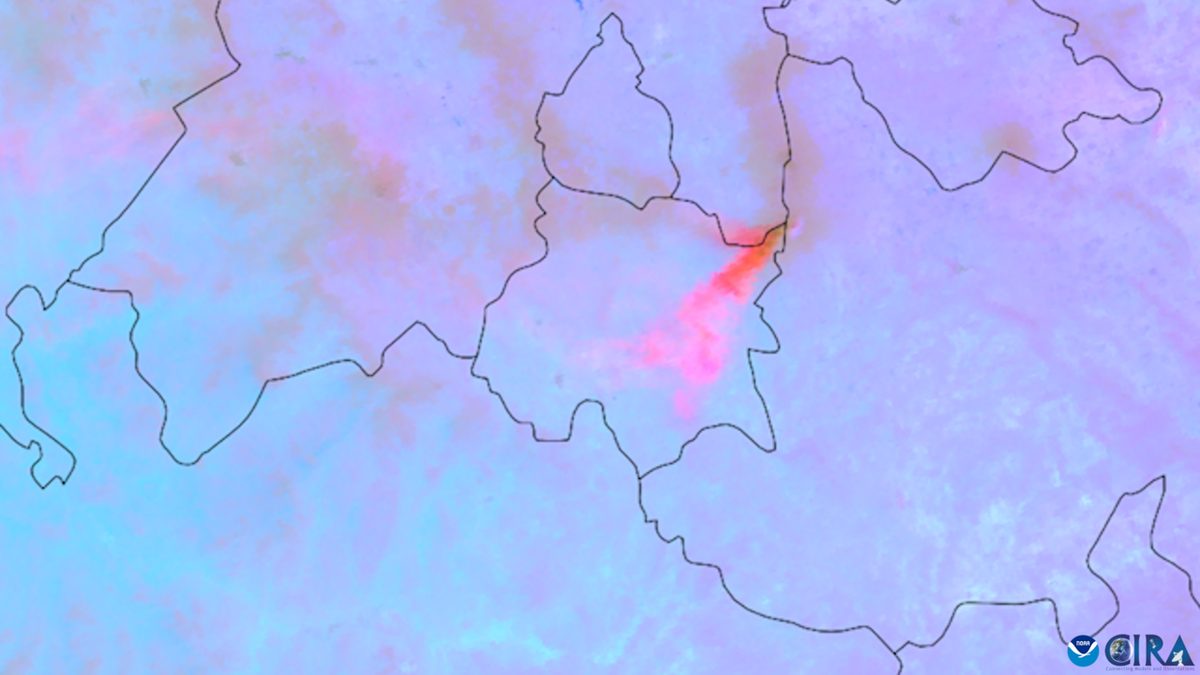
Tracking ash needs satellite analysis and dispersion modelling over areas far larger than any single flight information region, so ICAO has established nine Volcanic Ash Advisory Centres (VAACs). Each covers a large region regardless of flight information region boundaries. A VAAC uses satellite images, dispersion models driven by the forecast upper winds, and reports from volcano observatories and pilots to analyse where the ash is and forecast where it will go.
Its product is the volcanic ash advisory (VAA), issued as a text message and in graphic form, giving the volcano, the observed extent and levels of the ash cloud and its forecast movement. The advisory is guidance for the meteorological watch offices, not the operational warning: the message that applies within a flight information region is the SIGMET issued by that region's meteorological watch office.

Advisories, SIGMETs and the aviation colour code
Several messages carry ash information to crews:
- Volcanic ash SIGMET. Identified by the letters WV, it may be valid for up to 6 hours, rather than the usual maximum of 4, because ash moves and changes more slowly than most SIGMET phenomena. In the contiguous United States volcanic ash is one of the phenomena of the non-convective SIGMET, with the same 6-hour validity (see SIGMET, AIRMET and weather warnings).
- ASHTAM. A special series of NOTAM for volcanic activity and volcanic ash.
- METAR and SPECI. Volcanic ash at an aerodrome is reported with the code VA, or VCVA when it is in the vicinity. In the United States a volcanic eruption is also a criterion for a SPECI (see METAR and SPECI).
- Pilot reports. Encounters are reported at once (see below), and these reports feed the advisories.
The state of a volcano is summarised by the aviation colour code (volcanic activity):
| Colour | Meaning |
|---|---|
| Green | Volcano in its normal, non-eruptive state |
| Yellow | Signs of elevated unrest above the known background level |
| Orange | Heightened unrest with an increased likelihood of eruption, or an eruption under way with no or minor ash emission |
| Red | Eruption imminent with significant emission of ash expected, or eruption under way with significant emission of ash into the atmosphere |
In the United States, 14 CFR 91.137 temporary flight restrictions may also be issued around a volcano whose imminent eruption could endanger aircraft. ICAO regional volcanic ash contingency plans set out how airspace affected by ash is managed.
Planning and avoidance
Before flight in a region with active volcanoes, crews check the VAAs, SIGMETs, ASHTAMs and NOTAMs, and plan routes that stay clear of forecast ash, preferably upwind of the source. ATC may reroute traffic around it. Because ash spreads with the upper winds, a route passing downwind of a volcano deserves attention even if the eruption was days earlier. In flight, any special air-report of ash on or near the route, and any change in the colour code, is a reason to reassess.
Exam tip: Volcanic ash hazards: engine flameout, reduced visibility, scored windscreens, blocked pitot probes and sandblasting of the airframe. ICAO has nine VAACs, a volcanic ash SIGMET can be valid for up to 6 hours, and the aviation colour code runs green, yellow, orange, red.
Encounter procedures
Every aircraft type has its own volcanic ash procedure, and it takes precedence over any generic list. The actions common to most are:
- Leave the ash by the quickest route. This is usually a 180° turn, since the air flown through before the encounter was clear; terrain permitting, a descending turn is likely to be the quickest way out.
- Reduce thrust, to idle if conditions allow, to lower turbine temperatures and the amount of ash that melts.
- Don oxygen masks.
- Select engine anti-ice and continuous ignition as the procedure requires.
- Monitor the engines, and if one flames out, follow the relight procedure; engines may relight once out of the ash.
- Cross-check airspeed and be ready for the unreliable airspeed procedure if the probes block.
- Declare an emergency or urgency as appropriate and report the encounter.
- Land at the nearest suitable aerodrome, allowing for a scored windscreen, and have the aircraft inspected before further flight.
The diversion matters even when the engines appear to recover. Damage from a brief encounter may not be evident in flight, so the engines, windscreens, probes and exposed surfaces are inspected on the ground, and the encounter is reported to the authorities as well as to ATC.
Warning: Do not try to climb out of an ash cloud with high thrust. More thrust means hotter turbines and more molten ash on them. Turning back into clear air is normally the quickest escape.
On the A320, the "one procedure at a time" rule requires a crew to complete a procedure before starting another, with an exception when an unexpected abnormal or emergency situation, such as smoke or a volcanic ash encounter, makes the crew update its assessment of the situation.
The encounter must also be reported. Under SERA, volcanic ash and volcanic activity, including pre-eruption activity, are among the conditions that oblige the pilot to make a special air-report by voice to the ATS unit as soon as practicable. In the United States the same report is an urgent PIREP (UUA), given priority over routine reports (see position reports and required reports). Because ash cannot be seen on radar, these reports are often the first warning others receive.
Frequently asked questions
Why is volcanic ash so dangerous to jet engines?
Volcanic ash is made of fine particles of glass and rock, largely silica, with a melting point low enough for the ash to melt in the hot section of a jet engine. The molten ash re-solidifies on the turbine, disrupts the airflow and can make the engine surge and flame out. The same particles erode compressor blades. In 1982 a British Airways Boeing 747 lost all its engines temporarily in ash over Java.
Can weather radar detect volcanic ash?
No. Airborne weather radar is designed to detect water in the form of raindrops and wet hail, and the dry particles of an ash cloud give no useful echo. Ash is also hard to see at night or when mixed with ordinary cloud. Crews therefore rely on volcanic ash advisories, SIGMETs, NOTAMs and reports from other aircraft to avoid it, and on recognising the signs of an encounter.
What is a Volcanic Ash Advisory Centre?
A Volcanic Ash Advisory Centre (VAAC) is one of nine centres set up under ICAO to track volcanic ash clouds. Each covers a large region regardless of flight information region boundaries and uses satellite images, dispersion models and reports to issue volcanic ash advisories on the position and forecast movement of the ash. The advisories go to meteorological watch offices, which issue the volcanic ash SIGMETs that reach aircraft.
What is the aviation colour code for volcanoes?
It is a four-level code describing a volcano's state for aviation. Green means normal, non-eruptive activity. Yellow means unrest above the background level. Orange means heightened unrest with an increased likelihood of eruption, or an eruption under way with little or no ash. Red means an eruption is imminent with significant ash emission expected, or under way with significant emission of ash into the atmosphere.
What should a pilot do after flying into volcanic ash?
Follow the aircraft's volcanic ash procedure. It typically calls for leaving the ash by the quickest route, usually a 180 degree turn back into clear air; reducing thrust to idle if conditions allow; donning oxygen masks; and monitoring the engines, ready to relight any that flame out. The crew reports the encounter to ATC and lands at the nearest suitable aerodrome, where the aircraft is inspected before it flies again.
Test yourself on Volcanic Ash
The v1prep banks cover this topic in Meteorology (050), with a worked explanation for every answer. EASA ATPL, PPL, IR and CPL, the FAA written tests and A320/B737 type ratings.
Start practising →Sources and further reading
- FAA Aeronautical Information Manual, Chapter 7, Section 6 (Potential flight hazards, 7-6-10, Flight Operations in Volcanic Ash)
- FAA Aeronautical Information Manual, Chapter 7, Section 1 (Meteorology, SIGMETs and PIREPs)
- FAA-H-8083-28B, Aviation Weather Handbook (Chapter 26, Advisories, volcanic ash advisories)
- ICAO EUR Doc 014, EUR SIGMET and AIRMET Guide
- SKYbrary, Volcanic Ash
- US Geological Survey, Volcano Hazards Program, Volcanic alert-levels characterize conditions at U.S. volcanoes (aviation colour code)
- FAA Aeronautical Information Manual, Chapter 3, Section 5 (temporary flight restrictions under 14 CFR 91.137)
Library articles are written for study and exam preparation. They do not replace your aircraft's approved documentation, your operator's procedures or the regulations themselves.