B737 APU
The Boeing 737 auxiliary power unit is a self-contained gas turbine in a fireproof compartment in the tail. Run by its own electronic control unit, it supplies bleed air for engine starting and air conditioning and drives a generator that can power both AC transfer buses, on the ground or in flight.
The Boeing 737's auxiliary power unit (APU) is a self-contained gas turbine engine installed in a fireproof compartment in the tail. On the ground it makes the aeroplane independent of ground equipment: it supplies bleed air for engine starting or air conditioning, and an AC generator on the APU provides an auxiliary electrical source that can power both AC transfer buses. In flight it can supply electrical power up to the maximum operating altitude, and bleed air lower down.
The 737 NG and the 737 MAX use the same unit, the Honeywell 131-9[B]. This article follows the 737 NG flight crew operations manual (FCOM) and notes where the MAX differs. The general principles are covered in auxiliary power unit (APU), and the electrical network the APU feeds in B737 electrical system.
APU overview
An electronic control unit (ECU) monitors and controls the APU and governs its speed through the electronic fuel control. If the ECU detects a fault that could damage the APU or the aeroplane, it carries out a protective shutdown on its own.
Air for the APU enters through an automatically operated air inlet door on the right side of the fuselage, and the exhaust gases leave overboard through an exhaust muffler. Cooling air takes a separate path: it enters through an inlet above the exhaust outlet, circulates through the APU compartment and the oil cooler, and leaves through the exhaust outlet.
Fuel comes from the left side of the fuel manifold when the AC fuel pumps are running; when they are not, the APU draws fuel by suction from main tank No. 1 (see B737 fuel system). The fuel is heated automatically to prevent icing. When the APU is to run for a long time on the ground with the aeroplane on AC power, the crew switch on an AC fuel pump, which extends the service life of the APU fuel control unit.
The APU runs only if three conditions are met:
- the APU fire switch on the overheat/fire protection panel is in;
- the APU fire control handle on the APU ground control panel is in;
- the battery switch is ON.
Moving the battery switch to OFF, on the ground or in the air, therefore shuts the APU down: the ECU has lost its power.
Operating and altitude limits
The APU starts and operates up to the aeroplane's maximum certified altitude; the NG's maximum operating altitude is 41,000 ft. What it can deliver falls with altitude, however, and the limitations give separate ceilings for bleed air and electrical load:
| APU use | Maximum altitude |
|---|---|
| Electrical load only | 41,000 ft |
| Bleed air only | 17,000 ft |
| Bleed air and electrical load together, in flight | 10,000 ft |
All three are memory items in the NG limitations, and the combined figure is the one given for operation under FAA rules. With every generator lost and the aeroplane on batteries, APU start attempts are not recommended above 25,000 ft on most variants.
Capacity sets the other boundaries. The APU supplies bleed air for both air conditioning packs on the ground but for only one pack in flight. Its generator can power both transfer buses on the ground or in flight and, as the only source, meets the electrical needs of all ground conditions and most flight conditions.
The limitations, and notes in the FCOM system description, add:
- at least 30 seconds between failed start attempts, and a 15-minute cooling period after three consecutive failures;
- two full minutes of running before the APU is used as a bleed air source, to extend its service life;
- the APU bleed valve closed in certain configurations, for example with ground air connected and the isolation valve open, to prevent reverse flow;
- no engine power above idle during an engine start with the APU bleed valve open, which the limitations say to avoid.
Exam tip: the electrical ceiling equals the maximum operating altitude, the bleed ceiling is 17,000 ft and the combined in-flight ceiling, the most restrictive, is 10,000 ft.
Starting and shutting down
The APU switch has OFF, ON and a momentary START position. Moving it from OFF to START and releasing it to ON begins an automatic start sequence. First the air inlet door opens, and the sequence proper begins only when the door is fully open. The APU's starter-generator then turns the engine, using AC power from the No. 1 transfer bus if it is available and the main battery if it is not. When the APU reaches the proper speed, ignition and fuel are provided.
A start may take as long as 120 seconds. If the APU does not reach the proper speed with the proper acceleration within the starter's time limit, the cycle ends automatically, and an EGT exceedance causes an automatic shutdown. When the APU is ready to accept a bleed air or electrical load, the blue APU GEN OFF BUS light comes on. If the start fails, or that light has not come on by the end of the start cycle, a system failure has occurred and the amber FAULT light comes on.
Three indications during the start are normal and do not affect it. The APU EGT indication may fluctuate between 0 and 1,100 °C before the normal rise, and the EGT need not be monitored during the start. The LOW OIL PRESSURE light may cycle on and off several times. On a start using battery power alone, with the AC meters selector at APU GEN, the CPS FREQ indication is blank and AC VOLTS reads 0 until the start sequence is complete and APU GEN OFF BUS lights.
Selecting OFF with the APU running trips the APU generator off the buses, if connected, and closes the APU bleed air valve. The APU then runs on for a 60-second cooling period, which meets Boeing's recommendation of one full minute without bleed load before shutdown. When its speed has decreased far enough, the fuel valve and the air inlet door close; if the fuel valve fails to close, the FAULT light comes on after about 30 seconds. The APU EGT indicator stays powered for 5 minutes after shutdown. An immediate shutdown, without the cooling period, is made by pulling the APU fire switch.
In the normal procedures the APU BLEED and APU switches go to OFF in the before taxi procedure, and the APU is started again after landing as needed. At shutdown, if APU power is needed, the crew check that APU GEN OFF BUS is lit, select both APU generator switches ON and check that the SOURCE OFF lights go out.
APU generator and bleed air
The blue APU GEN OFF BUS light means the APU is running and not powering a bus. What an APU GEN switch does depends on what is already connected:
- with both AC transfer buses on their IDGs, one APU GEN switch ON powers its own transfer bus from the APU, and the other bus stays on its IDG;
- with neither transfer bus on an IDG, a single APU GEN switch ON connects both buses to the APU and disconnects external power; the opposite SOURCE OFF light stays on until the second switch is moved to ON;
- with both external power and the APU available, whichever is selected last powers both buses: one cannot be on ground power and the other on the APU.
The ECU protects the APU when demand is too high. With an electrical load only, if speed or EGT exceed acceptable levels, some electrical load is shed. When electrical load and bleed extraction together raise the EGT too far during an engine start, electrical load is shed before bleed air is reduced; at other times the inlet guide vanes move towards closed, reducing bleed extraction while the electrical load is kept.
The aeroplane also sheds load automatically. In flight, with the APU as the only source of electrical power, all galley buses are shed (the electrical chapter of the FCOM lists the main buses as well), and both in-flight entertainment buses follow if the load still exceeds design limits. On the ground the APU tries to carry the full load and sheds buses only if it senses an overload. Moving the CAB/UTIL switch to OFF and back to ON attempts to restore them.
The APU bleed air valve is DC controlled and pressure operated, and closes automatically when the APU shuts down. The amber DUAL BLEED light shows that APU air and engine bleed air can meet: the APU bleed valve is open with the engine No. 1 BLEED switch ON, or with the engine No. 2 BLEED switch ON and the isolation valve open. With both APU and engine bleed valves open and the engines at idle, APU air can back-pressure the engine's 9th stage modulating and shutoff valve and make it close. For engine starting, the APU is one of three air sources, with a ground cart and the other engine (see B737 bleed air and anti-ice).
APU ground control panel
The APU ground control panel in the main wheel well lets the ground crew deal with an APU fire. It carries:
- the APU fire warning light, which flashes red for an APU fire while the APU fire warning horn sounds, and burns steady once the horn has been silenced;
- the HORN CUTOUT switch, which silences the fire bell and the horn; the light stops flashing but stays on;
- the APU fire control handle: pulled down, it closes the APU fuel shutoff valve, the bleed air valve and the air inlet door, trips the generator control relay and breaker, and arms the discharge switch on this panel only;
- the APU BOTTLE DISCHARGE switch, spring-loaded and safety-wired, which discharges the APU extinguisher when moved to the left; it is armed only with the handle pulled.
The horn and the flashing light work on the ground only. The handle must be in for the APU to run. Pushing a master FIRE WARN light in the flight deck also silences the remote horn.
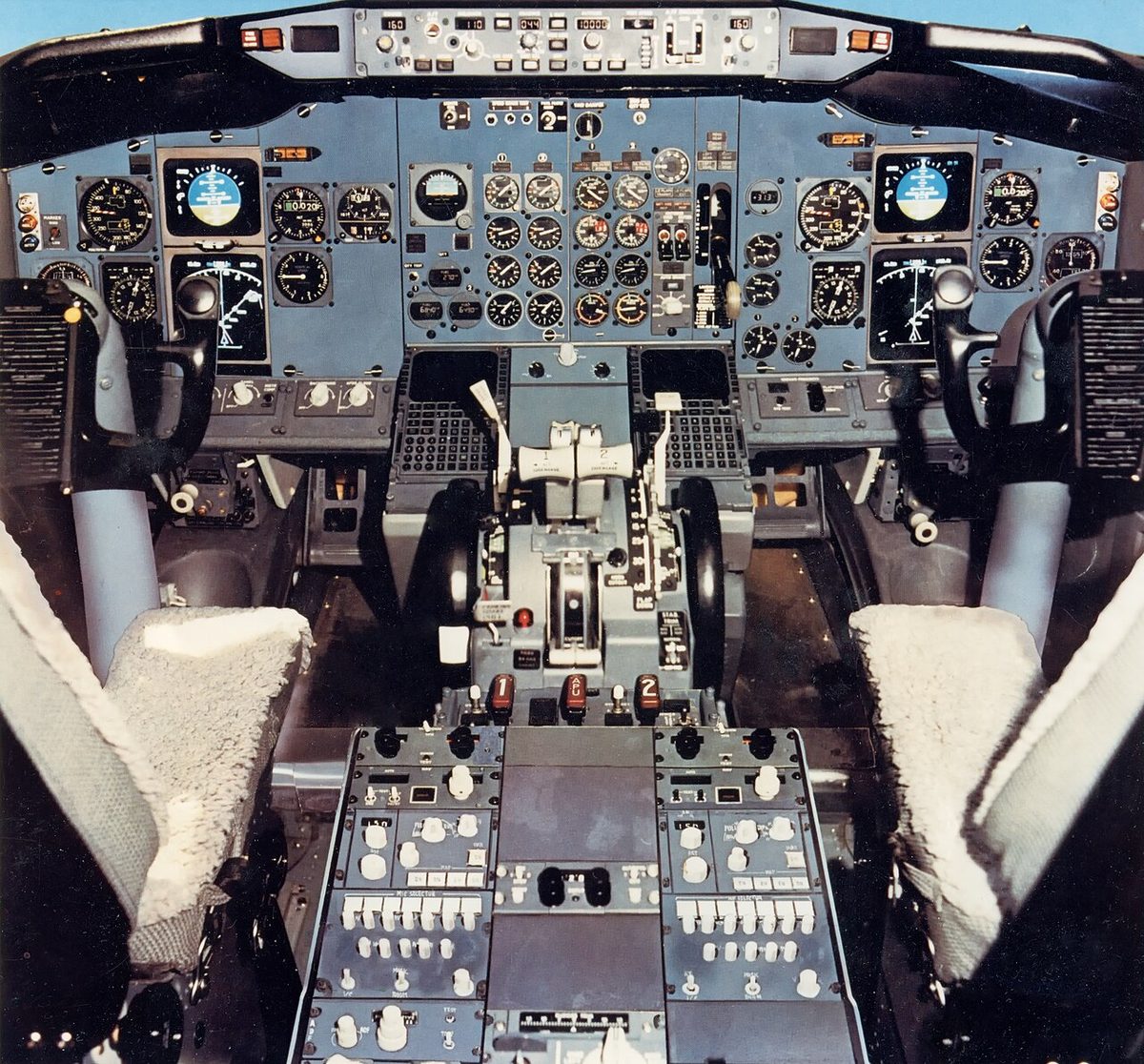
The flight deck has its own APU fire switch. Pulled up, it backs up the automatic shutdown that an APU fire triggers, closes the fuel shutoff valve, bleed valve and inlet door, trips the generator and arms the bottle; rotated either way, it discharges the single APU bottle. The APU has a single fire detection loop, and the APU DET INOP light shows that it has failed. If that light does not come on during the preflight fault test, the APU is not run. When the overheat/fire test is done with the APU running, the light on the ground control panel flashes and the horn sounds, which the ground crew can mistake for a real fire. The full system is described in B737 fire protection.
APU fault and protection lights
Four lights on the APU panel report the APU's health:
| Light | Colour | Meaning |
|---|---|---|
| MAINT | Blue | A maintenance problem exists; the APU may still be operated |
| LOW OIL PRESSURE | Amber | During the start, until oil pressure is normal; after the start cycle, low oil pressure has caused an automatic shutdown |
| FAULT | Amber | A malfunction has caused an automatic shutdown |
| OVERSPEED | Amber | The RPM limit was exceeded, causing an automatic shutdown, or the overspeed shutdown protection failed its self-test during a normal shutdown |
All four lights are disarmed when the APU switch is at OFF. If the OVERSPEED light is on when the switch is placed to OFF, it goes out after 5 minutes. After an ECU protective shutdown, one of the three amber lights, FAULT, OVERSPEED or LOW OIL PRESSURE, appears on the panel and tells the crew why.
Note: the blue MAINT light is advisory. It does not stop the APU and does not mean that the APU must be shut down.
Differences on the 737 MAX
Both the 737-800 and the 737-8 use the Honeywell 131-9[B] APU, and the maximum operating altitude is 41,000 ft on both. The FAA Flight Standardization Board report lists the 737-8's APU differences as:
- the APU MAINT light removed (Level A training and checking);
- the APU EGT gauge removed (Level A);
- a retractable door added (Level B), with a DOOR light (Level B, with a procedure change).
The 737-8 does have a MAINT light, but it replaces the NG's PSEU light and has nothing to do with the APU. The figures in this article come from the NG FCOM, and the MAX's own limitations and procedures should be taken from its documents.
Frequently asked questions
What are the APU altitude limits on the Boeing 737?
The 737 NG limitations allow APU electrical load alone up to 41,000 ft, the maximum operating altitude, and APU bleed air alone up to 17,000 ft. Bleed air and electrical load together are limited to 10,000 ft in flight, a figure given for operation under FAA rules. The APU itself starts and runs up to the maximum certified altitude, but with all generators lost and the aeroplane on batteries, start attempts are not recommended above 25,000 ft.
What do the APU FAULT and OVERSPEED lights mean on the 737?
Both are amber and both report an automatic shutdown. FAULT shows a malfunction that made the APU shut itself down; it also comes on when a start fails, or when the fuel valve has not closed about 30 seconds after a shutdown. OVERSPEED shows that the RPM limit was exceeded, or that the overspeed protection failed its self-test during a normal shutdown. Both are disarmed when the APU switch is OFF.
How many APU start attempts are allowed on the Boeing 737?
Up to three consecutive attempts, with at least 30 seconds between failed attempts. After three consecutive failures a 15-minute cooling period is required before the next try. A start cycle can take up to 120 seconds; it ends automatically if the APU does not reach the proper speed and acceleration within the starter's time limit, and an EGT exceedance shuts the APU down.
How long must the 737 APU run before its bleed air is used?
Two full minutes. The NG limitations require the APU to run that long before it is used as a bleed air source, a stabilisation period that extends its service life. One full minute without bleed load is likewise recommended before shutdown, and selecting the APU switch OFF provides it automatically: the generator is tripped, the bleed valve closes and the APU runs on for a 60-second cooling period.
What is on the 737 APU ground control panel?
The panel in the main wheel well lets the ground crew deal with an APU fire. It has an APU fire warning light, which flashes while a horn sounds, a HORN CUTOUT switch, the APU fire control handle and the APU BOTTLE DISCHARGE switch. Pulling the handle closes the APU fuel shutoff valve, bleed valve and inlet door, trips the generator and arms the discharge switch on that panel only.
What is different about the APU on the 737 MAX?
Not the APU itself: the NG and the MAX both use the Honeywell 131-9[B]. The MAX loses the APU MAINT light and the APU EGT gauge, and gains a retractable door with a DOOR light. The MAX does have a MAINT light, but it replaces the NG's PSEU light and has nothing to do with the APU. The remaining MAX APU limits and procedures come from the MAX documents.
Test yourself on B737 APU
The v1prep banks cover this topic in the B737 type-rating bank, with a worked explanation for every answer. EASA ATPL, PPL, IR and CPL, the FAA written tests and A320/B737 type ratings.
Start practising →Sources and further reading
- EASA Type Certificate Data Sheet IM.A.120, Boeing 737
- FAA Flight Standardization Board Report, Boeing 737
- EASA Easy Access Rules for Large Aeroplanes (CS-25), Subpart J, auxiliary power unit installations
- 14 CFR 25.1181, Designated fire zones; regions included
- FAA Aviation Maintenance Technician Handbook, Airframe (FAA-H-8083-31B), Fire Protection Systems
- EASA, Explanatory Note to ED Decision 2018/001/R, Part-FCL theoretical knowledge learning objectives (021 Airframe and Systems)
Library articles are written for study and exam preparation. They do not replace your aircraft's approved documentation, your operator's procedures or the regulations themselves.