Aircraft Batteries
An aircraft battery is a set of rechargeable secondary cells that stores electrical energy chemically. It supplies the current for engine or APU starting, powers the aircraft on the ground, and keeps the essential services running for a limited time when the generators fail.
An aircraft battery is the electrical system's reserve. With the engines stopped it powers the aircraft and turns the starter or the APU; in flight it floats on the bus, charged by the generators, until they fail and it becomes the only source left. How long it then lasts, and how honestly its instruments report its condition, depends on the chemistry inside it and on how well it has been looked after.
The subject runs from the PPL centre-zero ammeter to ATPL questions on nickel-cadmium thermal runaway; type examples below come from the A320, Boeing 737 NG and Embraer E-Jet crew documents.
Role of the aircraft battery
The battery has two jobs. It is the emergency source of DC power when no generator is on line, and it supplies the heavy current, hundreds of amps for a few seconds, that a starter motor draws. Once an engine is running, its generator or alternator carries every load and recharges the battery.
Exam texts require the battery to keep the essential loads running for at least 30 minutes after a total generator failure, long enough to descend and reach a diversion aerodrome. The Boeing 737 NG's two fully charged batteries provide standby power for at least 60 minutes. Batteries also bridge short gaps: when both AC buses of an A320 are lost in flight, they carry the emergency network for the roughly 8 seconds the ram air turbine needs to extend and bring the emergency generator on line.
The aircraft main battery is the one that does these jobs; some types add others. The 737 NG carries a main and an auxiliary battery, both 24 V nickel-cadmium, in the electronics compartment. The A320 has two main batteries of 23 Ah each.
A light aeroplane typically has a 14 V system with a 12 V battery, and larger aircraft a 28 V system with a 24 V battery. The bus is regulated above battery voltage deliberately: current only flows into the battery if the bus is at a higher potential.
Secondary cells and battery types
A secondary cell produces electricity from a reversible chemical reaction: a charging current passed through it in the opposite direction to the discharge restores it, storing electrical energy as chemical energy. Lead-acid, nickel-cadmium and lithium-ion aircraft batteries are all built from secondary cells. Cells connected in series, positive to negative, add their voltages while the capacity stays that of one cell. Cells in parallel add their capacities at the voltage of one cell.
| Lead-acid | Nickel-cadmium (NiCd) | |
|---|---|---|
| Battery electrolyte | Dilute sulphuric acid | Potassium hydroxide, a strong alkali |
| Cell voltage | About 2.0 V on load, 2.2 V off load, fully charged | About 1.2 V on load |
| Cells in a 24 V battery | 12 | 20 |
| Voltage during discharge | Falls progressively | Substantially constant over most of it |
| Specific gravity | Falls with discharge | Does not change with charge |
| Spilled electrolyte neutralised with | Sodium bicarbonate | Boric acid |
In the lead-acid battery the acid takes part in the reaction: discharge turns it into lead sulphate on the plates and water in the electrolyte, and charging reverses the process. The electrolyte therefore changes with the state of charge, which makes the cell easy to check.
The nickel-cadmium (NiCd) battery has nickel oxide hydroxide positive plates and cadmium negative plates. Its alkaline electrolyte only carries ions between the plates and is not consumed. Its advantages are a lower internal resistance, and so a high current capability, robustness, a long life and above all a steady terminal voltage that keeps the bus stable through a long discharge. It costs more. Lead-acid has not disappeared from airliners: the Embraer E190 E1's fly-by-wire backup battery is a lead-acid unit.
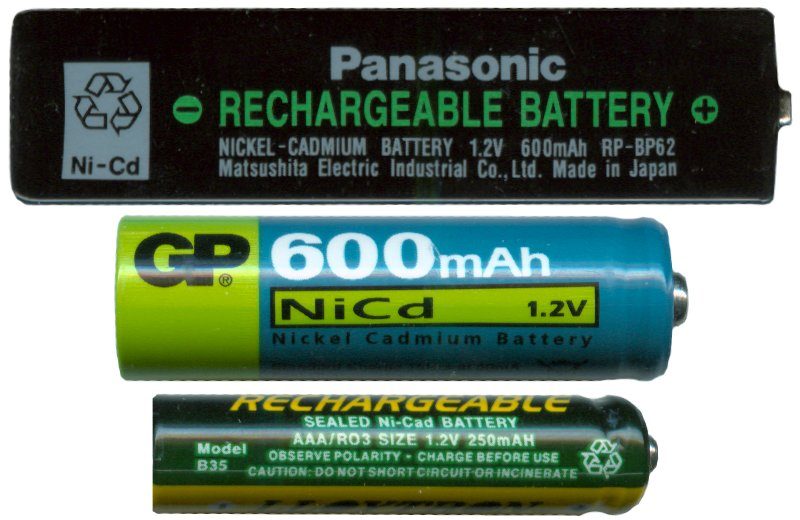
The battery type is identified before a spill is cleaned up, because the neutralisers are opposites: sodium bicarbonate, a mild alkali, for the acid, and boric acid, a mild acid, for the alkali. The wrong neutraliser makes matters worse.
The lithium-ion (Li-ion) battery is the third type. Its hazards differ from those of the other two and are covered under thermal runaway below.
Capacity and ampere-hour rating
Battery capacity is rated in ampere-hours (Ah): the current the battery can supply multiplied by the time. A 40 Ah battery can in theory deliver 40 A for one hour or 4 A for ten hours. Capacity is set by the plate area, so larger cells hold more.
Capacity falls as the battery ages, and a cold battery delivers starting current less readily: on the E190-E2, with the second battery below −20 °C the APU is started from a DC ground power unit instead.
A battery capacity test proves what the battery can really do. It is discharged at its one-hour rated load and must last at least 48 minutes, which is 80 % of its rated capacity, the minimum for it to stay in service. Exam texts give three months as a typical interval.
Crew documents turn this into limits. On the A320, after six hours or more unpowered, a battery reading above 25.5 V with its pushbutton off holds more than half its charge; at or below 25.5 V it needs a charging cycle of about 20 minutes. An APU start on batteries alone should be made within 30 minutes of selecting them to AUTO: after 35 minutes less than a quarter of their capacity remains.
Charging and state of charge
In the simplest arrangement the battery is permanently connected to the DC bus through its contactor, and the bus, held near 28 V by the generators or the transformer rectifier units, charges it. This is constant-voltage charging: the current is high while the battery is depleted and tapers as it approaches full charge. That is why an ammeter shows a large charge just after an engine start, falling over the next few minutes as the energy used by the starter is replaced.
Many transport aircraft add a dedicated battery charger or charge controller:
- On the Boeing 737 NG the main and auxiliary battery chargers are powered from AC ground service buses 2 and 1. After its primary charge cycle, the main charger reverts to a constant-voltage transformer rectifier mode, powering the hot battery buses, and it takes over the battery bus if TR 3 fails.
- On the A320 each battery has a battery charge limiter (BCL), which controls the battery contactor. The batteries are disconnected from the DC battery bus most of the time. The BCL connects a battery when its voltage falls below 26.5 V, immediately on the ground and after 30 minutes in flight, and ends the charge when the charging current falls below 4 A.
The battery state of charge is judged differently for each chemistry. A lead-acid cell's voltage falls steadily as it discharges, and its specific gravity is a direct measure of charge. A hydrometer measures it: about 1.270 to 1.285 fully charged and 1.150 to 1.180 discharged. A nickel-cadmium cell gives neither clue: its voltage stays nearly flat until it is almost exhausted, and its electrolyte's specific gravity, about 1.24 to 1.30, does not change. Only a measured discharge reveals the charge of a NiCd battery.
Exam tip: a hydrometer shows the state of charge of a lead-acid battery, because acid is consumed on discharge. It is useless on a NiCd battery, whose electrolyte is not consumed.

Battery bus, contactor and master switch
Battery current is far too large to route to the flight deck, so the battery master switch carries only a small control current. It energises a heavy-duty battery contactor (battery solenoid or relay) near the battery, whose contacts connect the battery to the bus or isolate it.
In a light aeroplane, switching the master switch off in flight removes the radios, transponder and electric flaps, and in many trainers the fuel gauges, but not the engine: its magnetos generate their own ignition energy.
A few loads must stay powered whatever the master switch position. They sit on a hot battery bus wired directly to the battery, typically the clock and fire detection. On the 737 NG the hot battery bus is always connected to the battery, while the switched hot battery bus is powered whenever the battery switch is ON. The A320's two hot buses are permanently connected to its two batteries.
A battery bus is a DC bus that the battery can feed directly. On the 737 NG it is normally powered by TR 3 and, after the loss of all generator power, by the batteries. On the A320 the batteries are connected to the DC battery bus only for charging, APU starting and abnormal configurations. On the ground, with no generator or external power and the battery pushbuttons at AUTO, the contactors open automatically on low voltage to prevent a complete discharge; selecting the pushbuttons OFF and back to AUTO resets them.
Warning: on the 737 NG, with the battery as the only source, selecting the battery switch OFF removes power from the battery bus, switched hot battery bus, DC standby bus, static inverter and AC standby bus. On the ground or in the air it also shuts down a running APU, whose control unit loses power.
Battery ammeters and monitoring
The centre-zero ammeter, or centre-zero battery ammeter, is wired between the battery and the bus and reads current in both directions. A deflection to the right of zero means current flowing in, so the battery is charging; to the left, current flowing out, so it is discharging. Near zero, the battery is floating on the bus. It is not the same instrument as the loadmeter, which reads the generator's output (see DC generators, motors and starter-generators).
In the cruise a steady discharge, usually with a low-voltage light, means the alternator or generator is no longer carrying the load: after one reset as the POH allows, shed every non-essential load and land while battery power remains.
Transport aircraft show the same information on meters and synoptic pages:
- A320: the ECAM electrical page shows battery voltage in amber below 25 V or above 31 V, battery discharge current in amber above 5 A, and a charge or discharge arrow when the current exceeds 1 A.
- Boeing 737 NG: the DC meters read the battery's voltage and current. The amber BAT DISCHARGE light means that, with the battery switch ON, excessive battery discharge has been detected. The battery voltage range is 22 to 30 V.
- Embraer E190-E2: a battery reaching 70 °C or more for 2 seconds is shown in red with an OVERTEMP warning; the trigger is temperature, not voltage.
Standby batteries
A standby battery keeps selected instruments or controls alive when the main electrical system cannot. In glass-cockpit light aircraft the electric standby attitude indicator often has its own battery, tested before flight (see standby instruments).
On the 737 NG the auxiliary battery is normally isolated from the distribution system and works in parallel with the main battery only when the batteries are powering the standby system. The E190 E1's fly-by-wire backup battery, charged from DC essential bus 3, keeps only the elevators and rudder controllable, for 15 minutes; it has no switches or EICAS messages and cannot power any other bus.
Thermal runaway and battery hazards
Thermal runaway is the characteristic failure of a nickel-cadmium battery. It is a positive feedback loop during charging: as the temperature rises the cells' internal resistance falls, the charging current rises, the extra I²R heating raises the temperature further, and so on. Overcharging, a high ambient temperature or a charger malfunction can start it, and an unchecked battery may explode. The protection is a thermal switch, usually bimetallic, built into the battery. It opens at a preset temperature to disconnect the battery from its charging source and resets as the battery cools; a flight deck warning light normally goes with it, and some installations also trip on charging current. Certification rules for large aeroplanes (CS 25.1353 and 14 CFR 25.1353) set requirements for battery installations.
Lithium-ion cells fail differently. A damaged, crushed or faulty cell can go into thermal runaway on its own, releasing flammable electrolyte, and the heat spreads to neighbouring cells, so a pack can reignite after the flames are out. Passengers' phones and laptops carry the same risk (see dangerous goods and in-flight fire, smoke and fumes). The other hazards are corrosive electrolyte spills and the very high current of a short circuit.
Frequently asked questions
What type of battery is used in aircraft?
Aircraft use rechargeable secondary cells of three chemistries. Lead-acid batteries use dilute sulphuric acid and give about 2 V per cell. Nickel-cadmium batteries use potassium hydroxide, give about 1.2 V per cell and hold a steady voltage through most of the discharge, which suits transport aircraft; the Boeing 737 NG has two 24 V nickel-cadmium batteries. Lithium-ion batteries are the third type, and their failures need particular care because of thermal runaway.
Why does a 28 volt aircraft have a 24 volt battery?
Current only flows into a battery when the bus is at a higher voltage than the battery. The voltage regulator therefore holds the bus a few volts above the battery's nominal voltage: about 28 V for a 24 V battery and about 14 V for a 12 V battery. A bus reading close to battery voltage in flight means the battery is not being charged.
What is thermal runaway in an aircraft battery?
In a nickel-cadmium battery, thermal runaway is a self-feeding loop during charging: a warmer cell has a lower internal resistance, so it draws more charging current, which heats it further. Overcharging, a high ambient temperature or a charger fault can start it, and an unchecked battery can explode. A thermal switch in the battery disconnects the charging source at a preset temperature. Lithium-ion cells can also run away, and the heat can spread from cell to cell.
How long does an aircraft battery last after a generator failure?
Exam texts require the battery to supply the essential loads for at least 30 minutes after a total generator failure. The actual time depends on the battery's condition and the load, so crews shed every non-essential service and plan to land. On the Boeing 737 NG, two fully charged batteries give standby power for at least 60 minutes.
What does a centre-zero battery ammeter show?
A centre-zero ammeter is wired between the battery and the bus and shows the current flowing into or out of the battery. A deflection to the charge side means the battery is being charged, to the discharge side that it is supplying the load, and near zero that it is floating on the bus. A steady discharge in flight means the generator or alternator is no longer carrying the load.
Test yourself on Aircraft Batteries
The v1prep banks cover this topic in Aircraft General Knowledge (021), with a worked explanation for every answer. EASA ATPL, PPL, IR and CPL, the FAA written tests and A320/B737 type ratings.
Start practising →Sources and further reading
- FAA Pilot's Handbook of Aeronautical Knowledge (FAA-H-8083-25), Chapter 7, Aircraft Systems (electrical system)
- FAA Aviation Maintenance Technician Handbooks, General (FAA-H-8083-30) and Airframe (FAA-H-8083-31), electricity, batteries and aircraft electrical systems
- EASA Easy Access Rules for Large Aeroplanes (CS-25), CS 25.1351 to 25.1365, electrical systems and equipment
- 14 CFR 25.1353, Electrical equipment and installations
- FAA SAFO 09013, Fighting Fires Caused by Lithium Type Batteries in Portable Electronic Devices
- EASA Easy Access Rules for Aircrew (Regulation (EU) No 1178/2011), ATPL and CPL theoretical knowledge learning objectives, subject 021
Library articles are written for study and exam preparation. They do not replace your aircraft's approved documentation, your operator's procedures or the regulations themselves.