Aerodrome Control Phraseology
Aerodrome control phraseology is the standard radiotelephony used between pilots and the ground and tower controllers of a controlled aerodrome, from start-up and pushback to taxi, runway entry, take-off and landing. Its fixed words and mandatory readbacks exist above all to prevent runway incursions and collisions.
Aerodrome control phraseology is the standard radiotelephony exchanged with the controllers who handle aircraft on and around a controlled aerodrome: clearance delivery, apron, ground and tower (see air traffic control units). It carries a flight from engine start and pushback through taxi, runway entry, take-off, the circuit and landing, until the aircraft is back on stand.
The runway is the most dangerous place on an aerodrome, and most of this phraseology exists to protect it. Words such as take-off, hold short and line up are reserved for one meaning each, runway instructions are always read back in full, and a taxi clearance never implies permission to enter a runway. ICAO's PANS-ATM, applied in Europe through SERA, sets the phrases; the FAA's differ in places, and those differences are a favourite examination trap.
Start-up and pushback
The first call is normally to clearance delivery or ground for the route clearance (see ATC clearances), then for start-up, quoting the stand and the ATIS letter. The controller replies with START UP APPROVED, START UP AT (time), EXPECT START UP AT (time), START UP AT OWN DISCRETION, or EXPECT DEPARTURE (time), START UP AT OWN DISCRETION. There is no combined clearance to start and taxi: taxi is a separate request. Where no ATIS is broadcast, the controller passes the departure information: runway, surface wind, QNH, temperature and, where relevant, the visibility or RVR for take-off.
Pushback is requested by stand, often from an apron management unit using the call sign suffix APRON. The replies include PUSHBACK APPROVED, STANDBY, and PUSHBACK AT OWN DISCRETION, sometimes with a warning such as EXPECT (number) MINUTES DELAY DUE TRAFFIC. STANDBY means wait and the controller will call; it is not an approval.
In the United States, pilots on IFR flight plans call ground control or clearance delivery before starting engines for start time, taxi and clearance information. The FAA's AIM asks the initial call to state who is called, who is calling, where the aircraft is and what it wants, for example: "Podunk Ground, Cessna Seven Two Four Five Kilo, north ramp with information Bravo, VFR westbound, request taxi."
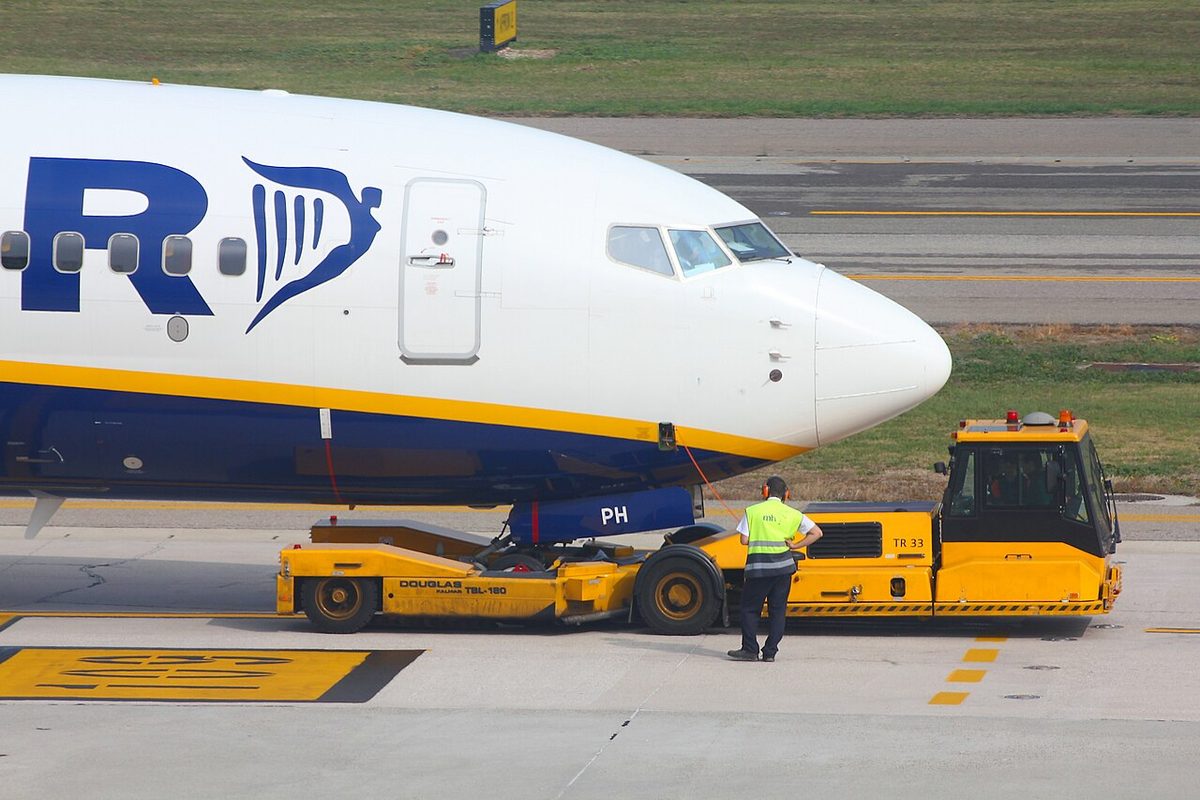
Taxi clearances
The ground controller, using the suffix GROUND, controls aircraft and vehicles taxiing on the manoeuvring area, the part of the aerodrome used for take-off, landing and taxiing, excluding aprons; the runway in use belongs to the tower. A typical clearance is "G-CD, taxi to holding point runway 27 via Alpha, hold short of runway 22." Other instructions are EXPEDITE TAXI (reason), answered EXPEDITING, and CAUTION TAXI SLOWER (reason), answered SLOWING DOWN.
A taxi instruction whose limit lies beyond a runway must contain either an explicit clearance to cross that runway or an instruction to hold short of it. If neither is given, the pilot holds short and asks: a taxi clearance never carries authority to cross a runway. The FAA applies the same principle strictly; since 2010 ATC must issue an explicit crossing clearance for every runway along the taxi route. The FAA also recommends reading back the full taxi route.
A pilot who is unsure of their position stops, holds clear of any runway and tells the controller. Guessing is how most runway incursions begin (see taxiing and runway incursion prevention).
Holding short and runway crossings
The instructions HOLD and HOLD POSITION are acknowledged with HOLDING, and HOLD SHORT OF (position) with HOLDING SHORT, always with the call sign and, for a runway, its designator. ROGER and WILCO are never enough, because they give the controller no proof of which runway the pilot heard. "G-CD, hold short of runway 27" is answered "Holding short runway 27, G-CD."
The aircraft stops at the runway-holding position, marked by two solid and two dashed yellow lines with the solid lines on the taxiway side, and by a red mandatory instruction sign carrying the runway designator. A lit stop bar, a row of red lights across the taxiway, is not crossed until it is switched off.
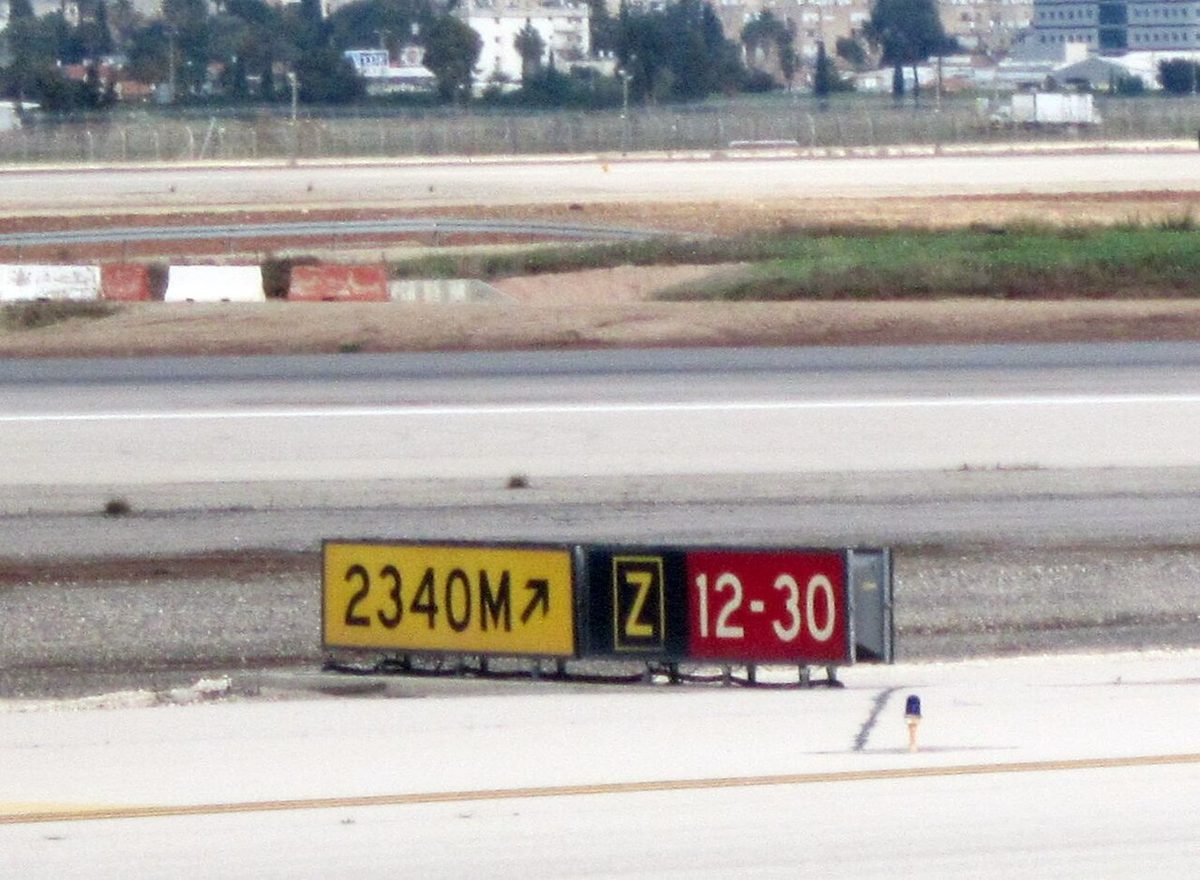
A crossing is cleared with CROSS RUNWAY (number), and read back in full. When the controller cannot see the crossing aircraft, at night or in low visibility, the instruction includes REPORT VACATED. An aircraft has vacated a runway only when every part of it is beyond the relevant runway-holding position; in low visibility procedures that is the CAT II/III holding position, further from the runway. After landing, the tower commonly says WHEN VACATED CONTACT GROUND (frequency), and the pilot changes frequency only once well clear.
Backtracking and line-up
To backtrack is to taxi along the runway in the direction opposite to that of take-off or landing, typically to reach the threshold at an aerodrome without a full parallel taxiway. It needs a clearance and a full readback, like any instruction to enter or taxi on a runway. The crew must also check that the runway is wide enough to turn. Airbus's FCOM gives about 24 m for a 180° turn on a dry runway in an A320 and about 30 m in an A321, using the recommended technique; the turn is flown at a ground speed of 5 to 8 kt.
LINE UP [AND WAIT] instructs the pilot to enter the runway and align for departure without taking off. It may be issued as soon as the preceding departure has begun its take-off run. A conditional line-up, "G-CD, behind the landing Airbus, line up runway 24 behind", is read back with its condition, "Behind the landing Airbus, lining up runway 24 behind, G-CD", and is only issued when the pilot and the controller can both see the aircraft concerned.
The FAA uses line up and wait (LUAW) in the same sense and warns that it is not a take-off clearance: many incidents involved pilots who read it back correctly and then departed. ATC tells the aircraft in position about landing traffic within 6 flying miles for the same runway and normally withholds a landing clearance while an aircraft waits on it. FAA analysis found that incidents followed a wait of two minutes or more, so a pilot left in position without a stated delay should query the tower. When the line-up is from an intersection, the clearance names it; if the designator is missing, the pilot asks.
Take-off clearances
At the holding point the pilot reports READY FOR DEPARTURE, never "ready for take-off". The words TAKE-OFF are used only in the take-off clearance and when cancelling it; at all other times controllers and pilots say DEPARTURE or AIRBORNE. The rule is one of the lessons of the Tenerife collision between two Boeing 747s, in which a transmission mentioning take-off was misunderstood.
The clearance itself is "G-CD, runway 27, cleared for take-off", and is read back. A departing aircraft is not normally cleared for take-off until the preceding departure has crossed the end of the runway in use or started a turn away from it. Behind a heavy aircraft, wake turbulence separation applies: two minutes for a medium or light aircraft departing from the same runway, three if it departs from an intermediate part of the runway (see wake turbulence and jet blast).
When the runway is needed quickly, the controller may say CLEARED FOR IMMEDIATE TAKE-OFF. Accepting it means taxiing onto the runway and taking off in one continuous movement; a crew that cannot comply refuses it and holds short. TAKE OFF IMMEDIATELY OR VACATE RUNWAY, or TAKE OFF IMMEDIATELY OR HOLD SHORT OF RUNWAY, demands a clearance be used at once or given up.
Two phrases stop a departure:
| Situation | Controller | Pilot |
|---|---|---|
| Aircraft not yet rolling | HOLD POSITION, CANCEL, I SAY AGAIN CANCEL TAKE-OFF (reason) | HOLDING |
| Aircraft already rolling | (call sign) STOP IMMEDIATELY, (call sign) STOP IMMEDIATELY | STOPPING |
After take-off the pilot may be asked to report AIRBORNE, with the time.
Landing clearances
Arrivals report their position in the circuit or on the approach. FINAL is reported at about 7 km (4 NM) from touchdown. LONG FINAL is reported when an aircraft turns onto final more than 7 km from touchdown, or, on a straight-in approach, at about 15 km (8 NM), with FINAL following at 4 NM. A joining clearance gives the position in the circuit, the runway, the surface wind and the QNH or QFE, with the temperature and traffic as required; MAKE STRAIGHT-IN APPROACH RUNWAY (number) replaces it for an aircraft that will not fly the circuit (see aerodrome traffic and circuits).
The landing clearances are CLEARED TO LAND, CLEARED TOUCH AND GO, CLEARED LOW APPROACH, for an approach down to a minimum height without landing, and CLEARED LOW PASS, for a fly-past, for example to let the tower inspect the landing gear. The tower then reports only what it can see, "LANDING GEAR APPEARS DOWN", which does not confirm that the gear is locked. GO AROUND is answered GOING AROUND, and the crew flies the published missed approach unless given other instructions (see go-around and missed approach).
Some authorities allow a land after clearance, which permits an aircraft to land while the preceding one is still on the runway. The conditions usually cited are daylight, the following pilot seeing the preceding aircraft throughout, a dry runway with good braking, and a controller who can see the whole runway.
The FAA has its own variants. Cleared for the option lets the pilot choose a touch-and-go, low approach, missed approach, stop-and-go or full-stop landing. In land and hold short operations, a clearance such as "runway 27, cleared to land, hold short of runway 18" must be read back in full, including the hold-short runway; the pilot may refuse it, and the FAA advises student pilots not to take part. At any US airport with an operating control tower, 14 CFR 91.129 forbids taxiing on a runway or taxiway, taking off or landing without an appropriate ATC clearance.
Aerodrome traffic and warnings
The tower passes traffic information with the clock code, distance and relative direction, and adds cautions where needed:
- CAUTION WAKE TURBULENCE, for the vortices behind a preceding landing or departing aircraft. It is given instead of wake separation to a VFR arrival landing behind a heavy or medium aircraft, and to an IFR flight on a visual approach that has the preceding aircraft in sight and has been told to follow it; the spacing then becomes the pilot's responsibility.
- CAUTION JET BLAST, for jet exhaust on the apron or taxiway, and CAUTION SLIPSTREAM, for propeller wash.
- Windshear and microburst alerts from ground detection systems (see windshear and microbursts). The FAA's phraseology is runway-specific: "runway 17 arrival, microburst alert, 40 knot loss, 3 mile final". A microburst alert means an expected airspeed loss of 30 kt or more; smaller losses or gains are given as windshear alerts.
When the radio fails, the tower falls back on light signals, described in radio communication failure.
Exam tip: hold short is answered "holding short" with the runway and call sign, a conditional clearance is read back with its condition, and take-off appears only in the take-off clearance and its cancellation.
Frequently asked questions
Why do pilots say ready for departure instead of ready for take-off?
The words take-off are reserved for the take-off clearance itself and for cancelling it. At all other times pilots and controllers say departure or airborne, so a report of readiness can never be mistaken for a clearance. The rule is one of the lessons drawn from the Tenerife collision between two Boeing 747s, in which a transmission mentioning take-off was misunderstood.
Does a taxi clearance allow you to cross a runway?
No. Under ICAO procedures a taxi instruction whose limit lies beyond a runway must contain either an explicit clearance to cross that runway or an instruction to hold short of it; if neither is given, the pilot holds short and asks. In the United States, ATC has had to issue an explicit clearance for every runway crossed since 2010, so taxiing to a runway no longer implies permission to cross another.
What does line up and wait mean?
Line up and wait instructs the pilot to taxi onto the departure runway, align with it and wait for the take-off clearance. It is not a clearance to take off. The FAA notes that many incidents involved pilots who read the instruction back correctly and then departed anyway, and advises calling the tower if no take-off clearance arrives within a reasonable time, since incidents have followed long waits in position on the runway.
What is the difference between final and long final?
Final is reported when the aircraft is on final approach within about 7 km, 4 NM, of touchdown. Long final is reported when the aircraft turns onto final approach more than 7 km from touchdown, or, on a straight-in approach, at about 15 km, 8 NM, after which final is reported at 4 NM. The calls let the tower and other traffic judge how close the aircraft is.
What does cleared for the option mean?
Cleared for the option is FAA phraseology that lets the pilot choose a touch-and-go, low approach, missed approach, stop-and-go or full-stop landing on the runway named. It is used mainly in training, so that an instructor can decide at the last moment. A pilot planning a stop-and-go should tell the tower. ICAO phraseology has no equivalent; European pilots state the intention, such as touch and go.
Test yourself on Aerodrome Control Phraseology
The v1prep banks cover this topic in Communications (090), with a worked explanation for every answer. EASA ATPL, PPL, IR and CPL, the FAA written tests and A320/B737 type ratings.
Start practising →Sources and further reading
- ICAO Doc 4444, Procedures for Air Navigation Services, Air Traffic Management (PANS-ATM), 16th edition, as published by Airservices Australia
- EASA Easy Access Rules for Standardised European Rules of the Air (SERA)
- FAA Aeronautical Information Manual, Chapter 4 Section 3, Airport Operations
- FAA Aeronautical Information Manual, Chapter 5 Section 2, Departure Procedures (5-2-5, Line Up and Wait)
- FAA Aeronautical Information Manual, Chapter 4 Section 2, Radio Communications Phraseology and Techniques
- FAA Aeronautical Information Manual, Chapter 7 Section 4, Wake Turbulence
- 14 CFR 91.129, Operations in Class D airspace
Library articles are written for study and exam preparation. They do not replace your aircraft's approved documentation, your operator's procedures or the regulations themselves.