Cargo and Lavatory Fire Protection
Cargo and lavatory fire protection covers the smoke detectors and fixed extinguishing systems that protect parts of a transport aircraft nobody can watch continuously: the cargo holds, classified A to E by how a fire there is detected and controlled, and the lavatories with their waste bins.
Cargo holds and lavatories share a problem: a fire there can grow unseen. Nobody watches the hold in flight, and a lavatory is a closed room that a passenger may have left minutes earlier. Cargo and lavatory fire protection therefore rests on smoke detection, which gives the earliest sign of a fire in stored material, and on fixed extinguishers that work without anyone having to reach the fire.
Two accidents are often quoted. The fatal lavatory fire on Air Canada Flight 797 in 1983, whose origin was never determined, led to smoke detectors in lavatories and automatic extinguishers in their waste bins. On ValuJet Flight 592 in 1996, chemical oxygen generators carried in the cargo hold without being declared as dangerous goods started the fire that brought the aircraft down (see dangerous goods). What the crew do once a warning appears is covered in in-flight fire, smoke and fumes.
Smoke detector types
Smoke detectors are installed wherever an area cannot be kept under constant physical surveillance: cargo holds, electrical and avionics bays, and lavatories. A smoke detection system must give a remote warning on the flight deck or in the cabin, be testable before flight, and be resettable, so that the crew can see whether the warning returns. ATPL texts describe four principles:
- Light refraction smoke detector. A lamp shines into a dark chamber, and a photoelectric cell is shielded from its direct light. Smoke particles in the chamber deflect light onto the cell (physicists would say they scatter it), and the change in current triggers the warning. It is the most common type in cargo holds and lavatories. Air is usually drawn through the chamber by a fan or the airflow, because waiting for smoke to diffuse into it would be too slow.
- Ionisation (ionization) smoke detector. A tiny radioactive source ionises the air in a chamber, so a small current flows across it. Smoke particles attach to the ions and reduce the current, and the drop triggers the warning. The E190-E2's lavatory detectors work this way.
- Semiconductor smoke detector. Two heated elements with a semiconductor coating absorb combustion gases such as carbon monoxide, which changes their conductivity. One samples the compartment, the other clean reference air, and a difference between them gives the warning.
- Flame detection, in which a photoelectric cell responds to the visible or infrared light of an open flame rather than to smoke.
A test function, typically a test lamp inside the chamber, simulates smoke and checks the whole chain from detector to warning lights and aural alert.

Cargo compartment classification
CS 25.857 and 14 CFR 25.857, which use the same classes, classify cargo and baggage compartments by how a fire in them would be found and fought. The cargo compartment classification decides what fire protection each needs:
| Class | Definition | Fire protection |
|---|---|---|
| A | So close to a crew member's station that a fire would be discovered there, with every part easily accessible in flight | Crew and hand extinguisher |
| B | Enough access in flight for a crew member to reach any part with a hand fire extinguisher | Separate smoke or fire detection system; hand extinguisher |
| C | Meets neither A nor B: the crew cannot reach a fire | Detection warning the flight deck, a built-in extinguishing or suppression system controlled from the flight deck, ventilation control, and exclusion of smoke and agent from occupied areas |
| D | Former class | No longer used for new designs and no longer cleared for passenger aircraft |
| E | Cargo-only aeroplanes, typically the former passenger cabin of a freighter | Detection; ventilation airflow shut off to starve a fire; smoke kept out of the flight deck; crew exits accessible |
The Class C cargo compartment is the one most pilots meet: the lower-deck holds of passenger airliners, such as the forward and aft holds of the E190, are Class C. Boeing describes its purpose as confining a fire completely without endangering the aeroplane or its occupants. In a Class E compartment on a freighter, the fire is controlled by starving it of oxygen, typically by shutting off ventilation and depressurising the aircraft.
Cargo smoke detection
Cargo smoke detection uses several detectors in the ceiling of each hold, arranged on the dual-loop principle familiar from engine fire detection.
- Airbus A320. The forward hold has two smoke detectors and the aft hold four, each linked to one of two detection loops. A smoke detection control unit with two identical channels, or on some aircraft the cabin intercommunication data system, passes the signals to the ECAM. The red SMOKE warning comes on if both loops detect smoke, or one does and the other has failed. At the same time the cargo ventilation isolation valves close and the extraction fan stops, so that the ventilation does not spread smoke or dilute the agent.
- Boeing 737. Each hold has detectors in a dual-loop configuration, and normally both loops must sense smoke. A power failure in one loop converts the system to single-loop detection automatically; a detector failure can be handled by selecting a single loop with the DET SELECT switch. The warning is a cargo fire warning, with the fire bell and master FIRE WARN lights, and the hold lights can go out and come back on during the rest of the flight.
- Embraer E190-E2. Photoelectric detectors with fans sit in the ceiling, and two must trigger before the master warning is given. The E190 E1 has four detectors forward and three aft.
Cargo fire detection is therefore, in practice, cargo smoke detection: the detectors sense smoke, but the flight deck is warned of a fire, because a fire in stored material can spread quickly. Cargo detectors are prone to false alarms: dust, dirt, condensation and gases such as those given off by rotting fruit can all look like smoke. That is why two detectors or loops must agree, and why the detectors are tested regularly. On the 737 the cargo fire test is done once per flight day, and faults in individual detectors are found only by that manual test.
Cargo fire suppression
A cargo fire suppression system in a Class C hold uses Halon 1301, discharged from the flight deck through nozzles in the hold. It is designed to suppress a fire rather than extinguish it. On many types a first, high-rate discharge knocks the fire down, and a second bottle, fired later or at a lower rate, keeps the halon concentration high enough to hold it for the rest of the flight. Smoke can remain, and the fire may still need to be put out by fire fighters after landing.
| Aircraft | Bottles | Operation |
|---|---|---|
| Airbus A320 | One bottle with two discharge heads, one per hold, feeding one nozzle forward and two aft | Crew press FWD or AFT DISCH; the amber DISCH light comes on within 60 seconds, once the bottle is empty |
| Boeing 737 NG | Two bottles in the air conditioning mix bay | Crew arm FWD or AFT, then push DISCH for at least 1 second; the first bottle fires at once and the second follows automatically after a delay; total suppression time 195 minutes |
| Embraer E190-E2 | High-rate bottle and a low-rate bottle lasting 75 minutes | After a smoke warning, one push of the hold button fires the high-rate bottle; in flight the low-rate bottle follows automatically after 1 minute |
The suppression time limits how far the aircraft may be from an airport. The 737's 195 minutes are made up of 180 minutes to reach an airport and 15 more for the approach, landing and unloading, and US ETOPS rules follow the same logic: under 14 CFR 121.633 the diversion time to an ETOPS alternate may not exceed the most limiting cargo fire suppression time minus 15 minutes (see ETOPS).
Whatever the system, a cargo fire warning means landing at the nearest suitable airport. Lithium batteries are a growing concern because a battery fire can exceed what a halon system is designed to suppress, one reason spare batteries travel in the cabin, where a fire can be seen and fought.
Lavatory smoke detectors
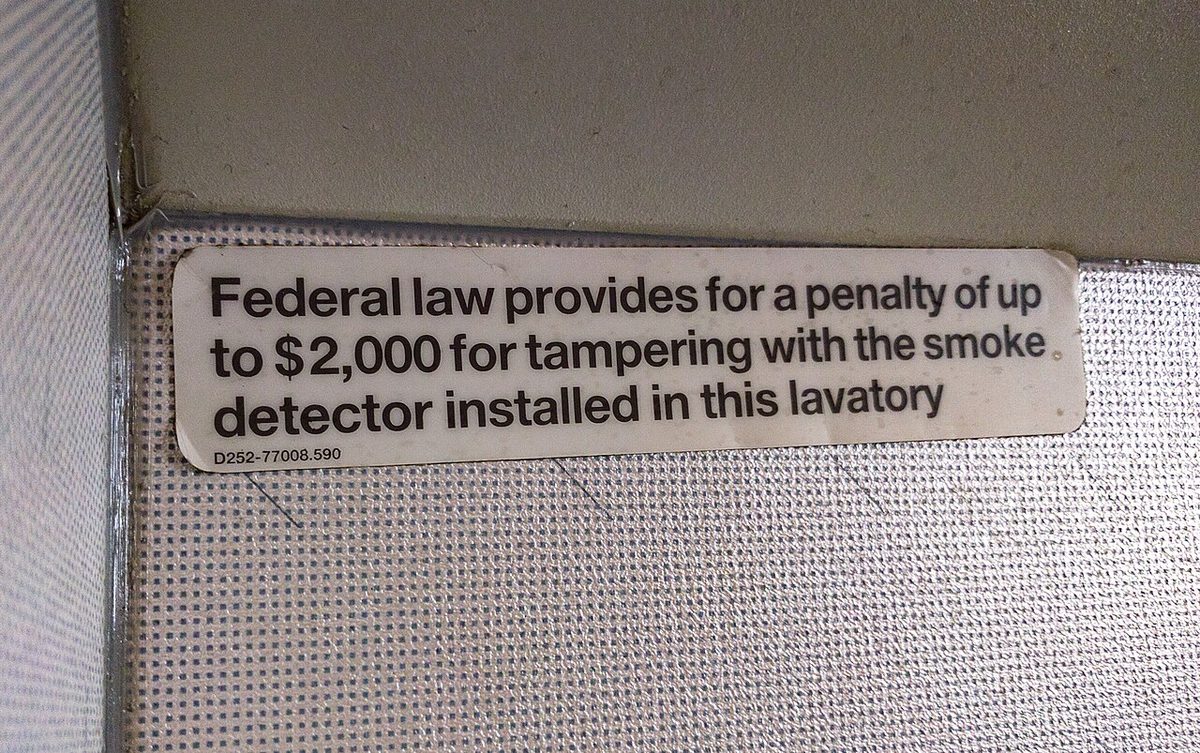
Since the Air Canada accident, CS 25.854 and 14 CFR 25.854 require a lavatory smoke detector in each lavatory of an aeroplane with 20 or more passenger seats. The warning need not reach the flight deck: on most Boeing 737 variants it is given only at the lavatory, for the cabin crew. The detector sits in the lavatory ceiling or in its air extraction duct, where smoke collects.
Lavatory smoke detection differs between types:
- On the A320 the detector is in the lavatory's air extraction duct, and the signal goes through the smoke detection control unit or cabin data system to the flight warning computer, which warns both the flight deck and the cabin.
- On the E190-E2 an ionisation detector in the ceiling gives a LAV SMOKE master warning, and the horn at the lavatory is silenced with a tool.
- On most Boeing 737 variants there is no flight deck indication: the detector sounds an aural alarm and lights a red indicator at the lavatory, and the cabin crew investigate. Some variants add an amber LAVATORY SMOKE light on the flight deck and a flashing lavatory call light.
A lavatory smoke warning may come from a passenger smoking in spite of the ban, but it is always investigated as a possible fire, and the flight crew are told at once.
Lavatory waste bin extinguishers
The waste bin, full of paper towels, is an obvious place for a lavatory fire to start. CS 25.854 and 14 CFR 25.854 require a built-in extinguisher for each waste receptacle in the lavatory, designed to discharge automatically into it if a fire starts there.
The lavatory waste bin fire extinguisher is a small bottle of agent, traditionally halon, mounted next to or beneath the bin; on the 737 it sits beneath the sink. Its outlet is closed by a fusible plug. When heat from a fire in the bin melts the plug, the agent discharges through a nozzle or spray ring into the receptacle. No crew action is involved, and on the 737 and E190-E2 there is no flight deck indication that the extinguisher has fired.
Holds and lavatories therefore differ in a way examiners like to test. In a cargo hold the pilots decide to discharge a fixed halon system; in a lavatory the waste bin extinguisher fires itself, and the rest of the room is protected by the cabin crew with hand extinguishers (see fire extinguishing agents and hand extinguishers).
Exam tip: Class A is seen from a crew station, Class B can be reached with a hand extinguisher, Class C cannot be reached and needs detection plus a built-in extinguishing system, Class D is no longer used, and Class E is for freighters. Lavatory smoke detectors and waste bin extinguishers are required with 20 or more passenger seats.
Frequently asked questions
What is a Class C cargo compartment?
A Class C compartment is a cargo or baggage hold that the crew cannot reach in flight, such as the lower-deck holds of most passenger airliners. Because nobody can fight a fire there, it must have a smoke or fire detection system warning the flight deck, a built-in extinguishing or suppression system controlled from the flight deck, control of the ventilation so that the agent stays concentrated, and means to keep smoke and agent out of occupied compartments.
How long can an airliner's cargo fire suppression system hold a fire?
It depends on the aircraft and the number of bottles. A fixed halon system is designed to suppress a fire, not to put it out, for a certified time. On the Boeing 737 NG it gives 195 minutes, 180 to reach an airport plus 15 for the approach, landing and unloading. For ETOPS, 14 CFR 121.633 limits the diversion time to the most limiting cargo fire suppression time minus 15 minutes.
Are there smoke detectors in aircraft toilets?
Yes. Since the fatal lavatory fire on Air Canada Flight 797 in 1983, transport aeroplanes with 20 or more passenger seats have a smoke detector in each lavatory and an automatic extinguisher in each waste bin. The detector sounds an alarm in the cabin and, depending on the type, warns the flight deck too. A lavatory smoke warning is always investigated by the crew as a possible fire.
How does a lavatory waste bin fire extinguisher work?
A small bottle of extinguishing agent, usually halon, is mounted beside or under the waste bin with its outlet sealed by a fusible plug. If the contents of the bin catch fire, the heat melts the plug and the agent discharges through a nozzle or spray ring into the bin. It works automatically, with no crew action, and on many types there is no flight deck indication that it has fired.
Why do cargo smoke detectors give false alarms?
Most cargo detectors see smoke as particles that scatter light in a sampling chamber, so anything that behaves like smoke can trigger them: dust, dirt, condensation, and even gases given off by rotting fruit. Designs reduce false alarms by requiring two detectors or two loops to agree, but a warning is still treated as a real fire, because the hold cannot be inspected in flight.
Test yourself on Cargo and Lavatory Fire Protection
The v1prep banks cover this topic in Aircraft General Knowledge (021), with a worked explanation for every answer. EASA ATPL, PPL, IR and CPL, the FAA written tests and A320/B737 type ratings.
Start practising →Sources and further reading
- 14 CFR 25.857, Cargo compartment classification
- 14 CFR 25.854, Lavatory fire protection
- EASA Easy Access Rules for Large Aeroplanes (CS-25)
- 14 CFR 121.633, Considering time-limited systems in planning ETOPS alternates
- EASA, Explanatory Note to ED Decision 2018/001/R, Part-FCL theoretical knowledge learning objectives (021 Airframe and Systems)
- NTSB AAR-97/06, In-Flight Fire and Impact with Terrain, ValuJet Airlines Flight 592, DC-9-32, Everglades, Miami, Florida, 11 May 1996
Library articles are written for study and exam preparation. They do not replace your aircraft's approved documentation, your operator's procedures or the regulations themselves.