Position Reports and Required Reports
A position report is a pilot's radio report of where the aircraft is, when it was there, its level and its estimate for the next point, made over designated reporting points when ATC has no surveillance picture of it. Required reports are the other items pilots pass without being asked, from revised estimates and equipment failures to hazardous weather.
A position report tells air traffic control where an aircraft is, when it was there, at what level, and when it expects to reach the next point. Where there is no radar or other surveillance, these reports are the controller's only picture of the traffic: procedural separation is built on them, and an estimate that is a few minutes out can erode it. Radar and ADS-B have made routine reports rare in busy continental airspace, but they remain the norm over the oceans and in remote areas, and they return whenever surveillance is lost.
Pilots also make a set of required reports without being asked: a revised estimate, a change of airspeed, leaving a level, a missed approach, a failure of navigation or communication equipment, and weather that others need to know about. ICAO procedures, applied in Europe through SERA, and the FAA's rules list much the same reports but differ in some thresholds, and exam questions probe exactly those differences.
Reporting points
A reporting point is a specified geographical location in relation to which the position of an aircraft can be reported. It may be a radio navigation aid, an intersection of radials or a named waypoint on an airway, or, for a VFR flight, a visual reporting point on the approach chart of a controlled aerodrome.
There are two kinds:
- a compulsory reporting point, where a report is required unless ATC has exempted the flight, charted as a filled triangle;
- an on-request reporting point, where a report is made only when ATC asks for one, charted as an open triangle.
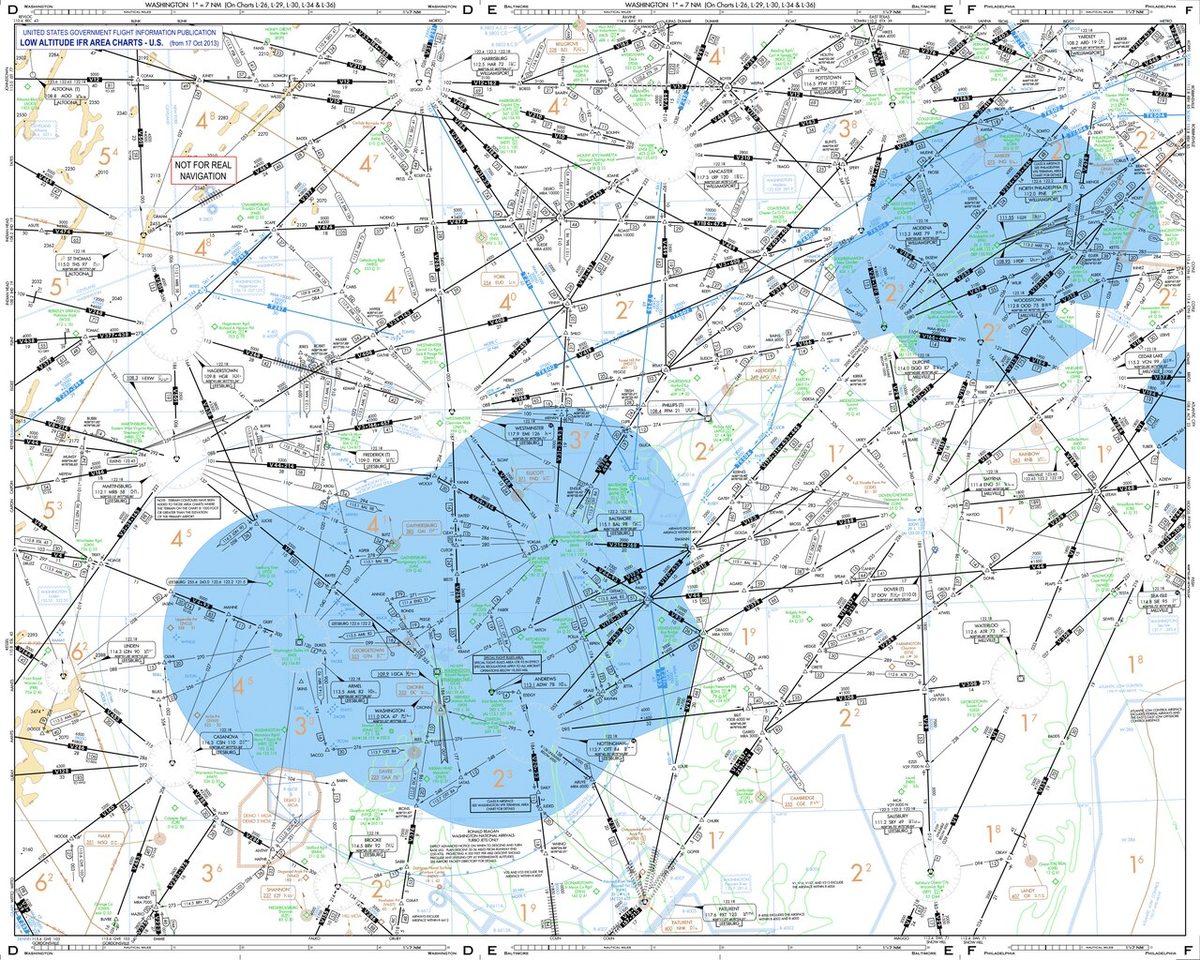
The same symbols appear on FAA en route charts and on ICAO-style charts such as the French visual approach charts. Controllers can make on-request points compulsory when they need more fixes: the AIP for Nantes Atlantique notes that ATC may require reports at its on-request points E1, E2 and E3. Database-only points, such as FAA computer navigation fixes, have no ATC name and are never used in position reports.
The time over a point should be as exact as the equipment allows. The FAA's AIM gives the rules: over a VOR, the time of the first complete reversal of the TO/FROM indicator; over an NDB with an ADF, the time at which the needle completes its reversal; with an aural or light indication such as a fan marker, the mean of the times at which the signal is first received and at which it ceases. A position given as a distance and direction from a point should be worked out as accurately as possible.
Compulsory and on-request reports
Under ICAO rules, applied in Europe by SERA, a controlled flight reports the time and level of passing each compulsory reporting point (a compulsory position report), and reports at other points when ATS asks. When adequate flight progress data are available from other sources, usually ATS surveillance, ATC can exempt the flight with the phrases:
- "OMIT POSITION REPORTS", optionally "UNTIL (point)";
- "NEXT REPORT AT (point)";
- "RESUME POSITION REPORTING".
An instruction to omit reports stays in force until ATC cancels it or advises that identification is lost or the surveillance service has ended (see radar services and vectoring).
The FAA's AIM follows the same logic. An IFR flight, including one cleared VFR-on-top, reports over each compulsory reporting point along the airway it is flying, and on a direct route over each point used in the flight plan to define the route. Once told "radar contact" the pilot stops reporting, and resumes when ATC says "radar contact lost" or "radar service terminated". In oceanic non-radar airspace every point used in the flight plan is reported, even if charted as on request, unless the aircraft reports automatically through an ADS-C logon, in which case voice reports stop. On North Atlantic east-west routes the points lie at every 10° of longitude (see oceanic and North Atlantic operations).
Position report format
ICAO's position report has six elements, in a fixed order that lets the controller copy it straight onto the flight progress strip:
- aircraft identification;
- position;
- time;
- level;
- next position and the time over it;
- ensuing significant point.
Elements 1 to 3 may never be omitted; elements 4 to 6 may be omitted where the appropriate authority allows. A speed assigned by ATC is included. The time is normally given as the minutes past the hour, each digit spoken separately, the hour being added only when there could be doubt (see radiotelephony transmitting technique). A report over OKTET at 1447 might therefore run: "(call sign), OKTET four seven, flight level three five zero, estimating BIGNO five nine, next DEVAS". The ensuing point is named without an estimate.
| Item | ICAO / SERA | FAA (AIM 5-3-2) |
|---|---|---|
| Identification, position, time | Always | Always |
| Level | Level | Altitude or flight level; actual altitude when VFR-on-top |
| Type of flight plan | Not included | Included, except in IFR reports made directly to a centre or approach control |
| Next point | Next position and time over it | ETA and name of the next reporting point |
| Following point | Ensuing significant point | Name only of the next succeeding reporting point |
| Other | Assigned speed, if any | Pertinent remarks |
A report in the FAA format, made to Flight Service, might run: "Cessna 12345, over PODUNK at 1520, 7,000, IFR, estimating SMITH at 1535, next JONES." A full report is not what a controller with surveillance wants on first contact: there the pilot gives the call sign and level, or the level passing and the cleared level.
Exam tip: call sign, position and time can never be left out. The ensuing point comes last and has no estimate.
Revised estimates
Procedural separation assumes that each aircraft will be where its estimate says. ICAO and SERA (SERA.8020) therefore require a revised estimate to be passed as soon as possible when the estimate for the next applicable reporting point, FIR boundary or destination aerodrome, whichever comes first, is found to be in error by more than 2 minutes, or by such other period as the competent authority prescribes; older texts give 3 minutes. The FAA uses the same figure, asking for a corrected estimate whenever a previous one is in error by more than 2 minutes. In the North Atlantic the threshold is 3 minutes or more, and it applies to the oceanic entry estimate once the oceanic clearance has been issued.
Airspeed is treated the same way. Under ICAO rules ATS is told when the average true airspeed at cruising level varies, or is expected to vary, by 5% or more from the figure in the flight plan; the FAA's threshold is 5% or 10 kt, whichever is greater. A turbojet flying under the Mach number technique on an oceanic clearance keeps its assigned Mach number and asks before changing it.
Exam tip: revised estimate: ICAO, SERA and FAA more than 2 minutes (3 minutes in older texts); North Atlantic 3 minutes or more. True airspeed 5% (FAA 5% or 10 kt, whichever is greater).
Other required reports
The FAA sets out its list in AIM 5-3-3 and 14 CFR 91.183. Some reports are made at all times, others only when not in radar contact.
| When | Report |
|---|---|
| At all times | Vacating any previously assigned altitude or flight level for a newly assigned one |
| At all times | An altitude change when on a VFR-on-top clearance |
| At all times | Unable to climb or descend at a rate of at least 500 ft per minute |
| At all times | A missed approach, with a request for further clearance |
| At all times | A change in average true airspeed at cruising altitude of 5% or 10 kt, whichever is greater |
| At all times | Time and altitude on reaching a holding fix or clearance limit, and leaving any holding fix |
| At all times | Loss of navigation, approach or communication capability; any information relating to safety of flight |
| Not in radar contact | Leaving the final approach fix inbound, or the outer marker or fix used in lieu of it on a precision approach |
| Not in radar contact | A corrected estimate in error by more than 2 minutes (NAT: 3 minutes or more) |
Pilots are also expected to report weather that was not forecast, and hazardous conditions that were. ICAO procedures rely more on specific requests, such as "REPORT REACHING (level)" or "REPORT PASSING (level)", and on the initial call to each new unit, but the same events, a missed approach or an inability to comply with a clearance, are reported promptly everywhere.
Equipment malfunction reports
Under 14 CFR 91.187 the pilot in command of an aircraft operated IFR in controlled airspace makes an equipment malfunction report to ATC, as soon as practical, for any malfunction of navigational, approach or communication equipment occurring in flight. The report gives:
- the aircraft identification;
- the equipment affected;
- the degree to which the capability to operate under IFR in the ATC system is impaired;
- the nature and extent of assistance desired from ATC.
The AIM names the loss of VOR, TACAN, ADF or low-frequency receiver capability, GPS anomalies with an IFR-certified receiver, complete or partial loss of ILS receiver capability, and impairment of air/ground communications. A GPS anomaly report includes the location and altitude and, if needed, the duration. Other equipment, such as weather radar, is reported when the pilot judges that its failure affects safety or IFR capability.
Elsewhere the same principle is expressed through standard phrases. An aircraft that loses the equipment needed for reduced vertical separation reports "UNABLE RVSM DUE EQUIPMENT", and ATC applies 2,000 ft or moves it out of the RVSM band (see separation standards). A radio that cannot use 8.33 kHz channels is declared with "NEGATIVE EIGHT POINT THREE THREE". A total communication failure is signalled with code 7600 and the published procedure (see radio communication failure), and a failure that threatens the aircraft calls for PAN PAN or MAYDAY.
Ride and turbulence reports
Pilots are the only direct source of information on turbulence, icing and cloud tops at altitude, and some reports of them are mandatory. Under ICAO rules, applied in Europe by SERA, a special air-report is made to the ATS unit, normally by voice and as soon as practicable, on meeting:
- moderate or severe turbulence;
- moderate or severe icing;
- severe mountain wave;
- thunderstorms, with or without hail, that are obscured, embedded, widespread or in squall lines;
- heavy dust storm or sandstorm;
- volcanic ash cloud, pre-eruption volcanic activity or a volcanic eruption.
In the United States, 14 CFR 91.183 requires an IFR pilot to report unforecast weather conditions encountered and any other information relating to the safety of flight. The pilot report (PIREP) is coded UA when routine and UUA when urgent, the latter for severe or extreme turbulence including clear air turbulence, severe icing, hail, low-level windshear, volcanic ash and similar hazards (see meteorological services and briefings).
The most frequent report on an airline frequency is less formal. A ride report tells ATC and other crews how the air feels at a given level: "smooth", "occasional light chop", "continuous moderate turbulence". Crews ask for ride reports when choosing a cruising level, and controllers pass them on. The words follow the AIM's scales. Chop is rapid, somewhat rhythmic bumpiness without appreciable change in altitude or attitude; turbulence produces such changes. Duration is occasional for less than a third of the time, intermittent for a third to two thirds and continuous for more than two thirds. A good report names the aircraft type, because moderate turbulence for a Boeing 737 may be severe for a Cessna 172 (see turbulence).
Exam tip: light turbulence or light icing needs no special air-report; moderate or severe does. In a PIREP, UA is routine and UUA urgent.
Frequently asked questions
What does a position report contain?
Under ICAO procedures a position report has six elements in a fixed order: aircraft identification, position, time, level, next position with the time over it, and the ensuing significant point. The first three may never be omitted. An assigned speed is included. The FAA's version adds the type of flight plan when reporting to Flight Service, and pertinent remarks, and gives the next point's ETA and the name only of the point after it.
What is the difference between a compulsory and an on-request reporting point?
A compulsory reporting point, charted as a filled triangle, must be reported whenever the flight is not exempted, which in practice means whenever it is not under surveillance. An on-request point, charted as an open triangle, is reported only when ATC asks for it. In oceanic airspace the FAA requires a report over every point used in the flight plan to define the route, even one charted as on request.
When must a revised estimate be passed to ATC?
Under ICAO rules and SERA.8020 a revised estimate is passed as soon as possible when the estimate for the next applicable reporting point, FIR boundary or destination is found to be in error by more than 2 minutes, unless the authority prescribes another period; older texts give 3 minutes. The FAA also asks for a corrected estimate beyond 2 minutes. In the North Atlantic the threshold is 3 minutes or more.
Which reports must be made to ATC even in radar contact?
The FAA's AIM lists reports made at all times without a request: vacating an assigned altitude, an altitude change on a VFR-on-top clearance, being unable to climb or descend at 500 ft per minute, a missed approach, a true airspeed change of 5% or 10 kt, reaching and leaving a holding fix, loss of navigation, approach or communication capability, and any information relating to safety of flight.
What must be reported after an equipment malfunction under IFR?
Under 14 CFR 91.187 the pilot in command of an IFR flight in controlled airspace reports any in-flight malfunction of navigation, approach or communication equipment as soon as practical, giving the aircraft identification, the equipment affected, how far the ability to operate IFR is impaired, and the assistance wanted from ATC. GPS anomaly reports should add the location, altitude and duration.
What is a ride report?
A ride report is a short pilot report of the ride at a given level, such as smooth, occasional light chop or continuous moderate turbulence, exchanged with ATC and other crews so that flights can choose a smoother altitude. It uses the standard turbulence intensity and duration terms and should include the aircraft type, because turbulence that is light for a large jet may be moderate or worse for a small aeroplane.
Test yourself on Position Reports and Required Reports
The v1prep banks cover this topic in Communications (090), with a worked explanation for every answer. EASA ATPL, PPL, IR and CPL, the FAA written tests and A320/B737 type ratings.
Start practising →Sources and further reading
- ICAO Doc 4444, Procedures for Air Navigation Services, Air Traffic Management (PANS-ATM), 16th edition, as published by Airservices Australia
- EASA Easy Access Rules for Standardised European Rules of the Air (SERA), special air-reports
- FAA Aeronautical Information Manual, Chapter 5 Section 3 (5-3-2 Position Reporting, 5-3-3 Additional Reports)
- 14 CFR 91.183, IFR communications
- 14 CFR 91.187, Operation under IFR in controlled airspace, malfunction reports
- FAA Aeronautical Information Manual, Chapter 7 Section 1 (PIREPs and turbulence reporting criteria)
- ICAO NAT Doc 007, North Atlantic Operations and Airspace Manual (2026 edition)
- UK CAA, CAP 413 Radiotelephony Manual
Library articles are written for study and exam preparation. They do not replace your aircraft's approved documentation, your operator's procedures or the regulations themselves.