Electrical Bonding, Static and Interference
Electrical bonding connects all the conducting parts of an aircraft with low-resistance paths so that they share the same electrical potential. Together with static dischargers and cable screening it controls static charge, carries lightning current safely and limits electromagnetic and radio frequency interference.
An aircraft in flight is an isolated conductor moving fast through air that carries dust, water and ice. It picks up electrical charge, it may be struck by lightning, and it carries dozens of electrical and electronic systems that can disturb each other. Three measures keep all of this under control: electrical bonding, which ties every conducting part together; static dischargers, which let the charge escape quietly; and cable screening, which keeps electrical noise in the cables that produce it and out of the cables that must not receive it.
The subject spans airframe electrics and radio. Its consequences range from a fuel vapour fire caused by a spark, through a burnt-out bonding strap after a lightning strike, to an ADF needle wandering in precipitation static. The circuits themselves are described in electrical fundamentals and DC circuits.
Electrical bonding
Electrical bonding connects all the metal parts of an aircraft, structure, components and equipment, with low-resistance conductors so that they all sit at the same electrical potential. It serves several purposes:
- Preventing sparks. Where two parts are at different potentials, charge can jump the gap between them as a spark, and a spark in the presence of fuel vapour is a fire. Parts at the same potential cannot spark.
- The earth return. Most metal aircraft use a single-pole, or earth-return, system: the negative side of the generator and battery, and of each load, is connected to the airframe, and only the positive wire is run to each load. The structure carries the return current, which works only if every part is well bonded.
- Lightning protection. A strike must be able to pass through the structure without jumping across poorly connected joints.
- Reducing interference. A loose or corroded joint can arc intermittently and become a source of radio noise.
Parts that are not already joined by metal-to-metal contact are connected by bonding straps or bonding jumpers. These are usually flexible braided copper wire or thin strip, sometimes tin-plated against corrosion, and flexible so that components can move slightly with vibration, expansion and the movement of control surfaces, doors and shock-mounted equipment.
The contact surfaces must be clean bare metal. Paint, anodising, grease and oxide all add resistance, which defeats the purpose of the bond and can lead to corrosion at the joint. For large aeroplanes, CS 25.899 and 14 CFR 25.899 require bonding and protection against static electricity designed to minimise the build-up of charge that could cause electric shock, ignite flammable vapour or interfere with installed equipment.
Exam tip: the principal purpose of bonding is to keep all metal parts at the same electrical potential. Preventing static sparks, providing the earth return and reducing radio interference all follow from that.
Bonding is also applied between the aircraft and the outside world on the ground. Before refuelling, the aircraft is bonded to the fuel truck or dispenser so that no spark can jump as the nozzle approaches the filler; the procedure is described in refuelling safety and fuel emergencies.
Static charge build-up
An aircraft accumulates static electricity in flight through friction between its surfaces and the airflow, and above all the particles the air carries: dust, water droplets, snow and ice crystals. Each impact transfers a little charge, and the airframe can be charged to many kilovolts.
The charge collects at points and sharp edges, where the electric field is strongest, and escapes from them into the air. If it escapes in small uncontrolled sparks from edges, gaps and poorly bonded parts, each spark is a burst of radio noise. The result is precipitation static (P-static): crackling or buzzing heard mainly on AM and HF equipment, such as the ADF and HF radio. On the ADF it raises the noise level, degrading the bearing and the identifier together; see NDB and ADF.
In strongly charged air, near thunderstorms, the discharge can become visible as St Elmo's fire, a bluish-violet glow on the windscreen, nose, wing tips or propeller tips. It is harmless in itself but a sign that a lightning strike is possible; see thunderstorms.
The charge must also be removed when the aircraft lands. Aircraft tyres are made with carbon in the rubber, which makes them electrically conductive, so that on touchdown the charge flows to the ground through the wheel and tyre.
Static dischargers and wicks
Static dischargers, also called static wicks or static discharge wicks, give the charge a controlled way out. They are small rods or wicks fitted to the trailing edges of the wings, ailerons, elevators, rudder, stabilisers and wing tips. Their sharp or teased ends concentrate the electric field, so the air around them ionises at a lower voltage than the rest of the airframe would need. The charge then leaks away continuously as a quiet corona discharge instead of in noisy sparks from edges, gaps and poorly bonded parts.
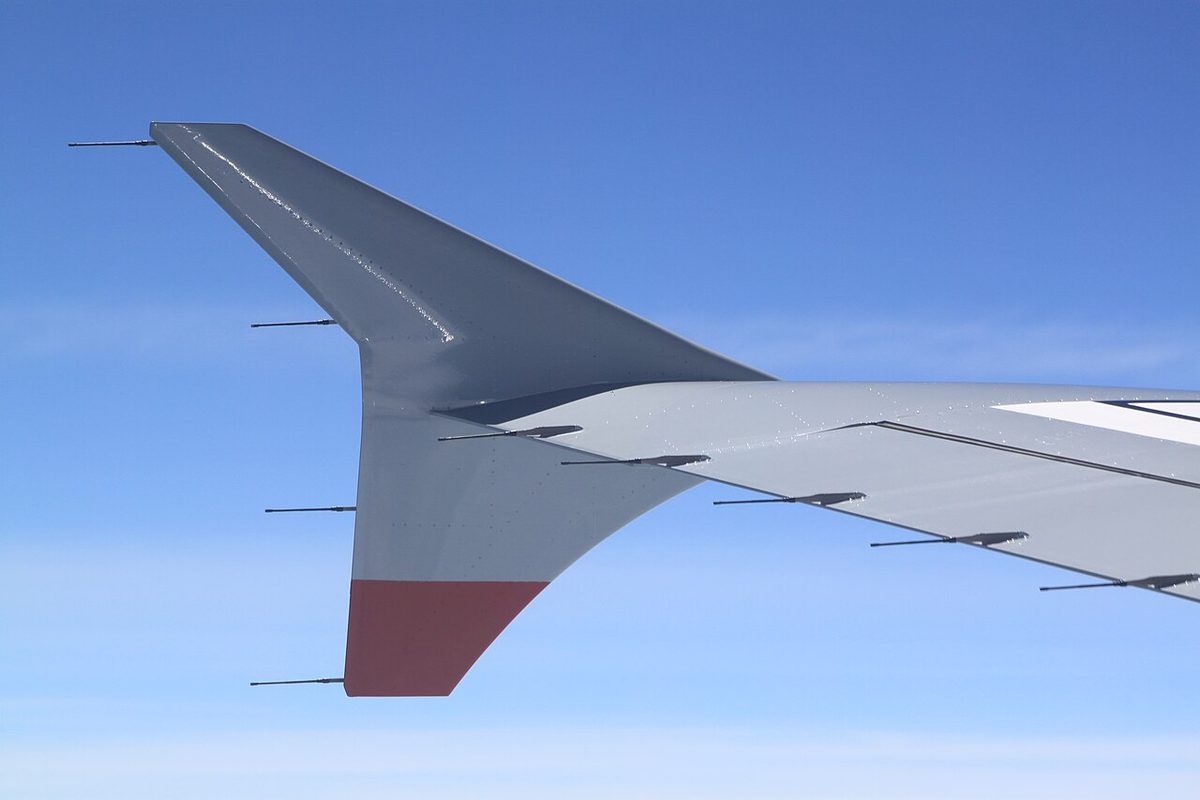
Dischargers reduce P-static; they do not prevent lightning, and they are among the parts commonly damaged by a strike.
Lightning and the airframe
A lightning strike enters the aircraft at one extremity and leaves from another. On a metal aircraft the current is carried by the skin; on composite structure it needs conductive material, such as metal mesh, built into the surface, because the composite itself conducts poorly. Bonding across every joint, hinge and access panel on that path lets the current pass without arcing, and the fuel system must be protected so that no spark can reach fuel vapour. 14 CFR 25.581 and the corresponding CS-25 paragraph require large aeroplanes to be protected against the catastrophic effects of lightning.
A strike typically leaves burn marks at entry and exit points and may damage radomes, antennas and static dischargers. Its current can induce transients in wiring and upset electronic equipment, and it can disturb the magnetic compass, which must then be checked with a compass swing; see magnetic compass. Any strike is followed by a maintenance inspection. When and where strikes happen, and how crews reduce the risk, is covered in thunderstorms.
Electrostatic discharge
Electrostatic discharge (ESD) is the sudden flow of current between two objects at different electrical potentials, when they touch or come close enough for a spark to jump. Static sparks matter in aviation in three ways:
- Fire. A spark between an aircraft and fuelling equipment, or between parts of the fuel system, can ignite fuel vapour. This is why the aircraft is bonded before a filler cap is opened.
- People. Personnel touching a charged aircraft can receive a shock, which is why the charge is drained through conductive tyres and, during servicing, earthing or bonding points.
- Electronics. Modern microelectronic components can be damaged by a discharge far too small for a person to feel. Components that are sensitive to it are handled with anti-static precautions during maintenance.
Electromagnetic interference
Electromagnetic interference (EMI) is any unwanted electromagnetic energy that degrades the performance of electrical or electronic equipment. It may be conducted along wiring or radiated through space, and it comes from inside and outside the aircraft:
- internal sources such as ignition systems, DC generators and motors with commutators, whose brushes spark, and circuits that switch rapidly, including relays and switching power supplies;
- external sources such as lightning, precipitation static and powerful transmitters on the ground and in the air.
Equipment is designed and installed so that the aircraft's systems neither emit enough interference to disturb each other nor are disturbed by the environment they will meet. On airliners, the computing and power units for the cockpit displays are housed in a separate avionics bay, which, among other benefits, reduces interference on the flight deck; see avionics computers and data buses.
Portable electronic devices (PEDs) carried by passengers and crew are a further potential source. The operator must take all reasonable measures to prevent the use of any PED that could adversely affect the aircraft's systems and equipment, and each airline decides which devices may be used and when; see cabin safety and passenger management.
Radio frequency interference
Radio frequency interference (RFI) is EMI in the radio frequency range, the kind that is heard as noise, whistles or crackle in receivers, or that corrupts navigation signals. Its main aircraft sources are:
| Source | Mechanism | Remedy |
|---|---|---|
| Ignition system | High-voltage sparks produce wide-spectrum noise | Screened ignition leads |
| Commutator machines | Sparking at the brushes | Screened cables, good bonding |
| Switching circuits | Rapid switching of current | Screening of the circuit's wiring |
| Precipitation static | Uncontrolled discharges from the airframe | Static dischargers, bonding |
| Poor bonds | Intermittent arcing at loose or corroded joints | Clean, secure bonding straps |
P-static is heard mainly on AM and HF equipment, such as the ADF and HF radio; the frequency bands and how they propagate are explained in radio wave propagation.
Cable screening
Cable screening, or shielding, is a continuous metal sheath of braid or foil wrapped around the conductor or conductors of a cable and earthed at one or both ends. It works in both directions:
- On a cable that generates interference, it contains the noise and conducts it to earth instead of letting it radiate.
- On a cable that carries sensitive signals, such as radio, audio and sensor lines, it keeps external noise out.
Screening is required in particular for ignition systems, DC generators and motors with commutators, slip-ring machines running above about 200 rpm and circuits that switch more than about ten times a second, as well as for sensitive signal cables. A damaged screen, or one whose earth connection has come loose, no longer does either job.
Note: the three measures complement each other. Bonding keeps the airframe at one potential, dischargers let its charge leave quietly, and screening keeps the noise that remains out of the wiring that matters.
Frequently asked questions
What is the purpose of electrical bonding on an aircraft?
Bonding connects every metal part of the aircraft with low-resistance straps or conductors so that all of them sit at the same electrical potential. With no potential difference between parts, static charge cannot spark across a gap and ignite fuel vapour. Bonding also completes the earth-return path of a single-pole electrical system, gives lightning current a continuous path through the structure and reduces radio interference from poor contacts.
What do static wicks do on an aircraft?
Static wicks, or static dischargers, are small rods or wicks fitted to the trailing edges of the wings, control surfaces and tail. Their sharp points concentrate the electric field, so the charge built up on the airframe in flight leaks away into the air quietly and continuously at a lower voltage than elsewhere. Without them the charge would discharge in small noisy sparks, producing precipitation static that is heard as crackling on HF and ADF receivers.
What is precipitation static?
Precipitation static, or P-static, is radio interference caused by static charge on the airframe. Rain, snow, ice crystals and dust striking the aircraft charge it, and the charge escapes in small discharges from sharp edges, gaps and poorly bonded parts. The noise is heard as crackling or buzzing, mainly on AM and HF equipment such as the ADF and HF radio. Good bonding, static dischargers and screened cables reduce it.
What is the difference between EMI and RFI?
Electromagnetic interference (EMI) is any unwanted electromagnetic energy that degrades the performance of electrical or electronic equipment, whether it is conducted along wires or radiated through space. Radio frequency interference (RFI) is EMI in the radio frequency range, the kind that is heard as noise in receivers. Sources include ignition systems, commutator machines, switching circuits, precipitation static, lightning and transmitters, including passengers' portable electronic devices.
Why do aircraft tyres contain carbon?
Rubber is normally an electrical insulator. Carbon added to the tyre compound makes it conductive, so that when the aircraft touches down the static charge it has accumulated in flight can flow to the ground through the wheel and tyre. This removes the risk of a spark between the aircraft and the ground or ground equipment after landing.
Test yourself on Electrical Bonding, Static and Interference
The v1prep banks cover this topic in Aircraft General Knowledge (021), with a worked explanation for every answer. EASA ATPL, PPL, IR and CPL, the FAA written tests and A320/B737 type ratings.
Start practising →Sources and further reading
- 14 CFR 25.899, Electrical bonding and protection against static electricity
- 14 CFR 25.581, Lightning protection
- EASA Easy Access Rules for Large Aeroplanes (CS-25)
- FAA Aviation Maintenance Technician Handbook, Airframe (FAA-H-8083-31B), Aircraft Electrical System
- FAA Aeronautical Information Manual, Chapter 7, Section 1 (Thunderstorms, Thunderstorm Flying)
- EASA Easy Access Rules for Aircrew (Part-FCL), theoretical knowledge syllabus, 021 Airframe, Systems, Electrics, Power Plant
Library articles are written for study and exam preparation. They do not replace your aircraft's approved documentation, your operator's procedures or the regulations themselves.