Fuel Feed, Boost Pumps and Crossfeed
The fuel feed system delivers fuel from the tanks to the engines, by gravity or under pressure from boost pumps, through selector and crossfeed valves that decide which tank feeds which engine. With the transfer system it also keeps the fuel balanced between the tanks.
An engine needs a steady flow of fuel at a positive pressure, whatever the aircraft's attitude, altitude or fuel state. The fuel feed system provides it. In the simplest aeroplanes gravity alone moves the fuel; in most others boost pumps in or near the tanks push it towards the engines, where engine-driven pumps take over (see gas turbine engine fuel system). Valves decide which tank feeds which engine, and a crossfeed lets one side's fuel reach the other side's engine.
Most feed failures are not failures to carry fuel but failures to deliver it. A tank selector on an empty tank, a pump inlet uncovered in a sideslip, a vapour lock or a crossfeed opened onto a leak can each stop an engine with fuel still on board. Understanding the feed system is therefore the basis of both normal fuel management and the fuel abnormal procedures.
Gravity feed systems
In a gravity feed fuel system, the tanks sit above the engine and the height of the fuel alone provides the pressure. Many single-engine high-wing aeroplanes, such as the Cessna 152 and the carburettor versions of the 172 and 182, work this way: the wing tanks lie above the carburettor, and gravity feed supplies its float chamber through a selector and a strainer, with no fuel pump at all. The system is simple, light and reliable, and the selector often has a BOTH position. Its limitation is pressure: the head of fuel is small, so gravity feed suits a carburettor but not a fuel injection system that needs higher pressure, and a low tank in a prolonged sideslip can uncover its outlet.
Gravity also serves as a back-up on transport aircraft. On the A320, suction valves in each inner tank, held closed by pump pressure in normal operation, let the engine draw fuel by gravity from the inner tank if its pumps fail. The centre tank pumps have no suction valves, so centre tank fuel cannot be gravity fed. The A320's outer tanks have no pumps either: when the inner tank falls to about 750 kg, two fuel transfer valves in each wing open and the outer tank fuel drains into the inner tank by gravity.
Fuel boost pumps
In a low-wing aeroplane the tanks sit below the engine, so an engine-driven pump must lift the fuel. Because that pump is a single point of failure, an electric fuel boost pump, also called the auxiliary fuel pump, is fitted to supply the engine on its own. The flight manual sets its use, typically:
- engine start and, on injected engines, priming;
- take-off and landing, so that a failed engine-driven pump cannot stop the engine at a critical moment;
- tank changes;
- whenever fuel pressure fluctuates or falls, the first response to rough running with low fuel pressure;
- in hot conditions at altitude, to prevent vapour lock by keeping the lines under pressure.
Transport aircraft carry fuel booster pumps, or fuel tank boost pumps, normally two in each tank and usually mounted in a collector tank so that they stay submerged (see fuel tanks, venting and inerting). They are typically centrifugal pumps driven by AC induction motors, delivering high flow at low pressure. Their main purpose is to push the fuel towards the engine under positive pressure: an engine-driven pump sucking fuel up from the tank at high altitude would lower the pressure in the line until the fuel boiled, causing vapour locks and cavitation.
The Boeing 737 has two AC pumps in each tank, cooled and lubricated by the fuel passing through them. An amber LOW PRESSURE light for each pump shows low output pressure; for a main tank pump it also comes on when the pump is switched off. The centre tank pumps deliver a higher pressure than the main tank pumps, so with all pumps running they override them and the centre tank empties first. Older A320ceo aircraft achieve the same with six main pumps, two in each inner tank and two in the centre tank: the wing pumps run throughout the flight, but pressure relief sequence valves let them feed only when the centre pump pressure drops. A320ceo aircraft delivered from 2014, the A320neo and every A321 instead move the centre tank fuel into the wing tanks with transfer jet pumps, and the engines are always fed by the wing tank pumps.
A jet pump, or ejector pump, has no moving parts and needs no electrical power. A flow of pressurised fuel, the motive flow, leaves a nozzle as a fast jet; the low pressure around the jet draws in the surrounding fuel, which is carried along with it. The Embraer E190 E1 uses an ejector pump, driven by motive flow from the engine, as the primary means of feeding each engine, with an AC pump as its back-up and for engine start. The Boeing 737 uses a scavenge jet pump to move the last of the centre tank fuel into main tank 1 once that tank is about half full.
If both pumps in a tank fail, the engine-driven pump can usually still draw fuel by suction. The 737 has a suction feed line that bypasses the pumps in each main tank. As the aircraft climbs, air dissolved in the fuel comes out of solution, collects in the suction line and restricts the flow, so thrust deterioration or flameout is possible at high altitude; once the dissolved air is depleted in the cruise, the engine may be able to run on suction feed at cruise power. After a double booster pump failure, the MEL or procedure therefore typically limits the aircraft's altitude.
Selector and crossfeed valves
A fuel selector valve chooses which tank feeds the engine. High-wing light aeroplanes usually offer OFF, LEFT, RIGHT and BOTH; low-wing types commonly offer LEFT, RIGHT and OFF only, so the pilot must change tanks on a schedule to keep the wings in balance. OFF is also the fuel shut-off of the engine fire drill. Take-off and landing are made on the fuller tank, or on BOTH, so that a low tank cannot unport in a slip, and flight manuals commonly call for tank changes with the boost pump on. A selector left on an empty tank is a classic cause of fuel starvation (see refuelling safety and fuel emergencies).
A fuel crossfeed connects the feed lines of the engines through a cross-feed valve, normally closed, so that either side's tanks can feed either engine. It has three uses: correcting a fuel imbalance, making the fuel on a failed engine's side available to the live engine, and feeding an engine whose own pumps have failed. In light twins crossfeed is intended for single-engine flight in the cruise, and manufacturers commonly restrict it to level flight; take-off and landing are flown with each engine on its own tanks.
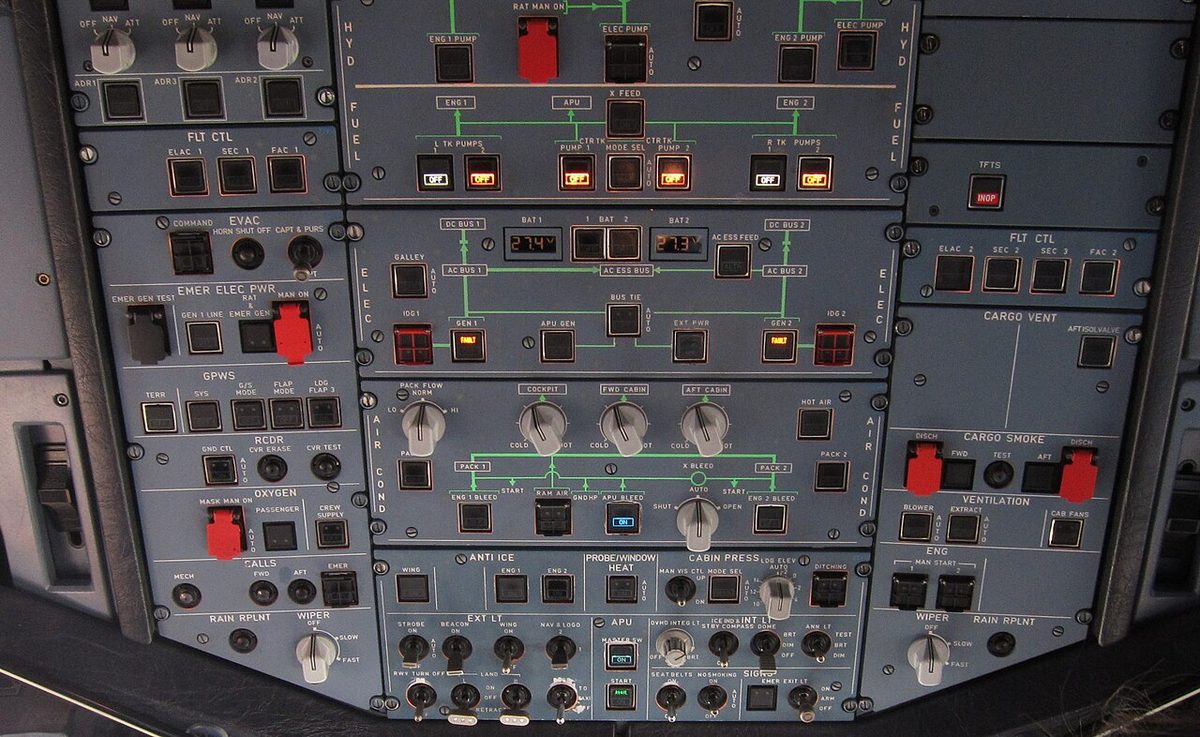
On the A320 the fuel crossfeed valve is driven by a double motor and controlled by the X FEED pushbutton, whose green OPEN light shows that the valve is fully open; the FUEL X FEED memo turns amber if the valve is open in the take-off phases of the warning system, flight phases 3 to 5. On the 737 the crossfeed valve is driven by a DC motor from the battery bus, and its blue VALVE OPEN light is bright while the valve moves or disagrees with the selector, dim when open. Crossfeed is not a normal cruise setting: left open, it produces a progressive imbalance of its own.
Fuel transfer and management
Besides feeding the engines, fuel is moved between tanks to keep the right fuel in the right place. On the A320 the outer-to-inner transfer valves, once open, stay latched open until the next refuelling; because their 750 kg trigger assumes level flight, they may open earlier in a steep descent or strong acceleration. Additional centre tanks are emptied into the centre tank by pressurising them. On the E190-E2 the centre tank pumps feed both wing tanks, keeping about 2,100 to 2,200 kg in each. Long-range types transfer fuel to a tail trim tank to move the centre of gravity (see fuel mass and fuel loading).
These sequences are automatic. A fuel management computer reads the tank quantities and level sensors and controls the pumps and transfer valves. On the A320 the fuel quantity indicating computer also runs automatic refuelling, and a level sensing control unit uses its sensors to control refuelling, transfers and the recirculation of fuel that cools the generator drives. On A320s with centre tank feed pumps, for example, the pumps in AUTO run for 2 minutes after engine start, then only with the slats retracted, pause whenever an inner tank is full until about 500 kg has been used from it, and stop 5 minutes after the centre tank reaches low level.
Fuel imbalance
A fuel imbalance is a difference in fuel quantity between the two sides. It comes from unequal consumption, a failed pump or transfer valve, a crossfeed left open, or a leak. It matters for handling, since the heavy wing must be held up with aileron, and for the structural loads on the wing. Each type sets limits:
| Type | Imbalance limit or alert |
|---|---|
| Boeing 737 NG | 453 kg between main tanks for taxi, take-off, flight and landing; IMBAL alert above 453 kg, until reduced to 91 kg |
| Airbus A320 | Advisory on the ECAM FUEL page, not a caution, when the wings differ by more than 1,500 kg (flight phases 2 and 6); inner tanks, for take-off, 500 kg when full; in flight and landing, 1,500 kg when full and no limit below 2,250 kg a side; outer tanks 370 kg for take-off, 690 kg in flight |
| Embraer E190-E2 | 360 kg; FUEL IMBALANCE at 360 kg, clears at 45 kg |
To correct an imbalance, the crew open the crossfeed and switch off the pumps on the side with less fuel, so that both engines draw from the heavier side, then restore the normal configuration when the tanks are balanced. Before that, a leak must be ruled out, by comparing fuel on board plus fuel used with the departure figure. A crossfeed opened onto a leak feeds the good side's fuel to it as well: in 2001 an Air Transat A330 ran out of fuel over the Atlantic after its crew treated a leak from a cracked fuel line on the right engine as an imbalance. EASA's certification basis for the A320neo lists managing an imbalance instead of a leak among the causes of fuel starvation.
Cavitation and unporting
Fuel unporting is the uncovering of a tank outlet or pump inlet when the fuel moves away from it in a sideslip, steep climb or descent, turbulence or negative g, so that the pump draws air. It is most likely with low tank quantities. On the 737 the pump LOW PRESSURE lights may flicker when a tank is low and the aircraft is climbing, descending or standing nose-down on the ground. In a light aeroplane unporting a low tank in uncoordinated flight can stop the engine, and the cure is to take off and land on the fuller tank and fly in balance when tanks are low.
Fuel pump cavitation occurs when the pressure at a pump inlet falls to the point at which the fuel boils. Vapour bubbles form and then collapse as the pressure rises inside the pump, eroding its surfaces and reducing its delivery. Low inlet pressure, high fuel temperature and high altitude all promote it, which is why engine-driven pumps are fed under boost pressure and why booster pumps are kept submerged in collector tanks. A pump running without fuel also loses the fuel that cools and lubricates it, and the 737's limitations prohibit running a centre tank pump dry.
Inlet screens and shrouded fuel lines
A fuel tank inlet screen, a coarse mesh on the suction inlet of each booster pump, keeps rust flakes, sealant residue and other debris in the tank out of the pump. Fine filtering is left to the engine's own filter downstream (see fuel additives and contamination), and debris found on a screen during maintenance usually means the tank needs cleaning.
Where fuel pipes pass through the pressurised fuselage, for example from a tail tank to the main system, a leak could put fuel or fumes into the cabin. These pipes are double-skinned: the inner pipe carries the fuel, and an outer shroud around it catches any leak and drains it overboard through a dedicated drain.

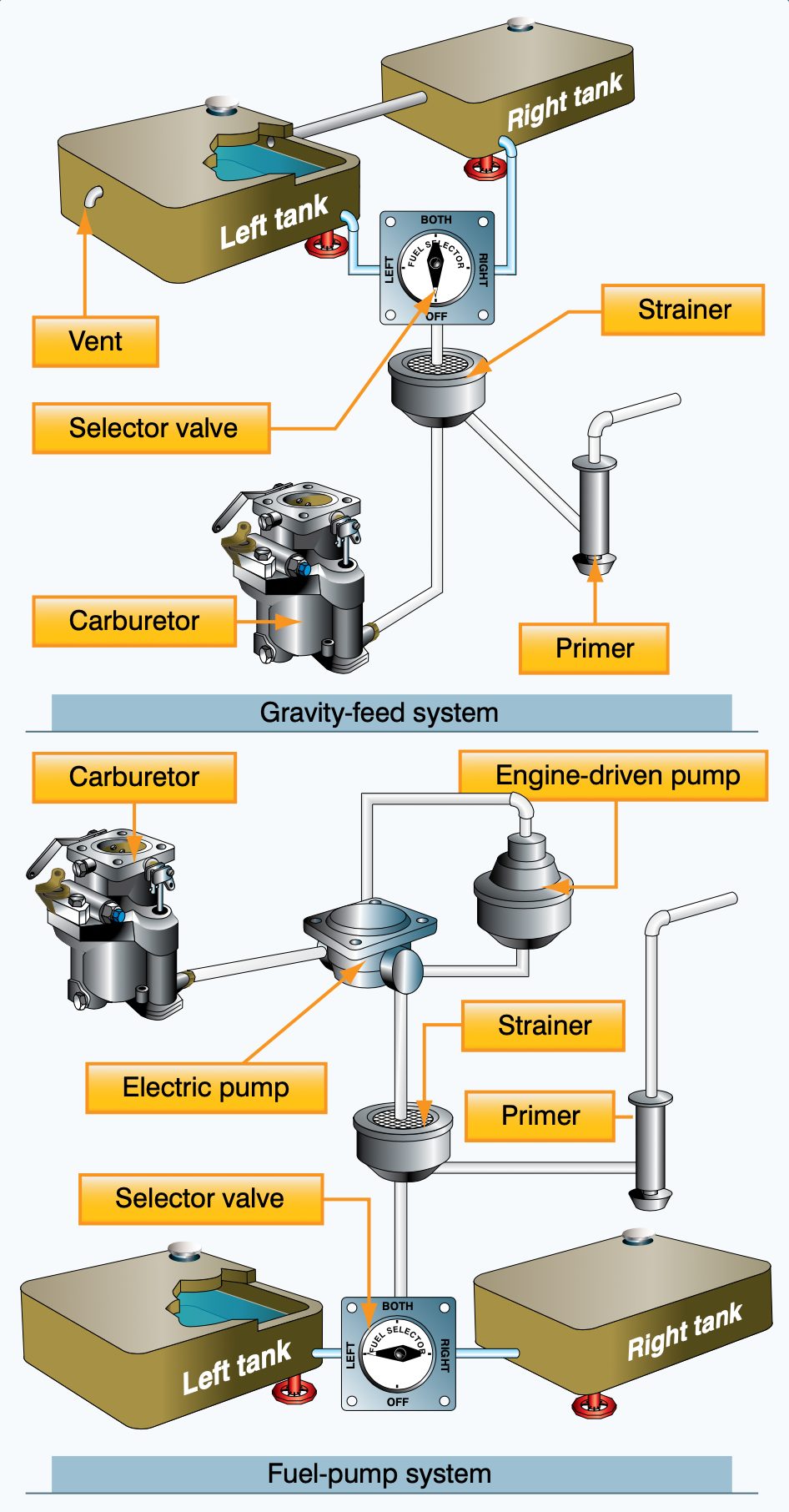
Exam tip: high-wing gravity feed needs no pump; low-wing aeroplanes use an engine-driven pump backed by an electric boost pump for take-off, landing and tank changes. Booster pumps prevent vapour lock and cavitation at altitude. To correct an imbalance: rule out a leak, open the crossfeed, switch off the pumps on the low side.
Frequently asked questions
Why do low-wing aircraft need a fuel boost pump?
In a low-wing aeroplane the tanks sit below the engine, so fuel cannot reach it by gravity and an engine-driven pump must lift it. A single engine-driven pump would be a single point of failure, so an electric auxiliary, or boost, pump is fitted. It is used for starting, take-off, landing and tank changes, whenever fuel pressure fluctuates, and to prevent vapour lock in hot conditions at altitude.
What is a fuel crossfeed used for?
A crossfeed valve connects the feed lines of the engines so that fuel from one side can feed the other side's engine. It is used to correct a fuel imbalance, to keep the fuel on a failed engine's side usable by the live engine, and to feed an engine whose own pumps have failed. It is normally closed for take-off and landing, and it must not be opened to correct an imbalance before a fuel leak has been ruled out.
How is a fuel imbalance corrected?
The crew first confirm that the imbalance is not caused by a leak, by comparing fuel on board with fuel used and the flight plan. They then open the crossfeed and switch off the pumps on the side with less fuel, so that both engines draw from the heavier side. When the tanks are balanced, the pumps are switched back on and the crossfeed closed; leaving it open lets a new imbalance develop.
What is fuel unporting?
Unporting is the uncovering of a tank's fuel outlet or pump inlet when the fuel moves away from it, so that air instead of fuel is drawn into the feed line. It happens with a low tank in a sideslip, uncoordinated flight, steep climbs and descents or negative g. The fuel pressure falls and the engine may lose power. Collector tanks, baffles and taking off on the fuller tank or BOTH guard against it.
Can a jet engine keep running if its tank pumps fail?
Usually, yes, but with limits. The engine-driven pump can draw fuel by suction through a bypass line, as on the Boeing 737, or by gravity through suction valves, as from the A320's inner tanks. At altitude, however, air comes out of solution in the fuel during the climb and can collect in the suction line, and the 737 manual warns of thrust deterioration or flameout at high altitude. After a double pump failure an altitude restriction may therefore apply.
Test yourself on Fuel Feed, Boost Pumps and Crossfeed
The v1prep banks cover this topic in Aircraft General Knowledge (021), with a worked explanation for every answer. EASA ATPL, PPL, IR and CPL, the FAA written tests and A320/B737 type ratings.
Start practising →Sources and further reading
- FAA Pilot's Handbook of Aeronautical Knowledge (FAA-H-8083-25), Chapter 7, Aircraft Systems
- FAA Airplane Flying Handbook (FAA-H-8083-3C), Chapter 12, Transition to Multiengine Airplanes
- FAA Aviation Maintenance Technician Handbook, Airframe (FAA-H-8083-31B), Chapter 14, Aircraft Fuel System
- EASA Easy Access Rules for Large Aeroplanes (CS-25), CS 25.951 to CS 25.1001, fuel system
- EASA TCDS EASA.A.064 (Airbus A318/A319/A320/A321), Explanatory Note, Annex I, Special Condition F-13 Fuel System Low Level Indication - Fuel Exhaustion
- GPIAA, Final Investigation Report 22/ACCID/2001, Air Transat A330-243 C-GITS, Lajes, Azores, 24 August 2001 (English text, hosted by the FAA)
Library articles are written for study and exam preparation. They do not replace your aircraft's approved documentation, your operator's procedures or the regulations themselves.