Aerodrome Markings and Signs
Aerodrome markings are symbols and lines painted on runways, taxiways and aprons, and aerodrome signs are panels beside them; together they tell pilots where they are, which way to go and where they must stop, following the colour and layout conventions of ICAO Annex 14.
Aerodrome markings are painted on the pavement; aerodrome signs stand beside it. Together they are the pilot's road signs on the ground: they identify the runway ahead, show where the landing distance begins, lead the aircraft along the taxiways and, above all, mark the places where it must stop and wait for a clearance. Misreading them is a classic first step towards a runway incursion (see taxiing and runway incursion prevention).
The system rests on a few colour rules, set in ICAO Annex 14 and followed, with some differences, by the FAA. Runway markings are white. Taxiway and aircraft stand markings are yellow, and either may be outlined in black on a light-coloured surface to stand out. Among the signs, red is reserved for mandatory instructions, always with a white inscription, while information signs are yellow and black. Numbers alone always mean a runway: taxiways are designated by letters, or letters followed by numbers, and the letters I, O and X are avoided so that they cannot be confused with 1, 0 and the closed marking.

Runway designation and centre line
The runway designation marking is a two-digit number: the whole number nearest to one-tenth of the runway's magnetic direction, seen from the approach. A runway on 094° magnetic is runway 09; one on 268° is runway 27, and its other end, on 088°, is runway 09. Some States omit the leading zero.
Parallel runways carry a letter: L and R for two, L, C and R for three, left to right as seen from the approach. With four parallel runways, one pair takes the next number: 09L, 09R, 10L and 10R. The FAA follows the same scheme.
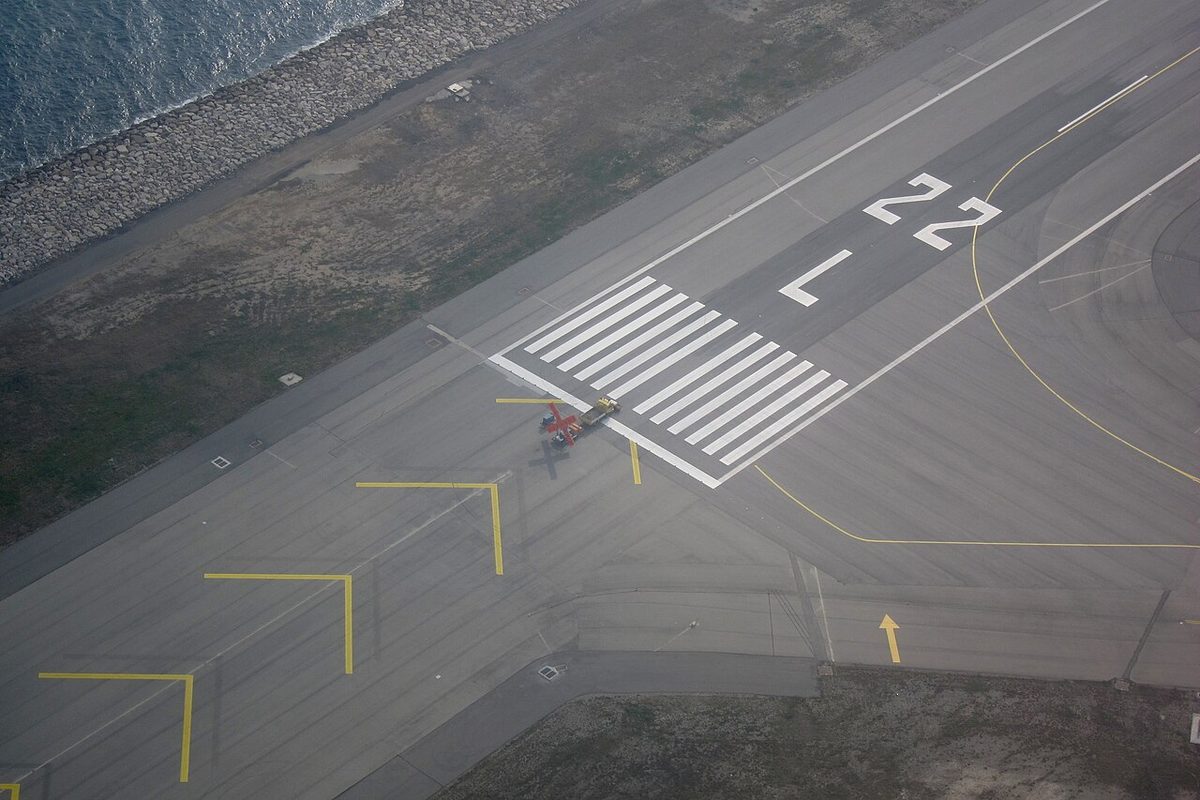
The runway centre line marking is a line of uniformly spaced white stripes and gaps between the designation markings at each end. A stripe and a gap together measure not less than 50 m and not more than 75 m, and each stripe is at least as long as the gap, or 30 m, whichever is greater.
Threshold and displaced threshold
The threshold marking, the familiar "piano keys", is a row of longitudinal white stripes that begins 6 m from the threshold. The stripes are at least 30 m long, and their number depends on the runway width:
| Runway width | Stripes |
|---|---|
| 18 m | 4 |
| 23 m | 6 |
| 30 m | 8 |
| 45 m | 12 |
| 60 m or more | 16 |
When a threshold is permanently displaced, a transverse white bar is painted across the runway at the new threshold, and white arrows on the part of the runway before it point towards the threshold. That part is still runway: it may be used for taxiing, for the take-off run and for the landing roll of aircraft landing from the opposite direction, but an aircraft landing towards the bar must not touch down before it. French national rules mark a displaced threshold with one to three V-shaped marks instead.
Paved ground before a threshold that is not fit for normal use by aircraft is marked differently. Where such a pre-threshold area is more than 60 m long, it is marked along its whole length with yellow chevrons pointing towards the runway. The FAA uses the same yellow chevrons on a blast pad or stopway, and no taxiing, take-off or landing is allowed on it.
Aiming point, touchdown zone and distance markings
The aiming point marking, two broad white rectangles either side of the centre line, gives the pilot a visual aiming point for landing. Annex 14 requires it at each approach end of a paved instrument runway of code 2, 3 or 4, and places it further from the threshold on longer runways:
| Landing distance available | Aiming point from threshold |
|---|---|
| Less than 800 m | 150 m |
| 800 m to less than 1,200 m | 250 m |
| 1,200 m to less than 2,400 m | 300 m |
| 2,400 m or more | 400 m |
Touchdown zone markings are pairs of rectangular white marks either side of the centre line, spaced 150 m apart starting from the threshold, on paved precision approach runways of code 2, 3 and 4. On a runway with 2,400 m or more of landing distance there are six pairs; a pair that would fall within 50 m of the aiming point is left out. In the United States the aiming point marking is about 1,000 ft from the threshold, and the touchdown zone markings are groups of one, two or three stripes every 500 ft.
Fixed distance markers, found mainly at military aerodromes, are white numbers on a black background at 1,000 ft intervals along the runway, counting down the distance remaining. The FAA's runway distance remaining signs work the same way: a white 3 on a black background means about 3,000 ft of runway remain.
Closed runways and taxiways
A closed marking is placed at least at each end of a closed runway or taxiway, or of the closed portion, and on a runway no more than 300 m apart. It is white on a runway and yellow on a taxiway. When a runway or taxiway is closed permanently, all its normal markings are obliterated and its lights are not operated except for maintenance. The FAA marks a closed runway with yellow X symbols at each end.
Runway-holding positions
A runway-holding position protects the runway: it keeps a holding aircraft far enough from the runway not to endanger aircraft using it and, where needed, clear of the ILS critical and sensitive areas. Its distance from the runway centre line depends on the runway type and code number:
| Runway type | Code 1 | Code 2 | Code 3 | Code 4 |
|---|---|---|---|---|
| Non-instrument, and take-off | 30 m | 40 m | 75 m | 75 m |
| Non-precision approach | 40 m | 40 m | 75 m | 75 m |
| Precision approach Category I | 60 m | 60 m | 90 m | 90 m |
| Precision approach Categories II and III | 90 m | 90 m |
For code F aeroplanes the distance on a precision approach runway rises to 107.5 m. In low visibility, holding positions for Category II and III operations are further out still, because an aircraft close to the localiser or glide path antennas can reflect or block their signals and bend the beams (see instrument landing system).
The runway-holding position marking comes in two patterns. Pattern A, two solid and two dashed yellow lines across the taxiway, marks the holding position closest to the runway. Where there are several holding positions on the same taxiway, those further out use pattern B. The solid lines of pattern A face the taxiway: an aircraft told to hold short stops before them, and no part of it may pass them without a clearance. The dashed lines face the runway: an aircraft leaving the runway has vacated it only when all of it is beyond the marking, which is why "runway vacated" is reported only then.
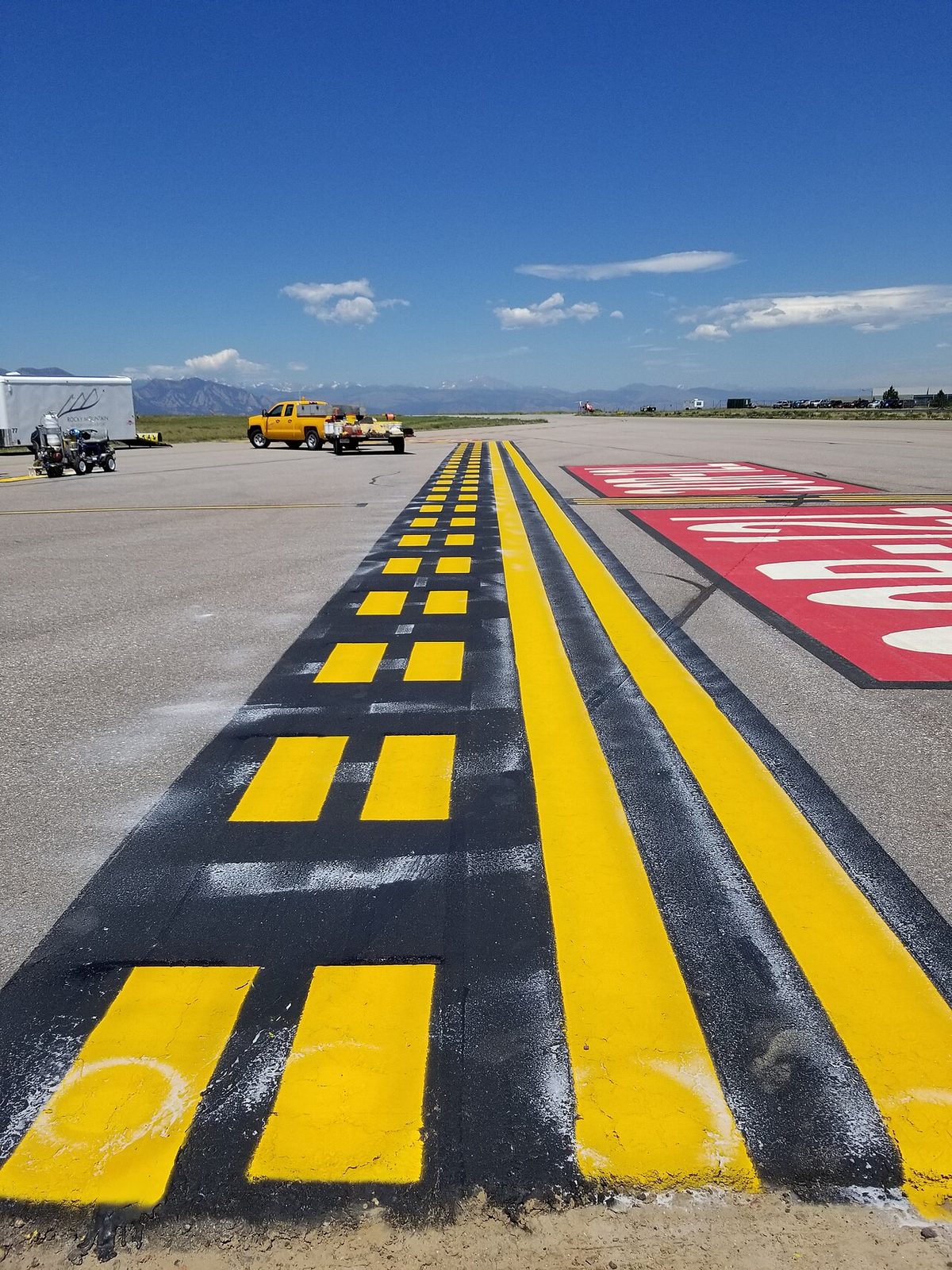
Other holding markings are:
- the intermediate holding position marking, a single broken yellow line where two taxiways meet;
- the mandatory instruction marking, a painted equivalent of a mandatory sign, white on a red background, used where a sign would be impracticable; it is not passed without a clearance;
- in the United States, the ILS critical area holding position, a ladder-shaped yellow marking with a red sign reading ILS, where aircraft stop only when ATC instructs them to hold short of the ILS critical area.
Places on the aerodrome where incursions have happened, or are likely, are shown as hot spots on aerodrome charts: on the Nantes Atlantique visual approach chart, for example, hot spot HS 2 warns of the risk of confusing taxiways RC and C and makes a complete readback mandatory. FAA airport diagrams mark them with a circled HS.
Taxiway markings and markers
The taxiway centre line marking is a continuous yellow line. It gives continuous guidance from the runway centre line to the point where the aircraft stand markings begin, and is required on paved taxiways where the code number is 3 or 4. Enhanced taxiway centre line markings, which warn of an approaching runway-holding position, are used in some States; the EU rules do not make them mandatory. In the United States, taxiway edges are marked by double yellow lines, both solid or both dashed, and the edge of the non-movement area, where ATC does not control taxiing, by one solid and one dashed yellow line, the dashed line on the movement side.
Where lights are not provided, markers do the same job:
- taxiway centre line markers are reflective green and are built to be run over by aircraft wheels;
- taxiway edge markers are reflective blue and frangible;
- boundary markers, in orange or red, or two contrasting colours, outline a landing area that has no runway, at intervals of not more than 200 m.
Apron and stand markings
On the apron, aircraft stand markings are yellow: the stand identification, lead-in line, turn bar, alignment bar, stop line and lead-out line. Apron safety lines, which show where ground equipment and vehicles may stand clear of aircraft, are in a colour that contrasts with the stand markings; if all equipment is parked behind them, a pilot or marshaller can concentrate on the stand markings alone. Many stands also have a visual docking guidance system that steers the pilot onto the stop position.
Mandatory instruction signs
A mandatory instruction sign has a white inscription on a red background. It marks a place that must not be passed without a clearance:
- the runway designation sign and runway-holding position sign, giving the runway designation, with each designator on the side of its own threshold as seen from the sign, as in 12-30;
- the Category I, II or III holding position sign, at the holding position for that category of operation;
- the road-holding position sign, where a vehicle road meets a runway, telling drivers to stop and obtain a clearance;
- the NO ENTRY sign, a white circle crossed by a horizontal bar on red in the FAA version, which forbids entry to an area.
At a towered aerodrome the pilot holds at a runway-holding position sign until cleared to enter or cross. At a non-towered US airport the pilot holds until satisfied that the runway and its final approach are clear.
Information signs
Information signs use yellow and black:
| Sign | Colours | Tells the pilot |
|---|---|---|
| Location | Yellow inscription on black, with a yellow border when it stands alone | The taxiway or runway the aircraft is on |
| Direction | Black letters and arrows on yellow | The taxiways leading out of an intersection |
| Destination | Black on yellow | The way to a destination such as a runway or the apron |
| Runway exit and runway vacated | Black on yellow | Where to leave the runway, and that the protected area has been left |
| Intersection take-off | Black on yellow, with an arrow | The take-off run available from that intersection |
| Aircraft stand identification | Black on yellow, or white on blue in Europe | The stand number |
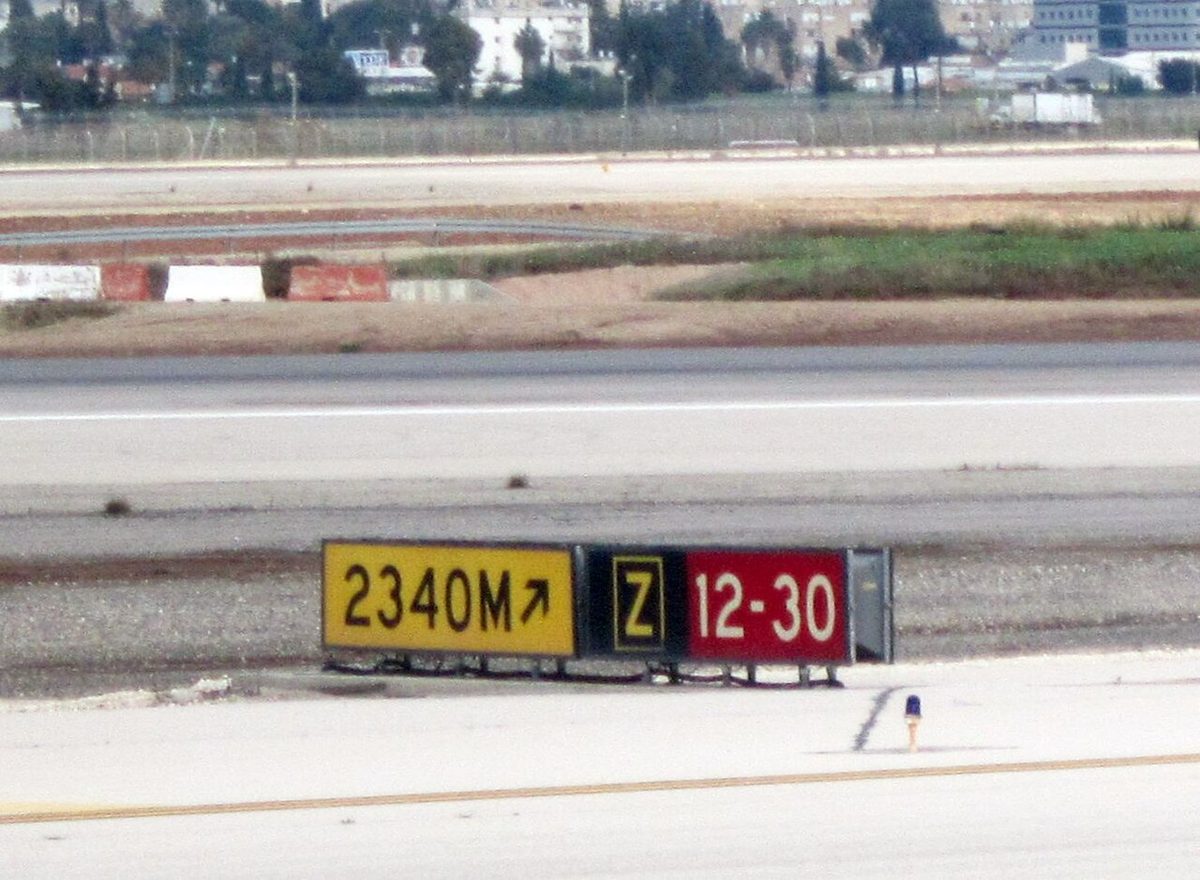
Direction signs are grouped around the location sign, with left turns on its left and right turns on its right. A common memory aid for the colour code is "black square, you're there; yellow array, points the way". An intersection take-off sign reading 2340M with an arrow gives 2,340 m of take-off run available from that point, a figure the crew must check against the performance requirements before accepting the intersection. French intersection take-off signs omit the letter m.
All signs are rectangular with the longer side horizontal, frangible, and mounted low enough to clear propellers and engine pods. They are illuminated when intended for use in runway visual range below 800 m, at night with instrument runways, or at night with non-instrument runways of code 3 or 4, and are otherwise reflective. The lights that complement them at night and in low visibility, from taxiway centre line lights to stop bars, are described in aerodrome lighting and visual aids.
Frequently asked questions
What do the yellow lines at a runway holding position mean?
The runway-holding position marking, ICAO pattern A, is two solid and two dashed yellow lines across the taxiway. The solid lines face the taxiway. An aircraft told to hold short stops before them and may cross only with a clearance to enter or cross the runway. The dashed lines face the runway, and an aircraft leaving the runway has vacated it only when all of it is beyond the marking.
What colour are mandatory instruction signs?
Mandatory instruction signs have a white inscription on a red background, and they are the only signs on the movement area that use red. They include runway designation signs, Category I, II and III holding position signs, runway-holding position signs, road-holding position signs and NO ENTRY signs. A pilot does not pass a mandatory instruction sign, or the same instruction painted on the pavement, without a clearance from ATC.
How are runway numbers worked out?
The runway designation is the magnetic direction of the runway, seen from the approach, divided by ten and rounded to the nearest whole number. A runway on 094° magnetic is runway 09, and one on 268° is runway 27. Parallel runways add L and R, or L, C and R for three; where there are four, one pair takes the next number, as in 09L, 09R, 10L and 10R.
What can you do on the runway before a displaced threshold?
A displaced threshold is marked by a white bar across the runway, with white arrows on the pavement before it pointing towards the threshold. That pavement is still runway. It can be used for taxiing, for the take-off run and for the landing roll of aircraft landing from the opposite direction, but an aircraft landing towards the bar must not touch down before it.
What is the difference between a location sign and a direction sign?
A location sign names the taxiway or runway an aircraft is on. It has a yellow inscription on a black background, with a yellow border when it stands alone. A direction sign shows the taxiways leading away from an intersection, with black letters and arrows on a yellow background. A common memory aid is black square, you're there, and yellow array, points the way.
Test yourself on Aerodrome Markings and Signs
The v1prep banks cover this topic in Air Law (010), with a worked explanation for every answer. EASA ATPL, PPL, IR and CPL, the FAA written tests and A320/B737 type ratings.
Start practising →Sources and further reading
- ICAO Annex 14, Aerodromes, Volume I, Aerodrome Design and Operations
- FAA Aeronautical Information Manual, Chapter 2 Section 3, Airport Marking Aids and Signs
- FAA Pilot's Handbook of Aeronautical Knowledge (FAA-H-8083-25), Chapter 14, Airport Operations
- AIP France, GEN 1.7, Differences from ICAO Standards, Recommended Practices and Procedures (Annex 14, chapter 5)
- EASA Easy Access Rules for Aerodromes (Regulation (EU) No 139/2014)
Library articles are written for study and exam preparation. They do not replace your aircraft's approved documentation, your operator's procedures or the regulations themselves.