Structural and Operating Speed Limits
Structural and operating speed limits are the airspeeds, fixed in certification and published in the flight manual, that keep an aeroplane within the loads its structure, flaps and landing gear were designed for: design speeds such as VA, VC and VD, and operating limits such as VNE, VMO/MMO, VFE and VLE.
Every aeroplane has a set of speeds it must not exceed and, in each configuration, speeds it should not fly below. Some are design speeds, chosen by the manufacturer to size the structure and prove it in certification: VA, VB, VC and VD. Others are operating limits, derived from the design speeds with margins and shown to the pilot on the airspeed indicator or in the flight manual: VNO and VNE on light aeroplanes, VMO and MMO on jets, and the flap and landing gear limits VFE, VLO and VLE.
The logic is the same throughout. Aerodynamic loads grow with dynamic pressure, so every structure, and every flap, door and gear leg, has a speed beyond which the air loads, a gust or a control input could overstress it or start flutter. The limits keep a margin between the speeds flown and the speeds the structure was designed and tested to survive.
| Speed | Name | Kind |
|---|---|---|
| VA | Design manoeuvring speed | Design, placarded |
| VB | Design speed for maximum gust intensity | Design |
| VC / MC | Design cruising speed | Design |
| VD / MD | Design diving speed | Design |
| VNO | Maximum structural cruising speed | Operating, top of the green arc |
| VNE | Never-exceed speed | Operating, red line |
| VMO / MMO | Maximum operating limit speed and Mach number | Operating, jets |
| VRA / MRA | Rough air (turbulence penetration) speed | Operating |
| VFE | Maximum flap extended speed | Operating, per flap setting |
| VLO / VLE | Landing gear operating and extended speeds | Operating |
Design speeds VC and VD
The design cruising speed (VC) is the speed at which the structure must withstand the cruise gust and manoeuvre loads. The design diving speed (VD), often written design dive speed, is the highest speed the structure is designed for, representing an inadvertent upset or dive; its Mach equivalent is MD. The two are spaced so that a speed upset from the cruise can be recovered before VD is reached: under CS and 14 CFR 25.335(b), VD is chosen so that VC is no more than 0.8 VD, or so that the margin between them covers a defined speed upset. Design speeds are equivalent airspeeds, since equivalent airspeed measures the dynamic pressure that loads the structure.
Gust loads are designed with standard vertical gusts, in equivalent airspeed, that shrink as speed rises. Exam texts quote the classic values of 66 ft/s at VB, 50 ft/s at VC and 25 ft/s at VD. Current large-aeroplane rules (CS 25.341 and 14 CFR 25.341) use instead a discrete gust whose reference velocity is 56 ft/s at sea level between VB and VC, reducing with altitude, and half that value at VD. A smaller gust is assumed at VD because the load a gust produces grows with airspeed (see load factor and flight envelope).
Manoeuvring speed VA
The design manoeuvring speed (VA) is the speed at which the wing reaches its critical angle of attack exactly at the limit load factor: VA = VS × √n, where n is the positive limit load factor. Below VA, a single full, abrupt deflection of one control, or a sharp gust, stalls the wing before the structure is overloaded; above it, the same input can exceed the limit load. An aeroplane with a 1 g stall speed of 60 kt and a limit of 2.5 g has a VA of about 95 kt. For large aeroplanes CS 25.335(c) requires VA to be at least VS1 × √n.
Because the stall speed varies with the square root of weight, so does VA. A published VA applies at maximum weight; 20 % below it, VA is about 10 % lower. That is why VA is placarded or found in the flight manual rather than painted on the airspeed indicator.
Warning: VA protects against one full input on one axis, not against rapid reversals or full inputs on several axes. In 2001 American Airlines Flight 587, an Airbus A300-600, lost its vertical stabiliser after large alternating rudder inputs below VA. Transport flight manuals now state, under 14 CFR 25.1583, that such inputs may cause structural failure at any speed, and the A320 and 737 limitations carry the same caution.
Gust speed and turbulence penetration
The design speed for maximum gust intensity (VB) is the gust counterpart of VA: in the classic exam definition, at VB the aeroplane meeting the 66 ft/s design gust stalls before it exceeds the limit load factor. In service the pilot flies a turbulence penetration speed, also called the rough-air penetration speed or turbulent air penetration speed.
- Light aeroplanes slow to VA or below, corrected for weight, where a strong gust stalls the wing rather than overloading it, and never fly above VNO in anything but smooth air.
- Transport aeroplanes publish a rough air speed, VRA, and often a Mach number, MRA. Under CS and 14 CFR 25.1517 VRA must be far enough below VMO that speed excursions in rough air will not trigger the overspeed warning too often; without an analysis supporting another figure it must be less than VMO minus 35 KTAS. Where VMO is limited by Mach number, VRA may be chosen for the best margin between low-speed and high-speed buffet.
Type figures illustrate the idea. The 737's severe turbulence penetration speed for climb and descent is 280 KIAS or M 0.76, whichever is lower. The E190-E2's VRA/MRA is 250 kt below FL100 and 270 kt or M 0.76 above it. The technique is to hold attitude, accept altitude and speed excursions, and at high altitude descend to widen the buffet margins (see turbulence).
VNO and VNE
On light aeroplanes the operating limits are marked on the airspeed indicator. The maximum structural cruising speed (VNO) is the top of the green arc, the normal operating range. Above it the aeroplane is no longer protected against the design gust, so the yellow arc from VNO to VNE is a caution range for smooth air only. In turbulence the speed must come back below VNO, and a light aeroplane slows to its turbulence penetration speed, normally VA or below.
The never-exceed speed (VNE) is the red radial line at the top of the yellow arc. It is set at no more than 0.9 VD, so that a speed upset beyond VNE can still be recovered before the design diving speed, and it leaves a margin against flutter. VNE is an absolute limit in any conditions.
VMO and MMO
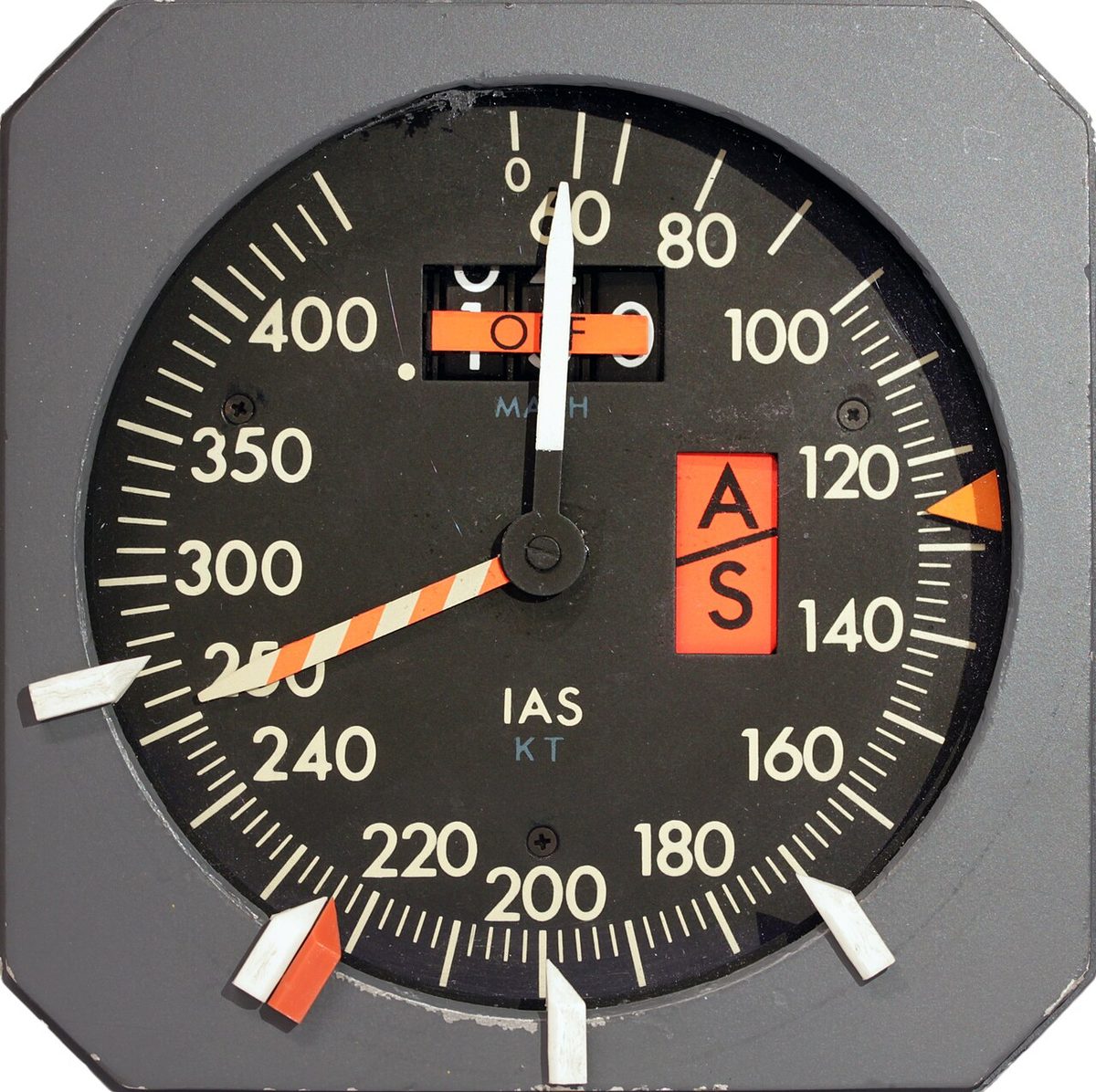
Jets do not use VNO and VNE. Their limit is the maximum operating limit speed (VMO), an indicated airspeed, and the maximum operating Mach number (MMO). Together, written VMO/MMO, they may not be deliberately exceeded in any phase of flight, except where a higher speed is authorised for flight test or pilot training. VMO may not exceed VC and must be far enough below VD that VD is highly unlikely to be reached inadvertently.
The two limits protect against different things. Lower down, dynamic pressure sets the limit: structural loads, gust response and control loads, so VMO is a constant indicated airspeed. At altitude the same indicated airspeed means a higher Mach number, and shock waves on the wing and tail bring buffet, Mach tuck and reduced control effectiveness, so MMO takes over above the crossover altitude. For the A320 family, VMO is 350 kt and MMO M 0.82, crossing at about FL245 in ISA. The E190-E2 has an MMO of M 0.82 and a VMO of 300 kt at or below FL80 and 320 kt above FL100.
The overspeed warning does not rely on the crew watching the display. Under CS and 14 CFR 25.1303(c)(1) an aural warning must sound whenever the speed exceeds VMO + 6 kt or MMO + 0.01. On a round dial the limit is the red and white barber pole pointer; on a speed tape it is a red and black bar (see airspeed indicator and Machmeter). Fly-by-wire aircraft add high-speed protection that commands nose-up as speed goes beyond VMO/MMO, preventing the aircraft from reaching VD/MD.
The display usually shows a single maximum allowable speed, the lowest of the limits that apply at that moment. On the 737 the bottom of the red and black bar is the lowest of VMO/MMO, the landing gear placard speed and the flap placard speed. The A320 draws VMAX as a red and black strip on the speed scale; it follows the flap lever position, while the overspeed warning uses the actual surface position, so a brief warning during flap transition can occur without the speed entering the strip.
Note: below MMO is not the same as below buffet onset. At high altitude and weight, or in a steep turn, high-speed buffet can begin below MMO (see high-speed flight).
Flap extended speed VFE
The maximum flap extended speed (VFE) is the highest speed at which a given flap setting may be selected or flown. Flaps raise the lift coefficient, so at high speed they would produce loads the flap tracks, actuators and wing could not carry; on transport aeroplanes such as the A320 the manoeuvring limit also falls from +2.5 g clean to +2.0 g with slats or flaps extended, and flap is avoided in turbulence. On a light aeroplane VFE is the top of the white arc.
Transport aeroplanes publish a VFE for each setting. For the A320 they are 230 kt in CONF 1, 215 kt in CONF 1+F, 200 kt in CONF 2, 185 kt in CONF 3 and 177 kt in CONF FULL; the A320 also shows VFE NEXT, the limit for the next setting. The E190-E2's figures run from 230 kt at flaps 1 to 165 kt at flaps full. A flap load relief system protects the structure by stopping or reversing flap extension when the speed is too high and restoring the selected setting when it falls. The A320 and 737 also limit flight with flaps or slats extended to 20,000 ft.
Landing gear speeds VLO and VLE
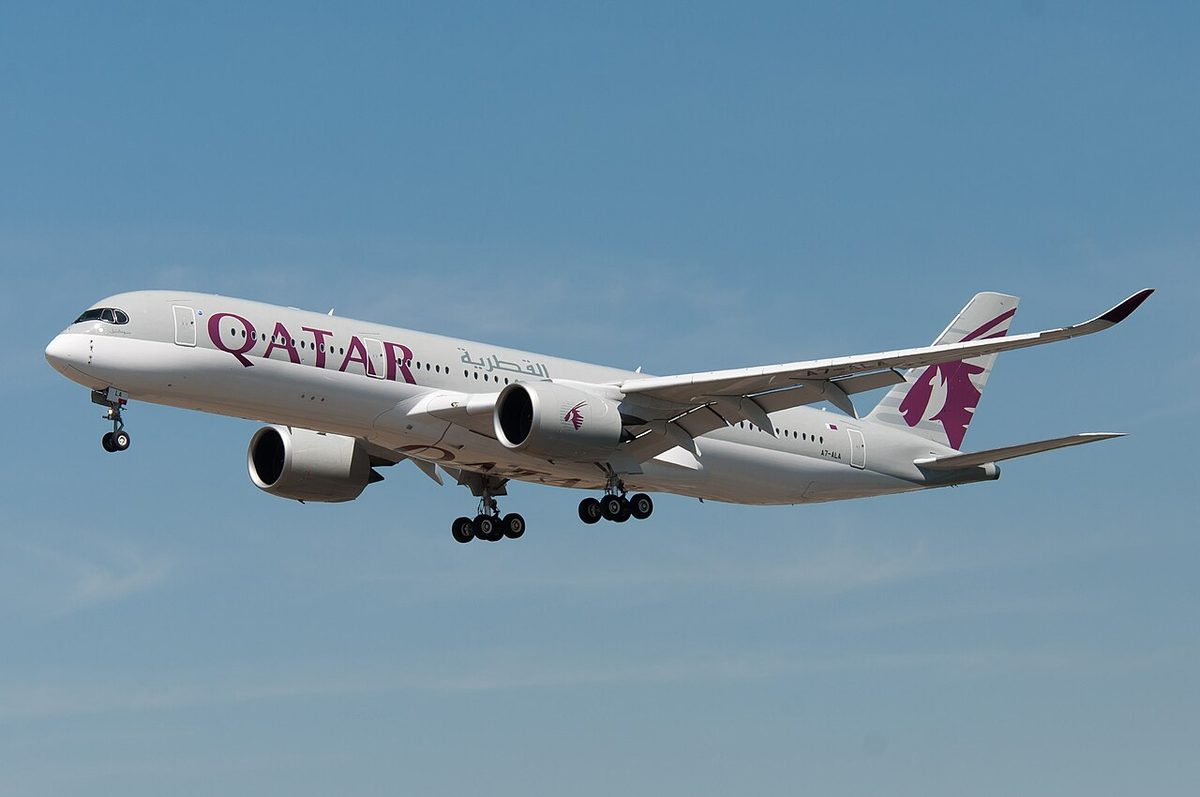
The maximum landing gear operating speed (VLO) is the highest speed at which the gear may be extended or retracted. The maximum landing gear extended speed (VLE) is the highest speed with the gear down and locked. VLO is often the lower of the two: in transit the gear is unlocked and its doors are open and moving broadside to the airflow, whereas the locked gear is braced by its locks and side stays. Some types publish separate limits for extension and retraction.
The A320's VLE is 280 kt or M 0.67; its VLO is 250 kt or M 0.60 for extension and 220 kt or M 0.54 for retraction. The E190-E2 has a VLE of 265 kt, a VLO of 250 kt for extension and 220 kt for retraction. Extending the gear within these limits is a legitimate way of adding drag for a rapid descent. On light aeroplanes VLO and VLE are found in the flight manual, not on the airspeed indicator.
Flap manoeuvring and minimum clean speeds
The upper limits have lower counterparts. Each configuration has a minimum manoeuvring speed that leaves a margin above the stall, and approach and departure flap schedules are built so that each setting is selected below its VFE and flown above its minimum speed (see high-lift devices).
- Boeing shows green flap manoeuvring speed bugs on the 737 speed tape, with an UP bug for the flaps-up manoeuvring speed that is not displayed above about 20,000 ft. The top of the amber minimum manoeuvre speed bar gives 1.3 g of manoeuvre capability to the stick shaker below about 20,000 ft, and to low-speed buffet above it; with flaps up, the bottom of the upper amber bar gives 1.3 g to high-speed buffet, equivalent to 40° of bank in level flight.
- Airbus uses characteristic speeds computed from the aircraft's mass. VLS, the lowest selectable speed, is 1.23 VS after one step of flap retraction and 1.28 VS in the clean configuration. F and S speeds are the minimum speeds for retracting the flaps and slats after take-off. Green dot, the best lift-to-drag speed in the clean configuration, is about twice the mass in tonnes plus 85 kt below 20,000 ft, plus 1 kt per 1,000 ft above.
- Embraer's green dot on the E190-E2, with slats and flaps up, is the driftdown speed and the ideal speed for starting flap extension; it is protected for full bank and is at least 1.3 VSS.
The minimum clean speed is the lowest safe speed with no flaps or slats extended, in practice the green dot or the flaps-up manoeuvring speed. Air traffic control asks for it with the phrase "reduce to minimum clean speed", and a crew that cannot comply at its weight and altitude says so.
Frequently asked questions
What is the difference between VNO and VNE?
VNO, the maximum structural cruising speed, is the top of the green arc on a light aeroplane's airspeed indicator. Above it the aeroplane is no longer protected against the design gust, so the yellow arc between VNO and VNE may be used only in smooth air. VNE, the never-exceed speed, is the red line, set at no more than 0.9 of the design dive speed VD to leave a margin against flutter and structural failure.
Why does manoeuvring speed decrease with weight?
VA is the speed at which the wing reaches its critical angle of attack exactly at the limit load factor, VA = VS times the square root of the limit load factor. A lighter aeroplane stalls at a lower speed, so it can reach the limit load factor at a lower speed too. VA falls roughly with the square root of the weight: 20 per cent below maximum weight it is about 10 per cent lower.
What is the difference between VMO and MMO?
VMO is a jet's maximum operating speed expressed as an indicated airspeed, set by dynamic pressure limits such as structural and gust loads at lower levels. MMO is the maximum operating Mach number, which protects against shock-wave effects such as buffet and Mach tuck at high altitude. Climbing at constant indicated airspeed raises the Mach number, so above a crossover altitude MMO becomes the limit, around FL245 for the A320 family.
Why is VLO often lower than VLE?
While the landing gear is travelling, the wheels and doors swing through the airflow unlocked, supported only by their actuators, and the doors are open. Once locked down, the gear is braced by its locks and side stays. The speed limit for operating the gear, VLO, is therefore often lower than the limit with the gear extended, VLE, and some types publish different limits for extension and retraction.
What speed should be flown in turbulence?
The flight manual's turbulence penetration speed. In a light aeroplane that means at or below the design manoeuvring speed VA, corrected for weight, and never above VNO in anything but smooth air. Transport aeroplanes publish a rough air speed VRA and Mach MRA, such as 280 KIAS or M 0.76, whichever is lower, for the 737 in climb and descent. The pilot holds attitude and accepts altitude deviations rather than chasing them.
Test yourself on Structural and Operating Speed Limits
The v1prep banks cover this topic in Performance (032), with a worked explanation for every answer. EASA ATPL, PPL, IR and CPL, the FAA written tests and A320/B737 type ratings.
Start practising →Sources and further reading
- EASA Easy Access Rules for Large Aeroplanes (CS-25), Subpart C, Structure, and Subpart G, Operating limitations
- 14 CFR 25.1505, Maximum operating limit speed
- 14 CFR 25.1517, Rough air speed, VRA
- 14 CFR 25.1583, Operating limitations (maneuvering speed statement)
- 14 CFR 25.1303, Flight and navigation instruments (speed warning device)
- FAA Pilot's Handbook of Aeronautical Knowledge (FAA-H-8083-25), Chapters 5 and 8
- NTSB AAR-04/04, In-Flight Separation of Vertical Stabilizer, American Airlines Flight 587
Library articles are written for study and exam preparation. They do not replace your aircraft's approved documentation, your operator's procedures or the regulations themselves.