Spatial Disorientation and the Vestibular System
Spatial disorientation is a pilot's failure to sense correctly the attitude, position or motion of the aircraft relative to the earth's surface. It arises mainly when outside visual references are lost and the vestibular and postural senses, which respond to accelerations rather than attitude, give a false picture.
Spatial disorientation is a pilot's failure to perceive correctly the attitude, position or motion of the aircraft relative to the earth. It is not a lack of skill or nerve. It is the normal output of sense organs that measure accelerations, not attitude, working without the visual horizon that normally corrects them. In cloud or on a dark night they produce a confident, coherent and wrong picture, and the control input that picture invites is often the dangerous one.
The FAA's Aeronautical Information Manual (AIM) ranks illusions among the most common factors cited in fatal accidents, and disorientation is a classic path to loss of control and to flight into terrain. This article covers the vestibular and postural senses and the illusions they produce; the illusions of the eye itself, such as the black hole approach and the false horizon, are covered in visual illusions.
The senses of orientation
Three systems tell the brain which way is up. Vision is the primary one, and the only one that gives a reliable attitude reference in flight. The vestibular system of the inner ear senses accelerations of the head. The somatosensory system, the pressure and position receptors in the skin, muscles and joints, reports the forces acting on the body. When they agree, orientation is effortless. When they conflict, EASA texts state the rule: vision gives the more accurate picture. In cloud or darkness it is lost, so the rule becomes "in IMC, believe the instruments; in VMC, look at the horizon".
Vertigo, strictly a sensation of rotating or tumbling, can affect healthy people too. EASA texts list blocked Eustachian tubes, sudden pressure changes in the inner ear such as a violent sneeze or nose-blow, high accelerations, drugs and alcohol among the causes. Pilots often use the word loosely for disorientation in general.
Semicircular canals
The vestibular apparatus (vestibular system) consists of the semicircular canals and the otolith organs. Each inner ear has three semicircular canals at roughly right angles to one another, so that between them they respond to rotation in pitch, roll and yaw. Each canal is filled with fluid, the endolymph, and has a swelling at one end in which a gelatinous flap, the cupula, sits across the channel with sensory hair cells at its base.
When the head starts to rotate in the plane of a canal, the endolymph lags behind through inertia and deflects the cupula, bending the hairs and signalling rotation. The canals therefore respond to angular acceleration, not to a steady rate of rotation and not to attitude.
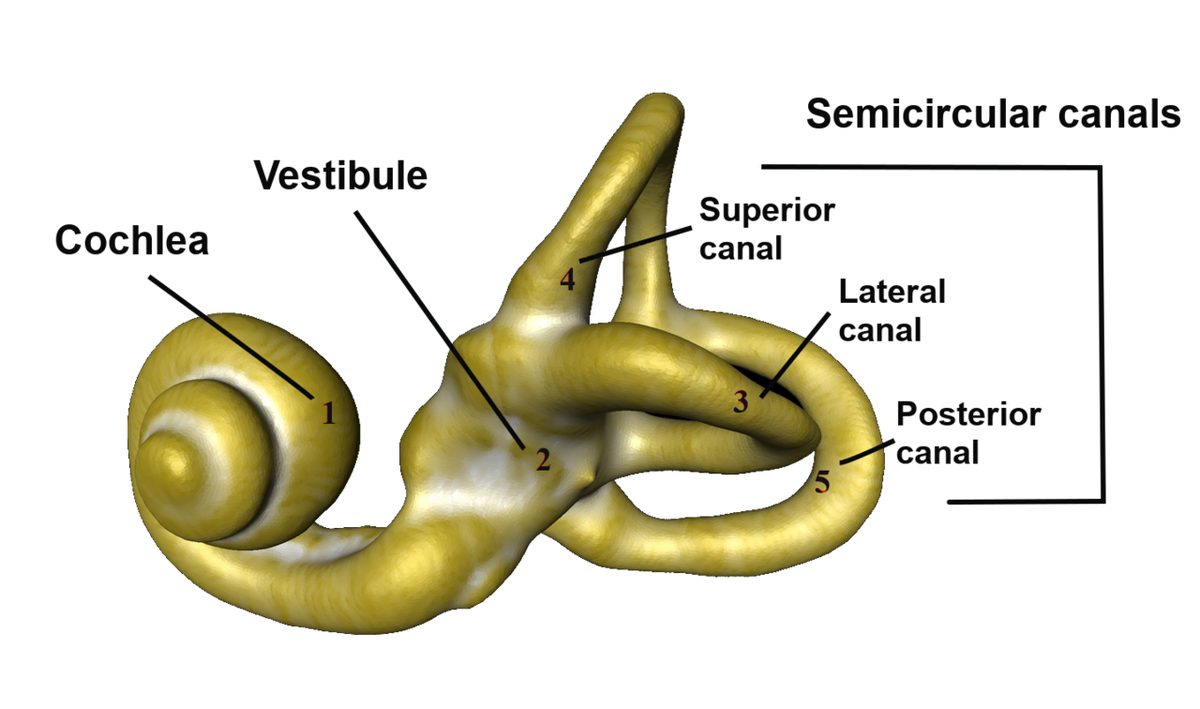
Two properties explain most of the illusions:
- The vestibular detection threshold. Below a certain angular acceleration nothing is felt. The value quoted differs with the axis of rotation, between individuals and between sources, but the principle is what matters: an aircraft can roll gently into a substantial bank without the pilot feeling it.
- Adaptation. In a steady turn the endolymph catches up with the canal walls and the cupula returns to neutral, so that after roughly 15 to 20 seconds the turn is no longer felt. When the rotation then stops, the fluid keeps moving and deflects the cupula the other way, producing a sensation of turning in the opposite direction.
Otolith organs
The otolith organs, the utricle and saccule, lie in the vestibule at the base of the canals. Each contains a patch of hair cells covered by a gelatinous membrane loaded with small crystals of calcium carbonate, the otoliths or "ear stones". Being denser than their surroundings, the crystals shift under any applied force and bend the hairs, so the organs sense tilt of the head and linear acceleration. The utricle responds mainly to horizontal accelerations and the saccule to vertical ones.
Their weakness is fundamental. A tilt of the head and a linear acceleration move the membrane in exactly the same way, so the otoliths cannot distinguish gravity from acceleration. They sense only the resultant of the two, and the brain takes that direction as "down".
Proprioception
Proprioception is the sense of the position of the body and its parts, from receptors in the muscles, joints and skin; with the pressure receptors of the skin it forms the somatosensory system, the pilot's "seat of the pants". In a coordinated turn the resultant force acts straight down through the seat, exactly as in level flight, so the seat gives no information about bank. Under instrument conditions proprioceptive sensations are completely unreliable and must be ignored. EASA texts note that on a missed approach this kinaesthetic effect adds to the otolith illusion of climbing described below.
Somatogyral illusions and the leans
Illusions produced by the semicircular canals are called somatogyral; those from the otoliths are somatogravic.
The leans is the commonest form of disorientation. Either the aircraft rolls slowly into a bank below the canals' threshold, or a turn is held long enough for the sensation to fade. When the pilot notices and rolls briskly back to wings level, only that correction is sensed, so the aircraft now feels banked the other way. The pilot may lean in the seat towards the false vertical or, worse, roll back into the original bank. The only remedy is to hold the wings level on the attitude indicator and let the sensation fade.
Graveyard spin and spiral
Graveyard spin. In a spin held for some seconds the endolymph catches up with the rotation and the sensation of spinning fades. On recovery the canals report a spin in the opposite direction, and a pilot who reacts to that sensation re-enters the original spin.
Graveyard spiral. In a prolonged, coordinated descending turn the sensation of turning fades and the pilot feels a wings-level descent. Seeing height being lost, the pilot pulls back, which with the wings still banked only tightens the turn, increases the load factor and steepens the descent. Rolling out may then feel like a turn the other way, tempting the pilot back into the spiral. The recovery is by instruments: level the wings on the attitude indicator first, then raise the nose and adjust power (see spins and spiral dives).
In a University of Illinois study popularised in FAA safety material as "178 Seconds to Live", pilots without instrument training flew into simulated instrument conditions. All lost control, entering a graveyard spiral or other unusual attitude, on average after 178 seconds.
Coriolis illusion
The Coriolis illusion, or cross-coupled stimulation of the canals, occurs when the head is moved out of the plane of a prolonged, constant-rate turn, for example to look down at a chart, pick up a dropped pencil or reach a switch. The movement swings the settled canal out of the plane of rotation and brings others into it, so several canals report acceleration at once and the brain perceives rotation about an axis in which the aircraft is not moving. The AIM calls it the most overwhelming of all illusions in flight, and the instinctive control input can put the aircraft into a dangerous attitude.
It is prevented by keeping the head still during turns, especially in IMC, organising charts and setting up avionics before the approach, and leaving dropped items where they fall. If it happens, return the head to the upright position, fix the eyes on the attitude indicator and fly on instruments until it passes.
Somatogravic and elevator illusions
The somatogravic illusion follows from the otoliths' inability to separate acceleration from gravity. Strong forward acceleration tilts the resultant force rearwards, exactly as a nose-up attitude would, so the pilot feels the aircraft pitching up and is tempted to push the nose down. EASA texts add that an air-driven attitude indicator also shows a false climb after an acceleration, reinforcing the error. Deceleration does the opposite: closing the throttle or lowering gear and flap is felt as a pitch down, inviting a pull that erodes airspeed.
The classic accident scenarios are a take-off into darkness or cloud, over dark sea or unlit ground, and a go-around, when high thrust coincides with the loss of outside references at low height. The defence is decided beforehand: set a known pitch attitude on the attitude indicator, confirm a climb on the altimeter and vertical speed indicator, and disregard the sensation. FAA training material advises treating every night take-off as an instrument take-off.
The otoliths produce two more named illusions:
- Elevator illusion. An abrupt upward vertical acceleration, usually from an updraft, feels like a climb and invites a push; a downdraft feels like a descent and invites a pull.
- Inversion illusion. An abrupt change from a climb to straight and level flight can create a sensation of tumbling backwards. The pilot pushes the aircraft abruptly nose-down, which can intensify the illusion.

Exam tip: "gyral" is the canals and rotation (leans, graveyard spin and spiral, Coriolis); "gravic" is the otoliths and linear acceleration (somatogravic, elevator and inversion illusions).
Preventing and recovering
No training makes vestibular sensations reliable; the defence is procedural. The main points are:
- Instrument proficiency. A disciplined, continuous instrument scan replaces the missing visual horizon. Disorientation becomes dangerous when the scan is interrupted and the body is consulted instead.
- Avoid the situation. A pilot without instrument training should not continue into cloud or poor visibility; after inadvertent entry, FAA training material advises a 180° turn back towards visual conditions, flown by reference to the instruments.
- Head discipline. Keep the head still during turns, prepare charts and avionics beforehand, and use the autopilot for tasks that need a look down.
- Fitness. Alcohol changes the specific gravity of the fluid in the inner ear, and EASA texts note that it can persist there for days, so small head movements may cause disorientation long after drinking; the AIM also warns that alcohol makes a pilot much more susceptible to disorientation. A cold that blocks the Eustachian tubes can bring on vertigo.
- Recovery. If disoriented, believe the attitude indicator and cross-check it against the other instruments. In a spiral dive, level the wings before raising the nose; the full recovery techniques are covered in upset prevention and recovery.
Motion and simulator sickness
Motion sickness is caused by a mismatch between what the eyes and the vestibular system report, typically when exposed to real or apparent motion of an unfamiliar kind. A passenger reading a chart inside a moving cabin is a classic case: the inner ear reports movement that the eyes, fixed on the cabin, do not confirm. The signs are pallor, sweating and nausea, sometimes with hyperventilation. EASA texts say that up to 8 % of passengers on board modern aircraft show symptoms, and that anyone with a normal sense of balance will suffer if stimulated enough: it is a normal response, not a disease. It is worse in rear seats, in turbulence, in heat and with the head down or moving.
Relief comes from restoring agreement between the senses: look outside at the horizon, keep the head still, open the fresh-air vents and fly gently; letting a passenger take the controls often helps because the motion becomes predictable. Most student pilots adapt with experience. Anti-sickness drugs cause drowsiness, so a pilot must not take them before flying as pilot in command; a pilot with recurrent motion sickness should consult an aviation medical specialist.
Simulator sickness is the same conflict in reverse: the eyes see motion that the simulator does not fully reproduce, or motion cues do not match the visual scene, and symptoms can appear without any real movement at all.
Frequently asked questions
What causes the leans?
The semicircular canals do not detect a roll that is slower than their threshold, and in a steady turn they stop signalling after roughly 15 to 20 seconds. When the pilot then rolls briskly back to wings level, only that correction is sensed, so the aircraft feels banked the other way. The pilot may lean in the seat or roll back into the original bank. The cure is to hold the wings level on the attitude indicator until the false sensation fades.
What is the difference between somatogyral and somatogravic illusions?
Somatogyral illusions come from the semicircular canals and concern rotation, for example the leans, the graveyard spin and spiral and the Coriolis illusion. Somatogravic illusions come from the otolith organs, which cannot tell linear acceleration from gravity. Forward acceleration is felt as a pitch up and deceleration as a pitch down, which is dangerous on a night take-off or go-around.
What is the graveyard spiral and how do you recover?
In a prolonged descending turn without outside references, the sensation of turning fades and the pilot feels a wings-level descent. Seeing the altimeter unwind, the pilot pulls back, which only tightens the turn and steepens the descent, and rolling level may feel like a turn the other way. Recovery is by instruments. Roll the wings level on the attitude indicator first, then raise the nose and adjust the power.
What is the Coriolis illusion?
It is a violent sensation of tumbling or rotating about an axis in which the aircraft is not moving, caused by moving the head out of the plane of a prolonged, constant-rate turn. The head movement stimulates canals in more than one plane at once. The FAA's AIM calls it the most overwhelming of all illusions in flight. Keep the head still in turns and prepare charts and settings before an instrument approach.
What does "178 seconds to live" mean?
The phrase comes from a University of Illinois study, popularised in FAA safety material, in which pilots without instrument training flew into simulated instrument conditions. Every one of them lost control, entering a graveyard spiral or another unusual attitude, on average after 178 seconds. It shows how quickly disorientation overwhelms an untrained pilot, and why the response to inadvertent cloud entry is a turn back to visual conditions by reference to the instruments.
Test yourself on Spatial Disorientation and the Vestibular System
The v1prep banks cover this topic in Human Performance and Limitations (040), with a worked explanation for every answer. EASA ATPL, PPL, IR and CPL, the FAA written tests and A320/B737 type ratings.
Start practising →Sources and further reading
- FAA Aeronautical Information Manual, Chapter 8 Section 1 (8-1-5 Illusions in Flight)
- FAA Pilot's Handbook of Aeronautical Knowledge (FAA-H-8083-25C), Chapter 17, Aeromedical Factors
- FAA Instrument Flying Handbook (FAA-H-8083-15B), Chapter 3, Human Factors
- FAA Pilot Safety Brochure, Spatial Disorientation: Why You Shouldn't Fly By the Seat of Your Pants
- EASA, Explanatory Note to ED Decision 2018/001/R, Part-FCL theoretical knowledge learning objectives (040 Human Performance)
- ICAO Doc 10011, Manual on Aeroplane Upset Prevention and Recovery Training
Library articles are written for study and exam preparation. They do not replace your aircraft's approved documentation, your operator's procedures or the regulations themselves.