Hearing and Noise
Hearing is the sense by which the ear turns pressure waves in the air into nerve signals. On the flight deck it carries radio calls, crew speech and aural warnings, and it is threatened by the continuous noise of engines, propellers and airflow, which can cause permanent hearing loss.
Hearing is the sense that turns pressure waves in the air into nerve signals the brain interprets as sound. For a pilot it carries radio calls, crew speech and aural warnings, and it is the channel through which a stall horn, a fire bell or a terrain warning must get through. It is also exposed, flight after flight, to the noise of engines, propellers and airflow.
That combination makes hearing a subject of the Human Performance syllabus. Noise loud enough to damage the ear does so gradually, painlessly and permanently, and the loss begins in frequencies the pilot does not notice until it has spread into the range of speech. By then it can affect radio communication and, in the end, the hearing standard of the medical certificate. Unlike most hazards in aviation, it is almost entirely preventable.
Structure of the ear
The ear has three parts:
- Outer ear. The visible auricle and the ear canal collect sound and lead it to the eardrum (tympanic membrane), a thin membrane that vibrates when sound reaches it. The outer ear is filled with air at ambient pressure.
- Middle ear. An air-filled cavity behind the eardrum containing three small bones, the ossicles: the malleus (hammer), incus (anvil) and stapes (stirrup). They carry the vibration of the eardrum across the cavity to the oval window of the inner ear. The Eustachian tube connects the middle ear to the back of the nose and throat so that pressure can equalise on both sides of the eardrum, which matters on every climb and descent (see barotrauma and decompression sickness).
- Inner ear. A fluid-filled system in the temporal bone. The snail-shaped cochlea is the organ of hearing. The semicircular canals and otolith organs beside it are the organs of balance and motion sense (see spatial disorientation and the vestibular system).
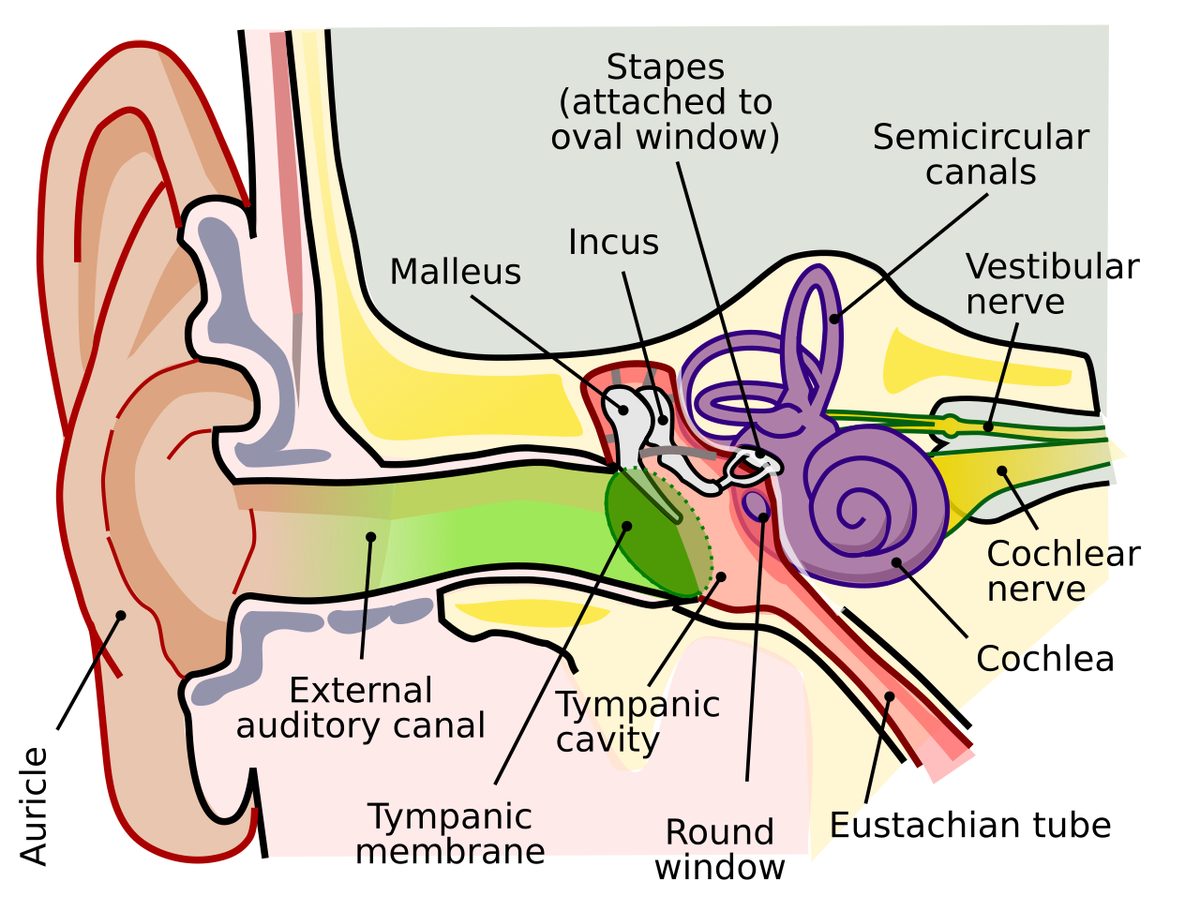
EASA training texts compare the roughly 1.2 million nerve cells that carry information from the eye to the brain with about 50,000 from the inner ear, one reason why vision dominates orientation. Hearing nevertheless has advantages: it needs no line of sight, works in any direction and does not require the pilot to be looking at the source.
How hearing works
A sound wave entering the ear canal makes the eardrum vibrate. The ossicles pass and amplify that vibration to the oval window, setting the fluid of the cochlea in motion. Inside the cochlea a fine membrane is covered with tiny hair cells; the movement of the fluid bends them by an amount and at a place that depend on the loudness and pitch of the sound, and the auditory nerve carries the resulting signals to the cortex of the brain.
Sound can also bypass the outer and middle ear. Because the cochlea sits in a bony cavity of the temporal bone, vibration of the whole skull moves the cochlear fluid directly. This bone conduction is why a vibrating tuning fork pressed against the skull can be heard, and why a person whose eardrum or ossicles are damaged may still hear sound conducted through bone.
What reaches the brain is then filtered by attention. EASA texts describe the echoic memory, a sensory store that holds sounds for about 2 to 8 seconds, long enough to replay a call that was only half attended to. Selective attention lets a pilot pick out the aircraft's own callsign from busy radio traffic, the so-called cocktail party effect. Continuous sound undergoes habituation: the receptors and the brain gradually stop responding to it, so steady engine noise fades from awareness while it goes on reaching the ear. And under extreme stress, EASA texts note that auditory information is commonly the first to be discarded, which is why a clearly audible warning can go unheard (see stress).
Frequency and decibels
Sound has two properties that matter here. Frequency, measured in hertz (Hz), is heard as pitch. The audible frequency range of a young person with normal hearing runs from about 20 Hz to 20,000 Hz, depending on intensity. Human speech occupies a much narrower band, roughly 500 to 3,000 Hz, and it is this band that radio and interphone systems must reproduce clearly.
Intensity, heard as loudness, is measured in decibels (dB). The decibel scale is logarithmic: an increase of 10 dB means ten times the sound intensity, and an increase of about 3 dB doubles it. A figure that looks only slightly higher therefore represents a great deal more energy reaching the ear. Measurements for hearing protection are usually A-weighted, written dB(A), which weights the frequencies according to the ear's sensitivity. EASA training texts place the threshold of pain at around 140 dB.
Noise exposure limits
Damage to the ear depends on both the intensity and the duration of exposure. EASA human performance texts link noise-induced hearing loss to exposure above about 90 dB, and quote maximum exposures of about 87 dB for eight hours, 100 dB for two hours and 110 dB for 30 minutes. The three figures do not come from a single rule. Eighty-seven decibels over eight hours is the EU limit value described below, while 100 dB for two hours and 110 dB for 30 minutes are permissible exposures under the US occupational noise standard (29 CFR 1910.95), which allows 90 dB(A) for eight hours and halves the time for every 5 dB above it. Whatever the rule, the higher the level, the shorter the time before damage begins.
In the European Union, workplace noise is regulated by Directive 2003/10/EC. It sets an exposure limit value of 87 dB(A) averaged over an eight-hour working day, assessed at the ear with the attenuation of any hearing protection taken into account, and lower exposure action values of 80 and 85 dB(A), assessed without hearing protection, that oblige employers to take measures such as providing hearing protection and hearing checks. It applies to workers in general, including those who work on the ramp near running engines and auxiliary power units.
Noise also matters short of damage. The FAA's Pilot's Handbook of Aeronautical Knowledge lists noise, with heat, vibration and lack of oxygen, among the physical stressors that add to a pilot's load, and EASA texts list constant, monotonous noise among the conditions that promote hypovigilance (see fatigue). It masks speech, forcing radio and intercom volume up, which in turn adds to the sound reaching the ear.
Noise-induced hearing loss
Noise-induced hearing loss (NIHL) is permanent damage to the hair cells of the cochlea caused by sustained high noise levels. The hair cells do not regenerate, so each exposure adds to the last and the loss cannot be reversed. It develops gradually and without pain. It begins with the finer hair cells that respond to high-pitched sounds, typically around 4,000 Hz, above the main speech band, which is why it goes unnoticed until it spreads far enough to make conversation in a noisy room, and then radio calls, hard to follow. EASA texts also note that high-frequency noise is the most damaging to the ear.
A temporary dullness of hearing after a long, noisy flight is a warning that the ear has been overloaded. Repeated often enough, the temporary shift becomes a permanent one. Pilots of noisy light piston aircraft who fly without an adequate headset, or who run engines on the ground without ear protection, are the classic victims.
Presbycusis and conductive deafness
Presbycusis is the deterioration of hearing with age. The upper frequency limit falls, and EASA texts give an audible range of about 50 to 8,000 Hz in old age. It adds to any noise damage, and the combination may be enough to fail the hearing requirements of a medical certificate.
Conductive deafness is a failure to carry sound through the outer or middle ear to the cochlea, with the inner ear itself intact. Causes include a perforated or scarred eardrum, damage to the ossicles from a blow to the head, excessive wax or a growth in the ear canal. A blocked Eustachian tube causes a temporary form: flying with a cold can leave the middle ear unable to equalise in the descent, with pain, pressure on the eardrum and dulled hearing. Because the cochlea works normally, sound delivered by bone conduction is still heard, which distinguishes conductive loss from the sensorineural loss caused by noise and age.
Hearing is part of medical certification. Under EASA Part-MED, Class 1 applicants are tested by pure-tone audiometry, and a PPL holder who adds an instrument rating must meet the Class 1 audiometry standard. Part-MED (MED.A.020) also forbids exercising licence privileges when aware of any decrease in medical fitness; in the United States, 14 CFR 61.53 has the same effect. A pilot who notices a change in hearing should seek aeromedical advice.
Hearing protection and ANR headsets
Prevention is the only cure. Passive protection, from earplugs or from ear cups that seal around the ear, blocks sound physically and is most effective at the higher frequencies. Training texts stress wearing a headset or earplugs on every flight, including ground runs, and ear protection on the ramp.
Active noise reduction (ANR) headsets add electronics to the passive seal. A small microphone in each ear cup samples the noise inside the cup, and a circuit produces a sound wave of equal size and opposite phase that cancels much of it. ANR works best against steady, low-frequency noise such as the drone of engines and propellers, which a passive seal struggles to stop, while the seal continues to deal with higher frequencies. The result is less noise at the ear, and radio and intercom speech that can be heard clearly at a lower volume.
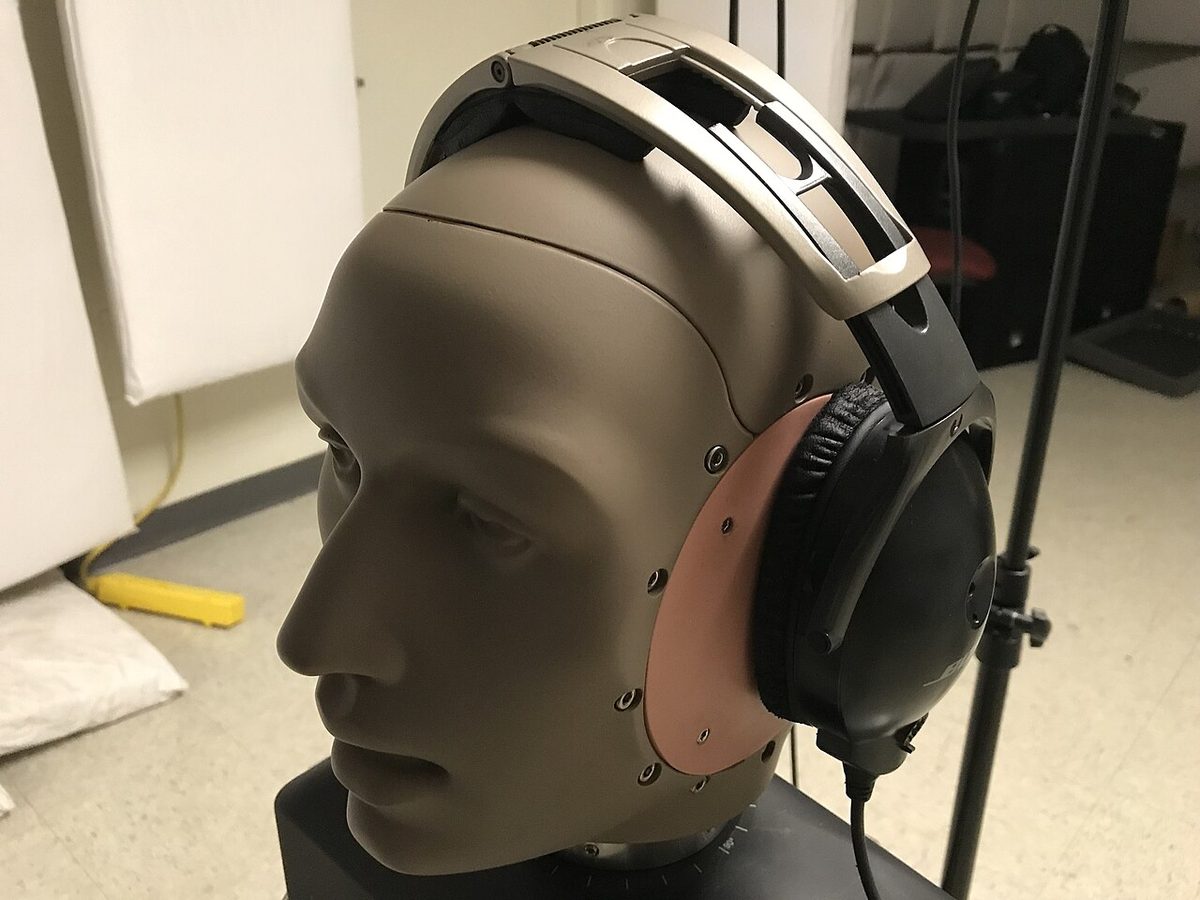
Good habits complete the defence: fit the ear cups carefully, since hair, glasses arms and a poor seal all let noise in; set radio volume no higher than needed; and treat any lasting dullness or change in hearing as a reason for an early hearing check rather than something to live with. Clear communication also depends on technique, with standard phraseology and full readbacks (see aircraft interphone and audio systems).
Exam tip: noise-induced hearing loss depends on both intensity and duration, affects the high frequencies first, is painless and is permanent. Conductive deafness involves the eardrum or ossicles; presbycusis is the effect of age.
Frequently asked questions
Can flying cause hearing loss?
Yes. The engine, propeller and airflow noise of many aircraft, especially light piston aeroplanes, is loud enough to destroy the hair cells of the cochlea over a flying career. The loss builds up gradually and painlessly, starts at high frequencies above the speech range and is permanent, so it is usually noticed only when radio calls become hard to follow. Wearing a well-sealed headset on every flight prevents it.
What frequency range can humans hear?
A young person with normal hearing hears from about 20 Hz to 20,000 Hz, depending on loudness. Human speech uses a much narrower band, roughly 500 to 3,000 Hz. With age the range narrows, a process called presbycusis, and EASA training texts give about 50 to 8,000 Hz in old age. Noise damage usually appears first around 4,000 Hz, above the main speech band.
How long can you be exposed to 100 dB of noise?
EASA ATPL texts quote about two hours at 100 dB and 30 minutes at 110 dB, alongside 87 dB for eight hours. The 100 and 110 dB times come from the US occupational noise standard, which allows 90 dB(A) for eight hours and halves the time for every 5 dB above it. The EU's workplace noise directive, 2003/10/EC, sets a daily exposure limit of 87 dB(A), assessed with the effect of hearing protection taken into account.
Does an ANR headset protect your hearing?
An active noise reduction headset adds electronic cancellation to the passive seal of its ear cups. A microphone in each cup picks up the noise and the electronics produce an opposing sound wave that cancels much of it, working best on the steady low-frequency drone of engines and propellers. Lower noise at the ear means less damage, and radio calls can be heard clearly at a lower volume.
What is the difference between conductive and noise-induced hearing loss?
Conductive deafness is a failure to carry sound through the outer and middle ear, caused for example by a perforated or scarred eardrum, damaged ossicles, a blocked ear canal or middle-ear barotrauma. Noise-induced hearing loss is damage to the hair cells of the cochlea in the inner ear. Conductive loss can often be treated; noise-induced loss cannot, because the hair cells do not regenerate.
Test yourself on Hearing and Noise
The v1prep banks cover this topic in Human Performance and Limitations (040), with a worked explanation for every answer. EASA ATPL, PPL, IR and CPL, the FAA written tests and A320/B737 type ratings.
Start practising →Sources and further reading
- EASA Easy Access Rules for Aircrew (Regulation (EU) No 1178/2011), Annex IV Part-MED
- Directive 2003/10/EC on the minimum health and safety requirements regarding the exposure of workers to the risks arising from physical agents (noise)
- FAA Pilot's Handbook of Aeronautical Knowledge (FAA-H-8083-25C), Chapter 17, Aeromedical Factors
- FAA Pilot Safety Brochure, Hearing and Noise in Aviation
- 29 CFR 1910.95, Occupational noise exposure (US)
- FAA, Fundamentals of Noise and Sound
- ICAO Doc 9683, Human Factors Training Manual
- EASA, Explanatory Note to ED Decision 2018/001/R, Part-FCL theoretical knowledge learning objectives (040 Human Performance)
Library articles are written for study and exam preparation. They do not replace your aircraft's approved documentation, your operator's procedures or the regulations themselves.