Gas Turbine Principles, Thrust and Ratings
A gas turbine works on the Brayton cycle: air is compressed, heated at almost constant pressure and expanded, continuously. Its thrust is the reaction to the rearward acceleration of the air passing through it, plus a pressure thrust when the propelling nozzle is choked.
A gas turbine engine is a heat engine. It takes in air, raises its pressure, adds heat by burning fuel in it and lets the hot gas expand, first through a turbine that drives the compressor, and the fan of a turbofan, then through a propelling nozzle. The thrust it produces is the reaction, in the sense of Newton's third law, to the rearward acceleration of that mass of air: the engine pushes air backwards, and the air pushes the engine forwards.
A few principles explain almost everything the pilot sees of engine performance: why thrust falls with speed, altitude and temperature, why high-bypass engines are economical, why engines are flat rated and why take-off thrust is limited in time. The practical side of setting those ratings is covered in reduced and derated take-off thrust.
- The Brayton cycle
- Gas laws and adiabatic compression
- Convergent and divergent ducts
- Propelling and choked nozzles
- Net thrust and pressure thrust
- Ram effect and ram recovery
- Thermal and propulsive efficiency
- Specific fuel consumption
- Thrust, altitude and temperature
- Flat rating and thrust limits
- Frequently asked questions
The Brayton cycle
The gas turbine runs the Brayton cycle, also called the constant-pressure cycle. It has four stages: intake, compression, combustion and expansion through the turbine and exhaust. The difference from the four-stroke piston engine's Otto cycle lies in the combustion: the piston engine burns its charge at roughly constant volume in a closed cylinder, with peak pressures above 1,000 psi, while the gas turbine burns fuel at almost constant pressure in an open chamber. Without those pressure peaks the gas turbine can be built lighter for its power and can use fuel of lower grade.
In a piston engine the four strokes follow one another in the same cylinder. In a gas turbine they take place all at once, each in its own part of the engine, in a continuous flow.
A higher compressor pressure ratio extracts more work from each unit of fuel, raising thermal efficiency and lowering specific fuel consumption. A higher turbine entry temperature mainly raises the thrust a given core can produce. Both are capped by the turbine: the maximum gas temperature is set by the materials of the nozzle guide vanes and turbine blades (see combustion chambers and turbines).
Gas laws and adiabatic compression
Three gas laws describe what happens to the air. Boyle's law says that at constant temperature the pressure of a gas varies inversely with its volume. Charles's law says that at constant pressure its volume is proportional to its absolute temperature. The combined gas law joins them: PV/T is constant, so that P1V1/T1 = P2V2/T2 for two states of the same mass of gas.
Compression in the engine is close to adiabatic: it happens too quickly for heat to flow in or out, so the work done on the air appears as a rise in temperature as well as in pressure. Air leaves the last compressor stage several hundred degrees hotter than it entered. The same effect warms the air in a temperature probe: air brought to rest adiabatically at M 0.85 in the cruise is about 30 °C warmer than the surrounding air (see air data computer and air temperature).
In the combustion chamber the pressure stays almost constant, so, as Charles's law predicts, the heat added makes the gas expand greatly in volume. In the turbine the gas expands again, and its pressure and temperature fall as it gives up work.
Convergent and divergent ducts
At subsonic speeds the shape of a duct decides how the gas behaves. A divergent duct, widening in the direction of flow, slows the gas and raises its pressure: the engine intake and the diffuser at the compressor outlet are divergent for this reason. A convergent duct, narrowing in the direction of flow, accelerates the gas and lowers its pressure: the passages between the nozzle guide vanes and the propelling nozzle are convergent. This is why the gas leaving the turbine moves faster than it did in the combustion chamber, although it has given up much of its energy.
In supersonic flow the rules reverse: a divergent passage accelerates the gas and a convergent one slows it. A supersonic intake therefore needs a convergent section to slow the air before a divergent one, and the nozzles of supersonic aircraft diverge after their throat to accelerate the jet further.
Propelling and choked nozzles
The propelling nozzle at the end of the jet pipe turns the pressure left in the gas into velocity. With a convergent nozzle, the jet velocity rises as the pressure ratio across the nozzle increases, until the gas at the throat reaches the local speed of sound. The nozzle is then choked. The throat velocity cannot rise any further; the gas leaves at a static pressure above ambient, and the rest of its expansion takes place behind the engine.
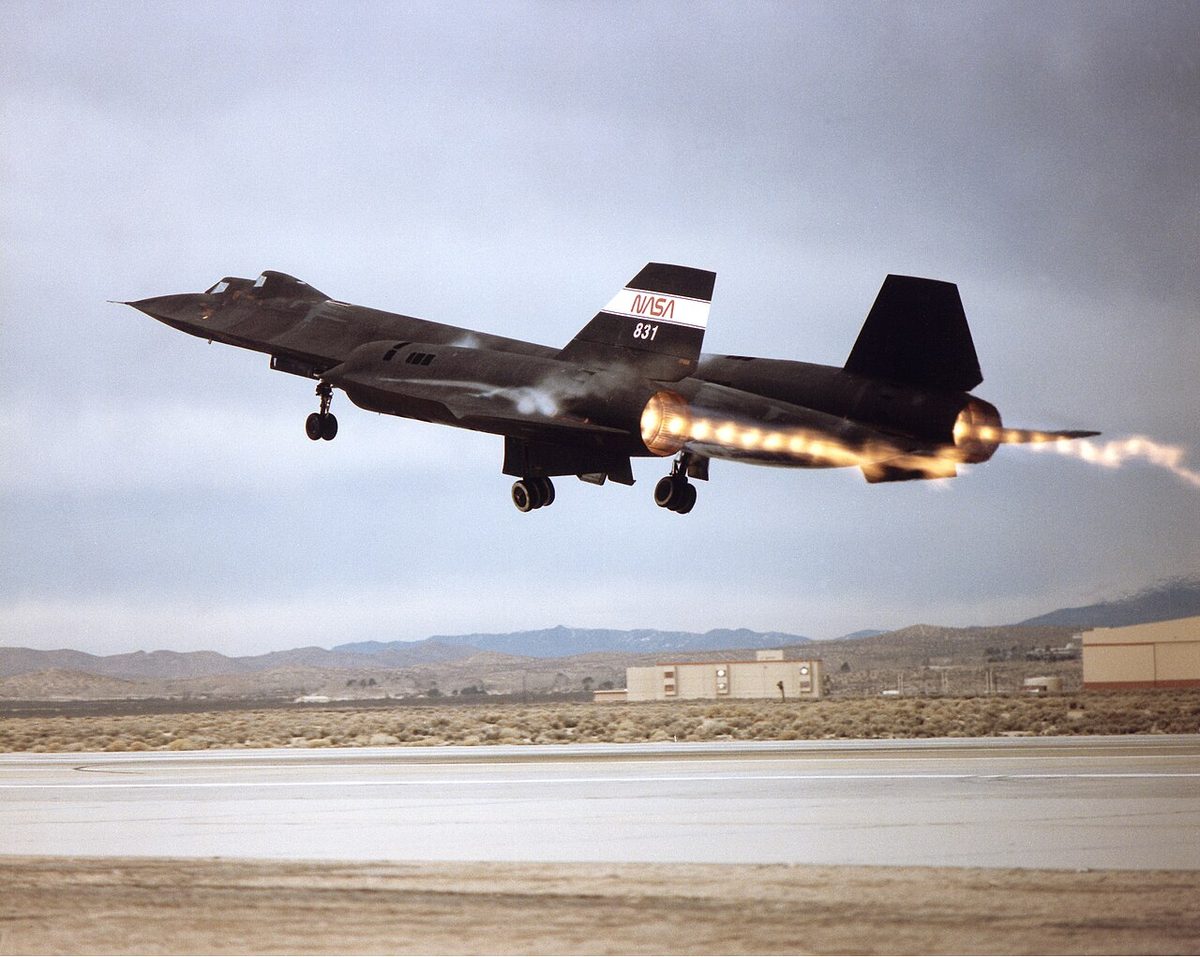
Once a nozzle is choked, the only way to raise the exhaust velocity is to raise the gas temperature, and with it the local speed of sound. That is the principle of the afterburner (see gas turbine engine types).
Net thrust and pressure thrust
The gas turbine thrust equation gives the thrust as the mass flow multiplied by the change in velocity, plus a pressure term:
Thrust = W (Vj − Va) + A (Pj − Pa)
W is the mass flow of air per second, Vj the jet velocity and Va the velocity of the air entering the intake, which in flight is the aircraft's speed. The first term is the momentum thrust. The second is the pressure thrust: the difference between the static pressure in the nozzle exit (Pj) and ambient pressure (Pa), acting over the nozzle exit area A. It is zero when the nozzle expands the gas to ambient pressure and appears when the nozzle is choked. In imperial units, with mass flow in lb per second and velocities in ft per second, the result is divided by g, 32.2 ft/s², to give pounds of force.
W × Vj is the gross momentum of the jet; W × Va is the intake momentum drag, the momentum of the air the engine must first take on board. Net thrust is gross thrust minus intake momentum drag, and it is net thrust that propels the aeroplane. Thrust is also far from proportional to rotational speed: on a high-bypass turbofan about 25 % N1 gives only about 5 % of take-off thrust.
Ram effect and ram recovery
As the aeroplane accelerates, Va rises and, at constant engine speed, net thrust falls. The intake offsets part of the loss. Moving forward, it slows the approaching air and turns part of its kinetic energy into pressure, the ram effect. On the ground the intake has to accelerate still air into the engine and the pressure at the compressor face is below ambient; as speed rises, ram pressure makes up for the intake losses, and above the ram recovery speed the intake adds its own compression to that of the compressor, raising the overall pressure ratio.
The ram ratio at the intake grows with speed. As it does, the mass flow increases, and so does the fuel flow needed to hold the same engine speed. The two effects together give the familiar curve: starting from rest, thrust first falls, then partly recovers as ram effect builds, but in the ATPL model it never quite regains its static value. Because the net thrust falls while fuel flow rises, the specific fuel consumption increases with airspeed. Ram effect also explains why engine pressure ratio falls during the take-off roll although thrust has not (see engine indications and condition monitoring).
Thermal and propulsive efficiency
Thermal efficiency measures how much of the energy in the fuel the engine turns into kinetic energy of the gas. It rises with the pressure ratio and the turbine entry temperature the materials can accept.
Propulsive efficiency measures how much of that kinetic energy actually drives the aeroplane. With V the flight speed and Vj the jet velocity it is 2V / (V + Vj). It approaches 100 % as the jet velocity approaches the flight speed: with Vj twice V it is about 67 %, with Vj 1.5 times V it is 80 %. A fast jet leaves most of its energy in the wake. The way to high propulsive efficiency at subsonic speed is to accelerate a large mass of air gently, which is the whole case for the high-bypass turbofan. The overall efficiency of the engine is the product of the two.
Specific fuel consumption
Specific fuel consumption (SFC) is the fuel flow needed per unit of thrust, for example kg per hour per newton or lb per hour per lbf; for a turboprop it is expressed per unit of shaft horsepower. Over the cruise thrust range it is roughly constant, so a jet's fuel flow in level flight is roughly proportional to its thrust, and therefore to the drag.
SFC falls with a higher compressor pressure ratio and a higher bypass ratio. It rises whenever the engine must produce the same thrust with less useful air or more load. Bleeding air for air conditioning or anti-icing reduces the mass flow; to keep the thrust the fuel control adds fuel, so N1 or N2, EGT and SFC rise, while EPR falls. Adding an accessory such as another hydraulic pump to the gearbox has the same effect on SFC. On a turboprop, by contrast, SFC falls as airspeed rises, because ram effect increases the shaft horsepower faster than the fuel flow.
Thrust, altitude and temperature
Thrust depends on the mass of air through the engine, so it follows air density. As altitude increases, falling pressure reduces density and thrust, while falling temperature partly offsets the loss; thrust therefore falls, but more slowly than the pressure. Above the tropopause the temperature stops falling and thrust falls faster with height. At FL370 a turbofan may give about a quarter of its sea-level thrust.
On a hot day the air is less dense and the thrust is lower. At a fixed throttle setting the compressor, with less air to compress, speeds up unless the fuel control reduces fuel. On a cold day density and thrust are higher, up to the limit set by the engine's rating.
Flat rating and thrust limits
Modern engines are flat rated. The engine is certified to deliver its full rated thrust from very cold temperatures up to a flat-rating temperature, called TREF on Airbus types. Below it, the engine could produce more thrust, but it is held to the rating by mechanical and certification limits such as shaft speed, casing pressure and structural loads. Above it, the exhaust gas temperature limit takes over and the available thrust falls as the outside air temperature rises. The engine control holds the N1 or EPR target that gives the rating in the conditions of the day. An engine whose EGT margin has been worn away by age reaches its temperature limit sooner.
The thrust rating limit is the value of N1 or EPR that the rating allows in the current conditions. On the A320 the FADEC computes it for the thrust lever detent selected (TOGA, FLX/MCT or CL) and shows it in green on the engine display; on the Boeing 737 the FMC normally calculates the N1 limit. The rating is largely a matter of software: the 737 NG's CFM56-7B is rated between about 22,000 and 27,000 lbf of take-off thrust depending on the variant, and the EEC limits the maximum thrust for the model it is installed on.
The three ratings used in airline operation are:
| Rating | Use | Time limit |
|---|---|---|
| Take-off / go-around (TOGA) | Take-off and go-around | 5 min; 10 min with one engine inoperative where approved |
| Maximum continuous thrust (MCT) | Engine inoperative after take-off and en route | None |
| Climb (CLB) | Normal climb, slightly below MCT | None |
The take-off thrust time limit comes from 14 CFR 25.1521 and the engine certification rules; on the A320, TOGA may be used for 5 minutes with all engines operating and 10 minutes with one inoperative, with a take-off EGT limit of 950 °C on the CFM56-5B. After that the engine must be brought back to maximum continuous thrust, which a long engine-out climb over high terrain has to allow for (see takeoff climb segments). The reduction from full take-off thrust by the assumed temperature or derate methods is covered in reduced and derated take-off thrust.
Frequently asked questions
What is the Brayton cycle in a jet engine?
The Brayton cycle is the constant-pressure cycle of the gas turbine: intake, compression, combustion and expansion through the turbine and nozzle. Heat is added in the combustion chamber at almost constant pressure, whereas a piston engine burns its charge at roughly constant volume. All four processes happen at once, each in its own part of the engine, so the gas turbine has no pressure peaks and can be built light for its power.
What is pressure thrust?
When the pressure ratio across a convergent propelling nozzle is high enough, the gas at the throat reaches the local speed of sound and the nozzle is choked. The gas then leaves at a static pressure above ambient, and that excess pressure acting over the nozzle exit area adds a pressure thrust to the momentum thrust. Once choked, the exit velocity can only be raised by raising the gas temperature.
Why does jet engine thrust fall as airspeed increases?
Net thrust depends on the difference between the jet velocity and the speed of the air entering the intake. As the aircraft accelerates, the intake momentum drag rises and, at constant engine speed, the thrust falls. Ram compression in the intake partly offsets the loss by raising the mass flow, so thrust dips and then partly recovers, but in the ATPL model it never quite returns to its static value.
What is a flat-rated engine?
A flat-rated engine is certified to deliver its full rated thrust from very cold days up to a flat-rating temperature, called TREF on Airbus types. Below that temperature it could produce more, but mechanical and certification limits hold it to the rating. Above it, the exhaust gas temperature limit takes over and the available thrust falls as the outside air gets warmer. Reduced-thrust take-offs exploit this behaviour.
How long can take-off thrust be used?
Take-off thrust is time limited. Under 14 CFR 25.1521 and the engine certification rules it is normally limited to 5 minutes, which may be extended to 10 minutes for one-engine-inoperative operations where this has been approved. On the A320 TOGA may be used for 5 minutes with all engines operating and 10 minutes with one inoperative. After that, maximum continuous thrust applies.
What is propulsive efficiency?
Propulsive efficiency is the share of the energy given to the air that actually drives the aircraft forward. It equals 2V divided by (V + Vj), where V is the flight speed and Vj the jet velocity. It is highest when the jet leaves only a little faster than the aircraft flies: with Vj twice V it is about 67 %, with Vj 1.5 times V it is 80 %. This is the case for high-bypass turbofans.
Test yourself on Gas Turbine Principles, Thrust and Ratings
The v1prep banks cover this topic in Aircraft General Knowledge (021), with a worked explanation for every answer. EASA ATPL, PPL, IR and CPL, the FAA written tests and A320/B737 type ratings.
Start practising →Sources and further reading
- FAA Aviation Maintenance Technician Handbook, Powerplant (FAA-H-8083-32B), Chapter 1, Aircraft Engines
- EASA, Explanatory Note to ED Decision 2018/001/R, Part-FCL theoretical knowledge learning objectives (021 Powerplant)
- EASA Easy Access Rules for Engines (CS-E)
- 14 CFR 25.1521, Powerplant limitations
- EASA Easy Access Rules for Large Aeroplanes (CS-25)
- FAA AC 25-13, Reduced and Derated Takeoff Thrust (Power) Procedures
- FAA Airplane Flying Handbook (FAA-H-8083-3C), Transition to Jet-Powered Airplanes
Library articles are written for study and exam preparation. They do not replace your aircraft's approved documentation, your operator's procedures or the regulations themselves.