Airline Pilot Recruitment and Selection
Airline pilot recruitment and selection is the process by which an airline screens applications, assesses candidates' knowledge, flying skill and behaviour through interviews, tests and simulator evaluations, and then confirms their records and background before offering a place on a new-hire training course.
Airline pilot recruitment is the process that turns an application into a place on a new-hire training course. No two airlines run it identically, but almost all of them test the same things: whether the candidate has the licences, hours and records required, whether they know their aircraft and their theory, whether they can fly an instrument profile accurately in a simulator, and whether they will behave as a safe, cooperative crew member for thirty years.
The process differs in emphasis by region. Airlines in Europe and the Middle East typically lean on computer-based aptitude testing, group exercises and competency interviews; US airlines, whose first officers must meet the hours for an ATP or restricted ATP, lean on the records: the logbook, the Pilot Records Database and the background check. What happens after hire, from indoctrination to line training, is covered in airline pilot training and checking, and how a pilot reaches the point of applying in pilot career pathways.
The Stages of Selection
A typical selection runs through the following stages, though airlines reorder, combine or skip them:
| Stage | What it tests |
|---|---|
| Application and screening | Licences, hours, medical, right to work, education |
| Aptitude and personality testing | Numerical, verbal and spatial reasoning, memory, multitasking, work style |
| HR or competency interview | Communication, motivation, behaviour in past situations |
| Technical interview or test | Systems, procedures, ATPL theory, regulations |
| Group exercise | Teamwork and decision making under time pressure |
| Simulator evaluation | Instrument flying, procedures, crew cooperation |
| Offer and pre-employment checks | Records, background, drug test, medical |
Some airlines compress the assessments into a single day; others spread them over two. Candidates who already hold the type rating for the airline's fleet sometimes skip the simulator.
Résumé and Application
Most airlines apply online, through their own careers pages or hiring platforms, and score the application on the numbers: total time, pilot-in-command time, multi-engine and turbine time, education, and any flow agreement or referral. The pilot résumé, where one is asked for, is a single page: name and contact details, a line of certificates and ratings with the medical, a flight-time table as of a stated date, employment history in reverse order, education, and a short line of other skills. It carries no photograph in the US, no objective statement and no typing errors.
The figures must match the logbook and the application exactly. Airlines compare totals, sample pages, look for endorsements and signatures, and some review the logbooks again at the class date. Totals that change, entries that are unsigned, or time that looks padded raise questions, and falsifying a logbook or an application is itself a violation of FAA rules under 14 CFR 61.59.
Pilot Competencies
Selection is increasingly organised around the same pilot competencies that airlines use for training. Evidence-based training, following ICAO Doc 9995, assesses competencies including the application of procedures, communication, flight path management, leadership and teamwork, problem solving and decision making, situation awareness and workload management. Each is described by observable behaviours, so an assessor can say what a good or a weak performance looked like.
Interviews, group exercises and simulator evaluations are designed to show those behaviours. A candidate who briefs an approach clearly, cross-checks the other pilot, notices a deviation and says so, and keeps the workload under control is demonstrating competencies, whatever the exact question (see crew resource management).
Behavioural Interviews and STAR
The HR or competency interview uses behavioural interview questions, which ask for a real past event rather than an opinion: tell me about a time you made a mistake, disagreed with a captain, saw something unsafe, or had to decide with incomplete information.
The standard structure for an answer is the STAR method (Situation, Task, Action, Result):
- Situation: one sentence of context.
- Task: the candidate's own role.
- Action: what they did, in order, in three or four sentences.
- Result: the outcome and what they learned or changed.
A good story is concise, is true, and shows ownership rather than blame. Candidates are advised to prepare eight to ten stories covering the common themes. Anything in the candidate's record, such as a failed check or an accident, should come from the candidate first; an interviewer who finds it later will assume it was hidden.
Technical Interview
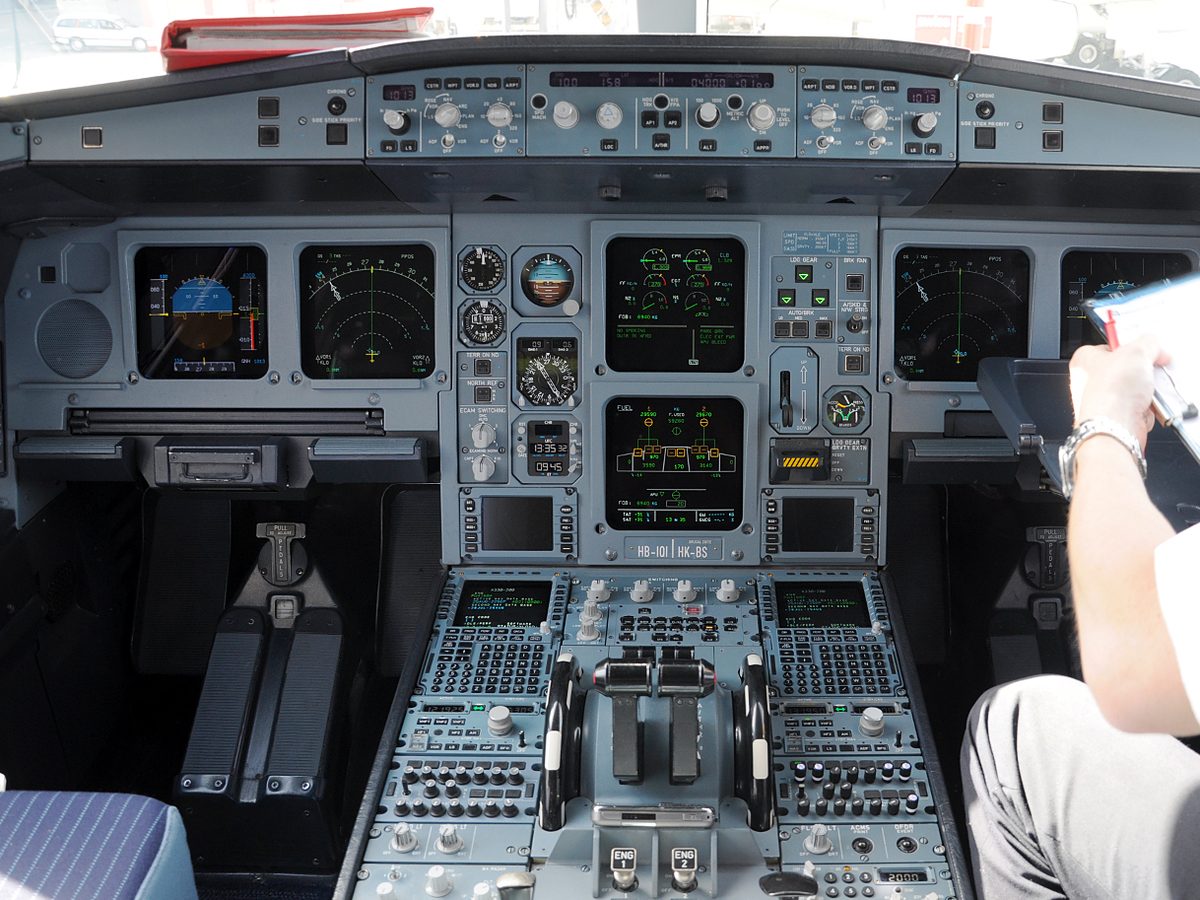
The technical interview tests knowledge in three areas: the systems and procedures of the type the candidate flies or will fly, ATPL theory asked as open questions rather than multiple choice, and operational scenarios such as a pressurisation failure in the cruise, in which the candidate talks through the actions, the communication and the decision. Some airlines use a written or computer-based technical test instead of, or before, the interview.
Interviewers score the reasoning as much as the answer. A candidate who does not know should say so, then explain what they do know and where they would look it up; guessing confidently and being wrong suggests someone who will guess in the aircraft.
Aptitude and Personality Assessment
Airlines in Europe and elsewhere commonly screen with computer-based aptitude testing: timed numerical and verbal reasoning, spatial orientation and instrument interpretation, memory, and psychomotor and multitasking tasks. A personality assessment is a questionnaire about work style and behaviour, sometimes accompanied by a situational judgement test built around flight deck scenarios. Personality questionnaires have no right answers to learn; consistency and honesty are what they look for.
A group exercise puts several candidates around a planning or prioritisation task against the clock, while assessors watch how each contributes, listens, and helps the group reach a decision.
Simulator Evaluation
Where an airline uses one, the airline simulator evaluation usually lasts 30 to 60 minutes in a fixed-base or full flight simulator of a jet or a generic transport, flown as a crew with another candidate or a company pilot. A typical profile contains a take-off, steep turns, climbs, descents and turns at set speeds, a holding entry, an ILS to minimums with a missed approach, and sometimes a non-precision approach or an engine failure.
The assessors score instrument scan, procedural discipline, callouts and briefings, crew cooperation, and how the candidate copes with an unfamiliar aircraft and with things going wrong. The standard advice is to ask for the pitch attitudes and power settings before starting, fly them, and brief every approach as an airline crew would (see flight simulation training devices).
Conditional Job Offer
A successful candidate usually receives a conditional job offer (CJO): the airline will hire them once everything checks out. Typical conditions are:
- a satisfactory background check and records review;
- a negative pre-employment drug test;
- verification of certificates, medical and flight hours;
- meeting the ATP or restricted ATP minimums by the class date, since 14 CFR 121.436 requires one of those certificates of a US Part 121 first officer (the checkride itself is usually part of initial training);
- a clean record until the class date: a new driving conviction, accident or failed check must be reported and can end the offer.
A CJO is not employment. The offer letter also sets out any training contract and bonus terms, which deserve careful reading.
Background and Records Checks
In the United States the records review is built on the Pilot Records Database (PRD). Required by 14 CFR Part 111, it replaced the paper-based process of the Pilot Records Improvement Act (PRIA). A hiring air carrier must review a candidate's records in the PRD, with the pilot's consent, before hiring. The database holds the pilot's FAA records, including certificates, ratings, medical, enforcement actions and accident and incident history, and records uploaded by previous employers, including training and checking results with any failures, disciplinary actions and the reason for leaving. Pilots can see their own file and are advised to read it before an interview.
The pre-employment background check adds:
- a criminal history records check (CHRC), fingerprint-based, under the airport and aircraft operator security rules of 49 CFR Parts 1542 and 1544, looking for disqualifying offences within the last 10 years;
- in some cases a security threat assessment (STA) by the Transportation Security Administration;
- a check of the National Driver Register (NDR) and the driving record for alcohol- or drug-related motor vehicle actions, which 14 CFR 61.15 requires pilots to report to the FAA within 60 days;
- the history of DOT drug and alcohol testing with previous employers, employment verification including gaps, and education checks.
European airlines verify licences, medicals, logbooks and references in the same spirit. Everywhere, the most common reason for withdrawing an offer is a discrepancy between what the candidate declared and what the records show.
Class Date and Signing Bonus
The class date is the day new-hire training begins. It may be weeks or months after the offer, depending on the airline's hiring volume, and many candidates hold a CJO for months before a class date is assigned. The course from class date to first line flight, typically 6 to 10 weeks at a US airline, is described in airline pilot training and checking.
When pilots are in demand, airlines, particularly US regional airlines, offer a signing bonus, tuition reimbursement or retention bonuses. The terms matter: when each part is paid, what triggers repayment if the pilot leaves early, and whether repayment is pro-rated. Some offers tie training costs to a repayment obligation for a period after training (see pilot career pathways).
Note: the details of every airline's process change between campaigns. Candidates should rely on the airline's own careers pages and invitation, not on descriptions of past campaigns.
Frequently asked questions
What is the STAR method in a pilot interview?
STAR stands for Situation, Task, Action, Result. It is a way of structuring an answer to a behavioural question such as "tell me about a time you disagreed with a captain". The candidate sets the scene briefly, states their own role, describes what they did in order, and ends with the outcome and what they learned. A good STAR answer is a real event, is told concisely, and shows ownership rather than blame.
What happens in an airline simulator evaluation?
Where an airline uses one, it typically lasts 30 to 60 minutes in a fixed-base or full flight simulator of a jet or a generic transport, flown with another candidate or a company pilot. Expect a take-off, steep turns, basic instrument flying, a holding entry, an ILS to minimums with a missed approach, and sometimes a non-precision approach or an engine failure. Assessors look at scan, procedures, callouts and crew cooperation, not perfection.
What is a conditional job offer for pilots?
A conditional job offer (CJO) is the airline's commitment to hire a candidate once conditions are met. Typical conditions are a successful background check and records review, a negative pre-employment drug test, verified certificates, medical and hours, meeting the licence minimums by the class date, and a clean record until then. A CJO is not employment, and it can be withdrawn if the records do not match the application.
What is the Pilot Records Database?
The Pilot Records Database (PRD) is an FAA electronic database, required by 14 CFR Part 111, that replaced the paper process of the Pilot Records Improvement Act (PRIA). Before hiring a pilot, a US air carrier must review the pilot's records in it with the pilot's consent. It holds FAA records, such as certificates, ratings and enforcement actions, and records from previous employers, including training and checking results and disciplinary actions.
What background checks do US airlines run on pilots?
Expect a fingerprint-based criminal history records check, employment verification including gaps, education checks, a review of the Pilot Records Database, the history of DOT drug and alcohol testing with previous employers, a driving record check including the National Driver Register, and verification of FAA certificates and medical. Some airlines add a security threat assessment. Discrepancies between the application and the records are the commonest reason offers are withdrawn.
Test yourself on Airline Pilot Recruitment and Selection
The v1prep banks cover this topic in the airline interview bank, with a worked explanation for every answer. EASA ATPL, PPL, IR and CPL, the FAA written tests and A320/B737 type ratings.
Start practising →Sources and further reading
- 14 CFR Part 111, Pilot Records Database
- FAA, Pilot Records Database (PRD)
- FAA Advisory Circular 120-68J, Pilot Records Database and Pilot Records Improvement Act
- 14 CFR 121.436, Pilot qualification, certificates and experience requirements
- ICAO Doc 9995, Manual of Evidence-based Training (SKYbrary bookshelf)
- EASA Easy Access Rules for Air Operations (ORO.FC, flight crew requirements)
Library articles are written for study and exam preparation. They do not replace your aircraft's approved documentation, your operator's procedures or the regulations themselves.