Aircraft Materials, Fastening and Corrosion
Aircraft materials are the metals and composites from which an airframe is built, chosen above all for strength in relation to weight. They are joined mainly by riveting and adhesive bonding, and they must be protected against corrosion, the slow electrochemical destruction of a metal in service.
An airframe is a compromise between strength and weight. Every kilogram of structure is a kilogram less of payload or fuel, so designers choose materials by their strength-to-weight ratio first, then by stiffness, fatigue resistance, heat resistance, cost and the ease of making and repairing them. Aluminium alloys remain the backbone of most airliners; steel and titanium appear where strength or heat matter more than weight, magnesium where weight matters most, and fibre-reinforced composites take a growing share.
Each material brings its own weakness, and the commonest is corrosion. It is slow, often hidden, and among the most persistent problems in aircraft maintenance. This article covers the materials, the ways parts are joined and the forms of corrosion and the treatments that hold it off. How the structure carries its loads is covered in structural design and design loads and airframe structure and construction.

Aluminium alloys and Alclad
Aluminium and its alloys are the most widely used structural metals in aircraft, because they combine low density with good strength. Aluminium has a density of about 2.7 g/cm³, against about 7.8 g/cm³ for steel. Pure aluminium is soft; alloying it with other elements makes it strong enough for structure.
Duralumin is the classic aircraft alloy: an aluminium alloy based on copper. It has a good strength-to-weight ratio, good fatigue resistance and good thermal and electrical conductivity, which is why duralumin-type alloys predominate in skins and structure. Its drawbacks are that it is difficult to weld, being sensitive to heat, and that its corrosion resistance is poor.
The answer to the corrosion problem is Alclad: duralumin sheet with a thin layer of pure aluminium bonded to each face. Pure aluminium forms a stable, self-healing oxide film that protects the alloy core beneath. The cladding is also sacrificial: if corrosion begins, it attacks the pure aluminium in preference to the structural alloy. Alclad is widely used for fuselage skins.
Aluminium alloys are non-ferrous, so, like copper and brass, they do not disturb the magnetic compass.
Magnesium, titanium and steel
Magnesium alloys are the lightest structural metals: aluminium is about 1.5 times heavier for the same volume. They have an excellent strength-to-weight ratio but poor elastic properties, they burn, and a magnesium fire is difficult to extinguish, and they corrode easily. Their use is therefore limited to non-primary parts where the weight saving is worth it, such as gearbox housings, some fittings and covers. Wheels are sometimes cast or forged from the magnesium alloy known by the trade name Electron, which saves weight on a heavy item repeated many times on a large aircraft.
Titanium alloys have about 60 % of the density of steel with high strength, and they keep their strength and corrosion resistance up to about 400 °C. Titanium melts at about 1,668 °C against about 660 °C for aluminium, so it is chosen for firewalls and engine cowlings, where it holds a fire back long enough to land, and for some highly stressed parts such as landing gear components and compressor blades; the fan blades of the A320's CFM56-5B and V2500 engines are titanium. Titanium is expensive and hard to machine, which limits it to places where it earns its cost. Stainless steel is the heavier alternative for firewalls.
Steel is used only where strength is vital and the weight penalty is acceptable: landing gear parts, engine mounts and fasteners.
Composites: GRP, CFRP and aramid
A composite material combines two or more materials into a new one with properties that neither has alone. In aircraft composites a matrix, usually an epoxy or polyester resin, holds the material together and passes the load to a reinforcement of fibres, which carry it. The properties can be tailored by choosing the fibre and laying it in the directions the loads run.
- Glass reinforced plastic (GRP), glass fibre in resin, is economical with good strength and is used for fairings and similar parts.
- Carbon fibre reinforced plastic (CFRP) gives the highest strength for its weight and is used in primary structure; the Boeing 787 is about half composite by weight, including its wings.
- Aramid, best known as Kevlar, has excellent impact resistance and is used where damage tolerance is needed.
Fibres can be combined in hybrid composites. Many aircraft use composites for secondary structure and control surfaces: the EASA type certificate data sheet for the Embraer E190 describes an aluminium alloy fuselage, wing, tailplane and fin, with composite ailerons, flaps, spoilers, elevators and rudder.
Composites behave differently from metals in fatigue. At stresses below about 80 % of their ultimate strength fatigue is generally not a concern, and when they are fatigued they lose their properties gradually. A metal keeps its design strength up to a critical point and then fails quickly as a crack runs, which makes undetected metal fatigue the more dangerous. A composite airframe cannot use its structure as the electrical return path, so it needs return wiring and bonding of its own (see electrical power distribution).
Honeycomb sandwich construction
In honeycomb sandwich construction a core of thin hexagonal cells, made of aluminium foil or aramid paper, is bonded between two skins of composite or aluminium alloy. Like an I-beam, the skins carry the bending loads while the light core holds them apart, so the panel is light, very stiff and has an excellent strength-to-weight ratio. It is strongest along the axis of the cells, and concentrated loads such as fittings and attachment points need local reinforcement.
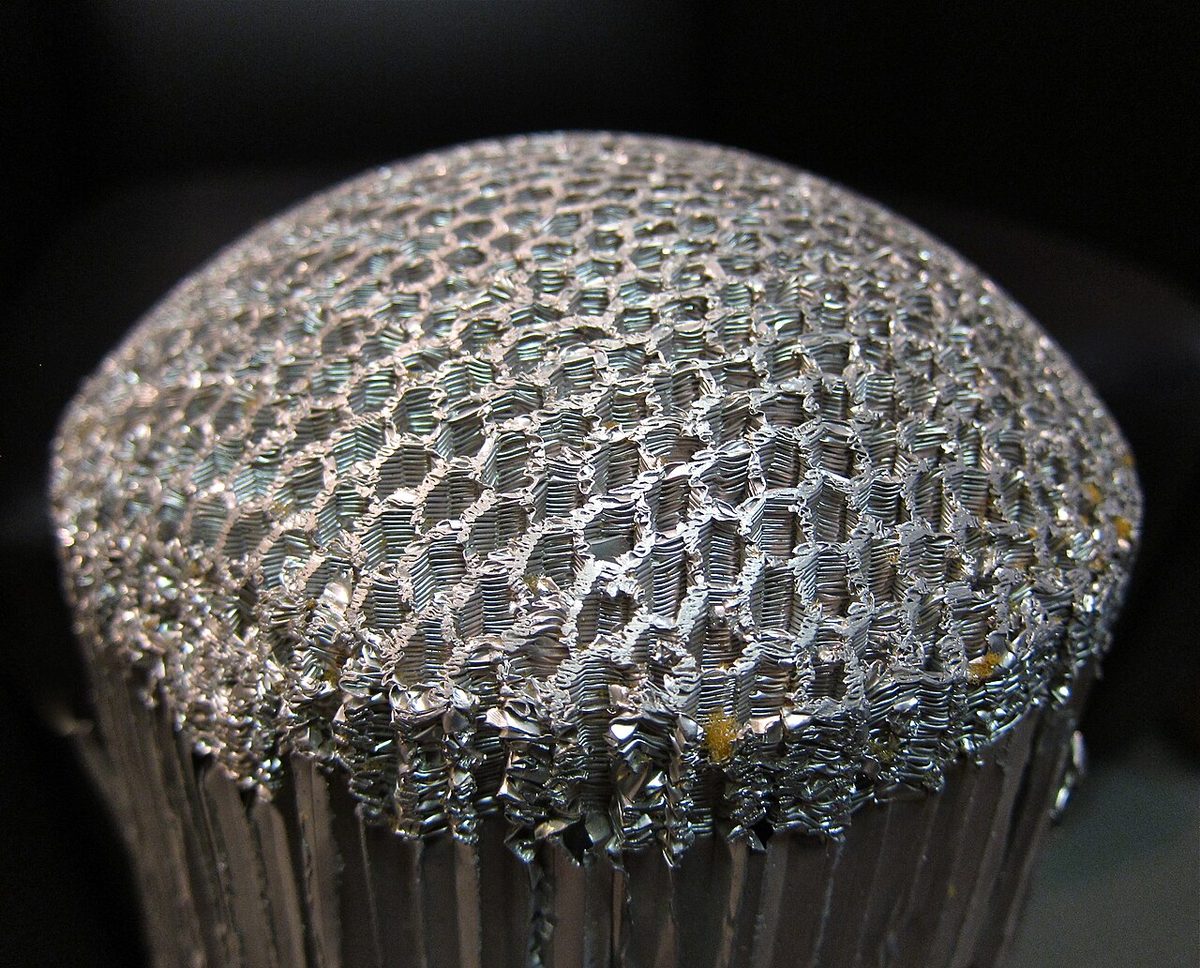
Honeycomb panels are used for flight control surfaces, cabin floor panels, fuselage and empennage panels, and for sound proofing in engine nacelles. The core can also be designed to crush and absorb energy: the tail skid of the Boeing 737 contains a cartridge of crushable honeycomb that collapses if the tail strikes the runway.
Riveting and adhesive bonding
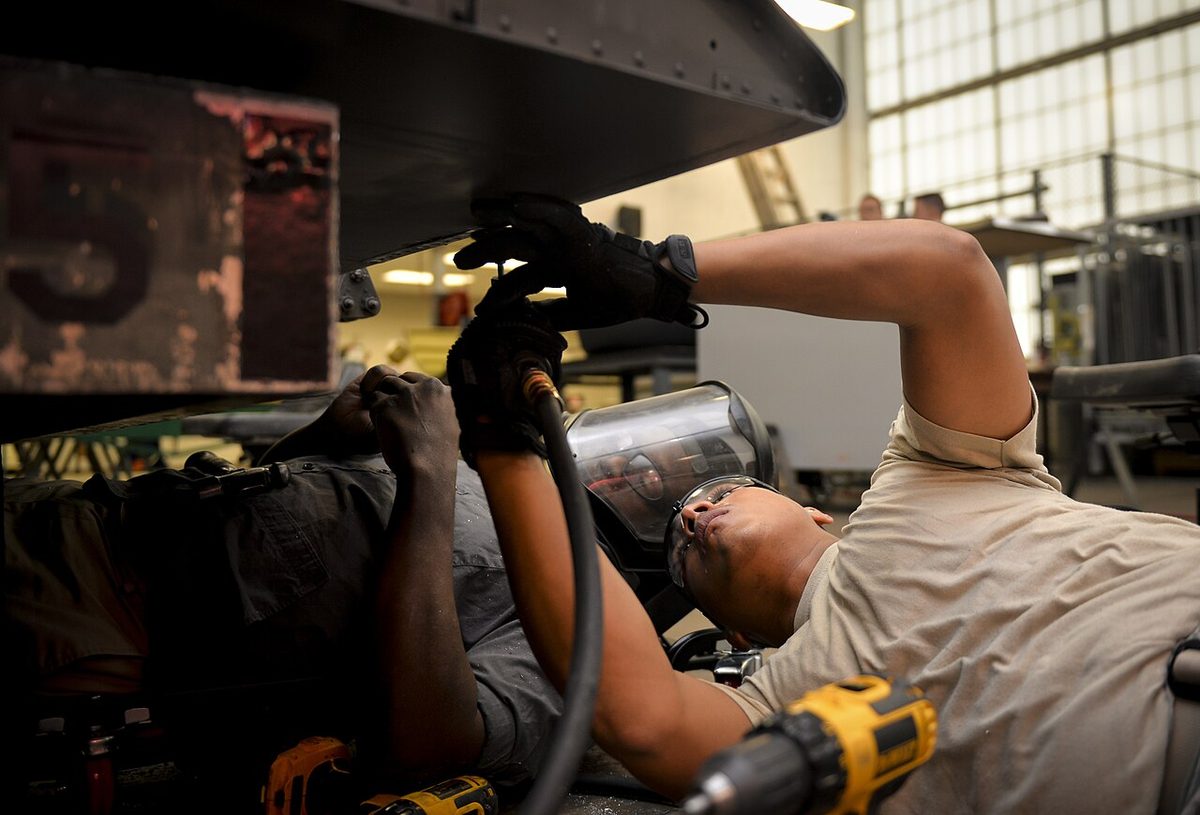
Riveting is the most common way of joining aircraft structure. A rivet is placed in a pre-drilled hole and its tail is deformed, by hammering or pressing, to form a second head that clamps the parts together. Rivets are designed to work in shear, resisting the tendency of two panels to slide over each other; they have little strength in tension, because the heads can pull off under an axial load. Joints are laid out so that the rivets share the shear load, and bolts are used where a joint must carry tension or very high shear.
A blind rivet is set from one side only. It is used where the far side of the joint cannot be reached, for example inside a closed box section, and its tail is formed from the accessible side.
The term shear rivet has a second meaning: a rivet made to break at a known load, used as a deliberate weak link. In some flight control jamming protection schemes the captain's and first officer's control wheels are tied together by shear rivets. If the ailerons jam on one side, the pilots turn the wheels against each other until the rivet breaks, and each wheel then controls the surfaces on its own side.
Every rivet or bolt hole is a stress concentration, a local rise in stress where the load path is interrupted, and fatigue cracks most commonly start at such points. Designers reduce the effect with smooth radii at cut-outs, doublers around openings and cold working of fastener holes, which leaves a residual compressive stress around the hole and delays crack initiation. Fatigue is covered in structural loads, stress and fatigue.
Adhesive bonding, often called Redux bonding, places a sheet of adhesive between the parts and cures it with heat. It has three advantages over riveting: there are no holes, and so no stress concentrations; the load is spread over the whole bonded area instead of being concentrated at fasteners; and the joint seals well, which suits fuel tanks and pressurised structure. The integral fuel tanks of transport aircraft, formed by the wing structure itself, are sealed with fuel-resistant sealant at every joint and fastener. Other joining methods include welding, bolting and pinning.
Types of corrosion
Corrosion is the slow destruction of a metal by electrochemical action. Most metals are unstable in their refined form and tend to return to a stable state resembling the ore they came from: oxides, hydroxides, carbonates, sulphates and other salts.
Oxidation is a relatively dry reaction between a metal surface and the oxygen in the air, which forms an oxide film. Whether that film protects depends on the metal. On aluminium and stainless steel it adheres, heals itself and acts as a barrier between the metal and the air. On iron and ordinary steel it is porous and flakes off, exposing fresh metal, so rust keeps advancing.
Electrolytic corrosion, also called galvanic corrosion, needs three things together:
- an electrolyte, such as water carrying impurities;
- a difference in electrical potential, between two dissimilar metals in contact or between the constituents of one alloy;
- oxygen.
Most aircraft corrosion is electrolytic, and oxidation and electrolytic corrosion often occur together, one leading to the other. Where two dissimilar metals touch in the presence of moisture they form a small cell, and the more anodic metal corrodes. The same mechanism is at work in the Alclad layer, which corrodes in place of the alloy it covers, and it is one reason why electrical bonding surfaces must be clean bare metal: paint, anodising and oxides not only add resistance but can leave a partial contact where electrolytic corrosion starts.
The forms of corrosion differ greatly in how easily they are found:
| Form | What happens | Why it matters |
|---|---|---|
| Surface corrosion | Reddish-brown rust on ordinary steels, white to grey powdery deposits on aluminium and magnesium, blue-green salts on copper alloys | The least damaging form, because it is visible and can be found and treated early |
| Pitting corrosion | Local attack that eats small, deep pits into the surface; magnesium in particular may pit deeply | Removes metal at a point and concentrates stress, and a pit can be the starting point of a crack |
| Intergranular corrosion | Attack along the grain boundaries inside the metal, which are anodic to the grain centres; accelerated by tensile and cyclic stress | Severe internal weakening with little or no sign on the surface, perhaps only hairline cracks under a magnifying glass; the part is rejected at once |
| Stress corrosion cracking (SCC) | A steady tensile stress and a corrosive environment together: a surface pit concentrates the stress, a crack forms and spreads under corrosion and load | Stresses may be built in during manufacture or assembly as well as imposed in service; failure can come with little visible warning |
Exam tip: surface corrosion is the least dangerous because it can be seen. Intergranular corrosion follows the grain boundaries, and SCC needs a steady tensile stress plus a corrosive environment.
The environment sets the pace. Tropical, industrial and marine conditions are the most corrosive, with heat and humidity, acid pollutants or salt-laden air; temperate, suburban and inland conditions are moderate; arctic and rural conditions the least. Aircraft based in coastal or tropical areas are inspected more often, and immersion in salt water, as after a ditching, calls for immediate corrosion control.
Corrosion hides under paint, inside lap joints and within the metal itself, and advanced cases can take thousands of man-hours to repair. In 1988 corrosion together with fatigue in an Aloha Airlines Boeing 737 allowed a large section of the upper fuselage to separate in flight, killing a cabin crew member. The case is discussed in structural design and design loads.
Anodising and chromate protection
Protection starts at the design stage. CS 25.609 and 14 CFR 25.609 require each part of a large aeroplane's structure to be protected against deterioration or loss of strength in service, including from weathering, corrosion and abrasion, and to have ventilation and drainage where needed. The main surface treatments are:
- Anodising, for aluminium alloys: an electrochemical process in an acid bath that builds up a thick, dense oxide layer on the surface, reinforcing the natural protective film. Aluminium alloy wheels, for example, are anodised after machining. The anodic layer is an electrical insulator, which is why it must be removed where a bonding strap is attached.
- Chromate conversion treatment, for magnesium alloys: magnesium's oxide is porous and anodising is much less effective, so a chromate treatment is used instead, forming a corrosion-resistant chromium compound on the surface. Magnesium wheels receive it in place of anodising.
- Paint: after the conversion treatment, a finish such as cellulose or epoxy resin paint seals the surface.
Cladding, as in Alclad, protects by sacrifice; sealants keep moisture out of joints and fastener holes. None of these treatments works if it is breached, so the rest of corrosion control belongs to maintenance: keeping the aircraft clean and dry, keeping drain holes clear, repairing damaged paint and inspecting the areas where moisture collects, as described in continuing airworthiness and maintenance.
Frequently asked questions
What is Alclad aluminium?
Alclad is sheet of aluminium alloy, usually duralumin, with a thin layer of pure aluminium bonded to each face. Pure aluminium forms a stable, self-healing oxide film and resists corrosion far better than the copper-bearing alloy underneath. The cladding is sacrificial: if corrosion starts, it attacks the pure aluminium in preference to the structural core. Alclad is widely used for fuselage skins.
Why are rivets designed to work in shear?
A rivet is a pin set in a drilled hole with its tail deformed to clamp the parts together. It resists well the tendency of two panels to slide over each other, which is shear, but its head and tail can pull off if it is loaded along its axis. Riveted joints are therefore laid out so that the rivets carry shear, and bolts are used where a joint must take tension.
What is the most dangerous type of corrosion on an aircraft?
The forms that cannot be seen. Intergranular corrosion runs along the grain boundaries inside the metal and may show only as hairline cracks under a magnifying glass, so a part found with it is rejected. Stress corrosion cracking combines a steady tensile stress with a corrosive environment: a pit concentrates the stress, a crack grows from it, and failure can follow with little warning. Surface corrosion, being visible, is the least damaging.
What three things does corrosion need?
Electrolytic corrosion, the commonest form on aircraft, needs an electrolyte such as water carrying impurities, a difference in electrical potential between dissimilar metals or between the constituents of one alloy, and oxygen. Remove any one of the three and the reaction stops, which is why aircraft are kept clean and dry, dissimilar metals are kept apart and surfaces are sealed with protective treatments and paint.
Why are magnesium wheels chromate treated rather than anodised?
Magnesium and aluminium have different oxide chemistry. Anodising builds a dense, stable protective oxide layer on aluminium, but magnesium's oxide is porous and anodising is much less effective. Magnesium alloy parts, such as wheels made of the alloy known as Electron, are therefore given a chromate conversion treatment, which forms a corrosion-resistant chromium compound on the surface, before the final paint finish.
Test yourself on Aircraft Materials, Fastening and Corrosion
The v1prep banks cover this topic in Aircraft General Knowledge (021), with a worked explanation for every answer. EASA ATPL, PPL, IR and CPL, the FAA written tests and A320/B737 type ratings.
Start practising →Sources and further reading
- FAA Aviation Maintenance Technician Handbook, General (FAA-H-8083-30B), Aircraft Materials, Processes and Hardware; Cleaning and Corrosion Control
- FAA Aviation Maintenance Technician Handbook, Airframe (FAA-H-8083-31B), Aircraft Structures and Advanced Composite Materials
- FAA Advisory Circular AC 43-4B, Corrosion Control for Aircraft
- EASA Easy Access Rules for Large Aeroplanes (CS-25), CS 25.603 Materials, CS 25.605 Fabrication methods, CS 25.609 Protection of structure
- 14 CFR 25.609, Protection of structure
- NTSB AAR-89/03, Aloha Airlines Flight 243, Boeing 737-200, near Maui, Hawaii, 28 April 1988
- EASA Easy Access Rules for Aircrew (Regulation (EU) No 1178/2011), ATPL and CPL theoretical knowledge learning objectives, subject 021
Library articles are written for study and exam preparation. They do not replace your aircraft's approved documentation, your operator's procedures or the regulations themselves.