Vueling Pilot Interview Prep: Process, Sim, Questions (2026 Guide)
LAST UPDATED: 28 SEPTEMBER 2026
Vueling is a Spanish operator whose fleet is reported, by third parties only, as the Airbus A320 family. Barcelona-El Prat is the main base and the only one corroborated from Vueling's own domain; the reported network reaches the Canaries, Paris, Amsterdam and London. This guide is built on what Vueling itself has published, and is deliberate about the gaps — most of what circulates about Vueling selection mirrors a closed advert. You get the published requirements, the process as far as anyone can honestly describe it, and eight A320 technical questions with answers you could say to a panel.
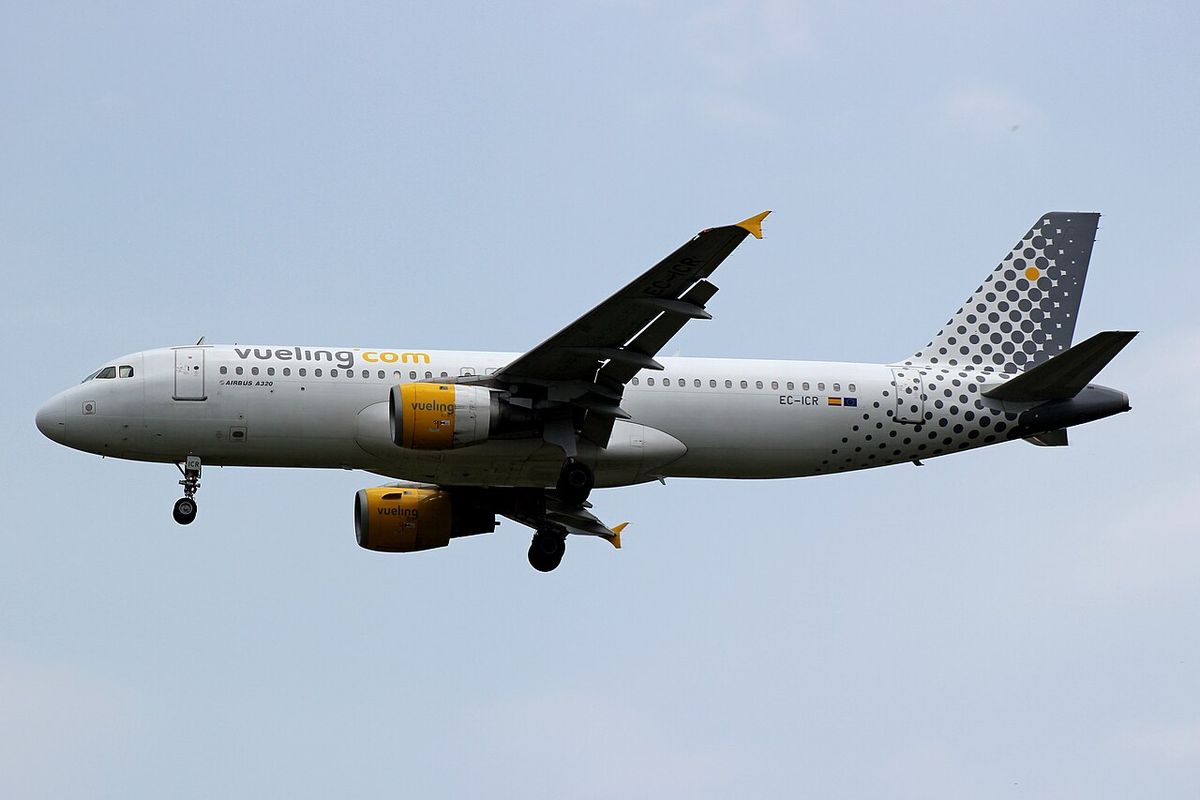
As at 25 August 2026 Vueling had no pilot vacancy open on its own careers site and the FTEJerez MAPS cadet route was closed to applications, with only an expression-of-interest talent pool live — recruitment status changes constantly, so check our airline pilot jobs tracker for the current position.
About Vueling
Vueling flies an all-Airbus single-aisle fleet — A319, A320 family and A321. Vueling's own fleet page returned an HTTP 403 on 25 August 2026, so no aircraft list here comes from an airline-owned page. Third-party trackers also report A320neo and A321neo variants. Counts and sub-types are unconfirmed — do not quote a fleet number.
One type rating covers the lot — good news and a small trap. Your technical prep is narrow, so go deep rather than wide; but an A319 and an A321 do not behave alike, and an interviewer may well ask — there is a question on exactly that below.
Barcelona-El Prat is the main base and the only one corroborated from Vueling's own domain — and the closed First Officer advert gave its location as Viladecans-Barcelona, the head office, not an operating base. Third parties list Bilbao, Málaga, Palma de Mallorca, Seville, Valencia, Alicante, Gran Canaria, Tenerife, Paris-Orly, Rome-Fiumicino and Florence, and separately call London-Gatwick, Amsterdam, Santiago de Compostela and Ibiza bases; Madrid, A Coruña and Asturias are reported closed. Treat every base list as indicative — Vueling does not publish where an applicant would be based.
Published entry requirements
Everything below is quoted from the First Officer A320 - 2026 vacancy on Vueling's own careers site — the direct-entry route. It is one of two documented entry routes: the other is the Vueling MAPS cadet scheme with FTEJerez (MPL syllabus including the A320 type rating), whose official page stated on 25 August 2026 that it "will return, but is currently closed for applications". No direct-entry Captain vacancy was found on Vueling's careers site or anywhere else in this research — that is an absence of evidence, not a Vueling policy.
The direct-entry advert is closed — as at 25 August 2026 the page returned "This position is no longer active" — so read it as the most recent standard Vueling published, not as live criteria. The archived original could not be re-read on 25 August 2026; wording was corroborated only via third-party mirrors.
| Item | What Vueling published |
|---|---|
| Licence | ATPL, frozen or unfrozen. You must "be a First Officer with a Spanish EASA licence" — required before the Operator Conversion Course, not at application. |
| Total hours | No total-time minimum is published. The only figure given is "200 Factorized Vueling Hours" — see below. |
| Hours on type | Not published. Experience on the A320, A330 or A340 "will be an advantage". |
| Type rating | Not published. Non-type-rated candidates accepted; the advert mentions only an Operator Conversion Course after joining, and never says who pays. |
| Medical | Class 1 medical certificate. |
| English | ICAO Level 4 or higher, before the Operator Conversion Course begins. |
| Right to work | Not published. No nationality or visa policy is stated; the practical gate is the Spanish licence. |
| Age | Not published. Vueling publishes no minimum or maximum age. |
The hours line needs its own paragraph. "200 Factorized Vueling Hours" is not the same statement as "200 hours total time." Vueling defines neither "factorized" nor "Vueling hours". Read literally it points at hours flown at Vueling under an hour-factoring formula, not raw logbook time. Third-party sites contradict each other — one says 300 factored hours, another 200 — reason enough to distrust them all.
Note too that the licence line asks you to already be a First Officer while accepting a frozen ATPL. It never reconciles the two.
The selection process
The honest position is more useful than a confident-sounding list: Vueling does not publish its pilot selection process. The First Officer A320 vacancy set out eligibility requirements and nothing else — no stages, no order, no formats, no test providers. An article telling you Vueling runs "four stages" is reporting something the airline has never said.
What Vueling does publish about what follows selection:
- An Operator Conversion Course (OCC) follows selection.
- A Spanish EASA licence must be held before the OCC starts.
- ICAO English Level 4 or higher must be held before the OCC starts.
Both are pre-OCC deadlines, not application deadlines. What Vueling does not say is whether it will take an application with a state-of-licence transfer still in progress — do not assume it will.
Reported by third parties, not published by Vueling. The stages below appear on pilot-jobs sites and training-provider pages, and on no Vueling-owned page. Prepare for them — they are plausible and cost little — but do not treat them as confirmed:
- Aircraft general knowledge and operational procedures test
- English written and listening assessment
- Psychometric testing
- Personal interview with a role-play exercise
- Simulator assessment
No source gives a pass rate, a stage count, an assessment centre location or a test provider's name. Your invitation letter is the only authority. For the shape of European selection generally, see our interview prep guide.
The simulator assessment
The simulator assessment is itself a third-party report, not a published Vueling stage, and no device type, duration or location is published. What follows is not "the Vueling sim profile" — it is what an A320 line captain assesses in any European check.
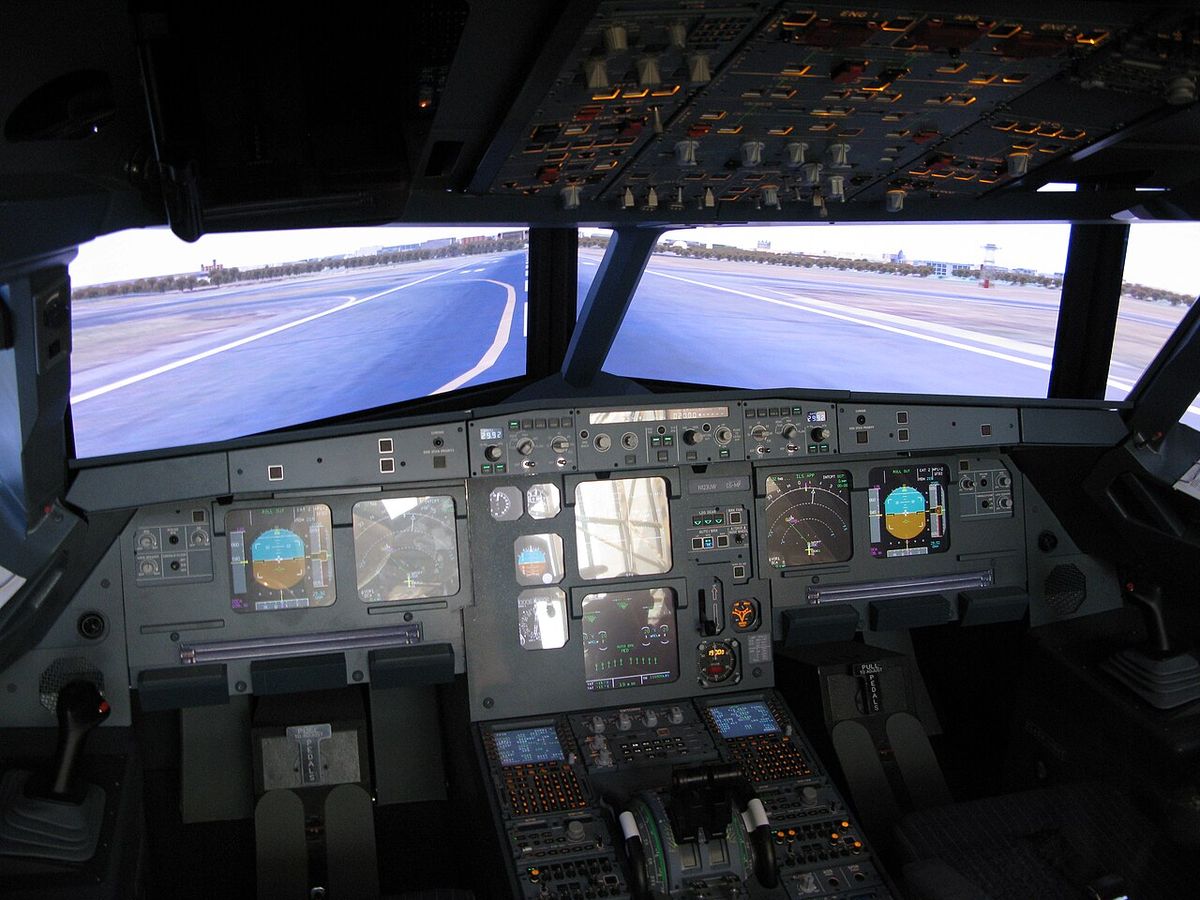
The captain behind you is answering one question: would I be comfortable with this person in the right-hand seat on a bad day?
- Instrument scan. Raw data, no flight director, straight and level without wandering. Scan breakdown under workload is a common failure, and it usually shows before the handling does.
- Manual handling. Pitch, power, trim — anticipated, not chased. Over-controlling under observation is the classic tell, and trim discipline is scored even when nobody mentions it.
- Standard calls. On time, in the standard words. Silence reads as task saturation or poor discipline, and the assessor cannot tell which.
- CRM. Brief out loud, state intentions, accept an input without defending your ego. A candidate who flies well and says nothing fails a check a weaker handler passes.
- Recovery from an unstable approach. The point is not to salvage it — it is to recognise it against your stabilisation criteria and go around early and cleanly.
Practise on whatever honest device you can reach. Drill a raw-data departure, level-offs at assigned altitudes, a hand-flown ILS to minima, a low go-around, and one abnormal that makes you talk while flying.
Technical questions, with answers
Everything below is A320-family — the type every third-party tracker reports Vueling operating, though no Vueling-owned page confirms the fleet. Each answer is short enough to say out loud in about a minute.
Walk me through the hydraulic systems and tell me what the PTU does.
Three independent circuits at 3,000 psi — Green, Yellow and Blue. Green is driven by an engine-driven pump on engine 1; Yellow by an EDP on engine 2, plus an electric pump and a cargo-door hand pump; Blue by an electric pump, with the RAT as its emergency source. The PTU lets Green and Yellow drive one another mechanically — it transfers power, not fluid, so the circuits stay separate — and arms when differential pressure exceeds about 500 psi. It is inhibited during the first engine start and during cargo door operation, and whenever the PTU pushbutton is off or the yellow reservoir level is low. FCOM ATA 29. Depth in our A320 hydraulic system guide.
What are the flight control laws, and what moves you between them?
Normal Law gives load factor demand in pitch, roll rate demand with automatic turn coordination, and the full protections — high speed, high angle of attack, pitch attitude and bank angle. Losing enough redundancy — combinations of air data references, flight control computers or hydraulics — degrades you to Alternate Law: still load factor demand in pitch, and load factor protection is retained — but roll reverts to direct, and the high angle of attack, pitch attitude and bank angle protections give way to low-speed and high-speed stability. Gear down for landing then usually gives Direct Law, stick to surface. Mechanical backup always remains: pitch trim wheel and rudder. FCOM ATA 27 and FCTM. See our flight control laws guide.
What is a FLEX takeoff, and when may you not use one?
FLEX is reduced-thrust takeoff by the assumed temperature method: you enter a temperature higher than actual OAT and the FADEC delivers the thrust available at that temperature. It is certifiable because real performance in the real conditions still meets every requirement — you are not spending margin you do not need, which buys engine life. FLEX is not permitted on a contaminated runway, or where a procedure or MEL item prohibits it; those are hard limits. A TOGA requirement where windshear is expected is operator policy, so quote it as such. The flex temperature must be above actual OAT — our FLEX guide gives at least OAT+5°C, with a ceiling of ISA+53°C — and the reduction may not exceed 25% of full rated takeoff thrust. FCOM and FCTM performance. See our FLEX takeoff guide.
Engine failure at V1 — what happens in the next 400 feet?
At or after V1 you are going. Keep straight with rudder and rotate at VR smoothly, at a slower rate than an all-engines takeoff — about 2 degrees per second — towards roughly 12.5 degrees of pitch. Fly the SRS command — with an engine out it targets V2, or the speed at failure if that is higher, up to V2+15 — until clean. Gear up on a positive rate. Below 400 feet AGL there is no ECAM and no troubleshooting — memory items apart: fly the aeroplane, silence the warning, confirm the flight path. At 400 feet you call for ECAM actions; at engine-out acceleration altitude you accelerate, clean up on schedule and set maximum continuous thrust. The certification framing: V1 is never below VMCG, V2 not below 1.13 VSR nor 1.1 VMCA, and raising V1 trades stopping margin for going margin. FCTM and EASA CS-25. See our engine failure at V1 guide and V-speeds guide.
What powers the aeroplane electrically, and what survives in emergency configuration?
Each engine drives an integrated drive generator feeding its own side of the 115 V AC network, with a bus tie contactor letting one generator supply both sides. The APU generator can replace either, and external power feeds the aircraft on stand. Lose both IDGs and the APU generator and the RAT deploys automatically above roughly 100 knots, driving the emergency generator through the Blue system. You then keep the AC and DC essential buses, both batteries, the captain's displays, standby instruments, one VHF and one transponder. FCOM ATA 24. See our electrical system guide.
What does ECAM actually do for you, and where does it stop?
ECAM presents what the aeroplane has detected, in priority order: failure title, required actions, then the consequences — INOP SYS and STATUS — once the drill is complete. What it does not do is think. It has no picture of your fuel state, the destination weather, the runway ahead or any failure its sensors cannot see, and it will run a drill while the real problem is elsewhere. Read it, do it, then step back and decide. It is also why memory items exist: ECAM is too slow for them. FCTM abnormal procedures. See our ECAM practical guide.
Which drills are memory items, and why is the list so short?
On the A320 family the immediate actions are those where reading is slower than the threat: loss of braking, unreliable airspeed, stall recovery, EGPWS and windshear escape manoeuvres, emergency descent initiation and the TCAS RA response. Then say out loud that the exact list is set by your operator's QRH, so you learn the one you are handed — our memory items guide walks through the same set. Vueling's own QRH is not published. Terrain, an aerodynamic limit and a converging aircraft do not wait while you find a page; everything else is deliberately not a memory item, because a checklist read properly beats one recalled badly. Give the list crisply, then give that reason — the reason is what is scored. QRH and FCTM.
You fly the A319, A320 and A321 on one rating. What actually changes?
Commonality is the point — same rating, same laws, same philosophy. What changes is geometry and mass. The A321 is substantially longer, so tail strike margin at rotation is smaller, and the FCTM rotation technique and pitch limits reflect that; the A319 is lighter and more eager in pitch. Higher A321 weights mean higher speeds, longer field lengths and different flap and thrust choices, and neo variants differ from ceo in engines and some anti-ice logic. Fly the FCOM for the sub-type in front of you. See our performance calculation guide.
HR and motivation questions
Vueling publishes nothing about its interview format, so prepare content rather than choreography. Bring one real example per competency — situation, task, action, result — weighted on what you personally did and what changed afterwards. Ninety seconds each. A story that ends at "and then I told him" is not finished.
- A time you disagreed with a captain or instructor — and how it ended.
- A decision made with incomplete information, and what you did about the gap.
- A mistake of your own, what it cost, and what you changed permanently.
- A time you had to raise a safety concern to someone senior.
On motivation, build only on what is known about this operator — a panel notices invented detail faster than a thin answer. Three themes the record supports:
- Single-fleet flying on one aircraft family. Vueling publishes nothing about sector counts, seasonality or rosters, so talk about why a single-type operation suits you — procedural depth, recency, consolidation — not about a roster no source describes.
- The Spanish EASA licence. If your licence sits in another member state, know how a state-of-licence transfer works and where you are in it. It bites before the Operator Conversion Course, not at application.
- Barcelona. The main base is Barcelona-El Prat, and Vueling does not publish base assignment. "I am completely flexible" is weaker than a real answer about where you would go and why you can sustain it.
Expect scenarios too — a destination below minima, a captain continuing an unstable approach, smoke in cruise. The structure is the answer: assess, generate options, evaluate against fuel and time, decide, communicate, review. See our top 50 A320 interview questions.
Common mistakes
- Quoting an hours minimum Vueling has never published. Repeating "200 hours" as total time misreads "200 Factorized Vueling Hours" — say what is published and that it needs clarifying.
- Believing an aggregator over the airline. As at 25 August 2026 pilot-jobs sites were still presenting the closed First Officer A320 - 2026 call — which ran around October 2025 — as open; check Vueling's own careers page and our airline pilot jobs tracker first.
- Presenting the third-party stages as fact. Prepare for them quietly — describing "the four stages" to a panel that never published four is a poor opening.
- Leaving the Spanish licence question late. A state-of-licence transfer takes real time — understand it before you need it, not after an offer.
- Preparing only the A320. Third-party trackers report A319, A320, A320neo, A321 and A321neo, and no Vueling-owned page confirms any of it — prepare the family, not the middle of it.
- Flying the sim silently. Excellent handling with no calls and no briefing scores as failed CRM — talk while you fly.
- Salvaging an unstable approach. The assessor wants an early, clean go-around against stated criteria, not proof you can rescue it.
Practice the technical bank
v1prep covers 9,600+ A320 and ATPL questions — drill them until your answers are reflexive in both languages.
Practice the full bank →