Takeoff Mass Limitations
Take-off mass limitations are the limits on an aeroplane's mass at the start of the take-off run: the structural maximum and the performance limits set by runway length, climb gradient, obstacles, brake energy, tyre speed and pavement strength. The lowest of them governs each departure.
An airliner's structural maximum take-off mass is only a ceiling. On any given day the runway, the temperature, the pressure altitude, the wind and the terrain around the aerodrome may allow less. Before each departure the crew, or the performance software, works out the highest mass at which every take-off requirement can be met, and the aeroplane may not start its take-off run heavier than that.
The requirements are independent of one another, and each produces its own limiting mass. Which one binds changes from day to day and runway to runway: a short runway is usually field-limited, a hot and high aerodrome climb-limited, a valley departure obstacle-limited. The rules below are those of Performance Class A, which covers all multi-engined jets and the multi-engined turboprops with more than nine passenger seats or a maximum take-off mass above 5,700 kg, under CS-25 and Part-CAT in Europe and 14 CFR Parts 25 and 121 in the United States.
Performance-limited take-off mass
For a Class A aeroplane the maximum permissible take-off mass is the lowest of seven limits:
| Limit | Requirement | Tends to bind with |
|---|---|---|
| Field length | TORR, TODR and ASDR fit TORA, TODA and ASDA | Short, wet or contaminated runway, tailwind |
| Climb | One-engine-inoperative gradients in every segment | Hot or high aerodrome |
| Obstacle | Net flight path clears obstacles by the required margin | Terrain or buildings in the departure path |
| Brake energy | V1 no higher than VMBE | Heavy mass, hot and high, tailwind |
| Tyre speed | Lift-off ground speed within the tyre rating | Hot and high, tailwind |
| Runway strength | Aircraft classification within pavement strength | Weak pavement |
| Structural | Maximum take-off mass (MTOM) | Long runway, cool day |
The lowest of the six performance limits is the performance-limited take-off mass. The lower of that and the structural MTOM is the regulated take-off mass (RTOM, or RTOW in weight-based texts). The load sheet then takes the lowest of three figures as the maximum for the flight: the regulated take-off mass, the landing mass limit plus the trip fuel, and the maximum zero fuel mass plus the take-off fuel (see maximum structural and regulated masses).
Field length limit
The field-limited mass is the highest mass at which the take-off run, take-off distance and accelerate-stop distance required all fit within the declared distances, at the chosen V1. It falls with a shorter runway, a tailwind, a higher pressure altitude or temperature, and a wet or contaminated surface, which lengthens the stop and forces a lower V1. An upslope lengthens the continued take-off and a downslope the stop; flight manual data typically cover slopes from −2 to +2 per cent. The distances themselves are explained in take-off distances and field length.
A stopway or clearway raises the field limit by allowing an unbalanced V1, and an inoperative anti-skid system lowers it, because the flight manual then penalises the accelerate-stop distance heavily.
Climb limit and MAT limit
The climb-limited mass is the highest mass at which the aeroplane, with one engine inoperative, meets the minimum gross gradient of every take-off climb segment. In practice the second segment, flown at V2 with the landing gear up and take-off flap still set, is usually the one that binds. Its minimum gradient is 2.4 per cent for a twin, 2.7 per cent for a three-engined and 3.0 per cent for a four-engined aeroplane (see take-off climb segments).
The climb gradient is roughly the excess of thrust over drag divided by the weight, (T − D) ÷ W. A heavier aeroplane climbs less steeply both because the weight is larger and because its V2, and the drag at V2, are higher. Engine thrust falls as air density falls, so a hot day or a high aerodrome removes thrust while the requirement stays the same. That is why the climb limit dominates at places such as Denver in summer, and why it does not depend on runway length at all.
Flight manuals present this limit as a chart of maximum take-off mass against aerodrome pressure altitude and temperature for each flap setting: the mass-altitude-temperature (MAT) limit, also called the WAT limit (weight-altitude-temperature). The gradients are measured through the air, so wind does not enter the climb limit. A headwind steepens the path over the ground, which helps with obstacles, not with the climb requirement itself. Approach and landing climb gradients set an equivalent limit on the landing mass.
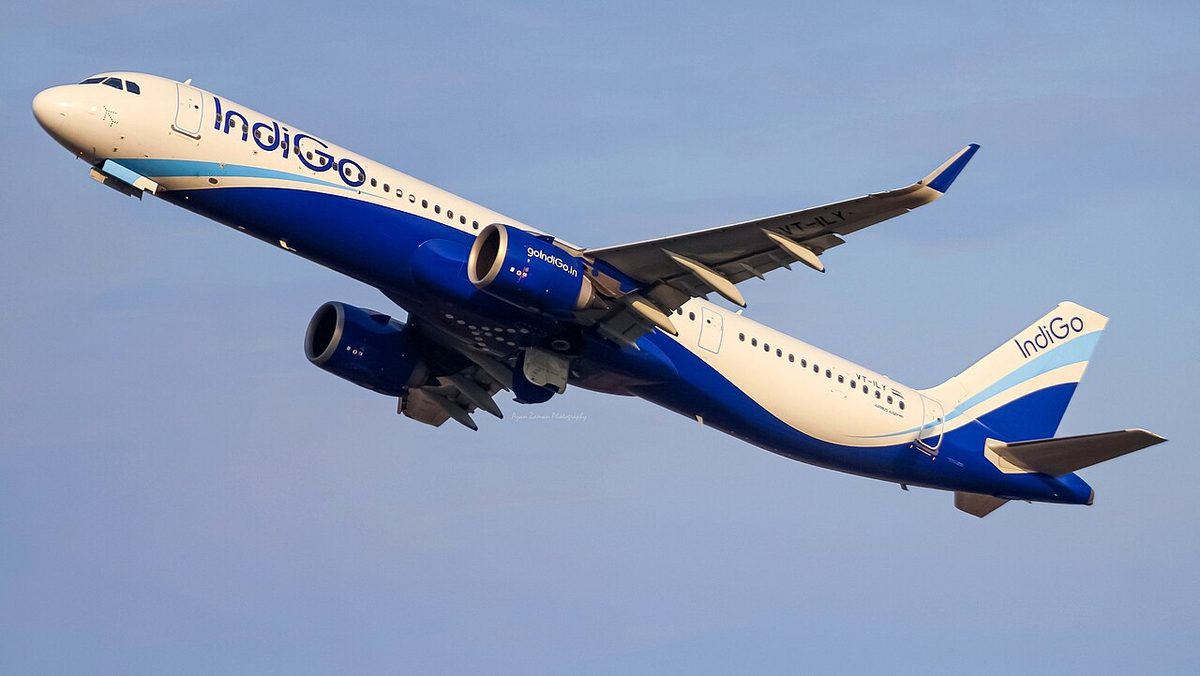
Obstacle limit
The obstacle-limited mass is the highest mass at which the net take-off flight path, the gross path reduced by a fixed gradient margin, clears every obstacle in the area that must be considered by at least 35 ft, or 50 ft where the aeroplane is banked by more than 15°. A close, tall obstacle or rising terrain under the departure track can make it the most restrictive limit of all, regardless of runway length. Operators relieve it with engine-out procedures that turn away from high ground, with a higher acceleration height, or with a lower flap setting. The method is described in take-off flight path and obstacle clearance.
Brake energy, tyre speed and runway strength
Three further limits come from the hardware. The energy a rejected take-off puts into the brakes grows with the mass and with the square of the ground speed at which braking begins. A hot, high aerodrome raises the true airspeed for the same indicated speeds, and a tailwind adds to the ground speed, so a heavy take-off can reach the certified brake energy before the runway limits V1. If V1 would exceed the maximum brake energy speed VMBE, the mass must come down.
Tyres are rated for a maximum ground speed: 195.5 kt, or 225 mph, on most of the A320 family. At a hot, high aerodrome the true airspeed at lift-off is well above the indicated value, and a tailwind adds directly to the ground speed, so the lift-off speed can reach the tyre limit. A higher flap setting, which lowers the lift-off speed, can relieve it (see brake energy and tyre speed limits).
Finally, the aircraft classification rating (ACR) at the take-off mass must not exceed the pavement classification rating (PCR) published for the runway. The ACR-PCR method replaced ACN-PCN on 28 November 2024 (see aerodrome physical characteristics).
RTOW charts and airport analysis
Working through every limit by hand for each departure would be impractical. Operators therefore carry out an airport analysis, or runway analysis: performance engineers, or a specialist provider, combine the flight manual data with each runway's declared distances, slope and surveyed obstacles to find the maximum mass for each runway and flap setting. Crews use the result either as RTOW charts, regulated take-off weight tables, or through the electronic flight bag.
On paper or on screen, the analysis takes the runway and its obstacles, the temperature and pressure, the wind and the runway condition, and returns the maximum mass together with the take-off speeds to use. The Airbus take-off application on the electronic flight bag computes the maximum take-off mass, the take-off speeds and the flexible temperature directly from the aircraft configuration and the runway, obstacle and weather inputs.
An illustrative twin-jet with a structural MTOM of 77,000 kg, on a hot afternoon, might give these limits:
| Limit | Mass |
|---|---|
| Field length | 79,200 kg |
| Climb (second segment) | 74,600 kg |
| Obstacle | 76,100 kg |
| Brake energy and tyre speed | above 80,000 kg |
| Structural | 77,000 kg |
The regulated take-off mass is 74,600 kg, climb-limited. If the actual mass is 71,000 kg, the unused margin of 3,600 kg can be taken as a reduced-thrust take-off instead (see reduced and derated take-off thrust).
Optimum flap setting
Most jets have several certified take-off flap settings, such as CONF 1+F, 2 and 3 on the A320 or flaps 1 to 25 on the 737. More flap raises the maximum lift coefficient, which lowers VR, VLOF and V2 and shortens the take-off distance, so the field-limited mass rises. It also adds drag at climb speed, which lowers the climb gradient, so the climb- and obstacle-limited masses fall.
The optimum take-off flap setting is the one that gives the highest regulated mass for the conditions, usually near the point where the rising field limit meets the falling climb limit. A short runway at sea level calls for more flap; a long runway at a hot or high aerodrome, or a distant obstacle, calls for less. Flap also affects the tyre speed limit, since more flap lowers the lift-off speed. Performance software normally optimises the flap and speeds together. Whatever is chosen, the flap actually set must match the computed one, because a mismatch invalidates every speed on the take-off data card.
Improved climb and increased V2
The minimum V2 is set by stall and control margins at low speed, where induced drag is high and the aeroplane climbs less steeply than it could. When the climb limit is lower than the field limit, a long runway allows an improved climb take-off, also called the increased V2 procedure. The aeroplane accelerates further on the runway to a higher V2, with correspondingly higher V1 and VR, and climbs closer to its best one-engine-inoperative gradient speed. The climb-limited mass rises, paid for with runway length.
The flight manual or RTOW chart gives the mass increment and the speed increments. Brake energy and tyre speed limits cap the gain, and EASA exam texts treat the procedure as incompatible with reduced thrust, because both use up the same margin. For the crew the technique is invisible apart from higher numbers on the take-off data card.
Increased V2 should not be confused with the speeds flown after lift-off. With all engines operating, the Airbus take-off guidance targets V2 + 10 kt; after an engine failure it holds V2 or the speed at the failure, up to V2 + 15 kt. Boeing limits the bank angle on the 737 to 15° until V2 + 15 kt.
Packs-off take-off
Bleed air taken from the compressor for the air conditioning packs and for engine or wing anti-ice reduces the thrust available. Take-off data are therefore computed for the bleed configuration: packs on or off, anti-ice on or off. A packs-off take-off recovers that thrust and raises the climb- and field-limited masses, at the cost of briefly interrupting the cabin air supply.
On the A320, selecting the packs off, or supplying them from the APU bleed, improves performance when TOGA thrust is used and lowers the take-off exhaust gas temperature with FLEX thrust. The APU bleed may not be used if wing anti-ice is needed. The packs are reselected only once the thrust has been reduced, since selecting them earlier would raise the EGT, with pack 2 following pack 1 by at least 10 seconds for passenger comfort. With one pack inoperative, the take-off N1 is limited to the bleed-on value and the performance must be computed accordingly. In icing conditions engine anti-ice is on for take-off, and the calculation must include it.
Take-off data cross-checks
The limits only protect the aeroplane if the right numbers go into the calculation. Studies of take-off data errors have repeatedly found wrong masses and wrong runways entered. On 20 March 2009 an Airbus A340-500 at Melbourne struck its tail and overran the runway after a take-off weight nearly 100 tonnes below the actual figure was entered into the electronic flight bag, which produced speeds far too low for the aeroplane.
Operators therefore require independent calculation or cross-checking by both pilots, and a gross error check of the result against the aeroplane's actual mass. On the A320 the cross-check covers the runway identifier, the take-off shift, V1, VR and V2, green dot speed, the take-off thrust (TOGA, FLEX or derated), the flap setting, the stabiliser trim, the packs, the anti-ice and the engine-out acceleration altitude. Green dot speed depends on the gross weight entered, so checking it indirectly confirms that the weight is consistent. A change of runway or intersection means the calculation must be redone and cross-checked again, not adjusted.
Frequently asked questions
What is the regulated take-off mass?
The regulated take-off mass, often called RTOW, is the lower of the structural maximum take-off mass and the performance-limited take-off mass for the runway and conditions of the day. The performance limit is itself the lowest of the field length, climb, obstacle, brake energy, tyre speed and runway strength limits. The actual mass at the start of the take-off run must not exceed it.
What is the difference between the field-limited and climb-limited take-off mass?
The field-limited mass is the highest mass at which the take-off run, take-off distance and accelerate-stop distance required all fit the declared distances. The climb-limited mass is the highest mass at which the one-engine-inoperative climb gradients can be met, usually the 2.4 per cent second segment gradient for a twin. The first depends on runway length; the second depends on altitude, temperature and configuration but not on the runway.
What is a WAT or MAT limit?
WAT stands for weight, altitude and temperature, and MAT for mass, altitude and temperature. It is the climb-limited take-off mass presented as a function of aerodrome pressure altitude and air temperature for each flap setting. Thin, warm air reduces engine thrust, so the mass at which the minimum climb gradients can still be achieved falls as the aerodrome gets higher or hotter.
How does the take-off flap setting affect the maximum take-off mass?
More flap raises the maximum lift coefficient, lowering the take-off speeds and shortening the take-off distance, so the field-limited mass rises. It also adds drag, reducing the climb gradient, so the climb- and obstacle-limited masses fall. The optimum flap setting is the one that gives the highest regulated mass for the conditions; performance software normally selects it.
What is an improved climb take-off?
When the climb limit is lower than the field limit, a long runway lets the aeroplane accelerate to a higher V2, with higher V1 and VR. At the higher V2 it climbs closer to its best one-engine-inoperative gradient speed, so the climb-limited mass increases. The gain is paid for with runway length and capped by brake energy and tyre speed limits, and EASA exam texts do not allow it to be combined with reduced thrust.
Test yourself on Takeoff Mass Limitations
The v1prep banks cover this topic in Performance (032), with a worked explanation for every answer. EASA ATPL, PPL, IR and CPL, the FAA written tests and A320/B737 type ratings.
Start practising →Sources and further reading
- EASA, Easy Access Rules for Air Operations (CAT.POL.A.205 and CAT.POL.A.210)
- EASA, Easy Access Rules for Large Aeroplanes (CS-25)
- 14 CFR 25.121, Climb, one-engine-inoperative
- 14 CFR 121.189, Airplanes, turbine engine powered, takeoff limitations
- ATSB AO-2009-012, Tailstrike and runway overrun, Airbus A340-541 A6-ERG, Melbourne
Library articles are written for study and exam preparation. They do not replace your aircraft's approved documentation, your operator's procedures or the regulations themselves.