Radiotelephony Call Signs
A radiotelephony call sign is the spoken identification of a station on the aeronautical radio. An aircraft uses its registration, or its operator's telephony designator with a flight number or registration letters; a ground station uses the name of its location followed by a suffix showing the service it provides.
A call sign is the name a station uses on the aeronautical radio. A call opens with the call sign of the station addressed, and every readback ends with the aircraft's call sign, because the controller must know which aircraft has accepted a clearance. Two families exist: aircraft call signs, built from registrations and operators' designators, and the call signs of ground stations, built from a place name and a suffix that says what kind of service is on the other end.
ICAO Annex 10, Volume II, defines the forms and the rules for shortening them; the operators' designators are listed in ICAO Doc 8585, and the four-letter location indicators, which identify aerodromes and units in writing rather than by voice, in Doc 7910. The rules are much the same everywhere, and exam questions on them appear from PPL communications to ATPL.
Aircraft call sign types
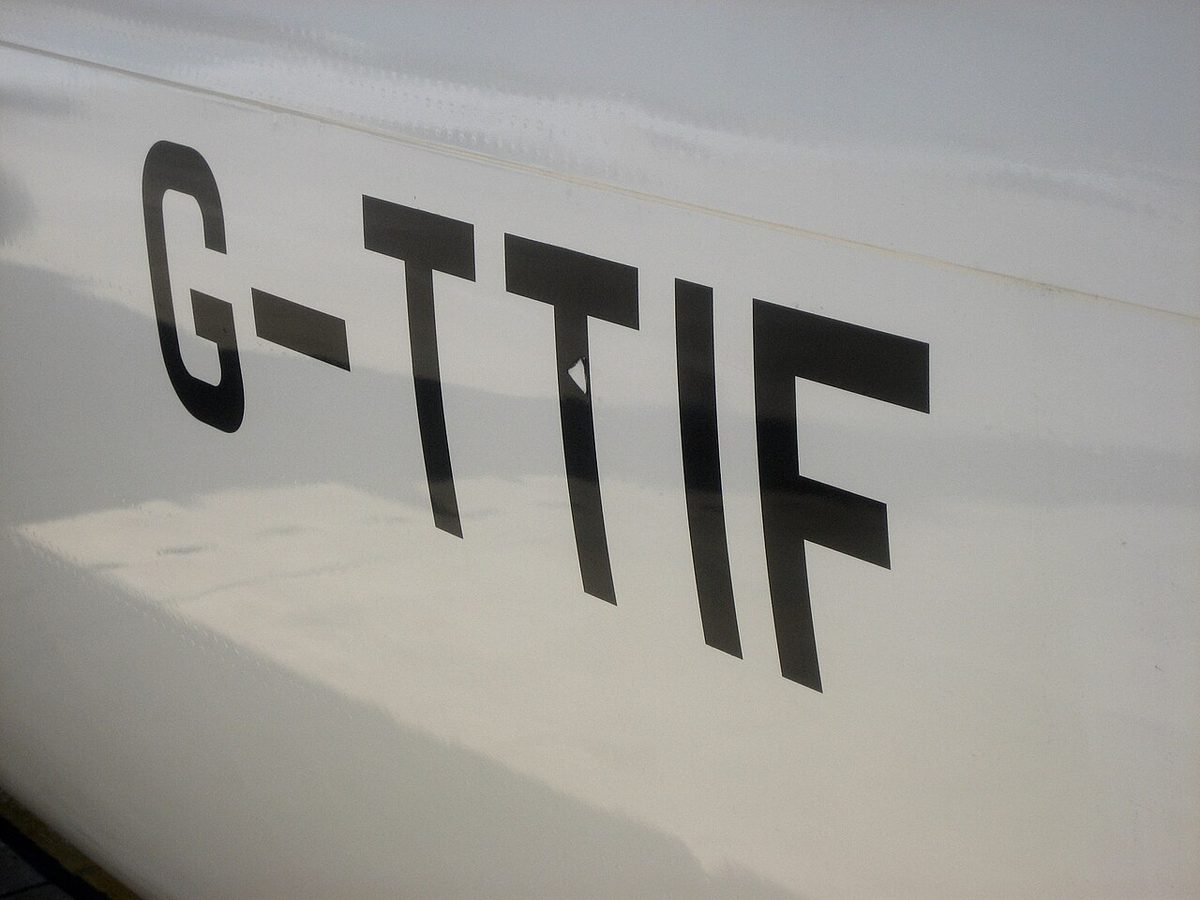
Every aircraft carries nationality and registration marks. The nationality mark, such as G for the United Kingdom, comes from the series of radio call signs that the ITU allocates to the State of Registry; the State then assigns the registration mark, separated from it by a hyphen when it begins with a letter. Combinations that could be confused with distress, urgency or safety signals, such as SOS, PAN, XXX and TTT, or with Q codes, are not allowed.
From these marks and from the operator's designator ICAO builds three types of call sign, known as aircraft call sign types (Type A, B, C):
| Type | Built from | Full example | Abbreviated |
|---|---|---|---|
| A | The registration marking, which may be preceded by the manufacturer's name or aircraft model | G-ABCD; CHEROKEE XY-ABC | G-CD; CHEROKEE BC or CHEROKEE ABC |
| B | The operator's telephony designator and the last four characters of the registration | (designator) ABCD | (designator) CD |
| C | The operator's telephony designator and the flight identification | SCANDINAVIAN 937 | No abbreviated form |
Type A is typical of private and general aviation flights, while airlines normally use Type C, the telephony designator followed by the flight number, spoken digit by digit like every number in a call sign: SCANDINAVIAN NINER TREE SEVEN.
Aircraft of the heavy wake turbulence category, with a maximum certificated take-off mass of 136,000 kg or more, add the word HEAVY after the call sign in the initial call to each ATS unit. The FAA's heavy category is based on a take-off weight capability of 300,000 lb or more, and the Airbus A380 and Antonov An-225 use SUPER. See wake turbulence.
Telephony designators
An operator receives two designators through ICAO, both published in Doc 8585: a three-letter designator, used in flight plans, in air traffic service messages and in the aircraft identification that ATC systems display, and a telephony designator, the word spoken on the radio. The two can look quite unlike each other: British Airways files and displays as BAW, but speaks as SPEEDBIRD.
The difference matters in the cockpit. The aircraft identification entered in a Mode S transponder must match item 7 of the flight plan exactly, in its written form, for example BAW123, not the spoken form SPEEDBIRD ONE TWO THREE; the registration goes there only when the registration is the call sign. A wrong entry can leave the flight uncorrelated or mislabelled on the controller's display (see transponders and SSR).
Abbreviating call signs
Call sign abbreviation is allowed only when three conditions are met: satisfactory communication has been established, no confusion is likely, and the ground station has used the abbreviated form first. The pilot never shortens the call sign on their own initiative, because only the controller can see whether a similar call sign is on the frequency. On first contact with each new station the full call sign is used again.
The abbreviated forms are:
- Type A: the first character of the registration, or the manufacturer's name or model, followed by at least the last two characters. G-ABCD becomes G-CD, and CHEROKEE XY-ABC becomes CHEROKEE BC or CHEROKEE ABC.
- Type B: the telephony designator followed by at least the last two characters of the registration.
- Type C: none; the full call sign is always used.
A typical sequence runs like this. The pilot calls "(station) Approach, Golf Alfa Bravo Charlie Delta" and is answered with the full call sign. Later the controller transmits "Golf Charlie Delta, descend to altitude three thousand feet", and from then on the pilot may reply "Descend to altitude three thousand feet, Golf Charlie Delta". Had the controller kept using the full call sign, perhaps because a G-ABCE was also on the frequency, the pilot would have kept it too.
Ground stations shorten too: once satisfactory communication is established and no confusion is likely, the station's suffix may be omitted. A pilot unsure whether a message was meant for their aircraft asks, rather than acting on it. Every readback ends with the call sign, in full or in the abbreviated form now in use.
Changes of call sign
When two aircraft with the same or confusingly similar call signs are on the same frequency, the controller may instruct one of them to use another call sign for the time being:
- "CHANGE CALL SIGN TO (new call sign) [UNTIL FURTHER ADVISED]";
- "REVERT TO FLIGHT PLAN CALL SIGN (call sign)" when the risk has passed.
Only the ground station can order a change of call sign; an aircraft cannot rename itself. The change is temporary and is normally cancelled once the two aircraft are no longer on the same frequency.
Similar call signs are a persistent hazard: a crew accepts a clearance meant for another aircraft, and the error surfaces only when the aircraft moves. The defences are straightforward. Pilots listen carefully when a similar call sign is on the frequency, include their call sign in every readback so that the controller can hear who accepted the clearance, and question any instruction that seems to be meant for someone else. The FAA's AIM makes the same points for line up and wait operations on several runways: listen for similar call signs, acknowledge every instruction with the call sign and, if unsure whether a take-off clearance was meant for you, ask before starting the take-off roll.
In the United States a controller's reply establishes two-way communication for entry into Class C or D airspace only if it uses the aircraft's call sign: "(call sign), standby" does, "aircraft calling, standby" does not.

Ground station call sign suffixes
An aeronautical station's call sign is the name of its location followed by an ATS unit call sign suffix that shows the unit or type of service:
| Suffix | Unit or service |
|---|---|
| CONTROL | Area control centre |
| APPROACH | Approach control |
| RADAR | Radar, in general |
| TOWER | Aerodrome control |
| GROUND | Surface movement control |
| DELIVERY | Clearance delivery |
| APRON | Apron management |
| INFORMATION | Flight information service |
| RADIO | Aeronautical station |
| HOMER | Direction-finding station |
Examples are "Shannon Control", the call sign of the Shannon area control centre in the Shannon Oceanic Transition Area, "London Information" and "Paris Control". In the United States an air route traffic control centre is called "Center", as in "Memphis Center". Some States add further suffixes, which are listed in their AIPs.
The suffix tells the pilot what the station can and cannot do, which is why it matters even when the place name is familiar. Only air traffic control units, such as TOWER, GROUND, APPROACH and CONTROL, issue clearances and instructions. A station using INFORMATION or RADIO passes information and the decisions stay with the pilot; much of what a RADIO operator passes is traffic reported by other pilots. INFORMATION is used both by en-route flight information units and by an aerodrome flight information service, so the context shows which is meant. At busy aerodromes clearance delivery is split from ground control so that long route clearances do not block the taxi frequency. The structure of these units is described in air traffic control units.
ICAO location indicators
An ICAO location indicator is the four-letter code that identifies an aerodrome, or an ATS unit, in writing. The indicators are published in ICAO Doc 7910. The first two letters usually identify the State: EG for the United Kingdom, LF for France, ED for Germany, so EGLL is London Heathrow, LFPG Paris Charles de Gaulle and EDDM Munich. In the contiguous United States many indicators are a K followed by the three-letter identifier, as in KJFK.
Location indicators are not spoken as call signs; on the radio the station is called by its place name. They appear instead wherever text is exchanged:
- in the flight plan, where items 13 and 16 give the departure and destination aerodromes, with ZZZZ and the name in item 18 when an aerodrome has no indicator;
- at the head of METAR and TAF reports;
- as the logon address for CPDLC, where the crew enters the indicator of the ATS unit it wants to connect to.
They are also distinct from the three-letter airport codes that IATA assigns, such as JFK.
Exam tip: Type C call signs have no abbreviated form; only the ground station may initiate an abbreviation or a change of call sign; HEAVY is added on the initial call to each ATS unit.
Frequently asked questions
What are Type A, B and C call signs?
They are the three forms of aircraft call sign defined by ICAO. Type A is the registration marking, sometimes preceded by the manufacturer's name or aircraft model, such as G-ABCD. Type B is the operator's telephony designator followed by the last four characters of the registration. Type C is the telephony designator followed by the flight identification, such as SCANDINAVIAN 937, and is the form airlines normally use.
When can a pilot abbreviate the aircraft call sign?
Only after satisfactory communication has been established, when no confusion is likely, and only after the ground station has itself used the abbreviated form. A Type A call sign keeps the first character, or the manufacturer or model name, and at least the last two characters, so G-ABCD becomes G-CD. A Type B call sign keeps the telephony designator and at least the last two characters. A Type C call sign is never abbreviated.
What is a telephony designator?
It is the word an operator uses on the radio in place of its three-letter ICAO designator. Both are allocated through ICAO and listed in Doc 8585. The three-letter designator appears in the flight plan and in the Mode S aircraft identification, for example BAW123, while the telephony designator is what is spoken, in this case SPEEDBIRD ONE TWO THREE. The two forms must never be mixed up in the transponder entry.
What do the ATC call sign suffixes Tower, Ground and Approach mean?
The suffix after the location name shows which service the station provides. TOWER is aerodrome control, GROUND surface movement control, APPROACH approach control and CONTROL an area control centre. DELIVERY issues clearances, APRON manages the apron, RADAR is a radar unit, INFORMATION a flight information service and RADIO an aeronautical station. INFORMATION and RADIO pass information but do not issue clearances.
Why would ATC tell a pilot to change call sign?
When two aircraft with the same or confusingly similar call signs are on the same frequency, the controller may tell one of them to use another call sign for the time being, with CHANGE CALL SIGN TO followed by the new call sign, and later REVERT TO FLIGHT PLAN CALL SIGN. Only the ground station may order the change; an aircraft does not rename itself. The change is temporary and stays within that frequency.
Test yourself on Radiotelephony Call Signs
The v1prep banks cover this topic in Communications (090), with a worked explanation for every answer. EASA ATPL, PPL, IR and CPL, the FAA written tests and A320/B737 type ratings.
Start practising →Sources and further reading
- ICAO Annex 10, Aeronautical Telecommunications, Volume II, Communication Procedures including those with PANS status (ICAO Store)
- ICAO Doc 4444, Procedures for Air Navigation Services, Air Traffic Management (PANS-ATM), 16th edition, as published by Airservices Australia
- ICAO Doc 8585, Designators for Aircraft Operating Agencies, Aeronautical Authorities and Services (ICAO Store)
- ICAO Doc 7910, Location Indicators (ICAO Store)
- UK CAA, CAP 413 Radiotelephony Manual
- FAA Aeronautical Information Manual, Chapter 5 Section 2 (5-2-5, Line Up and Wait)
Library articles are written for study and exam preparation. They do not replace your aircraft's approved documentation, your operator's procedures or the regulations themselves.