Instrument Rating
The instrument rating (IR) is the rating added to a pilot licence that allows the holder to fly under instrument flight rules (IFR), in cloud and down to published approach minima. It is kept valid by an annual proficiency check under EASA rules and by recent instrument experience under FAA rules.
The instrument rating (IR) is the rating that allows a pilot to fly under instrument flight rules: to file IFR, enter cloud, fly airways and procedures under air traffic control, and descend on an instrument approach to the published minima. Without it a pilot is confined to visual flight rules and visual meteorological conditions, whatever the aircraft is equipped for (see VFR, IFR and meteorological conditions).
For a private pilot the IR is the rating that turns a fair-weather licence into a practical means of travel. For a professional pilot it is indispensable: the EASA ATPL(A) requires a multi-engine IR, commercial air transport is flown almost entirely under IFR, and an FAA commercial pilot without it may not carry passengers for hire beyond 50 NM or at night. EASA calls it the IR(A) for aeroplanes; the FAA speaks of the instrument rating (airplane).
Instrument rating privileges
ICAO Annex 1 states the principle: a licence does not permit its holder to act as pilot in command or co-pilot of an aeroplane under IFR unless the holder also holds a valid instrument rating appropriate to the aircraft category. The rating may be held with any licence from the PPL upwards.
Under Part-FCL the IR(A) gives the privilege to fly aeroplanes under IFR with a minimum decision height of 200 ft (60 m). Decision heights below 200 ft, as used on CAT II and CAT III approaches, are allowed only with an authorisation under the low-visibility operations rules of Part-SPA, which also call for specific crew training (see low-visibility operations). The rating brings two other consequences. Its holder must have demonstrated the ability to use English, and a PPL holder adding an IR must meet the Class 1 hearing (audiometry) standard. In return, an IR holder is exempt from the requirement for a night take-off and landing within 90 days before acting as pilot in command at night with passengers.
Under 14 CFR 61.3(e) an FAA pilot needs an instrument rating, or an ATP certificate, to act as pilot in command under IFR or in weather conditions less than the VFR minimums. Because all flight in Class A airspace must be IFR, the rating is also the key to Class A. A Special VFR clearance at night requires the pilot to meet the instrument requirements of Part 61 and the aircraft to be IFR-equipped, and a Part 135 airplane pilot in command needs an instrument rating even to fly VFR.
Warning: IFR is a set of flight rules, not a kind of weather. An IFR flight in clear skies still requires the rating, and a pilot whose IR has expired may fly the planned route only under VFR, complying with VMC minima and the airspace requirements.
Training and long cross-country
An applicant for the EASA IR(A) must hold at least a PPL(A), with night flying privileges if the IR will be used at night, or a CPL(A), and must have at least 50 hours of cross-country flight as pilot in command, of which at least 10 in aeroplanes. Training takes place at an approved training organisation (ATO). The applicant passes the IR theoretical examinations and a skill test with an examiner. Part of the flight instruction may be given in flight simulation training devices.
Under 14 CFR 61.65 an applicant for the FAA instrument rating (airplane) holds at least a private pilot certificate and must have logged:
- at least 50 hours of cross-country time as pilot in command, of which at least 10 in airplanes;
- a total of 40 hours of actual or simulated instrument time in the areas of operation, including at least 15 hours of instrument training with an authorised instructor;
- the instrument rating long cross-country: a flight under IFR, on an IFR flight plan, with an authorised instructor, covering at least 250 NM along airways or ATC-directed routing, with an instrument approach at each airport and three different kinds of approach using navigation systems, for example an ILS, a VOR approach and an RNAV (GPS) approach.
Part of the instrument time may be flown in approved simulators and training devices, within limits set by the training rules. The applicant then passes the instrument knowledge test and a practical test with an examiner (see knowledge tests and checkrides).
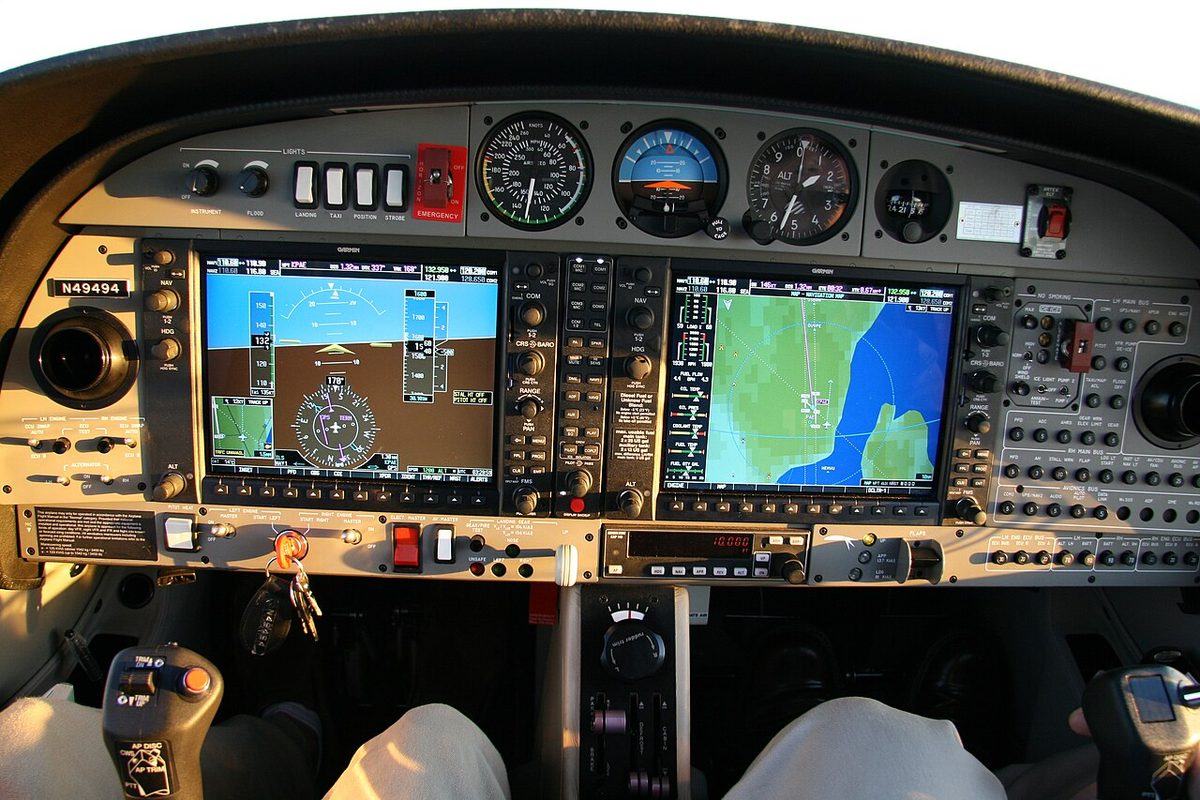
Multi-engine instrument rating
Under Part-FCL the IR(A) is tied to the kind of aeroplane in which it is held. A multi-engine instrument rating (ME IR) gives IR privileges on multi-engine aeroplanes, and the skill test for it is taken in a multi-engine aeroplane, including instrument flight with one engine inoperative (see asymmetric flight). A single-engine IR does not include them, and an aeroplane with centreline thrust counts as single-engine for the test.
The ME IR matters for a professional career because it is a prerequisite for the ATPL(A): the applicant must hold either an MPL, or a CPL(A) with a multi-engine IR and training in multi-crew cooperation. That is why many students build hours in single-engine aeroplanes and then take their instrument training on a light twin, finishing with the combination of CPL, ME IR and ATPL theory credit that airlines recruit from (see commercial and airline transport pilot licences).
The FAA does not split the instrument rating by number of engines in the same way: its instrument rating is issued for a category of aircraft, such as airplane, and the multi-engine privilege comes from the class rating (see class and type ratings).
Revalidation and renewal
The EASA IR(A) is valid for one year. It is revalidated by a proficiency check with an examiner, often combined with the proficiency check for a class or type rating. The timing follows the three-month rule:
- A check flown within the 3 months immediately before the expiry date keeps the anniversary: the new validity runs one year from the old expiry date.
- A check flown earlier still revalidates the rating, but the new year starts from the date of the check, so the remaining validity is lost.
- Once the expiry date has passed, the rating can no longer be revalidated. It must be renewed: refresher training at an ATO, to whatever extent is needed to restore the required standard, followed by a proficiency check.
- If the IR has not been revalidated or renewed within the preceding 7 years, the holder must pass the IR theoretical knowledge examination and the skill test again.
Exam tip: revalidation keeps a valid rating alive; renewal restores an expired one. An IR that expired last month needs renewal, not revalidation, and the rule pairs a training element with the check because instrument skills decay quickly.
FAA instrument currency
An FAA rating does not expire. Instead, 14 CFR 61.57(c) sets instrument currency, sometimes called instrument recency of experience: to act as pilot in command under IFR, or in weather below VFR minimums, the pilot must have performed and logged within the preceding 6 calendar months:
- at least six instrument approaches;
- holding procedures and tasks;
- intercepting and tracking courses through the use of navigational electronic systems.
The tasks may be flown in actual or simulated instrument conditions, in the aircraft with a safety pilot or instructor, or in a full flight simulator, flight training device or aviation training device representing the category of aircraft. Each approach logged for currency records its location and type and, where required, the name of the safety pilot (see flight time logging and recent experience).
Counting is by calendar months. A pilot whose last six approaches were logged on 3 March is current until 30 September. After that the pilot may not act as pilot in command under IFR, but during a further 6 calendar months, until 31 March of the next year, currency may be regained simply by flying the required tasks with a safety pilot, an instructor or in an approved device.
Under Part-FCL the annual proficiency check does this job instead. Commercial operators add their own requirements: a pilot flying single-pilot IFR in commercial air transport needs recent experience of 5 IFR flights, including 3 instrument approaches, in the single-pilot role in the preceding 90 days, or an IFR check.
Instrument proficiency check
A pilot who lets instrument currency lapse for more than those further 6 calendar months, 12 in all, may act as pilot in command under IFR again only after passing an instrument proficiency check (IPC) (61.57(d)). The IPC covers the areas of operation of the instrument rating Airman Certification Standards and may be given by an examiner, an authorised instrument instructor or a company check pilot, among others. Many pilots also fly an IPC voluntarily after a long break, because a pilot can be legally current and still rusty.
Note: currency is a legal minimum, not proficiency. The autopilot of a modern aeroplane does not replace a current pilot: after a failure in IMC the pilot is hand-flying on instruments, a skill that decays quickly without practice.
In European usage the term instrument proficiency check often simply names the annual IR proficiency check. Airline pilots are kept in practice by the operator's recurrent training and checking in the simulator, which includes instrument approaches and engine failures flown on instruments (see airline pilot training and checking).
Frequently asked questions
How long is an EASA instrument rating valid?
An IR(A) is valid for one year. It is revalidated by a proficiency check, and a check flown within the 3 months immediately before the expiry date keeps the anniversary, because the new year runs from the old expiry date. Once expired, the rating must be renewed through refresher training at an ATO and a proficiency check, and after 7 years without revalidation or renewal the IR theory examination and skill test must be passed again.
What are the FAA instrument currency requirements?
Under 14 CFR 61.57(c) a pilot acting as pilot in command under IFR must have performed and logged, within the preceding 6 calendar months, at least six instrument approaches, holding procedures and tasks, and intercepting and tracking courses with navigation systems. They may be flown in the aircraft, with a safety pilot in simulated conditions, or in a full flight simulator, flight training device or aviation training device.
What is an instrument proficiency check (IPC)?
In FAA usage it is a check of the tasks in the instrument rating Airman Certification Standards, given by an examiner, an authorised instrument instructor or a company check pilot, among others. A pilot who has not met the six-month instrument currency requirement for more than a further 6 calendar months, 12 in all, may act as pilot in command under IFR again only after passing one. In EASA usage the term often means the annual IR proficiency check.
What is the instrument rating long cross-country?
It is a flight required by 14 CFR 61.65 for the FAA instrument rating (airplane). It must be flown under IFR with an authorised instructor, cover at least 250 NM along airways or ATC-directed routing, include an instrument approach at each airport, and use three different kinds of approach with navigation systems, such as an ILS, a VOR approach and an RNAV (GPS) approach.
Can a pilot without an instrument rating fly IFR in good weather?
No. Under both ICAO Annex 1 and FAA rule 61.3(e), a pilot needs an instrument rating to act as pilot in command under IFR, whatever the weather. IFR is defined by the flight rules chosen, not by the conditions met, so a flight plan filed IFR in clear skies still needs the rating. A pilot whose EASA IR has expired may only fly the route under VFR, respecting VMC minima.
Test yourself on Instrument Rating
The v1prep banks cover this topic in Air Law (010), with a worked explanation for every answer. EASA ATPL, PPL, IR and CPL, the FAA written tests and A320/B737 type ratings.
Start practising →Sources and further reading
- EASA Easy Access Rules for Aircrew (Regulation (EU) No 1178/2011), FCL.600 to FCL.625 and Appendices 7 to 9
- ICAO Annex 1, Personnel Licensing
- 14 CFR 61.65, Instrument rating requirements
- 14 CFR 61.57, Recent flight experience, pilot in command
- 14 CFR 61.3, Requirement for certificates, ratings, and authorizations
- EASA Easy Access Rules for Air Operations (ORO.FC.202, single-pilot operations under IFR or at night)
- FAA Instrument Flying Handbook (FAA-H-8083-15B)
Library articles are written for study and exam preparation. They do not replace your aircraft's approved documentation, your operator's procedures or the regulations themselves.