B737 FMC and CDU
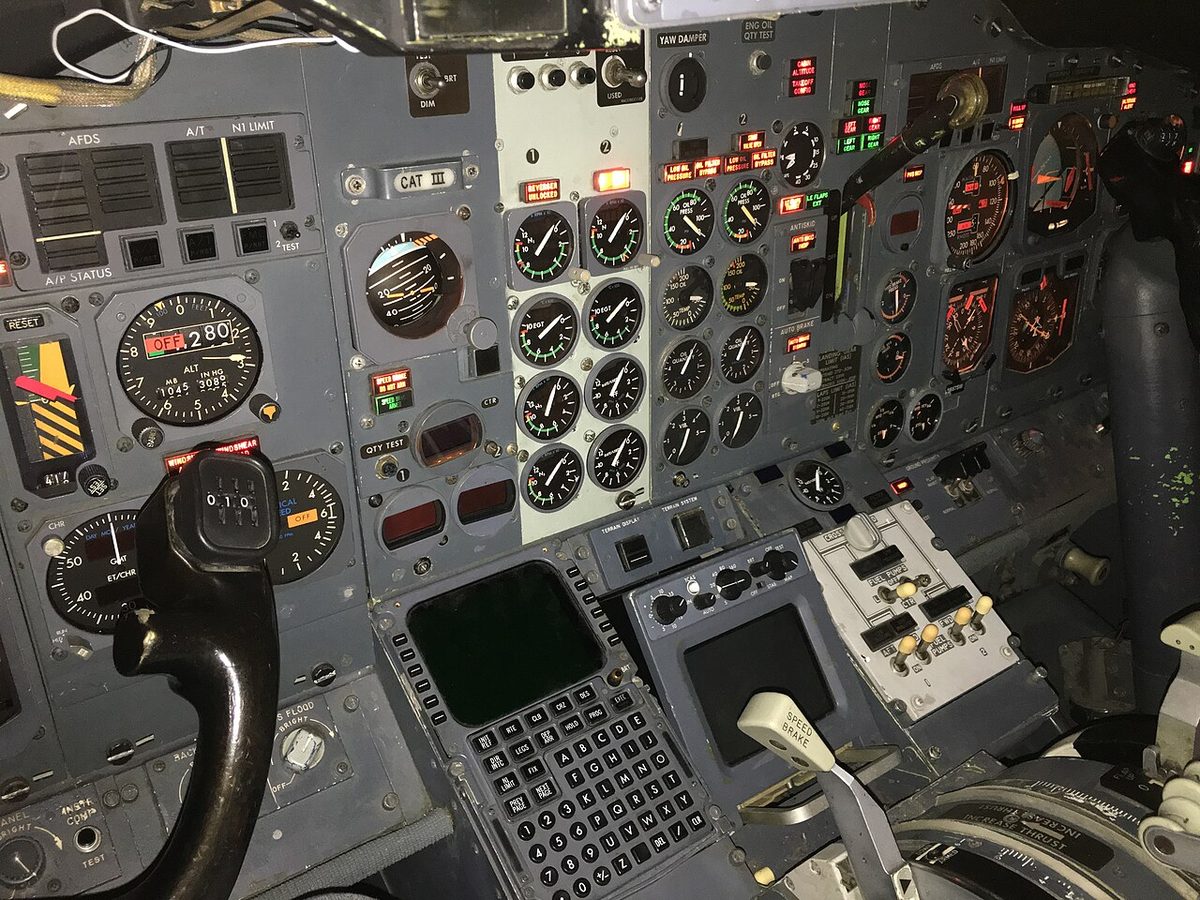
The flight management computer (FMC) is the heart of the Boeing 737's flight management system. From crew entries and its navigation and performance databases it computes the aeroplane's position and the pitch, roll and thrust commands for an optimum profile, and the crew work it through two control display units (CDUs).
The Boeing 737's flight management system (FMS) brings together the flight management computer system, the autopilot flight director system (AFDS), the autothrottle, the inertial reference systems and GPS. Its heart is the flight management computer (FMC). From the flight plan the crew enter, data from the aeroplane's systems and its navigation and performance databases, the FMC calculates present position and the pitch, roll and thrust commands for an optimum profile, and sends them to the autothrottle, the autopilot and the flight directors.
Aeroplanes with two FMCs are certified for sole source navigation, including outside radio navaid coverage; the second FMC is a back-up able to take over every navigation function. The primary FMC allocates navaid tuning and updating between the two, keeps them synchronised, controls the CDU displays, feeds the autopilot and autothrottle and processes ACARS messages. This article follows the 737 NG FCOM; the principles are in flight management system and FMS navigation and position updating.

The CDU
Each pilot has a control display unit (CDU). A line select key beside the screen moves scratchpad data to its line or line data to the scratchpad, selects a page, procedure or mode, and deletes the line when DELETE is in the scratchpad. CLR clears the last scratchpad character, or the whole scratchpad if held. Function keys call up pages: INIT REF the initialisation and reference pages, LEGS the lateral and vertical route data, PROG the progress data.
Besides the white execute light, the CDU has a white MSG light (a scratchpad message is shown), a white OFST light (LNAV is giving guidance for a lateral offset), a white CALL light (a system other than the FMC wants the CDU) and an amber FAIL light, which is for test purposes only and does not come on for an FMC failure.
Page conventions are worth knowing by heart:
| Convention | Meaning |
|---|---|
| Boxes | Entry mandatory |
| Dashes | Entry optional |
| ACT / MOD in the title | Page holds active / modified data |
| Magenta | Data the FMC is using for lateral and vertical commands: active waypoint, speed and altitude, holding data, next restrictions |
| Cyan | Titles of inactive RTE, RTE LEGS and RTE HOLD pages |
| Green | Actively tuned VOR, ILS or DME data; active selector positions |
| Shaded white | Modifications not yet executed |
Altitudes are entered as three digits for hundreds of feet or flight levels, with leading zeros, or as five digits above 9,994 ft; bearings always need three digits. In the crew procedure, CDU entries are made before taxi or when stopped where possible; during taxi the pilot monitoring makes them and the pilot flying verifies them before they are executed, and in flight the pilot making an entry executes it only after the other pilot has checked it.
Navigation databases
The FMC holds a performance database, with drag and engine characteristics, maximum and optimum altitudes and maximum and minimum speeds, so that the crew need not consult a performance manual in flight, and a navigation database of VHF navaids, waypoints, airports, runways and airline-selected SIDs, STARs, approaches and company routes. It carries two sets of navigation data, each valid for 28 days on the chart revision cycle, and navigates from the active set only.
A waypoint not in the database draws NOT IN DATA BASE, but can still be entered as a latitude and longitude or by place-bearing references. Crew-defined airports, navaids and waypoints go into the supplemental navigation database, kept indefinitely until the crew erase it, or the temporary navigation database, erased automatically at flight completion. The two share room for 40 navaids and six airports.
On the ground the FMC computes position from GPS, or from the IRS if GPS is unavailable. In flight it updates from GPS first, then two or more DMEs, a VOR with collocated DME, a localiser with collocated DME and a localiser alone. Its actual navigation performance (ANP) is the radius within which it is 95 per cent sure of its position; when ANP exceeds the required value for longer than the time to alert, UNABLE REQD NAV PERF-RNP appears and the amber FMC lights come on.
Preflight initialisation pages
The CDU preflight procedure has two deadlines: initial and navigation data must be complete before the flight instrument check, and performance data before the Before Start Checklist. Every boxed item is filled in, with the dashed items the procedure lists, and en route winds are entered, since without them flight plan time and fuel burn can be in error. An IRS position more than 4 NM from the origin airport draws VERIFY POSITION.
On the PERF INIT page, the zero fuel weight must never go into the gross weight boxes, or the FMC computes performance with significant errors. The FUEL figure must agree with the dispatch papers and the fuel gauges, and gross weight and cruise CG with the papers. The cost index drives the economy (ECON) speeds: a low cost index reflects high fuel costs and gives a lower cruise speed, and zero gives maximum range cruise. VNAV cannot be used until performance initialisation is complete.
The N1 LIMIT page selects thrust limits and derates (see B737 autothrottle and thrust management). On the TAKEOFF REF page, page 2/2 is completed before page 1/2: page 2 takes the thrust reduction height, 800 to 9,999 ft, and an intersection take-off must also be entered on TAKEOFF REF: with GPS updating off, a TO/GA push updates the FMC position to the runway threshold. The V speeds entered drive the PFD speed bugs; on the ground the amber NO VSPD flag stays until V1 and VR are entered. Before start the pilot flying normally displays TAKEOFF REF and the pilot monitoring the LEGS page.
The APPROACH REF page is used in the descent preparation, where VREF is checked and entered. When engine anti-ice will be used for landing, wing anti-ice has been used in flight, or icing was met and the landing temperature is below 10 °C, the crew set VREF ICE, VREF 15 plus 10 kt, with no more than 5 kt of wind additive.
LEGS page and route modification
The RTE LEGS page shows the route waypoint by waypoint, with lateral and vertical data, and is where the route is checked and changed; with the EFIS mode selector at PLN, it also steps the map through the route. The page shows ANP, and for an approach the published glide path angle. Before the top of descent the active route is modified as needed for the arrival and approach.
Any change to active data makes it a modification: MOD replaces ACT in the title, the changed data appear shaded white and the execute light comes on. The aeroplane keeps flying the active route until the EXEC key is pushed, which makes the modification active and puts the light out.
PROGRESS page and fuel monitoring
The PROGRESS page (PROG key) shows dynamic flight and navigation data: waypoint and destination ETAs, fuel remaining and arrival estimates, and the distance and ETA to the next step climb point. The FMC continually predicts the fuel remaining at destination if the active route is flown:
- USING RSV FUEL: predicted fuel at destination below the reserve entered on PERF INIT;
- INSUFFICIENT FUEL: 2,000 lb (900 kg) or less, with the amber FMC alert light;
- VERIFY GW AND FUEL: total fuel quantity data invalid; the FMC uses the last valid value and the crew must enter fuel weight, a prompt repeated every 30 minutes;
- CHECK FMC FUEL QUANTITY: an unexpected drop in fuel quantity.
Descent planning and early descent
The FMC calculates the top of descent (T/D) from an end of descent (E/D) point. Without an E/D it plans down to 1,000 ft above destination elevation and VNAV path descent is not available. The descent path assumes deceleration to reach the final approach fix or glideslope intercept at VREF 40 plus 20 kt. The target is normally ECON speed above the speed restriction altitude and 240 kt below it, and VNAV will not descend below that altitude until speed is no more than 10 kt above the restriction. Deceleration points appear on the map before speed constraints, holds and approach flap extension.
VNAV can fly a path descent, idle thrust and pitch holding a vertical path, or a speed descent, idle thrust and pitch holding the target speed like LVL CHG. A vertical angle leg becoming active in a speed descent changes VNAV to VNAV PTH. With a target speed within about 6 kt of VMO/MMO at the top of descent, VNAV may revert to LVL CHG to prevent an overspeed.
An early descent leaves cruise before the T/D: with a path descent planned VNAV commands 1,000 fpm until it meets the idle path, with a speed descent an idle thrust descent. More than 50 NM from the T/D, ALT INTV with a lower MCP altitude starts a cruise descent, unless the MCP altitude is below a descent constraint, when the FMC changes to EARLY DES and honours it.
Engine-out, approach and go-around logic
After an engine failure the crew select the left or right ENG OUT mode for the drift-down: autothrottle disengaged, maximum continuous thrust on the operating engine from the N1 line, MCP speed at the ENG OUT speed, MCP altitude at MAX ALT or lower, then LVL CHG. The aeroplane descends at CON thrust and drift-down speed, and MAX ALT may rise as weight falls.
The FMC goes on approach within 2 NM of the first approach waypoint or 2,000 ft of airport elevation, whichever comes first. VNAV then stays in path with the MCP altitude set at least 300 ft above for the missed approach, and commands zero vertical speed when more than 200 ft below the path until it intercepts it.
Below 2,000 ft RA, go-around logic replaces approach logic when TO/GA is pushed in a descent, when a direct-to is executed in the missed approach, when the last approach waypoint sequences to the missed approach, or when the aeroplane climbs at more than 600 fpm with the flaps retracting from a landing setting towards 15 or 1. LNAV can be engaged above 400 ft RA. After a go-around started with TO/GA or go-around thrust, the cruise altitude becomes the highest of the highest missed approach constraint, 1,500 ft above the airport and the MCP altitude.
FMC source select and alerts
The FMC source select switch normally stays at NORMAL: the left FMC controls the CDUs and feeds the autothrottle, the right runs in synchronisation and the maps show composite data. BOTH ON L or BOTH ON R puts everything on one FMC, and moving the switch disengages LNAV and VNAV.
The amber FMC alert light comes on for an alerting message on both CDUs, for INSUFFICIENT FUEL and in the light test; pushing it extinguishes both lights. The failure cases:
- Right FMC failed: FMC alert and message lights, SINGLE FMC OPERATION on both scratchpads, VTK on the right ND; LNAV and VNAV disengage if autopilot B is in use, but can be re-engaged with A.
- Left FMC failed: FMC alert light and the MENU page on both CDUs, VTK on the left ND; LNAV and VNAV can be re-engaged with autopilot B, and BOTH ON R restores full operation.
- Both failed: MENU pages, VTK on both NDs and LNAV and VNAV lost; failure information follows on the NDs after 25 to 30 seconds.
A power interruption under ten seconds disengages LNAV and VNAV but keeps the data. In flight beyond ten seconds, the RTE LEGS page returns with SELECT ACTIVE WPT/LEG; on the ground, ten seconds or more means repeating the whole preflight. Since software U10.8, most software exceptions cause a downgrade mode that keeps LNAV and the map but halts predictions and disconnects VNAV; re-entering and executing the cost index on PERF INIT restarts them after VNAV INVALID - PERF.
Differences on the 737 MAX
The FSB lists FMC software U13 as basic on the MAX (Level B), with the variable take-off rating function, revised PERF INIT and N1 LIMIT pages, a FUEL PROGRESS page and new fuel alerting, several with procedure changes. USING RSV FUEL and INSUFFICIENT FUEL already exist on the NG; what changes is how they are alerted. EASA's AFM prohibited RNP AR operations on the MAX at its return to service.
Frequently asked questions
What does the EXEC key do on the Boeing 737 CDU?
It makes a modification active. When active data such as the route is changed, MOD replaces ACT in the page title, the changed data appear shaded white and the white execute light comes on, but the aeroplane keeps flying the active data. Pushing EXEC activates the change and puts the light out. Crew procedure is that the other pilot verifies the entry before it is executed.
What are the supplemental and temporary navigation databases on the 737 FMC?
They hold airports, navaids and waypoints that the crew define when the permanent navigation database lacks them. Supplemental entries are kept indefinitely until the crew erase them; temporary entries are erased automatically at flight completion. Together they share storage for 40 navaids and six airports, on a first come, first served basis. The permanent database itself comes as two 28-day sets, of which the FMC uses the active one.
When does the 737 FMC go on approach?
The FMC transitions to on approach within 2 NM of the first approach waypoint or within 2,000 ft of airport elevation, whichever comes first. VNAV then stays in VNAV PTH when the MCP altitude is set at least 300 ft above the aeroplane for the missed approach, and if the aeroplane is more than 200 ft below the path, VNAV commands zero vertical speed until it intercepts the path.
What does the FMC alert light mean on the 737?
The amber FMC alert light comes on when an alerting message exists for both CDUs, when the INSUFFICIENT FUEL message is on the scratchpad, when ANP exceeds RNP with UNABLE REQD NAV PERF-RNP, after an FMC failure, and during the light test. Pushing it extinguishes both pilots' lights. The amber FAIL light on the CDU itself, by contrast, is for test purposes only and does not come on for an FMC failure.
What happens if FMC power is interrupted on the 737?
If power is lost for less than ten seconds, LNAV and VNAV disengage but all entered data are kept and the FMC resumes normal operation. Lost for more than ten seconds in flight, LNAV and VNAV disengage, data are kept, and the RTE LEGS page returns with SELECT ACTIVE WPT/LEG. Lost for ten seconds or more on the ground, all preflight procedures and entries must be done again.
How does early descent work in the 737 FMC?
An early descent leaves the cruise before the top of descent. If a path descent is planned, VNAV commands 1,000 fpm until it intercepts the idle descent path; if a speed descent is planned, it commands an idle thrust descent. More than 50 NM from the top of descent, pushing ALT INTV with a lower MCP altitude starts a cruise descent instead, or an early descent if the MCP altitude is below a descent constraint.
Test yourself on B737 FMC and CDU
The v1prep banks cover this topic in the B737 type-rating bank, with a worked explanation for every answer. EASA ATPL, PPL, IR and CPL, the FAA written tests and A320/B737 type ratings.
Start practising →Sources and further reading
- FAA Flight Standardization Board Report, Boeing 737
- EASA Type Certificate Data Sheet IM.A.120, Boeing 737
- FAA Aeronautical Information Manual, Chapter 1 Section 2 (1-2-1, Flight Management System)
- FAA Instrument Flying Handbook (FAA-H-8083-15B), Chapter 9, Navigation Systems
- EASA, Boeing 737 MAX Return to Service Report (January 2021)
- EASA, Explanatory Note to ED Decision 2018/001/R, Part-FCL theoretical knowledge learning objectives
Library articles are written for study and exam preparation. They do not replace your aircraft's approved documentation, your operator's procedures or the regulations themselves.