One Engine Inoperative En-Route Performance
One-engine-inoperative en-route performance is the ability of a multi-engine aeroplane, after an engine fails in the cruise, to descend to and hold a level on the remaining engines while clearing the terrain along its route by a regulated margin and reaching an aerodrome where it can land.
An engine failure in the cruise is rarely an immediate emergency for a multi-engine aeroplane, but it changes what the aeroplane can do. With one engine gone, the remaining thrust usually cannot hold the cruising level, so the aeroplane descends slowly to a lower altitude it can maintain, a manoeuvre known as drift-down. Whether that descent clears the mountains along the route, and where the aeroplane can then land, has to be settled before departure.
The operating rules therefore require the flight manual's one-engine-inoperative (OEI) en-route data to show, at every point of the planned route, that an engine failure leaves a safe way down and a safe way out. The same logic, with simpler rules, applies to a light twin, where the key numbers are the single-engine ceilings and the blue-line speed VYSE.
AEO, OEI and engine-out terms
- All engines operating (AEO) describes normal performance.
- One engine inoperative (OEI) describes performance with one engine failed, the others at the thrust or power the flight manual assumes, normally maximum continuous. For a propeller twin the failed propeller is assumed feathered and the aeroplane clean.
- Engine out (EO) means the same, and appears in flight management systems: the Boeing 737 FMC has an ENG OUT mode for the drift-down.
- Single-engine (SE) means one engine inoperative in the speeds VXSE and VYSE, but in "SE Class B" it means a single-engined aeroplane.
Losing one engine of two costs far more than half the climb. Climb gradient depends on excess thrust, the thrust left after drag has been paid for. When one engine fails, the thrust available halves while the drag rises, because the failed engine adds its own drag and the controls must be deflected to hold the asymmetry (see asymmetric flight). The excess thrust therefore falls by much more than half, and at cruise altitudes it is usually negative.

The en-route phase
In the performance rules the en-route phase runs from the end of the take-off flight path, 1,500 ft above the departure aerodrome, to the point where the approach requirements take over: 1,500 ft above the destination for performance Class A and 1,000 ft for Class B. Take-off climb and landing have their own OEI requirements; this article covers the part in between.
Drift-down
If an engine fails above the altitude the aeroplane can hold on the remaining engines, the crew set maximum continuous thrust on the live engines and fly the flight manual drift-down speed, close to the one-engine-inoperative minimum drag speed, which gives the shallowest descent. The aeroplane descends slowly until the remaining thrust balances the drag, and levels off. As fuel burns off, the level it can hold rises.
Type examples show the same principle:
- Boeing 737. With the ENG OUT mode selected, the crew disconnect the autothrottle, set maximum continuous thrust, set the ENG OUT speed and the MAX ALT, or a lower altitude as required, on the MCP, and select LVL CHG. The aeroplane descends at continuous thrust and the drift-down speed to the MAX ALT, which may increase as weight decreases.
- Airbus A320. Green dot, the engine-out operating speed in clean configuration and the best lift to drag ratio speed, is approximately 2 × weight in tonnes + 85 kt below 20,000 ft, with about 1 kt added per 1,000 ft above that.
- Embraer E190-E2. With slats and flaps up, the green dot on the speed tape is the drift-down speed.
Over high terrain the operator plans this in advance. Where the terrain limits the aeroplane, it publishes drift-down escape routes: a decision point, a turn towards lower ground and an aerodrome to fly to (see operational flight plan).
The net en-route flight path
The flight manual gives two versions of the OEI path. The gross flight path is what an average aeroplane of the type achieves. The net en-route flight path is the gross climb gradient reduced by a fixed margin, which covers differences between individual aircraft, piloting technique and the atmosphere:
| Number of engines | Gradient margin, one engine inoperative |
|---|---|
| Two | 1.1 % |
| Three | 1.4 % |
| Four | 1.6 % |
The margins are laid down in the certification specifications for large aeroplanes, CS 25.123 and, for the FAA, 14 CFR 25.123. They apply in the conservative direction: a net climb is shallower than the gross climb, and a net descent is steeper than the gross descent. Terrain clearance is always demonstrated with the net path.
Exam tip: Suppose a twin's gross OEI gradient at FL150 is +0.6 %. Its net gradient there is 0.6 − 1.1 = −0.5 %: for planning purposes it is still descending, although the real aeroplane could climb slowly. This is why the net ceiling lies below the level the aeroplane actually reaches.
Terrain clearance: the Class A rules
For performance Class A aeroplanes, EASA's CAT.POL.A.215, carried over from EU-OPS, requires the OEI net flight path data to show that one of two conditions can be met at every point of the route.
| Method 1: level-off above terrain | Method 2: drift-down to an aerodrome | |
|---|---|---|
| Requirement | Net path has a positive gradient at least 1,000 ft above all terrain and obstructions | Net path from the cruising level to an aerodrome where a landing can be made clears all terrain and obstructions by at least 2,000 ft vertically |
| Corridor | 5 NM (9.3 km) either side of the intended track | 5 NM (9.3 km) either side of the intended track |
| Common to both | Positive net gradient 1,500 ft above the aerodrome where the landing is assumed after the failure | Positive net gradient 1,500 ft above the aerodrome where the landing is assumed after the failure |
The 1,500 ft requirement sits in the general paragraph of the rule, so it applies whichever method is used, and the same paragraph requires the effect of ice protection systems to be taken into account when they will be needed. Under the drift-down method, fuel may be jettisoned to the extent consistent with reaching the aerodrome with the required reserves.
Method 1 means, in effect, that the aeroplane's OEI net ceiling must lie at least 1,000 ft above the highest terrain in the corridor. Where it does not, the operator either uses method 2, with a planned drift-down and escape route, or accepts a lower take-off mass.
Aeroplanes with three or more engines that fly far from an aerodrome must also account for the failure of a second engine, under a separate requirement. The FAA rule for turbine aeroplanes, 14 CFR 121.191, has the same two-method structure, with a corridor of 5 statute miles either side of track, the same 1,000 ft and 2,000 ft margins and, for all but the oldest types, a positive slope 1,500 ft above the airport where the landing is assumed.
OEI net ceiling
The OEI net ceiling, or one-engine-inoperative net ceiling, is the altitude at which the net OEI flight path becomes level: above it the net path descends, below it the net path climbs. It depends on mass, temperature and the use of ice protection, and it is always lower than the level at which the real aeroplane stops descending, because of the gradient margin.
Mass is the main lever. A heavier aeroplane needs more thrust to hold level flight and has a lower OEI ceiling, which is why terrain can limit the take-off mass on some routes. The FAA describes the drift-down calculation as one made at dispatch to set the weight over high terrain.
Class B twins and single-engined aeroplanes
The Class B rules are simpler. Under CAT.POL.A.315, a multi-engined Class B aeroplane must, after an engine failure, be able to continue at or above the minimum altitudes for safe flight stated in the operations manual to a point 1,000 ft above an aerodrome where the performance requirements can be met. For the calculation:
- the aeroplane may not be assumed to be flying higher than the altitude at which the all-engines rate of climb is 300 ft/min at maximum continuous power; guidance material makes clear that this does not limit the actual cruising level, only the level from which the engine-out case is planned;
- the OEI gross gradient of descent is increased by 0.5 %, or the gross gradient of climb decreased by 0.5 %.
In practice the pilot adds the distance covered in the OEI descent to the OEI cruise range at the OEI ceiling, and checks that a suitable aerodrome lies within that reach from every point of the route. A single-engined Class B aeroplane has no engine left to drift down on: under CAT.POL.A.320 it must be able, after an engine failure, to reach a place where a safe forced landing can be made.
Single-engine ceilings of light twins
For a light twin the flight manual gives OEI ceilings directly:
- the single-engine service ceiling is the altitude at which the aeroplane, at maximum weight, can still climb at 50 ft/min with one engine inoperative;
- the single-engine absolute ceiling is where that rate of climb reaches zero.
The all-engines service ceiling uses 100 ft/min instead. The FAA defines the single-engine ceilings as density altitudes, so on a hot day they correspond to lower pressure altitudes. A twin whose single-engine service ceiling is 5,000 ft cannot hold a minimum en-route altitude that works out at a density altitude of 7,500 ft: after a failure it will drift down, and over mountains the second engine may only carry it further into trouble.
Certification has not always guaranteed any single-engine climb. Under the former CS-23.67, still taught in the syllabus, a twin of 2,722 kg (6,000 lb) or less with a VS0 above 61 kt had to show a 1.5 % OEI climb gradient at 5,000 ft pressure altitude, but one with a VS0 of 61 kt or less only had to have its OEI gradient determined, and that gradient could be negative. CS-23 Amendment 5 (2017) replaced these paragraphs with objective-based requirements.
VXSE and VYSE
Two speeds define the light twin's OEI performance:
- VYSE, the best single-engine rate of climb speed, gives the greatest rate of climb, or the smallest rate of descent, with one engine inoperative. It is marked on the airspeed indicator by a blue radial line, the "blue line", established at maximum weight at sea level.
- VXSE, the best single-engine angle of climb speed, gives the most height per distance flown. It is slower than VYSE and is used only when an obstacle must be cleared.
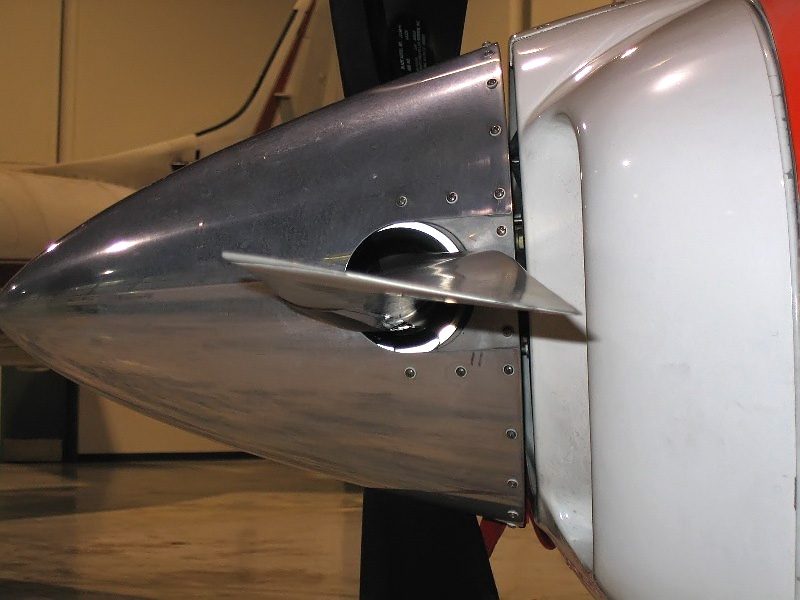
The red radial line lower on the scale marks VMCA, the minimum control speed with the critical engine inoperative (see minimum control speeds). The best single-engine performance needs the failed propeller feathered, landing gear and flaps up, the cowl flap of the dead engine closed, maximum continuous power on the live engine and a small bank towards the live engine, typically 2° to 3° and no more than about 5°, to cancel the sideslip. Anything less, such as a windmilling propeller or the wings held level with the ball centred, costs climb the aeroplane may not have.
One-engine-inoperative cruising speed
The one-engine-inoperative cruising speed is the speed established for each type, in still air and standard conditions, that turns diversion times into distances. EASA uses it for several planning limits:
- a take-off alternate for a twin must lie within 1 hour at this speed, or within 2 hours for an aeroplane with three or more engines;
- without an ETOPS approval, a Class A twin with 20 or more passenger seats, or a maximum take-off mass of 45,360 kg or more, must stay within 60 minutes of an adequate aerodrome at this speed;
- a Class A twin with 19 seats or fewer and a mass below 45,360 kg may go to 120 minutes, or up to 180 minutes for turbojets with approval, and Class B and C twins to the lesser of 120 minutes and 300 NM.
Beyond these limits a twin needs an ETOPS approval (see ETOPS and extended diversion time operations).
Frequently asked questions
What is drift-down after an engine failure?
Drift-down is the gradual descent that follows an engine failure at a cruise level too high to hold on the remaining engines. The crew set maximum continuous thrust on the live engines and fly the flight manual drift-down speed, close to the one-engine-inoperative minimum drag speed, which gives the shallowest descent. The aeroplane levels off where the remaining thrust balances the drag, and that level rises slowly as fuel burns off.
What are the EASA en-route terrain clearance requirements with one engine inoperative?
For performance Class A, CAT.POL.A.215 offers two methods. Either the net flight path has a positive gradient at least 1,000 ft above all terrain and obstructions within 5 NM (9.3 km) either side of the intended track, or the net drift-down path from the cruising level clears them by at least 2,000 ft all the way to an aerodrome where a landing can be made. Under either method, the net path must also have a positive gradient 1,500 ft above the aerodrome where the landing is assumed.
What is the difference between gross and net en-route flight path?
The gross flight path is the performance an average aeroplane of the type achieves. The net flight path is the gross gradient reduced by a fixed margin, 1.1 per cent for a twin, 1.4 per cent for a three-engined and 1.6 per cent for a four-engined aeroplane, so a net climb is shallower and a net descent steeper. Terrain clearance is always demonstrated with the net path, which covers variations in aircraft, piloting and atmosphere.
What is the single-engine service ceiling of a light twin?
It is the altitude at which a light twin with one engine inoperative can still climb at 50 ft per minute, at maximum weight and in the flight manual configuration. The single-engine absolute ceiling is where that rate of climb falls to zero. The FAA defines both as density altitudes, so on a hot day they are reached at a lower pressure altitude, and a twin above its single-engine ceiling when an engine fails will drift down.
What is VYSE, the blue line speed?
VYSE is the best rate of climb speed with one engine inoperative, marked on the airspeed indicator of a light twin by a blue radial line. It gives the greatest rate of climb, or the smallest rate of descent, on one engine. VXSE, the best single-engine angle of climb speed, is slower and is used only when an obstacle must be cleared. VMCA, the minimum control speed, is shown by the red radial line lower down.
Test yourself on One Engine Inoperative En-Route Performance
The v1prep banks cover this topic in Performance (032), with a worked explanation for every answer. EASA ATPL, PPL, IR and CPL, the FAA written tests and A320/B737 type ratings.
Start practising →Sources and further reading
- EASA Easy Access Rules for Air Operations (Regulation (EU) No 965/2012), CAT.POL.A.215, CAT.POL.A.315, CAT.POL.A.320 and CAT.OP.MPA.140
- EASA Easy Access Rules for Large Aeroplanes (CS-25), CS 25.123 En-route flight paths
- 14 CFR 121.191, Airplanes, turbine engine powered, en route limitations, one engine inoperative
- FAA Airplane Flying Handbook (FAA-H-8083-3C), Chapter 13, Transition to Multiengine Airplanes
- FAA Pilot's Handbook of Aeronautical Knowledge (FAA-H-8083-25), Chapter 11, Aircraft Performance
- EASA, Explanatory Note to ED Decision 2018/001/R, Part-FCL theoretical knowledge learning objectives (032 Performance)
Library articles are written for study and exam preparation. They do not replace your aircraft's approved documentation, your operator's procedures or the regulations themselves.