Aircraft Categories and CS-23 / Part 23
CS-23 (EASA) and 14 CFR Part 23 (FAA) are the airworthiness codes for light aeroplanes. Until 2017 they certified aeroplanes in the normal, utility, aerobatic or commuter category, each with its own limits; the current performance-based versions have one normal category divided into certification levels.
CS-23 in Europe and 14 CFR Part 23 in the United States are the airworthiness codes for light aeroplanes, from two-seat trainers to small twin turboprops and light jets. For decades they certified each design in one or more categories: normal, utility, aerobatic and commuter. The category decided how strong the structure had to be, which manoeuvres the aeroplane could fly and, for the commuter category, how demanding its performance standards were.
In 2017 both codes were rewritten as performance-based rules, with a single normal category divided into certification levels. Yet almost every light aeroplane now flying was certified under the old codes, and it keeps its old category for life. That is why the flight manual of a Cessna or a Piper still speaks of normal and utility categories, and why the PPL, CPL and ATPL syllabi still teach the traditional figures. This article covers both, marking which is which. How codes, type certificates and certification bases work in general is described in type certification.
Scope of CS-23 and Part 23
Until 2017 CS-23 was titled Normal, Utility, Aerobatic and Commuter Aeroplanes, and Part 23 carried the equivalent US title. Their scope was set by seats and mass:
- Normal, utility and aerobatic categories: aeroplanes with nine or fewer passenger seats, not counting the pilot seats, and a maximum take-off mass of 5,670 kg (12,500 lb) or less.
- Commuter category: propeller-driven twin-engined aeroplanes (multi-engined under Part 23) with 19 or fewer passenger seats, excluding pilot seats, and a maximum take-off mass of 8,618 kg (19,000 lb) or less.
Anything larger is certified to the large aeroplane code, CS-25 or Part 25, described in large aeroplane certification.
The certification thresholds are close to, but not the same as, the thresholds of the operating rules. EASA's performance Class B, for example, covers propeller aeroplanes with nine passenger seats or fewer and a maximum take-off mass of 5,700 kg or less (see performance classes), while the FAA calls an aircraft of more than 12,500 lb "large" in 14 CFR 1.1 and requires a type rating to fly it.
Exam tip: "category" has three unrelated meanings. On a pilot licence it is the kind of aircraft (aeroplane, helicopter). In approach procedures it is a speed band (A to E). In certification it is the design category described here. Likewise, the commuter category is a design standard, while a commuter operation is a kind of air carrier operation under FAA Part 135.
Normal category
The normal category is the category of touring and training aeroplanes. It is limited to non-aerobatic operation, meaning any manoeuvre incidental to normal flying, stalls except whip stalls, lazy eights, chandelles and steep turns in which the angle of bank does not exceed 60°. Intentional spins are prohibited.
The structure is designed for a positive limit load factor that depends on the design maximum weight, reaching +3.8 g for light types, with a negative limit of -1.52 g. With flaps extended the positive limit falls to +2.0 g, which is why manoeuvring with flap out is restricted.
Utility category
The utility category allows limited aerobatic operation: spins, where the type has been approved for them, lazy eights, chandelles, and steep turns with more than 60° but not more than 90° of bank. The structure is designed for +4.4 g and -1.76 g.
Many trainers are certified in both the normal and the utility categories. The utility approval then applies only inside a smaller envelope given in the flight manual, which commonly limits the mass, allows only the front seats to be occupied and narrows the centre of gravity range. Being below the normal category maximum mass is not enough: a spin is permitted only when the aeroplane is loaded within the utility limits. A type certified in two categories must meet the requirements of each, and the flight manual and placards state which manoeuvres are approved in which configuration (see spins and spiral dives).
Aerobatic category
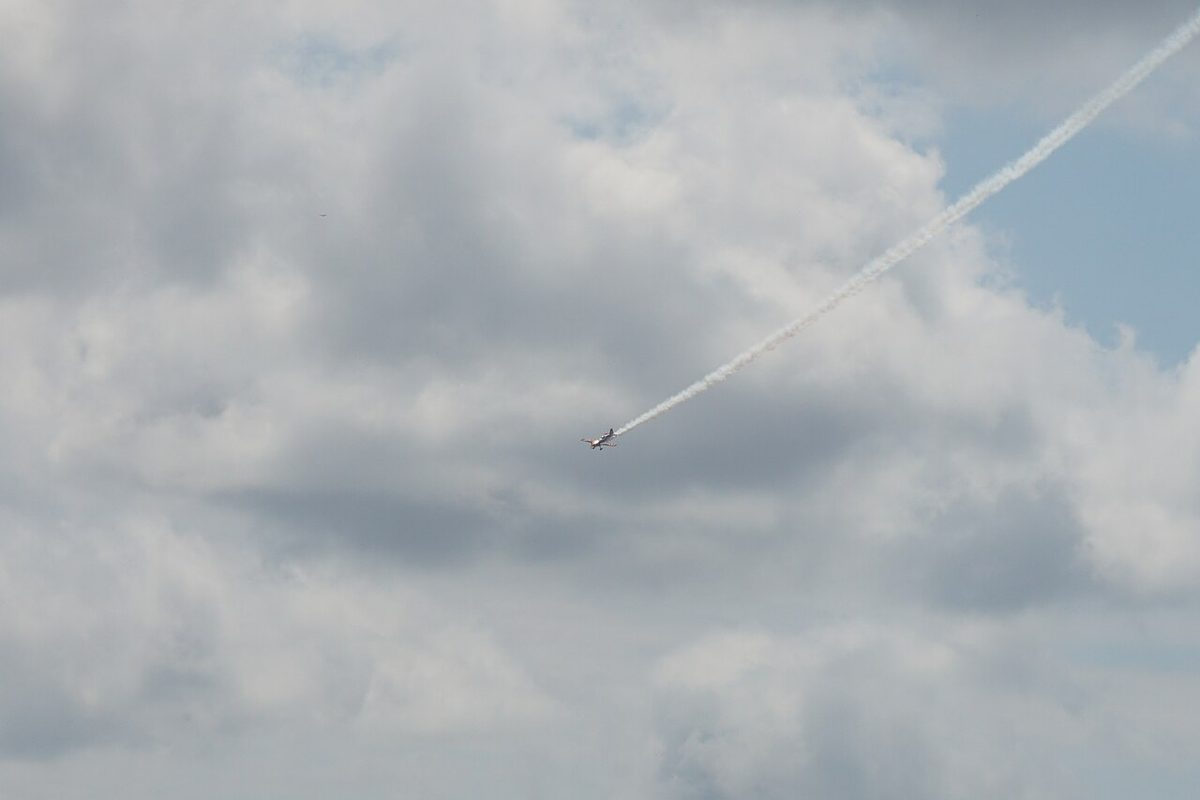
The aerobatic category (the FAA writes acrobatic) has no restrictions on manoeuvres other than those found necessary in the certification flight tests. Aerobatic aeroplanes are designed for at least +6.0 g and -3.0 g, the negative limit being half of the positive one rather than 0.4 times it as in the other categories. Dedicated aerobatic types are generally cleared for spins, and many are built to considerably higher load factors than the minimum the code demands.
Commuter category
The commuter category was added to cover propeller-driven multi-engined aeroplanes of up to 19 passenger seats, the size of a small regional turboprop. Its manoeuvres are restricted to those incidental to normal flying, stalls except whip stalls, and steep turns of not more than 60° of bank. Its performance standards are close to those of the large aeroplane code, and ATPL performance questions test the difference:
| Item | Non-commuter twin (normal category) | Commuter category |
|---|---|---|
| Rotation speed VR | At least 1.05 VMC and at least 1.1 VS1 | At least 1.05 VMC and at least V1 |
| Accelerate-stop distance | No certification requirement; any published data are advisory | Required, defined as for Class A aeroplanes |
For a single-engined aeroplane the rule is simpler still: VR may not be less than VS1. The missing accelerate-stop requirement matters in practice. On many runways, a light twin that loses an engine near lift-off can neither stop nor be sure to climb away, and the pilot has to plan for that.
Single-engine climb was not guaranteed either. Under the former CS-23.67, a twin of 2,722 kg (6,000 lb) or less whose VS0 exceeded 61 kt had to show a one-engine-inoperative climb gradient of 1.5 % at 5,000 ft pressure altitude, but a lighter or slower twin only had to have its gradient determined, and that gradient could be negative (see one-engine-inoperative en-route performance).
Load factor limits by category
The load factor limits are the figures most often examined. They come from the former CS 23.337 and the equivalent FAR 23 section:
| Category | Positive limit | Negative limit | Positive ultimate |
|---|---|---|---|
| Normal | 2.1 + 24,000 ÷ (W + 10,000), not more than 3.8 g needed | 0.4 × positive: -1.52 g at +3.8 g | Up to 5.7 g |
| Utility | +4.4 g | -1.76 g | 6.6 g |
| Aerobatic | +6.0 g | -3.0 g | 9.0 g |
W is the design maximum take-off weight in pounds, and n need not exceed 3.8, so every normal category aeroplane of up to about 4,100 lb is designed for +3.8 g, and heavier ones may be designed for slightly less. Under the former FAR 23.337 commuter category aeroplanes use the same weight formula.
The limit load is the greatest load expected in service, and the structure must carry it without permanent deformation. The ultimate load is the limit load multiplied by a safety factor of 1.5, and the structure must support it for at least three seconds without failure. The margin between the two is not a reserve for pilots: a load beyond the limit may bend the structure permanently, and an overstress must be reported and inspected even if nothing broke.
Gusts are covered too. At low altitude the gust envelope of a normal category aeroplane assumes vertical gusts of 50 ft/s at the design cruising speed VC and 25 ft/s at the design diving speed VD. How these figures shape the V-n diagram and the manoeuvring speed is explained in load factor and the flight envelope.
Exam tip: normal +3.8 / -1.52, utility +4.4 / -1.76, aerobatic +6.0 / -3.0. The negative limit is 0.4 times the positive one, except in the aerobatic category, where it is 0.5 times. Ultimate = 1.5 × limit.
Other light aeroplane standards
Several figures that pilots meet in the pilot's operating handbook also come from the certification code rather than from the aeroplane's real capability:
- Maximum demonstrated crosswind component: Part 23 requires satisfactory controllability to be shown in a 90° crosswind of at least 0.2 VS0. The published figure is what was demonstrated, not a structural or control limit, unless the limitations section makes it one.
- Fuel quantity indicators need be accurate only when reading empty: the gauge must read zero in level flight when only the unusable fuel remains. Fuel is therefore checked visually and managed by time and consumption.
- Stall warning: light aeroplane stall warners typically sound about 5 to 10 kt above the stall, from a vane or reed on the leading edge (see angle of attack, stall warning and stall protection).
Performance-based Part 23 and CS-23
The old codes described designs in detail. That made the certification of conventional aeroplanes predictable, but new technology such as electronic engine controls, new materials, electric propulsion or simplified flight controls often fitted none of the paragraphs and needed special conditions. The FAA's Part 23 Amendment 23-64, published in December 2016 and in force from August 2017, and EASA's CS-23 Amendment 5 of 2017 turned the codes into performance-based rules. They state the safety objective to be met, and the detailed ways of meeting it are moved into accepted means of compliance, many of them industry consensus standards. The detailed figures of the old code, such as the load factors above, survive only where they are used as such means of compliance. Part 23 is now titled Normal Category Airplanes, and CS-23 Normal-Category Aeroplanes.
The new codes have one category, normal, for aeroplanes of up to 19 passenger seats and a maximum take-off mass of 8,618 kg (19,000 lb). The utility, aerobatic and commuter categories no longer exist for new designs; aerobatic capability is instead an approval within the normal category. The requirements are scaled by two measures:
| Certification level | Maximum passenger seating |
|---|---|
| Level 1 | 0 to 1 |
| Level 2 | 2 to 6 |
| Level 3 | 7 to 9 |
| Level 4 | 10 to 19 |
The performance level is low speed when VNO and VMO do not exceed 250 kt CAS and MMO does not exceed 0.6, and high speed otherwise. Requirements are scaled to these levels, so a two-seat trainer is spared requirements meant for a 19-seat turboprop or a fast jet.
An aeroplane not certified for aerobatics may still fly the manoeuvres incidental to normal flying, including stalls other than whip stalls, and lazy eights, chandelles and steep turns of up to 60° of bank. One certified for aerobatics may be flown without manoeuvre restrictions other than the operating limitations established in its certification.
Note: the new rules apply to new type certificates and to changes certified under them. An aeroplane already certified keeps its certification basis, and with it its normal, utility, aerobatic or commuter category and all the limits described above. Exam questions on categories and load factors use the traditional figures.
Frequently asked questions
What is the difference between the normal and utility categories?
Both are light aeroplane categories of the traditional CS-23 and Part 23. A normal category aeroplane is limited to non-aerobatic flying: stalls other than whip stalls, lazy eights, chandelles and turns of up to 60 degrees of bank, and it is designed for a limit load factor of up to +3.8 g. A utility category aeroplane is built for +4.4 g and may perform limited aerobatics, including spins if approved, and turns of up to 90 degrees of bank.
What are the load factor limits for normal, utility and aerobatic aeroplanes?
Under the traditional CS-23 and Part 23 the positive limit load factor is up to +3.8 g for the normal category, set by a weight formula, +4.4 g for utility and +6.0 g for aerobatic. The negative limits are -1.52, -1.76 and -3.0 g. The structure must carry the limit load without permanent deformation and 1.5 times that load, the ultimate load, without failure.
Can you spin a normal category aeroplane?
No. Intentional spins are prohibited in the normal category. Many trainers are certified in both the normal and utility categories, and they may be spun only when the flight manual approves it and the aeroplane is loaded inside the utility envelope, which usually limits the mass, the number of occupants and the centre of gravity range. Aerobatic category aeroplanes are generally cleared for spins.
What is the commuter category?
The commuter category of the traditional CS-23 and Part 23 covered propeller-driven twin-engined aeroplanes (multi-engined under Part 23) with 19 or fewer passenger seats and a maximum take-off mass of 8,618 kg (19,000 lb) or less. Their performance standards were close to those of large aeroplanes, with an accelerate-stop distance and a decision speed V1. It is a design category, not the same thing as a commuter operation under FAA Part 135.
What changed in Part 23 and CS-23 in 2017?
FAA Part 23 Amendment 23-64 and EASA CS-23 Amendment 5 replaced the detailed design requirements with safety objectives, and moved the detailed methods into accepted means of compliance. The utility, aerobatic and commuter categories were dropped for new designs: there is one normal category, divided into certification levels 1 to 4 by passenger seats and into low and high speed performance levels. Aircraft already certified keep their original category.
Test yourself on Aircraft Categories and CS-23 / Part 23
The v1prep banks cover this topic in Air Law (010), with a worked explanation for every answer. EASA ATPL, PPL, IR and CPL, the FAA written tests and A320/B737 type ratings.
Start practising →Sources and further reading
- EASA Easy Access Rules for Normal-Category Aeroplanes (CS-23)
- 14 CFR Part 23, Airworthiness Standards, Normal Category Airplanes
- FAA final rule, Revision of Airworthiness Standards for Normal, Utility, Acrobatic, and Commuter Category Airplanes (Federal Register, 30 December 2016)
- FAA Pilot's Handbook of Aeronautical Knowledge (FAA-H-8083-25), Chapter 5, Aerodynamics of Flight
- EASA Easy Access Rules for Air Operations (Part-CAT performance classes)
Library articles are written for study and exam preparation. They do not replace your aircraft's approved documentation, your operator's procedures or the regulations themselves.