Airbus A220 Flight Deck and Avionics
The A220 flight deck, designed by Bombardier for the CSeries, is a two-pilot fly-by-wire cockpit with dual side-sticks and Rockwell Collins Fusion avionics: five large adaptive displays, an engine indicating and crew alerting system (EICAS) with an integrated electronic checklist, dual flight management systems and an optional single or dual head-up display.
The flight deck of the Airbus A220 was designed by Bombardier for the CSeries. It is a two-pilot fly-by-wire cockpit: each pilot flies with a side-stick, and the instruments form an integrated Rockwell Collins "Fusion" electronic flight instrument system (EFIS) with five large adaptive displays, an integrated electronic checklist (ECL) and dual Rockwell Collins flight management systems (FMS). The A220-100 and the A220-300 share this flight deck and a single pilot type rating, BD500.
For a pilot coming from the A320 family the cockpit looks familiar at first sight, with side-sticks and no control columns, but it works differently. Crew alerting follows the EICAS philosophy rather than ECAM, the displays are driven with trackballs, the thrust levers move, and the aircraft is trimmed by hand in manual flight. The general principles are covered in electronic flight instrument systems, flight warning and alerting systems and head-up displays.
Origins: the Bombardier CSeries
Bombardier launched the CSeries on 13 July 2008. The CS100 first flew on 16 September 2013 and the longer CS300 on 27 February 2015. Transport Canada (TCCA) certified the CS100, model BD-500-1A10, on 17 December 2015 and the CS300, model BD-500-1A11, on 8 July 2016; EASA followed on 15 June and 7 October 2016. In July 2018 Airbus took a majority stake in the programme and the aircraft were renamed: the CS100 became the A220-100 and the CS300 the A220-300. The type certificate passed from Bombardier to CSeries Aircraft Limited Partnership in October 2017 and to Airbus Canada Limited Partnership in June 2019. The model designations and the BD500 type rating did not change.
The FAA describes the CS300 as nearly identical to the CS100, with a 12 ft stretched fuselage, more windows, larger brakes and heavier weights. None of the design differences listed by TCCA and the FAA concerns the flight deck: they cover dimensions, weights and limitations, cabin and cargo capacity, towing, fuel capacity, doors, windows and engine ratings. TCCA set Level A differences training and checking in both directions; the FAA sets Level B training, for the changed limitations, with Level A checking. Neither lists any manoeuvre difference.
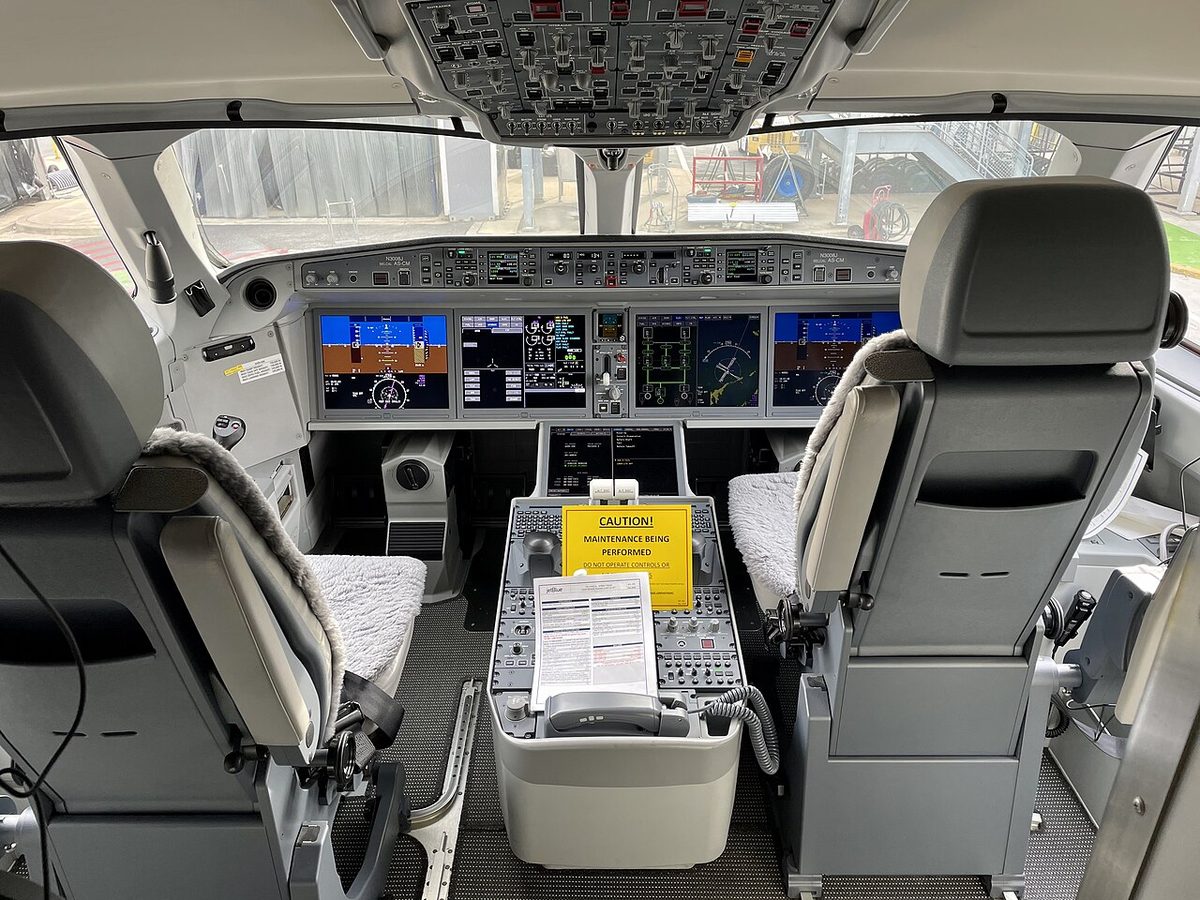
Five large displays
The MMEL names the five display units by position when it lists their cooling fans: left outboard, left inboard, lower, right inboard and right outboard. Photographs of the flight deck show four in a row across the main panel and the fifth, the lower display, at the front of the centre pedestal. The MMEL calls the system the Adaptive Flight Display (AFD), and the clocks (UTC and chronometer) are shown on it.
Each pilot has a primary flight display (PFD). Rücker and Scholz, comparing it with the A320, call it much bigger and better for situational awareness, and find more information on the navigation display, which since avionics Build 8.0A can add a vertical profile, the vertical situation display (VSD). The other display areas are configured by the crew. Their examples show a taxi map beside the engine and warning display, the electrical and flight control synoptic pages, the checklist, and FMS route and performance pages on the lower display. TCAS traffic appears as an overlay on the horizontal situation indicator (HSI) and on the multi-function window (MFW), and terrain as overlays and maps.
FMS pages are shown on the large displays and entered through the keyboards. Rücker and Scholz note the bigger FMS screen and flight plan upload by ACARS over VHF.
Controls for the displays
| Unit | Number | Main controls |
|---|---|---|
| Cursor control panel (CCP) | 2 | Trackball, double stack knob, MENU, upper and lower display select, cursor select buttons |
| Multifunction keyboard panel (MKP) | 2 | Alphanumeric keys, FMS keys (MSG, ROUTE, direct-to, DEP/ARR), EXEC and ENTER, direct access keys |
| Control tuning panel (CTP) | 2 | Display access keys, map range, NAV SRC, BARO (inHg or hPa, STD), TFC, WX and TERR, radio tuning, IDENT |
The display access keys, L, R, MAP, FMS, CNS, CHKL, SYN and DATA, call up formats, and the MKPs repeat MAP to DATA as direct access keys. The trackball, which Rücker and Scholz compare with the A350's, points at items on any display, including the map. A failed trackball is inhibited with its CURSOR INHIB button on the reversion switch panel (RSP), which also carries the L and R IRS buttons.
Behind the displays stand three inertial reference systems, four air data systems, of which ADS 4 can be selected in place of any of the other three, an integrated standby instrument (ISI) and a non-stabilised magnetic standby compass.
Side-sticks, glareshield and pedestal
Photographs of the flight deck show each pilot's side-stick on the outboard side console. The MMEL lists a stick shaker, an autopilot detent and push-to-talk and intercom switches on each. Priority between the two sticks is handled with a SIDESTICK priority switch on each side of the glareshield, with an arrow light and a PTY light, and a priority voice message. Their use is described in A220 fly-by-wire flight controls.
The glareshield panel also carries the CHRONO pushbuttons, the display dimming knobs and, where fitted, the CPDLC buttons (ACPT, RJCT, STBY, LOAD and refresh). The flight control panel (FCP) groups the autopilot (AP), autothrottle (AT) and two flight director (FD) pushbuttons, the vertical modes (FLC, ALT, VNAV, FPA and V/S), 1/2 BANK, the heading, speed and altitude selectors and the guarded pushbutton of the Emergency Descent Mode (EDM). Rücker and Scholz describe EDM as almost automatic: after donning the mask, one press makes the aircraft descend by itself to 15,000 ft, and spoilers can be added to steepen the descent. The MMEL counts three autopilot systems.
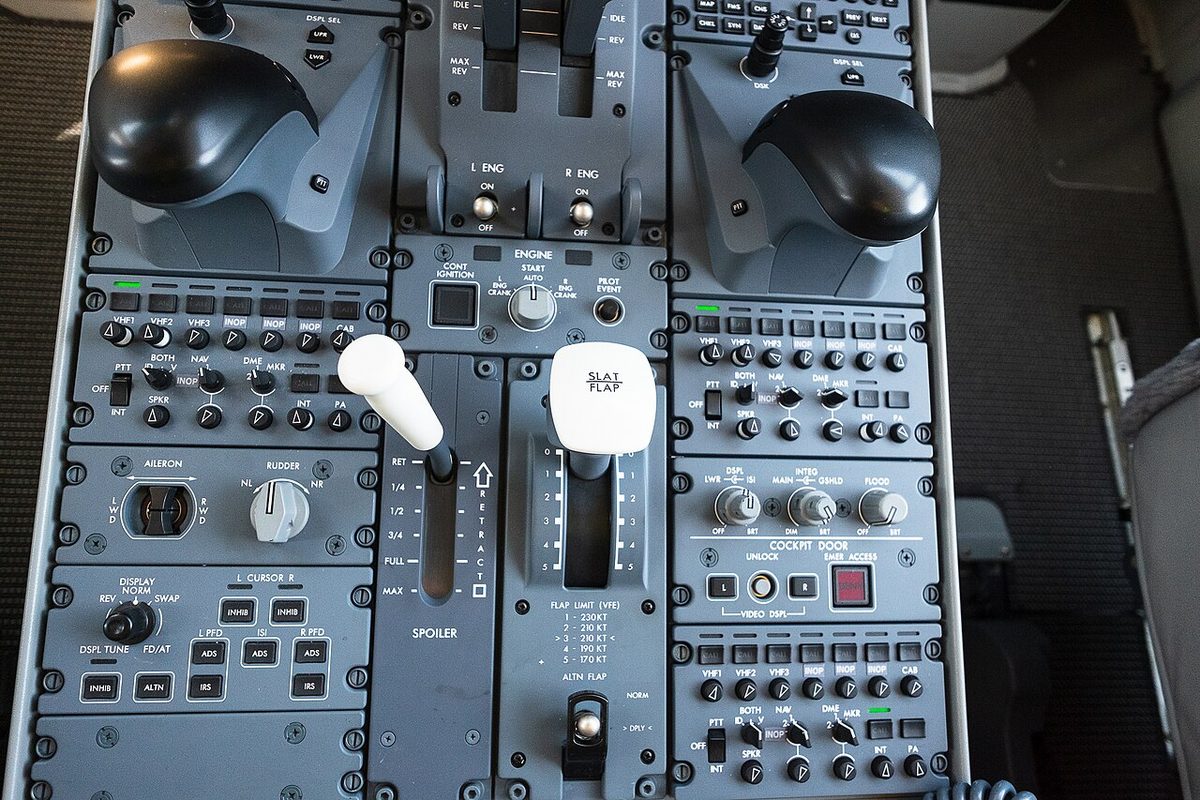
The pedestal carries the throttle quadrant: two thrust levers with TOGA switches, autothrottle disconnect buttons, a finger lift on each lever for reverse thrust and the L ENG and R ENG run switches. In the photograph below, a cursor control panel for each pilot sits beside the thrust levers; further aft are the ENGINE start panel, the SPOILER lever and the SLAT/FLAP lever with the ALTN FLAP switch, the aileron and rudder trim panel, the reversion switch panel and the audio control panels. A nosewheel steering tiller is fitted for the left seat; a second one for the right seat is optional.
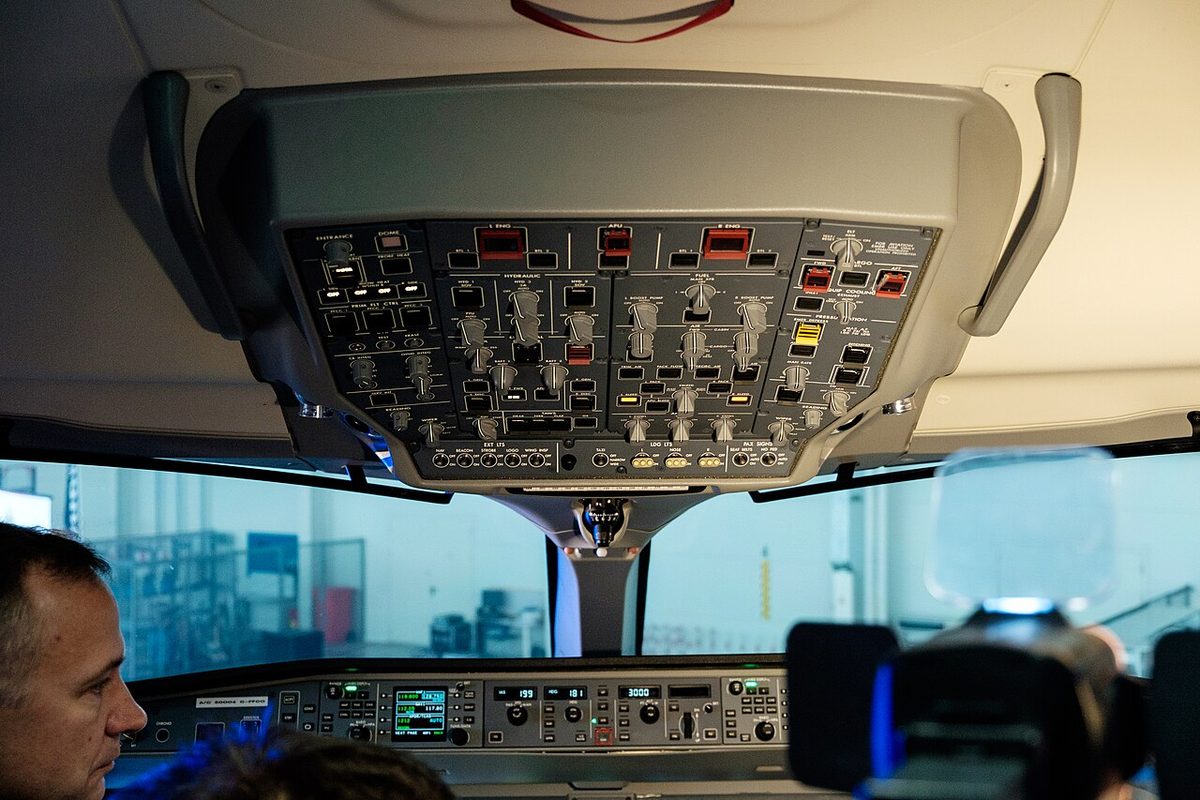
Overhead panel
The overhead panel holds the system controls as pushbutton annunciators (PBAs), which show legends such as FAIL, OFF or ON. In the photograph below, the ENGINE & APU FIRE panel runs across its top, the HYDRAULIC and FUEL panels sit in the middle and the exterior lights, landing lights and passenger signs line the lower edge. The MMEL lists, among others:
- Electrical: L GEN, R GEN and APU GEN (FAIL and OFF legends), EXT PWR (AVAIL and IN USE), RAT GEN (ON), the L and R generator DISC switches (OIL and DISC) and CABIN PWR.
- Flight controls: the three PFCC cut-out switches, each with an OFF light.
- Hydraulics and fuel: HYD 1 and HYD 2 SOV (CLSD) and FUEL GRAV XFR (ON).
- Air and anti-ice: pressurisation (EMER DEPRESS, AUTO PRESS, DITCHING), window heat (L SIDE, L WSHLD, R WSHLD, R SIDE) and PROBE HEAT GND ON.
- Terrain warning: the TAWS GEAR INHIB, TERR INHIB, FLAP INHIB and GS CNCL switchlights.
Crew alerting: EICAS and the electronic checklist
The engine indicating and crew alerting system (EICAS) shows the engine indications and the crew alerting system (CAS) messages. EASA accepted digital-only display of the power-plant instruments through an equivalent safety finding.
| Class | Examples |
|---|---|
| Warning | EMER PWR ONLY |
| Caution | L GEN FAIL, HYD PUMP 3A FAIL, FLAP FAIL |
| Advisory | PFCC 1 FAIL, ELECTRICAL FAULT, CB TRIP |
| Status | APU GEN OFF, PFCC 1 OFF |
| INFO (non-alerting) | 24 ELECTRICAL FAULT - EPC 1 DEGRADED |
The MMEL defines four classes of primary message, warning, caution, advisory and status. INFO messages are a separate, non-alerting category that indicates a failure relevant only to a dispatch decision. The absence of any message of status level or above means the system is working within its approved limits. Two master WARNING and two master CAUTION switchlights also cancel the associated alarm. The FAA's Build 8.0A3 difference table notes that a single "SPEED" aural alert sounds with the high angle-of-attack protection, inhibited below 30 ft radio altitude during landing.
Procedures are flown from the integrated electronic checklist (ECL). TCCA and the FAA make its use in normal, abnormal and emergency operations a special emphasis item in ground training, and require training in alternate checklist methods for when the ECL is deferred under the MEL. The MMEL considers the ECL inoperative if its part numbers do not match the latest Airplane Flight Manual. A dual ECL option introduced with Build 8.0A3 stores two databases, switchable on the ground only, and lets the crew resume a checklist on another display unit after a display failure.
Exam tip: A220 alerting is EICAS, not ECAM: four message classes (warning, caution, advisory, status) plus non-alerting INFO messages for dispatch.
Head-up display
A head-up display (HUD) is optional: a single installation for the left seat or a dual one for both seats. TCCA states that HUD symbology, alerting and flight mode annunciations are consistent with the PFD. With the HUD low visibility take-off (LVTO) function TCCA found the aircraft capable of take-off down to an RVR of 300 ft (75 m), against 600 ft (175 m) head-down; operators still need their own approval. A manually flown CAT II approach with HUD flight director guidance uses the pilot flying's HUD, so a first officer flying it needs a dual installation with both HUDs working.
The flight path vector (FPV) shows the instantaneous flight path angle and track; Rücker and Scholz describe flying the green FPV over the purple flight director cue. TCCA's HUD special emphasis items include the PFD and HUD differences, such as the size of the FPV, the similar shape and colour of the FPV and the guidance cue, and the appropriate use of the aircraft symbol versus the FPV in stall and upset recovery.
Avionics builds
The flight deck software is updated in numbered builds, each with differences training:
| Build | Main flight deck changes |
|---|---|
| 8.0A (evaluated 2018) | CAT III capability, optional Iridium SATCOM, redesigned PFD reversion, VSD, FMS noise abatement departure profiles |
| 8.0A2 (software v5.6) | Updated FMS performance databases, the optional airport moving map and take-off and landing awareness functions restored, reset a display unit before declaring it failed |
| 8.0A3 (software v6.5) | Dual ECL option, L and R PFD-ISI SAME ADS advisories, CB TRIP at the top of the advisory list |
Coming from another type
TCCA expects A220 trainees to have operational experience of multi-engine transport jets, highly integrated avionics, high-altitude operations, HUD where fitted, electronic checklists, electronic flight bags, fly-by-wire and FMS; pilots without it may need more training. Its special emphasis items include VNAV flight mode annunciations, the fly-by-wire normal and direct modes, manual flight with minimal automation, and the go-around after more than 2 s on the ground, when the autothrottle does not engage automatically after TOGA.
Rücker and Scholz list the main changes for an A320 pilot: EICAS instead of ECAM, trackball control, larger PFDs, moving thrust levers instead of fixed detents, and manual trim in manual flight where the A320 trims automatically. HUD use in each seat where fitted, and tiller use from the right seat with the optional dual tiller, are seat-dependent tasks.
Frequently asked questions
How many displays does the A220 cockpit have?
Five. The FAA describes an integrated Rockwell Collins Fusion EFIS with five large adaptive displays. The MMEL names them left outboard, left inboard, lower, right inboard and right outboard; photographs show four in a row across the main panel and the lower one at the front of the pedestal. Rücker and Scholz describe the displays as freely configurable, with maps, the engine and warning display, synoptic pages, the checklist or FMS pages.
Does the A220 use ECAM or EICAS?
EICAS, the engine indicating and crew alerting system, where the A320 family uses ECAM. EICAS primary messages come in four classes, warning, caution, advisory and status, and a separate category of non-alerting INFO messages concerns only dispatch decisions. Procedures are run from an integrated electronic checklist, whose use in normal, abnormal and emergency operations is a special emphasis item in A220 type rating training.
Does the A220 have a head-up display?
As an option. Operators can fit a single HUD for the left seat or a dual installation for both seats. TCCA notes that HUD symbology, alerting and flight mode annunciations are consistent with the PFD. With the HUD low visibility take-off function TCCA found the aircraft capable of take-off down to an RVR of 300 ft (75 m), against 600 ft (175 m) without the HUD, subject to the operator's own approval.
How do A220 pilots control the displays and the FMS?
Each pilot has a cursor control panel with a trackball, used to point at items on any display including the map, a multifunction keyboard panel for FMS entries, and a control tuning panel for radios, map range, barometric setting and the traffic, weather and terrain overlays. Display access keys (MAP, FMS, CNS, CHKL, SYN, DATA) call up formats, and FMS pages appear on the large displays.
Is the A220 cockpit similar to the A320's?
Only in part. Both have side-sticks and no control columns, but the A220 was designed by Bombardier and has its own type rating, BD500. It uses EICAS instead of ECAM, trackball cursor control as on the A350, thrust levers that move rather than fixed detents, and manual pitch trim in manual flight where the A320 trims automatically. TCCA expects pilots to have experience of highly integrated avionics, FBW, HUD and electronic checklists.
Test yourself on Airbus A220 Flight Deck and Avionics
The v1prep banks cover this topic in the A220 type-rating bank, with a worked explanation for every answer. EASA ATPL, PPL, IR and CPL, the FAA written tests and A320/B737 type ratings.
Start practising →Sources and further reading
- FAA Flight Standardization Board Report, Airbus Canada (formerly Bombardier) BD-500-1A10/-1A11 (A220-100/-300), Revision 3 (draft)
- Transport Canada, Operational Evaluation Report BD-500 (A220-100 and A220-300), Revision 3
- Transport Canada, Master Minimum Equipment List BD-500 (A220-100/-300), Issue 015
- EASA Type-Certificate Data Sheet EASA.IM.A.570, BD-500 (A220-100 and A220-300), Issue 25
- Airbus, A220 Aircraft Characteristics Publication (ACP), BD500-3AB48-13800-00
- J. Rücker and D. Scholz, Highlights of the Airbus A220 from a Pilot's Perspective, HAW Hamburg, 2024
Library articles are written for study and exam preparation. They do not replace your aircraft's approved documentation, your operator's procedures or the regulations themselves.