Inertial Reference System Alignment and Modes
IRS alignment is the stationary ground process in which an inertial reference system finds the local vertical from gravity and true north from the Earth's rotation, and accepts the aircraft's present position, before it can navigate. Its modes, selected on a mode selector, decide how much of that capability is available.
An inertial reference system (IRS) knows nothing when it is switched on. Before it can supply attitude, heading and position it must find the local vertical, find true north and be told where it is, all with the aircraft standing still. That IRS alignment is part of every airline pre-flight, and what the crew select on the mode selector afterwards decides whether the system navigates, gives attitude only, or nothing at all.
How inertial navigation works, from accelerometers and ring laser gyros to Schuler tuning, is covered in inertial navigation system (INS). This article is about operating the system: alignment, the modes and the drift that follows. The details below come from the Airbus A320 and Boeing 737, the types most exam and interview questions use; other types differ in detail but not in principle.
IRS and IRU overview
The FAA's AIM defines an inertial reference unit (IRU) as a self-contained system of gyros and accelerometers that gives attitude, heading, position and velocity, and whose position accuracy decays with time. An inertial reference system is the airline form: each unit carries three ring laser gyros and three accelerometers, strapped down to the airframe. The A320 and the 737 combine it with an air data computer in an air data inertial reference unit (ADIRU); on the A320 the ADR and IR parts of each ADIRU can work separately if one fails. The A320 has three identical ADIRUs; the Boeing 737 has two, with one display unit and one dual mode select unit.
The IR part supplies attitude, heading, track, groundspeed, position, accelerations, angular rates, inertial vertical speed and the flight path vector. It computes true heading and derives magnetic heading from a stored variation table (see heading indicators and compass systems), and wind from its ground velocity and the true airspeed from the air data computer. It measures no temperature; that is air data. Its outputs feed the displays, the flight management system, the autopilot and, on fly-by-wire aircraft, the flight controls: on the A320 the loss of all three IRs leaves pitch and roll in direct law. On the 737 the IRSs are the only source of attitude and heading apart from the standby attitude indicator and standby compass.
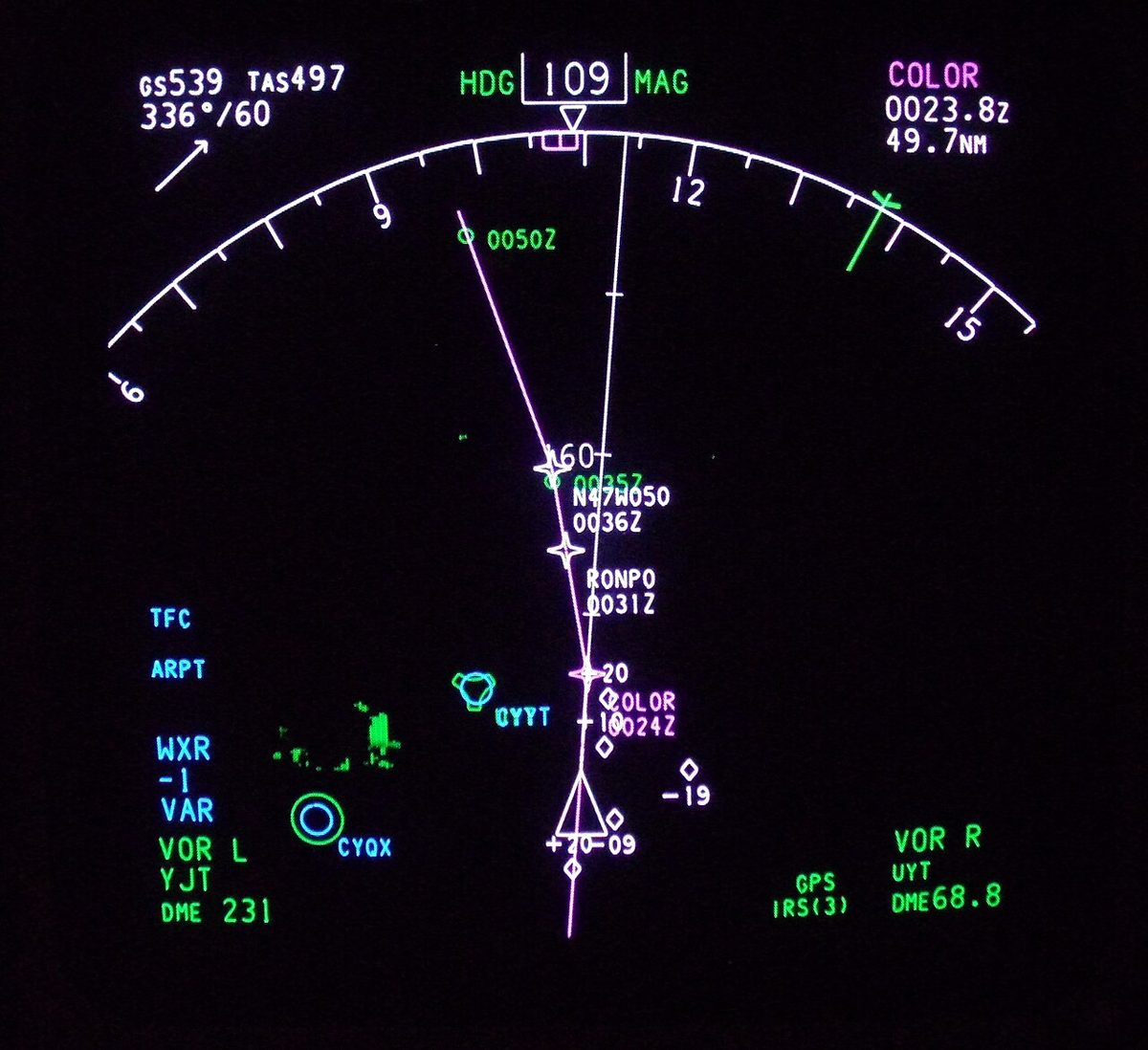
The units keep running on battery if normal power fails. On the A320 an ON BAT light shows that an ADIRU is on battery, and on the ground an external horn also sounds. On the 737 the IRSs switch to DC backup, shown by an ON DC light, and the backup to the right IRS is cut after five minutes if AC power has not returned.
Ground alignment and gyrocompassing
A full alignment, sometimes called establishing the trihedron, does three things.
- Levelling. The accelerometers sense gravity and so find the local vertical. The system can then separate every later measurement into horizontal and vertical parts.
- Gyrocompassing. The gyros measure the Earth's rotation, 15.04° per hour. Its horizontal component, 15.04° × cosine of latitude, lies along the local meridian and therefore points to true north; this is how the IRS finds true heading without any magnetic sensor. The ratio of the vertical component, 15.04° × sine of latitude, to the horizontal one gives the latitude.
- Position. The crew enter present position, latitude and longitude, through the FMS control display unit or, on the 737, the keyboard of the inertial system display unit (ISDU). The IRS compares the entered latitude with the latitude it has measured.
The earth-rate signal is tiny, so the aircraft must not move. On the A320 the IRS is not aligned during engine start or with engines running, and if the aircraft moves during alignment a new full alignment is needed. The older gimballed INS followed the same logic in stages: warm-up, coarse alignment, fine levelling, then gyrocompassing.
The IRS can check latitude but not longitude, since the Earth's rotation looks the same at every longitude. An error in longitude does not upset the system, but every position it then gives is wrong by that error. The checks are therefore procedural and built in:
- The IRS remembers its last position and warns if the entered one differs significantly. On the 737 the ALIGN light flashes if the entry differs markedly from the previous position, is unreasonable or is missing, and two consecutive entries that fail the latitude comparison illuminate the FAULT light.
- The 737 FMS shows VERIFY POSITION if the entered position is not within 4 NM of the origin airport.
Alignment takes typically 5 to 10 minutes and longer at high latitude. On the 737 it varies from five to seventeen minutes with latitude, the ISDU counting down the minutes remaining; the A320 shows IRS IN ALIGN with the minutes left on the ECAM, turning amber once an engine is started.
Because gyrocompassing needs the horizontal earth-rate component, which falls to zero at the poles, alignment has a latitude limit:
| Source | Ground alignment possible |
|---|---|
| ATPL texts, general | Unreliable above about 78° |
| Boeing 737 | Not above 78°15' N or S |
| Airbus A320 | Between 82°N and 82°S |
The A320 procedures also require a complete alignment when the departure airport lies between 2°N and 2°S.
Fast alignment and realignment
On a short turnaround the IRS is already aligned; what has accumulated in flight is groundspeed error and position drift. A fast alignment (Airbus) or fast realignment (Boeing) zeroes the groundspeed error without repeating the full alignment, about 30 seconds on the 737, and the position is brought up to date at the same time.
| Airbus A320 | Boeing 737 | |
|---|---|---|
| Full alignment | Before the first flight of the day; at a crew change; departure airport between 2°N and 2°S; no GPS and poor navaid coverage or a flight of more than 3 hours | Recommended before each flight |
| How a full alignment is started | IR mode selectors OFF for more than 5 s, then NAV | MSU from OFF to NAV |
| Fast alignment | When a full one is not required and the IRS and FMGC positions differ by 5 NM or more | When ground time does not allow a full one |
| How | Selectors OFF and back to NAV within 5 s | ALIGN selected while parked, about 30 s; enter present position before returning to NAV |
| Effect | Groundspeed and some internal filters reset to zero; no new position estimate | Alignment updated and groundspeed error zeroed |
The ON BAT light comes on for a few seconds at the start of an A320 full alignment but not for a fast one. After a long delay on the ground the IRS drifts like any other, and a new alignment and position entry are the cure.
Mode select unit
The crew select the IRS mode on a mode select unit (MSU) or mode selector.
- Boeing 737. A dual MSU has a four-position selector for each IRS: OFF, ALIGN, NAV, ATT, with ALIGN, ON DC and FAULT lights. Selecting OFF to NAV starts a normal alignment and the IRS enters NAV when it is complete. Selecting OFF loses the alignment and removes power after a shutdown cycle of about 30 seconds, during which the ALIGN light stays on.
- Airbus A320. The ADIRS panel on the overhead has an IR mode selector for each of the three ADIRUs, OFF, NAV, ATT, with IR FAULT lights, and the ON BAT light. OFF de-energises the whole ADIRU, so its air data is lost as well. When the aircraft is secured and the selectors are turned OFF, the crew wait at least 10 seconds before removing electrical power, so that the ADIRS can memorise the latest data.
Older INS installations had a mode selector with an ATT REF (attitude reference) position, described below.
NAV, ATT and ATT REF modes
NAV mode is normal operation: full inertial data to all users. Once in NAV the IRS does not accept a new position from the pilot, since that would corrupt its integration; the FMS applies radio and GPS updates to its own position instead. If NAV is lost in flight, or the selector is moved out of NAV, navigation is lost for the rest of the flight: a new navigation alignment needs the aircraft stationary on the ground.
IR ATT mode is the reversionary mode. It gives attitude and heading only, with no position or groundspeed:
- The IRS must relevel: on the 737 this takes about 30 seconds of straight, level, unaccelerated flight.
- Heading is invalid until the crew enter the magnetic heading, taken from the standby compass or another compass system, and it then drifts, by up to 15° per hour on the 737; the A320 asks for it to be reset about every 10 minutes.
- On the A320 a flashing IR FAULT light means attitude and heading may be recovered in ATT mode, and a steady one that the IR is lost. The ECAM shows IR IN ATT ALIGN while the IR is being aligned in attitude mode. On the 737 the selector must pass through OFF before ALIGN or NAV can be reselected.
Attitude reference mode (ATT REF) on older gimballed INS disconnected the navigation computing and lost the alignment. The accelerometers became gravity sensors and the gyros were tied to gravity, so the unit worked as an accurate artificial horizon and directional gyro, with a heading that drifted and needed resetting from a magnetic source.
Position drift and radial error rate
In NAV mode the unbounded errors of the inertial solution make the position error grow with time, the IRS drift. ATPL texts quote figures of about 1 to 2 NM per hour for an airliner system; attitude, heading and groundspeed remain accurate. Accuracy is therefore quoted as a radial error rate in NM per hour: how far the inertial position has drifted from the true one for each hour in NAV mode.

The crew see the drift at the gate. On the A320 the pilot monitoring checks the IRS positions on the MCDU POSITION MONITOR page after parking, against published limits. In flight they seldom see it, because the FMS blends the inertial positions with GPS and radio updates and a hybrid FMS position can have an error rate below 0.05 NM per hour. If all updating is lost, the FMS position degrades at the IRS drift rate (see FMS navigation and position updating).
With three IRSs a unit that drifts badly is identified by comparing all three. With two, a disagreement shows only that one is wrong; a malfunction code or an external fix, from radar or from NDB, VOR or DME, is needed to decide which.
Exam tip: an IRS navigates accurately from wherever it is told it started. A longitude typed in wrongly is not detected by the system itself and shifts every later position by the same amount; hence the cross-checks of the entered position against the airport or gate position and against the other IRSs.
Frequently asked questions
Why must the aircraft not move during IRS alignment?
During alignment the IRS finds the local vertical from gravity and true north from the Earth's rotation, which turns at only about 15 degrees per hour. Any movement of the aircraft, far larger than those tiny rates, corrupts the measurement. That is why the aircraft must be stationary, why alignment is not done during engine start, and why on the A320 movement during alignment calls for a new full alignment.
How does an IRS find true north?
By gyrocompassing. With the aircraft stationary, the gyros measure the Earth's rotation. Its horizontal component, 15.04 degrees per hour times the cosine of the latitude, lies along the meridian and so points to true north. The ratio of the vertical component to the horizontal one gives the latitude, which the IRS compares with the latitude entered by the crew. The accelerometers meanwhile find the local vertical from gravity.
What is the maximum latitude for IRS alignment?
It depends on the unit, because the horizontal component of the Earth's rotation, which gyrocompassing needs, shrinks with the cosine of latitude and vanishes at the poles. The Boeing 737 limits ADIRU alignment to 78 degrees 15 minutes north or south, while the A320's limitations allow ground alignment between 82 degrees north and 82 degrees south. ATPL texts quote about 78 degrees as the general limit.
What is the difference between a full and a fast IRS alignment?
A full alignment levels the system, finds true north by gyrocompassing and checks the entered latitude. It typically takes 5 to 10 minutes, longer at high latitude: 5 to 17 minutes on the Boeing 737. A fast alignment, used on a short turnaround, is much quicker and zeroes the groundspeed error without a full alignment. On the A320 it is selected by turning the IR mode selectors OFF and back to NAV within 5 seconds.
What does IRS ATT mode do?
ATT mode is the reversionary mode used when navigation alignment is lost in flight. The IRS relevels, on the Boeing 737 after about 30 seconds of straight, level, unaccelerated flight, and gives attitude again, but no position or groundspeed. Heading is available only after the crew enters it from the standby compass, and it drifts, by up to 15 degrees per hour on the Boeing 737, so it must be reset periodically.
Test yourself on Inertial Reference System Alignment and Modes
The v1prep banks cover this topic in Instrumentation (022), with a worked explanation for every answer. EASA ATPL, PPL, IR and CPL, the FAA written tests and A320/B737 type ratings.
Start practising →Sources and further reading
- FAA Aeronautical Information Manual, Chapter 1 Section 1 (1-1-15, IRU, INS and AHRS)
- FAA Aeronautical Information Manual, Chapter 1 Section 2 (RNAV sensors, DME/DME/IRU)
- FAA Instrument Flying Handbook (FAA-H-8083-15B), Chapter 9, Navigation Systems
- ICAO NAT Doc 007, North Atlantic Operations and Airspace Manual (2026 edition)
- EASA, Explanatory Note to ED Decision 2018/001/R, Part-FCL theoretical knowledge learning objectives (022 Instrumentation, 061 General Navigation)
Library articles are written for study and exam preparation. They do not replace your aircraft's approved documentation, your operator's procedures or the regulations themselves.